




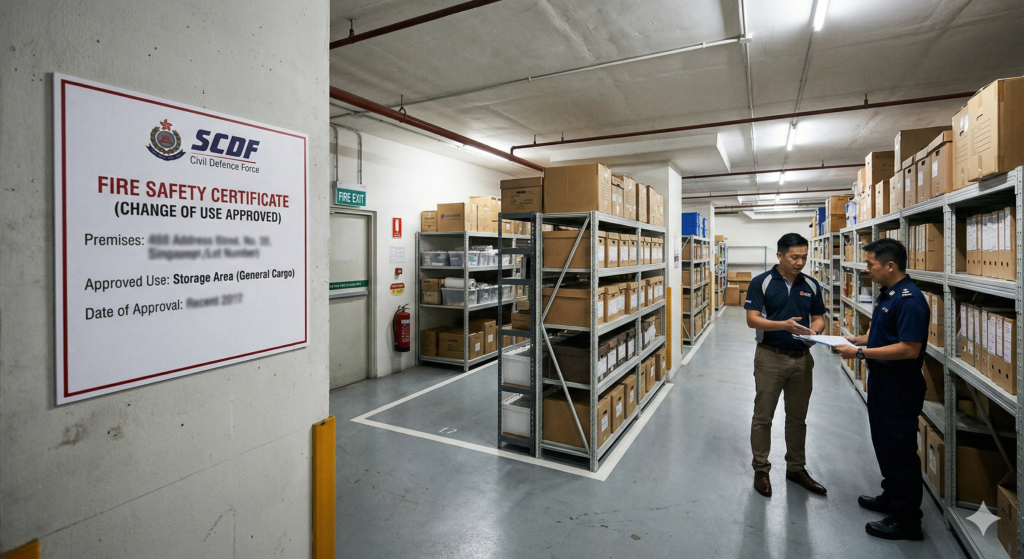
SCDF FSSD Submissions Singapore (2026) for Carpark to Storage Conversions
Strategic Search Engine Optimization (SEO) Metadata Architecture
To establish the structural foundation of this comprehensive technical report and align with advanced digital marketing algorithms, the following Search Engine Optimization (SEO) parameters have been rigorously engineered. These metadata configurations are designed to capture high-intent organic search traffic within the Singapore commercial real estate, fire safety engineering, and regulatory compliance sectors.1
| SEO Element | Strategic Implementation |
| Optimized SEO Title | The Definitive Guide to SCDF FSSD Submissions for Carpark to Storage Conversions in Singapore (2026) |
| Primary Focus Keyphrase | SCDF FSSD submission Singapore 2026 |
| Secondary Long-Tail Keywords | Change of use carpark to storage, best practices for basement warehouse smoke control Singapore, commercial property conversion Singapore SEO, URA 60:40 rule compliance, Fire Safety Certificate application processing timeline |
| Meta Description | Master the rigorous SCDF FSSD submission process for converting carparks to storage areas in Singapore. Discover definitive, proven strategies for Fire Code 2023 compliance, URA approvals, and avoiding catastrophic penalties in commercial real estate conversions. |
| Target Sentiment | Authoritative (Negative-Positive Equilibrium): Emphasizing the negative catastrophic risks and severe financial penalties of regulatory non-compliance, juxtaposed with the positive, guaranteed security, profitability, and operational excellence achieved through proven engineering adherence. |
| High-Converting Power Words | Definitive, rigorous, catastrophic, guaranteed, proven, exhaustive, essential, pivotal, robust, lucrative, unparalleled, vulnerable, above and beyond, unquestionable. |
| Taxonomy Tags / Categories | Commercial Real Estate, Regulatory Compliance, Fire Safety Engineering, Singapore Civil Defence Force, Urban Redevelopment Authority, Latent Semantic Indexing. |
1. Executive Summary and Macro-Economic Context
The commercial real estate and logistics landscape in Singapore is undergoing a profound structural paradigm shift.
Driven by the explosive, sustained growth of e-commerce, the decentralization of critical logistics networks, and the overarching national imperative to cultivate a “car-lite” urban ecosystem, the valuation of physical space has been radically altered.3
Within this transformative environment, building owners, real estate investment trusts (REITs), and asset managers are increasingly identifying underutilized multi-storey and basement carparks as highly lucrative opportunities.
These dormant concrete assets are prime candidates for conversion into localized storage facilities, micro-fulfillment centers, and high-density warehouse spaces.
However, the transition from Purpose Group VIII (Vehicle Parking) to Purpose Group VIII (Storage/Warehouse) is fraught with rigorous, uncompromising statutory hurdles.
The Singapore Civil Defence Force (SCDF), operating through its Fire Safety and Shelter Department (FSSD), enforces stringent regulations to safeguard human life, property, and critical national infrastructure.1
A carpark presents a fundamentally different fire risk profile compared to a storage facility. Carparks are characterized by transient human occupancy, open-sided natural ventilation, and highly localized hydrocarbon fire loads (e.g., fuel tanks).
In stark contrast, a high-density storage area features immense static fire loads, complex combustible commodity classifications, obstructed means of escape, and minimal natural ventilation.5
This exhaustive report dissects the definitive pathways, engineering imperatives, and bureaucratic mechanics required to achieve successful carpark-to-storage conversions in Singapore.
It outlines the inter-agency regulatory matrix, the detailed SCDF FSSD submission protocols under the Fire Code 2023 (incorporating the latest 2025/2026 amendments), structural load transitions, advanced active fire protection engineering, and the severe financial repercussions of unauthorized use.
Furthermore, it integrates a sophisticated digital marketing framework for commercial entities seeking to promote these specialized conversion services in a highly competitive digital economy.
2. The Inter-Agency Regulatory Matrix: Land Use and Structural Mandates
A successful change of use in Singapore is never an isolated SCDF application.
It demands a highly synchronized, multi-disciplinary approach involving the Urban Redevelopment Authority (URA), the Land Transport Authority (LTA), and the Building and Construction Authority (BCA) before the SCDF FSSD can even consider granting final operational approvals.7
Initiating fire safety design without securing baseline land-use and structural clearances invariably leads to aborted architectural efforts and wasted capital.
2.1 Land Transport Authority (LTA) Parking Provision Standards
The primary catalyst enabling the contemporary wave of carpark conversions is the LTA’s Range-based Parking Provision Standards (RPPS), which fundamentally overhauled vehicular infrastructure policies in February 2019.9
Moving away from rigid, archaic minimum requirements (the former Car Parking Standard), the RPPS stipulates an upper and lower bound for parking provisions, empowering developers with unprecedented flexibility.11
Under the RPPS, developments situated in well-connected public transit zones (specifically Zones 1, 2, and 3) are permitted to reduce their parking provisions by 20% to 50% compared to historical baselines.11
Furthermore, Zone 4 designates specific “car-lite” areas where parking requirements are restricted even further, subject to localized LTA assessments.10
Building owners possessing surplus parking lots that exceed the newly defined minimum standard can permanently convert these spaces to commercial or storage uses, unlocking significant real estate value.3
However, navigating these boundaries requires extreme precision. Falling below the minimum allowable RPPS standard incurs a punitive deficiency charge.
In Zone 1, this penalty amounts to SGD 32,000 per missing lot; in Zones 2 and 3, the penalty is SGD 16,000 per lot.12
Conversely, providing surplus lots above the upper bound also attracts identical financial penalties, actively discouraging the over-provision of parking in favor of alternative commercial utilizations.12
Asset managers must engage in formal pre-application consultations with the LTA before initiating any surplus conversion.10
2.2 Urban Redevelopment Authority (URA) Planning Permission and the 60:40 Rule
The URA acts as the supreme gatekeeper for zoning, urban planning, and land use across the island.
Converting a carpark to a storage area necessitates formal Change of Use planning approval to ensure the new function aligns seamlessly with the Master Plan zoning intent.13
Submitting an application incurs a non-refundable processing fee of SGD 500, with typical approval durations extending to three years or longer depending on the specific case parameters.13
Depending on the enhancement in land value generated by the conversion, the Singapore Land Authority (SLA) may also levy a substantial Land Betterment Charge (LBC).13
For industrial buildings, stakeholders must strictly navigate the URA’s 60:40 rule.
This critical regulatory metric dictates that at least 60% of the total gross floor area (GFA) must be dedicated to core industrial activities—such as manufacturing, assembly, research and development, or core warehousing and logistics.14
The remaining 40% may be allocated to ancillary uses, including supporting office spaces, staff amenities, or showrooms directly linked to the company’s products.14
Industrial developments are further bifurcated into B1 (Light Industrial) and B2 (General Industrial) classifications.
B1 spaces are restricted to clean activities with a nuisance buffer of 50 meters or less, whereas B2 spaces accommodate heavier operations with a greater environmental impact footprint.14
Violating the 60:40 zoning metric—often tempted by businesses seeking cheaper industrial rents for non-industrial purposes—can lead to the outright rejection of the conversion, revocation of existing business approvals, forced eviction, and severe fines up to SGD 200,000 or 12 months imprisonment.14
The standard URA processing timeline for a compliant Change of Use application is approximately 20 working days.7
2.3 Building and Construction Authority (BCA) Structural Constraints and Load Discrepancies
Before sophisticated fire safety systems can be engineered, the structural integrity of the proposed conversion must be validated by the BCA.
Carparks and high-density storage warehouses are governed by drastically different imposed floor load requirements, dictated by the Singapore National Annex to SS EN 1991-1-1 (Eurocode 1: Actions on structures).15
Carparks are primarily engineered to withstand dynamic, rolling loads of passenger vehicles.
Consequently, their reinforced concrete slabs are typically designed for an imposed load of approximately 2.5 kN/m² for light vehicular traffic.16
In profound contrast, storage areas and high-piled warehouses demand significantly higher load-bearing capacities to support towering steel racking systems, heavy forklift operations, and dense commodity packing.
Warehouse floor slabs frequently require imposed load capacities exceeding 5.0 to 7.5 kN/m², and potentially much higher depending on the specific rack height and commodity density.15
To bridge this critical structural deficit, a Professional Engineer (PE) must be engaged to submit detailed structural calculations.
The PE must either mathematically prove that the existing slab contains sufficient latent capacity to support the intensified static loads of a warehouse, or they must design physical structural reinforcements—such as carbon fiber reinforced polymer (CFRP) wrapping, steel beam under-girding, or localized micropiling.19
Furthermore, any structural modifications involving Mechanised Car Parking Systems (MCPS)—which utilize car lifts and heavy moving machinery—require specialized load-bearing submissions to the BCA.20
Beyond structural loading, the BCA enforces strict accessibility regulations.
While general industrial buildings must comply with the Code on Accessibility in the Built Environment to provide barrier-free access for Persons with Disabilities (PwD), specific exemptions exist.
Areas explicitly used for warehousing, heavy machinery production, and sterile clean rooms are exempted from providing full wheelchair accessibility features, acknowledging the hazardous and specialized nature of these operational zones.22
3. The SCDF FSSD Ecosystem: Navigating the Submission Paradigm
Once land-use consensus and structural viability are firmly established, the project enters the rigorous SCDF FSSD submission phase.
It is a strict legal mandate under the Fire Safety Act 1993 that all commercial and industrial buildings secure plan approvals and a Fire Safety Certificate (FSC) prior to occupying the newly converted space.7
Failure to submit these plans places the building and its occupants at grave risk during a fire emergency, leading to severe enforcement actions.23
3.1 Appointment of Qualified Persons (QPs)
The SCDF mandates that building owners and developers cannot submit fire safety plans independently; they must legally appoint registered Qualified Persons (QPs) to act as the primary liaisons and technical authorities.25
- Architect (QP-Archi): Registered with the Board of Architects (BOA) Singapore, the architect acts as the overall lead consultant for the project.7 They are fundamentally responsible for the preparation and submission of the Building Plan (BP). The BP focuses on the macro-level fire safety architecture, ensuring strict compliance with the Fire Code regarding site planning, fire engine accessways, compartmentation walls, structural fire precautions, and the complex geometry of the means of escape.7
- Professional Engineer (QP-PE): Registered with the Professional Engineers Board (PEB), the Mechanical & Electrical (M&E) PE is responsible for designing the critical active suppression systems. They submit the Fire Protection Plan (FP) detailing sprinkler arrays, fire alarms, and hose reels, as well as the Mechanical Ventilation Plan (MV) detailing smoke purging systems and staircase pressurization.7
3.2 Plan Preparation and CORENET Submission Mechanics
The appointed QPs consolidate the architectural layouts, structural fire ratings, sprinkler pipe routings, and smoke control schematics into standardized blueprints.
These highly detailed documents are submitted electronically to the SCDF via the Construction and Real Estate Network (CORENET) system.7
The submission documentation must explicitly declare the “Change of Use” and outline the heightened fire risk profile associated with the transition from a carpark to a storage facility.29
SCDF officers conduct a meticulous, code-by-code review to ensure absolute alignment with the prevailing Fire Code 2023.31 Standard BP, FP, and MV plan processing typically requires 3 to 4 weeks.28
Prompt responses by the QPs to any subsequent SCDF queries are essential to prevent costly project delays.28
If the designs are flawless, the SCDF issues a Notice of Approval (NOA), officially authorizing the commencement of physical construction and alteration works on site.7
3.3 Site Execution and Registered Inspector (RI) Verification
Upon receiving the NOA, physical conversion works—such as erecting fire-rated blockwalls, installing high-density sprinklers, and routing mechanical ventilation ductwork—can commence.
Following the completion of these works, the law requires the engagement of independent Registered Inspectors (RIs) to verify that the physical reality matches the theoretical CORENET plans.7
To maintain absolute regulatory integrity, RIs must have no professional or financial conflict of interest in the project.
They cannot have been involved in the design or construction phases, nor can they be partners or employees of the appointed QPs.27
RIs are highly experienced professionals, requiring a minimum of 10 years of practical experience in the design and inspection of fire safety works before being admitted to the SCDF’s elite RI panel.32
- An Architectural RI meticulously verifies the physical installation of fire doors, compartment walls, intumescent fire stopping, and illuminated exit signage.7
- An M&E RI conducts rigorous functional testing of the active systems, initiating pump flow tests for the sprinkler systems, triggering the fire alarm panels, and measuring airflow velocities for the smoke purging equipment.7
If the site accurately reflects the approved blueprints and functions flawlessly, the RIs issue a formal Form-1 certificate to the Architect QP.7
3.4 Acquiring the Fire Safety Certificate (FSC) and Post-Occupancy Compliance
Utilizing the validated Form-1, the Architect QP submits the final application to the SCDF for the Fire Safety Certificate (FSC).
The SCDF is highly efficient at this stage, typically processing FSC applications within 3 to 6 working days.7
Notably, the SCDF reserves the right to conduct a randomized, targeted on-site audit within 10 days of the submission to verify the RI’s findings.34
It is paramount to understand that until the FSC is physically issued, occupying the new storage space or commencing commercial operations is a severe criminal offense.7
Post-occupancy, the regulatory burden continues. Specified public and industrial buildings must renew their Fire Certificates to ensure ongoing maintenance of their critical systems.24
In a move to reduce regulatory compliance costs for businesses, the SCDF announced that starting from April 2026, it will implement a robust 3-year Fire Certificate validity period for renewal applications, replacing the traditional annual renewal cycle for compliant premises.35
4. Fire Safety Engineering & Code Compliance: The Fire Code 2023
Converting a carpark to a storage area fundamentally shifts the internal dynamics from a highly ventilated, open-sided concrete structure to a densely packed, enclosed hazard zone.
Design strategies must rigidly adhere to the Code of Practice for Fire Precautions in Buildings 2023 (Fire Code 2023).31
4.1 Purpose Group VIII Classification and Compartmentation
Under the SCDF classification system, both carparks and warehouses fall under Purpose Group VIII (Special Purpose).36
However, their compartmentation limits diverge drastically based on the presence of automated fire suppression and their location relative to ground level.
Under Table 3.2A of the Fire Code 2023, the maximum size of a fire compartment is strictly regulated to prevent catastrophic, uncontrollable fire spread.37
Compartment walls and floors must be constructed of non-combustible materials with specific fire resistance ratings, effectively creating secure “boxes” that contain the blaze.
| Compartment Location | Maximum Floor Area | Maximum Cubical Extent | Storey Limitation |
| Below Ground Level (Basements) | 2,000 m² | 7,500 m³ | Max 1 storey per compartment |
| Between Ground Level and 24m Height | 4,000 m² | 15,000 m³ | Max 3 storeys per compartment |
| Above 24m Habitable Height | 2,000 m² | 7,500 m³ | Max 1 storey per compartment |
Data derived from SCDF Fire Code 2023, Table 3.2A. 37
When a portion of a carpark is enclosed to form a storage unit, it must be completely separated from the remaining vehicle parking areas by fire compartment walls and floors featuring at least a 1-hour fire resistance rating.36
Exemptions to this heavy masonry requirement exist only under highly specific conditions: for instance, if both the warehouse and the adjacent carpark driveways are fully sprinkler-protected and equipped with an engineered smoke control system, the thermal insulation requirements of the fire-rated shutters dividing the spaces may be relaxed.36
Furthermore, building owners frequently attempt to maximize vertical space by installing mezzanine floors within the new warehouse.
Under Clause 9.8, a single open stair is permitted to serve a mezzanine floor provided the aggregate floor area of the mezzanine does not exceed 60m², the elements of structure possess a 1-hour fire resistance rating, and the space is strictly used for storage or an ancillary office.36
4.2 Means of Escape and Human Evacuation Dynamics
Warehouses introduce maze-like racking layouts, narrow aisles, and towering physical obstructions that severely hinder rapid evacuation.
Consequently, the determination of exit requirements (Clause 2.2) is a critical focal point for the Architect QP.
The Fire Code strictly dictates the maximum allowable travel distance a person must traverse to reach a protected exit staircase or the building exterior.
| Occupancy Type / Hazard Profile | 1-Way Travel Distance | 2-Way Travel Distance | 1-Way Direct Distance | 2-Way Direct Distance |
| General Storage (Non-Sprinklered) | 15m | 45m | 10m | 30m |
| General Storage (Sprinkler-Protected) | 25m | 60m | 16.6m | 40m |
| High Hazard Chemicals (Non-Sprinklered) | 10m | 20m | N/A | N/A |
| High Hazard Chemicals (Sprinklered) | 20m | 35m | N/A | N/A |
Data derived from SCDF Fire Code 2023, Table 2.2A and Clause 9.8. 36
Storage arrangements must maintain clearly demarcated, unobstructed aisles.
For basement storage areas, the psychological panic induced by darkness and smoke, combined with the physical impediments to evacuation, demand that exit staircases discharge directly to the exterior at ground level.40
Furthermore, no storage pallets or materials can obstruct access to fire alarm manual call points, fire extinguisher cabinets, hose reels, or exit doors.41
A compelling case study analyzing a 14,000m² underground carpark in Sweden highlighted the complexities of travel path measurement.
In such environments, the common path of travel must be calculated using a conservative 1.5 times multiplier of the physical length to account for the erratic movement of evacuees navigating around parked vehicles and concrete pillars.42
Applying this logic to a converted Singaporean warehouse means that rack placement must be rigidly enforced by the facility’s Fire Safety Manager (FSM) to ensure travel distances do not inadvertently exceed code limits over time.
5. Active Fire Protection Systems: Engineered Suppression and Ventilation
Passive fire compartmentation (concrete walls and fire doors) must be aggressively supplemented by active, automated Mechanical and Electrical (M&E) systems.
The transformation from an open parking lot to dense commodity storage drastically elevates the required threshold for automated suppression and mechanical ventilation.
5.1 Sprinkler Systems and Commodity Hazard Classifications
A standard, open-sided carpark may rely primarily on natural cross-ventilation, portable extinguishers, and basic wet riser systems.
However, according to Clause 6.4.1 of the Fire Code 2023, the provision of an automatic sprinkler system is absolutely mandatory for factories or warehouses under several conditions: if the building exceeds 24m in habitable height, if it features high-bay storage, if it requires an engineered smoke control system, or if it fails to meet the strict compartmentation size limits outlined in Chapter 3.43
Crucially, for enclosed basement carparks and storage areas, sprinkler systems are universally mandated due to the severe difficulties of subterranean firefighting.44
The design complexity of the sprinkler system hinges entirely on the “Commodity Classification,” a metric heavily influenced by the Singapore Standard SS CP 52 and international benchmarks like NFPA 13.46
Commodity classifications evaluate not just the product itself, but its packaging, pallets, and storage arrangement.
- Class I to III Commodities: Typically involve non-combustible or moderately combustible products (e.g., glass jars, metal parts) stored on wooden pallets or in standard single-layer corrugated cardboard packaging.47
- Class IV and Group A Plastics: These represent the highest hazard levels. Encapsulated goods, expanded plastics, polyurethane foams, and synthetic materials burn with exceptional ferocity, generating immense heat release rates and toxic smoke.47
If a converted storage area houses high-hazard materials—such as Energy Storage Systems (ESS) or lithium-ion batteries—the sprinkler system must be classified under a high-hazard occupancy.
This requires a massive minimum discharge density of 12.2mm/min operating over a designated area of up to 230m².48
Furthermore, if the storage stacking height exceeds standard thresholds (e.g., above 4m for non-sprinklered rooms), specialized in-rack sprinklers may be required.
These in-rack heads penetrate the shielded vertical layers of the storage array, delivering water directly to the seat of the fire where ceiling-level sprinklers cannot reach.40
5.2 Smoke Control and Purging Protocols: The 9 ACH Mandate
Smoke inhalation, rather than thermal burns, remains the leading cause of fatalities in enclosed building fires.
Consequently, the SCDF dictates uncompromising mechanical ventilation standards, particularly for underground conversions.50
The 9 ACH Smoke Purging Rule for Basements: Under Clause 7.1.9 of the Fire Code 2023, any basement carpark or storage area with a total floor area exceeding 2,000m² must be equipped with a robust mechanical smoke purging system capable of generating a purging rate of not less than 9 Air Changes per Hour (ACH).50
- Independence: The smoke purging system must be fully independent of any general HVAC or ventilation systems serving other parts of the building.50
- Activation: It must activate automatically upon detection by the building’s fire alarm system. Additionally, a remote manual start/stop override switch must be situated at the Fire Command Centre (FCC).50
- Discharge Parameters: Exhaust air must be drawn through heavy-gauge steel ducts (1.2mm thick) and discharged directly to the exterior, maintaining a minimum safety clearance of 5 meters from any fresh air intake openings to prevent smoke recirculation.50
Engineered Smoke Control Systems: If the scale of the conversion is massive—specifically, if a compartment’s floor area exceeds 5,000m² above ground or 2,000m² underground without purging—a highly sophisticated engineered smoke control system (Clause 7.4) is mandated.36
Unlike simple smoke purging, which merely dilutes the smoky atmosphere, an engineered system utilizes precise fluid dynamics to create a controlled pressure gradient.
The goal is to extract smoke from the ceiling reservoir at a rate that mathematically matches the smoke production of the fire, thereby maintaining a clear, breathable, smoke-free layer at least 1.8 meters above the floor level.52
This allows occupants to evacuate visually unimpaired. Designing this system requires the QP to obtain explicit SCDF concurrence on the projected “fire size” (measured in megawatts) before running the extraction calculations.36
6. Navigating Modern Complexities: Automation and Electrification
The modern logistics supply chain increasingly relies on advanced technologies that introduce novel, poorly understood fire risks into legacy concrete buildings.
6.1 Automated Storage and Retrieval Systems (ASRS)
Many modern e-commerce micro-fulfillment centers deploying within converted carpark spaces utilize Automated Storage and Retrieval Systems (ASRS).53
These robotic, high-density environments maximize cubic volume by utilizing bin-based or shelf-based picking robots operating on intricate 3D grids.54
While highly efficient, ASRS minimizes internal aisle space and flue spaces, effectively eliminating traditional firefighter access points and severely obstructing the downward distribution of water from ceiling sprinklers.54
The rapid, unimpeded vertical and horizontal spread of fire through contiguous plastic totes—as witnessed in the catastrophic 2021 Ocado warehouse fire in London, which was ignited by colliding robots and cost tens of millions in damages—demands revolutionary fire protection paradigms.55
Engineers must deploy advanced in-rack suppression technologies, highly calibrated thermal imaging detection algorithms, and non-combustible tote materials to satisfy SCDF requirements for ASRS installations.54
6.2 Adjacency to Electric Vehicle (EV) Infrastructure
As carparks transition, the residual parking areas are frequently retrofitted with high-voltage Electric Vehicle (EV) charging stations.
While empirical statistics indicate that EV fires remain relatively infrequent (comprising roughly 0.7% of vehicular fires in Singapore over a recent three-year period), the catastrophic thermal runaway characteristics of lithium-ion batteries require intense regulatory scrutiny.44
The SCDF mandates that emergency isolation shut-off switches be provided within 15 meters of any EV charging station.44
When converting adjacent parking lots to storage, meticulous 1-hour fire-rated compartmentation is absolutely essential to insulate the combustible warehouse inventory from a potential sustained, chemical EV blaze that cannot be easily extinguished by standard water application.36
7. The Performance-Based Approach (PBA) and Waiver Mechanisms
Existing buildings—particularly aging, subterranean multi-storey carparks constructed in the 1980s or 1990s—frequently possess immovable structural constraints that render strict compliance with the prescriptive Fire Code mathematically or physically impossible.
Common issues include inadequate ceiling heights that prevent the formation of an effective smoke reservoir, structural columns that block mandated exit stairwell widths, or excessive travel distances to existing egress points.57
In these complex instances, the SCDF permits a Performance-Based Approach (PBA) or the submission of a formal Waiver Application.57
- Fire Engineering Assessment: Instead of blindly following prescriptive codes, building owners must engage a specialized, highly credentialed Fire Safety Engineer (FSE).57
- Fire Engineering Design Brief (FEDB): The FSE develops an FEDB, proposing an alternative engineered solution. This involves utilizing advanced Computational Fluid Dynamics (CFD) fire modeling software (such as FDS) and human evacuation simulations. The FSE must mathematically prove that the Available Safe Egress Time (ASET) significantly exceeds the Required Safe Egress Time (RSET), demonstrating that the alternative design provides an equivalent or superior level of safety compared to the prescriptive code.57
- Independent Peer Review: To prevent confirmation bias, the intricate FEDB modeling must be rigorously cross-examined by an independent, third-party Peer Reviewer (another registered FSE) before the SCDF will even entertain the proposal.25
- Waiver Administration: Standard waiver submissions for minor deviations incur a nominal fee of SGD 160 per item.58 However, the professional fees required to execute the CFD modeling and secure the FSE and Peer Reviewer represent a substantial capital investment for the developer.
8. Financial Modeling and Professional Fee Structures for 2025/2026
Budgeting for a carpark-to-storage conversion requires anticipating significant, multi-layered regulatory and engineering expenditures.
Based on verified 2025/2026 industry benchmarks, the financial landscape includes:
| Service / Component | Estimated Cost Range | Description / Context |
| URA Change of Use Application | ~SGD 500 | Base application fee per specific case; non-refundable.13 |
| Architect / PE FSSD Submission Fees | SGD 1,200 – 5,000+ | Highly variable depending on project complexity, square footage, and M&E integration requirements.19 |
| Registered Inspector (RI) Fees | SGD 1,000 – 3,000+ | Both Architectural and M&E RIs are required for physical site validation and Form-1 issuance.7 |
| PUB / Drainage PE Endorsement | SGD 1,000 – 2,500 | Required if the conversion involves new sanitary discharge points, floor traps, or drainage modifications.19 |
| Fire Sprinkler Installation | QR 80 – 120 per m² | Approximate industrial benchmark; costs escalate exponentially for ASRS or complex cold-storage retrofits.62 |
| SCDF Waiver Application | SGD 160 per item | Assessed per specific code deviation requested.58 |
Beyond initial capital expenditures (CAPEX), asset managers must accurately forecast operational expenditures (OPEX).
Approximately 10% to 15% of the total installation costs must be allocated annually for the stringent maintenance, testing, and periodic RI certification of the active fire systems, ensuring they perform flawlessly upon demand.64
Additionally, firms operating these new logistics hubs often seek to protect their brand identity. The Intellectual Property Office of Singapore (IPOS) noted upcoming fee revisions taking effect between September 2025 and April 2026.
For instance, applying to register a trademark (Form TM4) utilizing pre-approved database terms will cost SGD 280 per class, securing the commercial branding of the newly established fulfillment center.65
9. Digital Marketing and SEO Strategy for Commercial Real Estate Conversions
For commercial real estate consultancies, architectural firms, and PE practices offering carpark conversion services, technical excellence must be matched by digital visibility.
Dominating the search engine results pages (SERPs) requires a sophisticated Search Engine Optimization (SEO) strategy tailored to B2B regulatory compliance.1
9.1 Long-Tail Keywords and Latent Semantic Indexing (LSI)
Broad, short-tail keywords like “Singapore real estate” or “fire safety” are oversaturated and lack commercial intent. Instead, firms must target high-conversion, long-tail keywords.
While these specific phrases (e.g., “SCDF FSSD submission process for change of use carpark to storage”) have lower aggregate search volumes, they boast a 3% to 5% higher click-through rate and attract highly qualified leads actively seeking consulting services.68
Google’s algorithms heavily utilize Latent Semantic Indexing (LSI) to understand the contextual relationship between terms.2
Content should naturally weave in LSI keywords—such as “Notice of Approval,” “CORENET X,” “URA 60:40 rule,” and “Registered Inspector”—to signal comprehensive topical authority to the search engine.2
9.2 Core Web Vitals and Technical SEO
Content quality is irrelevant if the website’s technical foundation is flawed.
Google’s ranking algorithms prioritize Core Web Vitals, specifically evaluating the Largest Contentful Paint (LCP) and Interaction to Next Paint (INP).2
- LCP: Measures loading performance. The largest visible element (typically a hero image of a converted warehouse) must load within 2.5 seconds to ensure optimal user experience and search performance.2
- INP: Measures page responsiveness. A swift INP ensures that when a potential client clicks a “Request a Consultation” button, the site reacts instantaneously without frustrating lag.2
9.3 Meta Descriptions and Power Words
Snippets are the brief descriptions displayed on Google Search results, automatically generated from page content or the HTML meta description tag.71
To maximize click-through rates, meta descriptions must be compelling and utilize psychological “Power Words.”
High-Impact B2B Power Words:
| Category | Examples to Deploy |
| Trust & Authority | Definitive, Proven, Verified, Authentic, Official, Professional.67 |
| Risk Mitigation | Protected, Ensured, Guaranteed, No Risk, Unquestionable.67 |
| Excellence | World-class, Above and beyond, Unparalleled, Detailed, Thorough.67 |
A highly optimized meta description for a consultancy might read: “Master the rigorous SCDF FSSD submission process.
Our verified Qualified Persons provide definitive, proven strategies for commercial property conversions, ensuring URA compliance and mitigating catastrophic regulatory risks.
This meticulously balances authority with the psychological trigger of risk aversion.
10. Safety Culture, Operational Enforcement, and the Cost of Negligence
Attempting to bypass the URA and SCDF FSSD submission processes is a reckless corporate strategy that exposes the enterprise to catastrophic financial, legal, and operational vulnerabilities.
The SCDF does not rely solely on passive reporting; it conducts aggressive, proactive enforcement through its Targeted On-Site Inspection Tool (TOIT).
Implemented in recent years, TOIT leverages sophisticated data analytics and predictive Artificial Intelligence (AI) to generate propensity scores, accurately identifying high-risk premises likely to be harboring illegal conversions.30
10.1 Severe Financial Penalties and Prosecutions
Unauthorized change of use is classified as a major offense under the Fire Safety Act. Owners and occupiers caught operating illegal storage facilities face immediate prosecution.
Baseline fines for minor violations start at SGD 5,000, but unauthorized conversions frequently result in fines ranging from SGD 3,500 to SGD 10,000 per charge, alongside potential imprisonment for up to six months.7
Crucially, the SCDF and the Attorney-General’s Chambers (AGC) aggressively pursue the “Continuing Offense” provision. In a highly publicized 2024 enforcement case, a logistics company was fined an initial SGD 2,000 for operating without a valid Fire Certificate.
However, the authorities invoked the continuing offense provision, resulting in a devastating additional fine of SGD 21,000—calculated specifically for the 210 consecutive days of non-compliance.30
10.2 Business Interruption and Institutional Safety Culture
Beyond statutory fines, the secondary costs of non-compliance are crippling. SCDF enforcement triggers immediate stop-work orders, forcing operational paralysis.
The resulting business interruption, potential eviction by the landlord, and severe reputational damage can bankrupt a logistics operation.14
Furthermore, in the catastrophic event of an actual fire, operating an unauthorized, non-compliant conversion will instantly nullify commercial fire insurance policies.
The asset owner and the occupying business become entirely, personally liable for all structural damages, loss of inventory, and tragic loss of human life.7
To prevent such outcomes, organizations must cultivate an uncompromising internal safety culture, driven by a certified Fire Safety Manager (FSM).74
Implementing memorable organizational safety slogans—such as “Prevention is better than cure,” “Prepare and prevent instead of repair and repent,” or “Stop! Think! Then act!”—helps embed safety consciousness into the daily operations of forklift drivers and warehouse staff, mitigating the human errors that frequently ignite industrial blazes.75
11. Strategic Conclusions
The strategic conversion of underutilized, excess carpark space into high-density, high-value storage areas represents a proven, highly lucrative methodology for optimizing commercial real estate yields in Singapore’s evolving urban landscape.
However, the ultimate success of this complex endeavor is intrinsically and irrevocably tied to an uncompromising adherence to the multi-agency regulatory framework.
Stakeholders must proactively engage Qualified Persons (Architects and Professional Engineers) at the earliest conceptual planning stages.
Success requires harmonizing URA 60:40 zoning constraints, leveraging LTA RPPS parking algorithms, satisfying BCA Eurocode 1 structural load thresholds, and flawlessly executing the SCDF FSSD life-safety imperatives.
By preemptively addressing the intricate engineering nuances of Purpose Group VIII compartmentation, high-hazard sprinkler discharge densities, ASRS limitations, and sophisticated 9 ACH smoke purging protocols, developers can shield their investments against devastating regulatory penalties.
Ultimately, rigorous compliance ensures the creation of a resilient, secure, and highly profitable node within Singapore’s modern logistics infrastructure.
Works cited
- Streamlining SCDF Submissions for Commercial Properties in Singapore – Stellar Structures, accessed March 28, 2026, https://structures.com.sg/streamlining-scdf-submissions-for-commercial-properties-in-singapore/
- SEO Glossary & Terms for Singapore Business Owners – Digitrio, accessed March 28, 2026, https://digitrio.com.sg/seo-glossary/
- New rule allowing better use of excess carpark space – Sgcarmart, accessed March 28, 2026, https://www.sgcarmart.com/articles/news/new-rule-allowing-better-use-of-excess-carpark-space-16595
- FSSD Submission Singapore | Fire Safety Shelter Department, accessed March 28, 2026, https://www.falconfire.com.sg/fssd-submissions
- FIRE SAFETY REQUIREMENTS FOR FULLY AUTOMATED MECHANISED CAR PARK (FAMCP) – SCDF, accessed March 28, 2026, https://www.scdf.gov.sg/docs/default-source/fire-safety-docs/downloads/fire-code-2013/appendix-5.pdf?sfvrsn=97a9256b_1
- How Do Fire Protection Needs Differ in Warehousing vs. Retail Spaces?, accessed March 28, 2026, https://guardiansouthinc.com/blog/how-do-fire-protection-needs-differ-in-warehousing-vs-retail-spaces/
- Fire Safety Guide – IX Architects Pte Ltd, accessed March 28, 2026, https://ixa.com.sg/fire-safety-guide/
- Authority’s Submissions Guide – IX Architects Pte Ltd, accessed March 28, 2026, https://ixa.com.sg/guide-on-authority-submissions/
- Vehicle Parking Provision – Land Transport Authority (LTA), accessed March 28, 2026, https://www.lta.gov.sg/content/dam/ltagov/industry_innovations/industry_matters/development_construction_resources/vehicle_parking/pdf/cop_on_vehicle_parking_provision_in_development_proposals_2019_edition.pdf
- LTA/DBC/F20.033.005 Date : 4 Oct 2022 CIRCULAR TO PROFESSIONAL INSTITUTES Who should know Developers, building own – Singapore Institute of Surveyors and Valuers, accessed March 28, 2026, https://www.sisv.org.sg/admin/efinder/files/doc/sisv/circulars/NewFolder/Final%20Circular%20for%20Announcement%20of%20new%20Car-Lite%20Areas_04Oct2022.pdf
- LTA announces changes to parking provisions from February 2019 – The Business Times, accessed March 28, 2026, https://www.businesstimes.com.sg/companies-markets/transport-logistics/lta-announces-changes-parking-provisions-february-2019
- A Guide to LTA Carpark Zoning | Property Review SG, accessed March 28, 2026, https://propertyreviewsg.com/a-guide-to-lta-carpark-zoning/
- Change of Use Approval | Licence & Accreditation – GoBusiness Licensing, accessed March 28, 2026, https://licensing.gobusiness.gov.sg/licence-directory/ura/change-of-use-approval
- URA 60-40 Rule Explained – Business Space and Office For Rent Singapore, accessed March 28, 2026, https://spacelookup.com.sg/what-is-ura-6040-rule/
- Loads – Building Control (Temporary Buildings) Regulations 2018 – Singapore Statutes Online, accessed March 28, 2026, https://sso.agc.gov.sg/SL-Supp/S807-2018/Published?DocDate=20181212&ProvIds=Sc2-
- EN 1991-1-1: Eurocode 1: Actions on structures – Part 1-1: General actions – Densities, self-weight, imposed loads for buildings, accessed March 28, 2026, https://www.phd.eng.br/wp-content/uploads/2015/12/en.1991.1.1.2002.pdf
- EN 1991-1-1:2002 – 64_e_stf, accessed March 28, 2026, http://ndl.ethernet.edu.et/bitstream/123456789/87977/58/EN%201991-1-1_2002.pdf
- Code of Practice for Dead and Imposed Loads 2011 (2021 Edition) – Buildings Department, accessed March 28, 2026, https://www.bd.gov.hk/doc/en/resources/codes-and-references/code-and-design-manuals/DIL2011e.pdf
- PE Endorsement Cost in Singapore | Pricing Guide 2025, accessed March 28, 2026, https://www.aectechnicalsg.com/how-much-does-pe-endorsement-cost-in-singapore/
- Mechanised Car Parking Systems (MCPS) – New Regulation and Technical Sharing Session – Building and Construction Authority (BCA), accessed March 28, 2026, https://www1.bca.gov.sg/docs/default-source/docs-corp-regulatory/lifts-and-escalators-legislation/question-and-answer_mechanised-car-parking-systems-(mcps)—new-regulation-and-technical-sharing-session.pdf?sfvrsn=8f676eeb_0
- Fixed Installations Legislations – Building and Construction Authority, accessed March 28, 2026, https://www1.bca.gov.sg/safety-and-standards/lifts-escalators-and-mechanised-car-parking-systems/fixed-installations-legislations/
- code on accessibility – in the built environment 2025, accessed March 28, 2026, https://file.go.gov.sg/bca-coa2025.pdf
- FSSD Submission | What You Need To Know – Bluetec M&E, accessed March 28, 2026, https://bluetecmne.com/blog/fssd-submission-what-you-need-to-know/
- Fire Certificate – Singapore – SCDF, accessed March 28, 2026, https://www.scdf.gov.sg/fire-safety-services-listing/permits-and-certifications/fire-certificate
- Plan Approval – Singapore – SCDF, accessed March 28, 2026, https://www.scdf.gov.sg/fire-safety-services-listing/plans-submission-process/plan-approval
- What Are The Requirements For A FSSD Submission? | bluetecmne – Bluetec M&E, accessed March 28, 2026, https://bluetecmne.com/blog/fssd-submission-requirements/
- Sharing on SCDF’s Requirements, accessed March 28, 2026, https://www.sfa.gov.sg/docs/default-source/food-farming/presentation-slide-land-based-farm-workshop/scdf-presentation-slide-workshop-for-farm.pdf
- Step-by-Step Guide to the FSSD Submission Process in Singapore – FSRM PTE LTD, accessed March 28, 2026, https://www.fsrm.com.sg/step-by-step-guide-to-the-fssd-submission-process-in-singapore/
- Singapore Civil Defence Force Fire Safety Checklist for Building Plan Submissions First Edition Update as of 1 June 2023, accessed March 28, 2026, https://www.scdf.gov.sg/docs/default-source/fire-safety-docs/downloads/forms/fire-safety-checklist-for-building-plan-submissions.pdf?sfvrsn=83f335a6_9
- FSM Seminar 2025 Common Fire Safety Enforcement Findings – SCDF, accessed March 28, 2026, https://www.scdf.gov.sg/docs/default-source/fire-safety-docs/fire-safety-manager-(fsm)/fsm-2025/common-fire-safety-enforcement-findings.pdf
- Fire Code 2023 – Singapore – SCDF, accessed March 28, 2026, https://www.scdf.gov.sg/fire-safety-services-listing/fire-code-2023
- Registered Inspector – Singapore – SCDF, accessed March 28, 2026, https://www.scdf.gov.sg/fire-safety-services-listing/permits-and-certifications/registered-inspector
- Fire Safety (Registered Inspectors) Regulations – Singapore Statutes Online, accessed March 28, 2026, https://sso.agc.gov.sg/SL/FSA1993-RG2?DocDate=20200911
- Fire Safety Certificate Application & Renewal Online Singapore, accessed March 28, 2026, https://www.falconfire.com.sg/fire-certificate-application-and-renewal
- SCDF’s Transformation, accessed March 28, 2026, https://www.scdf.gov.sg/home/about-scdf/scdfs-transformation
- Clause 9.8 Purpose Group VIII Occupancy – SCDF, accessed March 28, 2026, https://www.scdf.gov.sg/fire-safety-services-listing/fire-code-2023/table-of-content/chapter-9-additional-requirements-for-each-purpose-group/clause-9.8-purpose-group-viii-occupancy
- Clause 3.2 Provision of Compartment Walls and Compartment Floors – SCDF, accessed March 28, 2026, https://www.scdf.gov.sg/fire-safety-services-listing/fire-code-2023/table-of-content/chapter-3-structural-fire-precautions/clause-3.2-provision-of-compartment-walls-and-compartment-floors
- FIRE SAFETY REQUIREMENTS FOR CHEMICAL/HAZMAT WAREHOUSES – SCDF, accessed March 28, 2026, https://www.scdf.gov.sg/docs/default-source/fire-safety-docs/downloads/fire-code-2013/appendix-2.pdf?sfvrsn=f8cb6860_1
- Clause 2.2 Determinations of Exit Requirements – SCDF, accessed March 28, 2026, https://www.scdf.gov.sg/fire-safety-services-listing/fire-code-2023/table-of-content/chapter-2-means-of-escape/clause-2.2-determinations-of-exit-requirements
- FIRE SAFETY REQUIREMENTS FOR GENERAL WAREHOUSES – SCDF, accessed March 28, 2026, https://www.scdf.gov.sg/docs/default-source/fire-safety-docs/downloads/fire-code-2007-master-version/appendix_d.pdf?sfvrsn=173aa812_1
- CODE OF PRACTICE FOR FIRE PRECAUTIONS IN BUILDINGS 2023 – SCDF, accessed March 28, 2026, https://www.scdf.gov.sg/docs/default-source/fire-safety-docs/firecode-2023-111220241013.pdf?sfvrsn=b3dc3c15_3
- Fire safety evaluation of an underground car park – ResearchGate, accessed March 28, 2026, https://www.researchgate.net/profile/Axel-Mossberg/publication/309283152_Fire_safety_evaluation_of_an_underground_car_park_-_The_Swedish_case_study/links/584a637e08ae82313e7113c6/Fire-safety-evaluation-of-an-underground-car-park-The-Swedish-case-study.pdf
- Clause 6.4 Fire Sprinkler Installation – SCDF, accessed March 28, 2026, https://www.scdf.gov.sg/fire-safety-services-listing/fire-code-2023/table-of-content/chapter-6-firefighting-systems/clause-6.4-fire-sprinkler-installation
- Measures in place to mitigate EV fire risks | Building and Construction Authority, accessed March 28, 2026, https://www1.bca.gov.sg/resources/newsroom/measures-in-place-to-mitigate-ev-fire-risks/
- Number of Fires Reported at Indoor and Multi-Storey Carparks in the Past Five Years, accessed March 28, 2026, https://www.mha.gov.sg/media-room/newsroom/number-of-fires-reported-at-indoor-and-multi-storey-carparks-in-the-past-five-years/
- FIRE SAFETY REQUIREMENTS FOR GENERAL WAREHOUSES – SCDF, accessed March 28, 2026, https://www.scdf.gov.sg/docs/default-source/fire-safety-docs/downloads/fire-code-2013/appendix-4.pdf?sfvrsn=b403e196_1
- Commodity Classifications in NFPA 13, accessed March 28, 2026, https://www.nfpa.org/news-blogs-and-articles/blogs/2022/01/18/commodity-classifications-in-nfpa-13
- SCDF – Singapore, accessed March 28, 2026, https://info.corenet.gov.sg/docs/default-source/scdf-circulars/20250901_circular-amendments-to-fire-code-2023—4th-batch-of-amendments.pdf?sfvrsn=ffc2b8db_1
- Clause 10.3 Energy Storage Systems – SCDF, accessed March 28, 2026, https://www.scdf.gov.sg/fire-safety-services-listing/fire-code-2023/table-of-content/chapter-10-requirements-for-special-installations/clause-10.3-energy-storage-systems
- chapter 7 mechanical ventilation and smoke control systems – SCDF, accessed March 28, 2026, https://www.scdf.gov.sg/docs/default-source/fire-safety-docs/downloads/fire-code-2007-master-version/prescriptive_chap_7.pdf?sfvrsn=4aef036a_1
- Chapter 7- Mechanical ventillation and smoke control systems, accessed March 28, 2026, https://mfrs.govmu.org/Documents/Downloads/Fire%20Code/Chapters/Chapter%207-%20Mechanical%20ventillation%20and%20smoke%20control%20systems.pdf
- Clause 7.4 Smoke Control System – SCDF, accessed March 28, 2026, https://www.scdf.gov.sg/fire-safety-services-listing/fire-code-2023/table-of-content/chapter-7-mechanical-ventilation-smoke-control-systems/clause-7.4-smoke-control-system
- From code to custom: optimizing fire suppression for automated warehouses to optimize storage and reduce costs | Johnson Controls, accessed March 28, 2026, https://www.johnsoncontrols.com/building-insights/2026/feature-story/optimizing-fire-suppression-for-automated-warehouses
- Landscape Analysis of Automated Storage and Retrieval Systems and Fire Protection Guidance – NFPA, accessed March 28, 2026, https://www.nfpa.org/education-and-research/research/fire-protection-research-foundation/projects-and-reports/landscape-analysis-of-automated-storage-and-retrieval-systems-and-fire-protection-guidance
- The warehouse of the future… today: Navigating today’s fire sprinkler requirements for warehousing utilizing ASRS without breaking the bank, accessed March 28, 2026, https://www.iccsafe.org/building-safety-journal/bsj-technical/the-warehouse-of-the-future-today-navigating-todays-fire-sprinkler-requirements-for-warehousing-utilizing-asrs-without-breaking-the-bank/
- Call for Case Studies – 2026 SFPE PBD Conference, accessed March 28, 2026, https://www.sfpe.org/pbd2026/cfcs
- Fire Engineering Assessment + Waiver Application – SHEVS IFT Consultants, accessed March 28, 2026, https://www.shevs-ift.com/service/fire-engineering-assessment/
- Waiver Application – Singapore – SCDF, accessed March 28, 2026, https://www.scdf.gov.sg/fire-safety-services-listing/plans-submission-process/waiver-application
- Performance-Based Plan Approval Process – Singapore – SCDF, accessed March 28, 2026, https://www.scdf.gov.sg/fire-safety-services-listing/plans-submission-process/performance-based-approach-to-fire-safety-design/performance-based-plan-approval-process
- SCDF Waiver Application for Fire Safety | PDF | Payments | Leasehold Estate – Scribd, accessed March 28, 2026, https://www.scribd.com/document/463031118/FSSD-0-WVFSR02
- Application Fees for Submission of Building Plan and Water Service Works | PUB, Singapore’s National Water Agency, accessed March 28, 2026, https://www.pub.gov.sg/Professionals/Requirements/Qualified-Persons/Building-Plan-Submission-Process-Flow/Application-Fees-for-Submission-of-Building-Plan-and-Water-Service-Works
- Fire Sprinkle System Installation | Cost, Requirements & Safety Standards, accessed March 28, 2026, https://filcomfire.com/fire-sprinkle-system/
- Commercial Fire Sprinkler System – Cost per Square Foot – Smoke Guard, accessed March 28, 2026, https://smokeguard.com/blog/2022/february/02/what-is-the-cost-of-a-commercial-fire-sprinkler-system
- Automatic Fire Sprinkler System Market Growth 2025 – 2032 – Persistence Market Research, accessed March 28, 2026, https://www.persistencemarketresearch.com/market-research/automatic-fire-sprinkler-systems-market.asp
- Forms and Fees | Intellectual Property Office of Singapore – IPOS, accessed March 28, 2026, https://www.ipos.gov.sg/about-ip/forms-fees/
- Forms and Fees | Intellectual Property Office of Singapore – IPOS, accessed March 28, 2026, https://www.ipos.gov.sg/about-ip/trade-marks/forms-and-fees/
- SEO Power Words: Ultimate List & Guide – SEO.co Blog, accessed March 28, 2026, https://seo.co/power-words/
- Long-Tail Keywords: How to Effectively Use Them in SEO – Ematic Solutions, accessed March 28, 2026, https://www.ematicsolutions.com/long-tail-keywords-seo/
- Long-Tail Keywords: The Ultimate 2026 Guide – Yotpo, accessed March 28, 2026, https://www.yotpo.com/blog/long-tail-keywords-guide/
- Understanding Long Tail Keywords and Tips for Applying Them – DMB, accessed March 28, 2026, https://dmb.sg/blog/long-tail-keywords/
- How to Write Meta Descriptions | Google Search Central | Documentation, accessed March 28, 2026, https://developers.google.com/search/docs/appearance/snippet
- SCDF News Release – SCDF Reminds Property Owners and Occupiers To Seek Approval For Change of Use of Any Premises | PDF | Fire Safety – Scribd, accessed March 28, 2026, https://ru.scribd.com/document/572113749/scdf-news-release-scdf-reminds-property-owners-and-occupiers-to-seek-approval-for-change-of-use-of-any-premises-copy
- A Guide to SCDF Requirements for Commercial Spaces – INTLBM, accessed March 28, 2026, https://intlbm.com/2025/10/16/a-guide-to-scdf-requirements-for-commercial-spaces/
- Singapore Commercial Fire Safety Guide 2025 | SCDF Requirements & Compliance, accessed March 28, 2026, https://www.indesignmarketingservices.com.sg/singapore-commercial-fire-safety-guide-2025-scdf-requirements-compliance/
- Top 50 Safety Slogans for Workplaces | SafetyCulture, accessed March 28, 2026, https://safetyculture.com/topics/safety-symbols/safety-slogans
Top 100 Inspirational Workplace Safety Quotes – Damotech, accessed March 28, 2026, https://www.damotech.com/blog/inspirational-quotes-warehouse-safety