




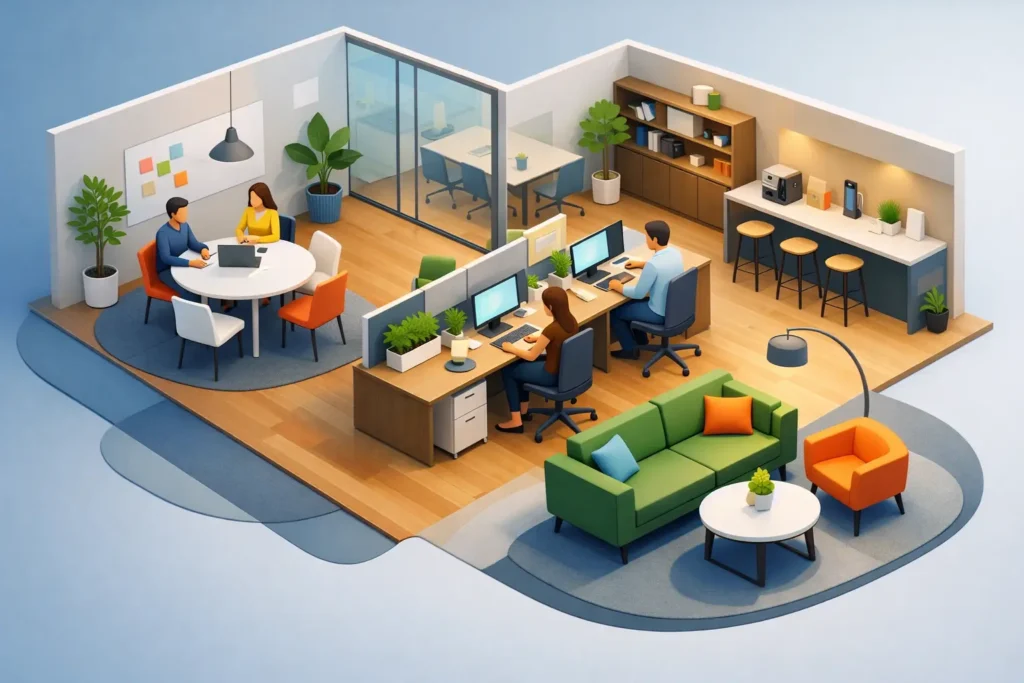
A good office rarely fails because of furniture alone. More often, the problem starts earlier – poor space planning, underpowered services, unclear circulation, acoustic complaints, or a design concept that ignores how the business actually operates. That is why interior design for office space needs to be treated as a working system, not a styling exercise.
For owners, tenants, and project teams, the stakes are practical. The office must support productivity, reflect the business appropriately, comply with building and fire requirements, and remain feasible to build within budget and timeline. If the layout looks impressive on paper but creates MEP conflicts, approval delays, or expensive variation orders, it is not a successful design.
What office interior design is really solving
In commercial projects, interior design has to do more than make a space presentable. It must organize people, equipment, privacy, circulation, storage, lighting, and brand use within a fixed floor plate. In many cases, it also has to work around landlord guidelines, existing structural conditions, sprinkler layouts, air-conditioning capacity, and egress requirements.
That is why office planning should begin with operational questions. How many people will occupy the space now, and how many within two to three years? Which teams need quiet, and which need collaboration? Will clients visit regularly? Are there meeting rooms that require acoustic separation? Does the business need a reception area that signals credibility, or is a lean front-of-house arrangement enough?
The right answer depends on the business model. A law office, a creative agency, a medical administration team, and a logistics operator will not use the same layout even if they lease the same square footage. Office design only performs well when it reflects the actual use case.
Interior design for office space starts with planning, not finishes
Many clients naturally focus on visible decisions first – feature walls, flooring, lighting style, furniture selection. Those matter, but they should come after the planning framework is settled. The most expensive mistakes usually happen when aesthetics are decided before workflow, services, and compliance are coordinated.
A sound planning process typically starts with zoning. Public-facing areas such as reception, waiting, and client meeting rooms should be separated from operational zones where staff need concentration or secure access. Shared amenities like pantries, print areas, and storage should be placed where they reduce movement friction rather than create noise spill into workstations.
From there, the design needs to consider density. A higher headcount can improve rental efficiency, but if desks are compressed without accounting for circulation widths, storage, and mechanical performance, the office may feel strained within months. In some projects, a lower-density layout produces better staff retention and fewer future fit-out changes, which can be the more economical choice over time.
This is also the stage where technical coordination matters. Ceiling design affects lighting, air distribution, detectors, sprinklers, and access panels. Meeting room placement affects return air paths and acoustic detailing. Built-in carpentry affects power routing and maintenance access. When these disciplines are considered together, the project is easier to approve and easier to build.
The layout decisions that have the biggest impact
Most office layouts succeed or fail on a few core decisions. The first is circulation. Staff and visitors should move through the office without cutting across focused work areas or creating congestion at pinch points. This sounds simple, but poor circulation often appears in smaller offices where every square foot is under pressure.
The second is adjacency. Teams that work closely should sit near each other, while functions that need confidentiality or concentration should be buffered. Finance, HR, executive rooms, and sensitive meeting areas often need more deliberate separation than open-plan concepts initially suggest.
The third is flexibility. A rigid layout may fit current needs precisely, but offices change. Headcount grows, departments shift, and hybrid work patterns alter room demand. Modular furniture systems, meeting rooms with convertible use, and planning grids that allow future reconfiguration can reduce later renovation costs.
There is also a trade-off between openness and control. Open offices can increase visibility and reduce construction cost, but they can also create distraction and speech privacy issues. Enclosed rooms improve confidentiality and focus, but too many partitions can make a floor feel cramped and reduce daylight penetration. The right balance depends on the organization, not design trends.
Compliance is part of the design brief
Commercial interiors cannot be planned in isolation from code, authority requirements, and building constraints. This is where many office renovations run into avoidable delays. A layout that appears efficient may conflict with fire safety provisions, means of egress, accessibility requirements, mechanical limitations, or landlord submission conditions.
For that reason, interior design for office space should be reviewed with technical and regulatory input early. Changes to partitions, occupancy arrangement, MEP systems, and fire protection elements can have downstream implications on approvals, cost, and construction sequence. In some cases, even minor-looking revisions affect detector locations, sprinkler coverage, or escape path compliance.
This is especially relevant when offices are being fitted out within mixed-use developments, older buildings, or industrial and commercial premises with existing service limitations. The design has to respond to the actual site condition, not just the lease brochure or schematic plan.
At Stellar Structures, this coordination is where integrated delivery becomes useful. When interior planning is considered alongside engineering, authority submissions, and practical construction constraints, clients can reduce redesign cycles and move more confidently toward execution.
Materials, lighting, and finishes should support performance
Finish selection should follow usage, maintenance expectations, and budget discipline. A reception area may justify a stronger visual statement, but high-traffic work areas usually benefit more from durable, easy-to-maintain materials than premium finishes that wear poorly. Office interiors are commercial environments. They need to perform under daily use.
Lighting is one of the most underestimated parts of the fit-out. Uniform brightness alone is not enough. Workstation lighting should reduce glare and support screen-based tasks. Meeting rooms need balanced lighting for both in-person discussion and video calls. Reception lighting often needs a different treatment from back-of-house areas. If lighting design is handled too late, it can clash with ceiling services and compromise both aesthetics and function.
Acoustics deserve similar attention. Hard finishes, exposed ceilings, and open collaboration zones can look contemporary, but they often create sound issues that staff notice immediately. Acoustic panels, carpet tiles, ceiling treatments, and room construction details can make a measurable difference. The best acoustic solution is not always the most expensive one, but it does need to be considered intentionally.
Budget control comes from early coordination
Clients often assume design quality and budget control are competing goals. In practice, they only conflict when the project lacks early technical alignment. Cost overruns usually come from changes after design sign-off, hidden site conditions, service conflicts, and unrealistic material expectations.
A commercially sound office design sets priorities clearly. If client-facing image is critical, allocate more budget to entrance experience, meeting rooms, and controlled branding points. If staff density and operational throughput matter most, invest in planning efficiency, services capacity, and durable finishes. Not every area needs the same treatment.
Value engineering also works better when it happens before tender or procurement pressure. Substituting materials late can affect detailing, lead time, maintenance quality, and the overall visual standard. It is better to build a realistic specification from the start than to produce an aspirational design that cannot be executed responsibly.
A better office is one that can still work two years from now
One of the most common mistakes in office fit-out is designing only for handover. The better approach is to think about what happens after occupation. Can teams expand without major reconstruction? Are power and data points placed for real use instead of idealized workstation diagrams? Can storage adapt as departments change? Will the office still function if hybrid schedules shift back toward higher in-person attendance?
This longer view matters because office interiors are not static assets. They are operational environments with ongoing pressure from staffing, technology, maintenance, and lease strategy. A design that is slightly less dramatic but easier to adapt may deliver better value than one that looks stronger in photos but becomes restrictive quickly.
For decision-makers, that is the practical test. Good office design should support the business, reduce friction, and hold up under real occupancy. If the planning is clear, the technical coordination is done properly, and the fit-out is aligned with compliance and budget realities, the result is not just a nicer office. It is a more useful one.
When planning your next workplace, aim for design decisions that can survive contact with operations, contractors, and approvals. That is where office value is actually built.