




Mezzanine Fire Safety Singapore: SCDF Sprinkler and 1-Hour Rating Rules
SEO Metadata and Specifications
| Element | Specification |
| SEO Title | Mezzanine Fire Safety Singapore: SCDF Sprinkler & 1-Hour Rating Rules |
| Focus Keyphrase | Mezzanine fire safety Singapore |
| Meta Description | Discover mandatory SCDF Fire Code 2023 regulations for mezzanine floors. Learn about 1-hour fire ratings, sprinkler rules, and CORENET X approvals. |
| Primary Keywords | Mezzanine fire safety, SCDF Fire Code 2023, 1-hour fire rating, fire sprinklers |
| LSI & Secondary Keywords | CORENET X submission, Fire Safety Certificate, intumescent paint, fire rated board, SCDF PLS |
| Search Volume Targets | smoke alarm (27,100), fire alarm (18,100), home security system (9,900) 1 |
| Target Audience | Facility managers, property developers, architects, and building compliance officers in Singapore. |
Introduction to Mezzanine Compliance
Singapore industrial real estate commands incredibly high premium prices today. Consequently, space optimization represents a critical objective for facility managers. Mezzanine floors provide a highly effective vertical expansion strategy locally.2
These intermediate structures unlock unused volume within factories and warehouses. However, building these additions introduces profoundly severe fire safety risks. Therefore, the Singapore Civil Defence Force strictly regulates these structures.
Unregulated structural modifications directly threaten human lives during fire emergencies. The SCDF Fire Code 2023 dictates precise, non-negotiable compliance metrics.3
Mezzanine fire safety revolves around two primary structural protection pillars.
Firstly, structural elements require a 1-hour fire resistance rating.4
Secondly, SCDF mandates comprehensive automatic fire sprinkler system installations.5
These specific systems delay structural collapse and suppress fire spread. Compliance is simply not optional for property owners or tenants.
Furthermore, heavy legal penalties await those who ignore these regulations.6 This exhaustive report details the complete mezzanine regulatory framework deeply. It covers structural requirements, active fire protection, and submission protocols.
Defining Mezzanine Floors Under SCDF Regulations
A precise legal definition separates mezzanines from other building structures. A mezzanine constitutes an intermediate floor within a commercial building.2 It sits directly between the primary floor and the ceiling.6
SCDF views this specific structure as a significant building work.6 Adding a mezzanine directly increases the property’s gross floor area.7 It fundamentally alters the overall occupant load of the facility.7 It also changes complex emergency evacuation dynamics very significantly.7
Equipment Platforms vs. Mezzanines
Building owners often confuse mezzanines with simple equipment platforms. However, the regulatory distinction between these two is absolutely critical.8
An equipment platform represents an unoccupied, elevated industrial structure entirely.9 It is used exclusively for accessing mechanical or industrial equipment.9 Furthermore, equipment platforms are strictly freestanding structural units by design.9 They are not considered permanent parts of the host building.9
| Feature Comparison | Equipment Platform | Mezzanine Floor |
| Size Limitation | Up to 2/3 of floor space below.9 | Maximum 1/3 of floor space below.9 |
| Fire Area Calculation | Not included in the building fire area.9 | Included strictly in building fire area.9 |
| Egress Requirements | Cannot be part of means of egress.9 | Requires dedicated means of egress.9 |
| Permit Stringency | Less stringent approval process generally.9 | Highly stringent multi-agency process.9 |
Mezzanines face far stricter size and fire area calculation limitations.8 Mezzanines require strict means of egress for human life safety.8 Consequently, SCDF approval processes for mezzanines are highly exhaustive.8
Specialized Building Definitions
Understanding SCDF terminology is essential for achieving full regulatory compliance. An area of refuge offers a temporary safe haven locally.10 Evacuees use this area instead of an immediate exit staircase.10
It requires adequate separation by strict fire-resisting construction materials.10 Furthermore, a concealed space represents a cavity enclosed by elements.10 This includes spaces within suspended ceilings or raised floor cavities.10 Finally, a coldroom utilizes combustible insulation materials for cold storage.10 Spaces under 10 square meters are treated merely as appliances.10
The Danger of Unauthorized Mezzanine Floors
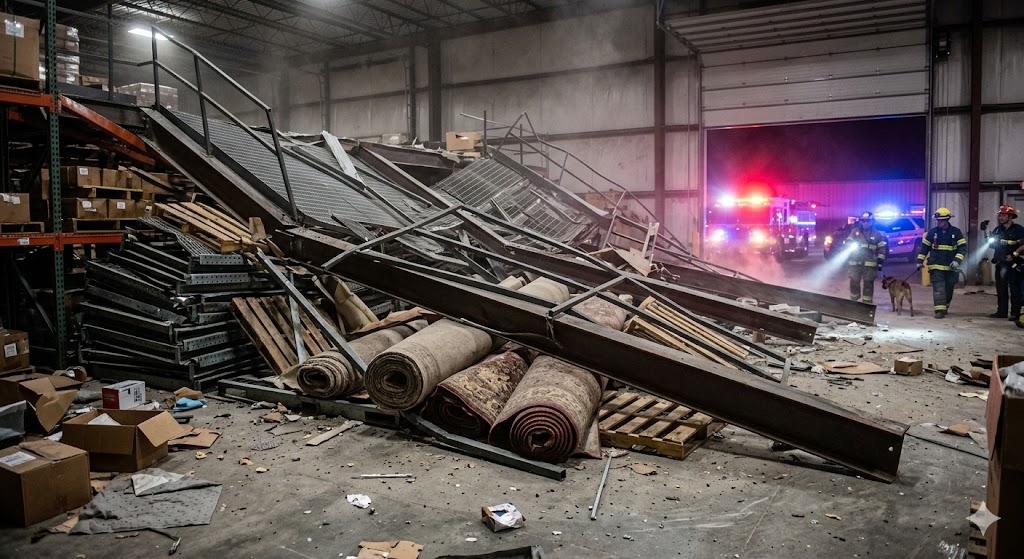
Constructing an unapproved mezzanine carries devastating physical and legal risks. The January 2025 Toa Payoh collapse highlights this extreme danger.6 An unapproved mezzanine in an industrial park failed suddenly there.6
Unauthorized building works are never vetted for load-bearing capacity.6 They are fundamentally unsafe and pose direct threats to life.6 Furthermore, these illegal structures lack critical structural fire protection completely.6
Strata Laws and The BMSMA
The Building Control Act mandates strict prior structural approval procedures.11 Singapore authorities actively prosecute unapproved structural building works continuously. The Building Maintenance and Strata Management Act regulates strata properties.11
The BMSMA stipulates strict rules regarding changes affecting floor area.11 Specifically, Section 37 requires approval from 90% of unit owners.11 This approval must occur formally at a general building meeting.11 Without this approval, structural modifications are legally deemed entirely unauthorized.11
Legal Ramifications and Penalties
Penalties for unauthorized mezzanine construction are extremely severe in Singapore.6 Property owners easily face massive fines up to $200,000 legally.6
Court judgments can also impose jail terms of two years.6 Failing to obtain a Fire Safety Certificate brings additional fines.6 These secondary statutory fines can reach up to $10,000.6
Recent court cases demonstrate aggressive enforcement by local government authorities. A secret mezzanine at The Alexcier went undetected for years.12 It spanned roughly 500 square meters on the top floor.12
A fake display shelf concealed the illegal staircase access completely.12 Authorities ultimately uncovered the structure through anonymous public tip-offs.12 The company director pleaded guilty to contravening safety acts formally.12 The local court imposed a heavy $50,000 fine accordingly.12 The owner also funded the expensive demolition of the floor.12
Structural Fire Precautions: The 1-Hour Rating
The 1-hour fire resistance rating is an absolute, non-negotiable necessity. Structural fire resistance prevents premature and catastrophic building structure collapse.7
Every element of the mezzanine structure requires this specific rating.13 This absolutely includes columns, primary beams, secondary beams, and floors.7 Standard unprotected structural steel fails this rigorous safety requirement completely.7
The Physics of Structural Steel Failure
Steel remains exceptionally strong under normal ambient operational building temperatures. However, it is highly vulnerable to extreme thermal fire stress.14 During a blaze, structural steel absorbs heat energy very rapidly.
At approximately 550 degrees Celsius, steel loses load-bearing capacity entirely.14 A standard building fire reaches this extreme temperature within minutes.14 Structural failure leads to immediate and deadly mezzanine floor collapse. The 1-hour rating acts as a critical thermal buffer mechanism.14
Fire Dynamics and Evacuation Calculations
Evacuation safety relies on precise mathematical thermal and time models. The Available Safe Evacuation Time is universally known as ASET.15 The Required Safe Evacuation Time is universally known as RSET.15
ASET must always be significantly larger than the calculated RSET.15 A 1-hour fire rating artificially extends the safe ASET window.16 It maintains structural integrity while occupants exit the burning building.16
Fire dynamics research illustrates the extreme dangers of mezzanine fires. Heat accumulation beneath a mezzanine floor is incredibly rapid structurally.17 Radiative heat flux causes fire spread between industrial storage racks.17
Full-scale testing shows radiant fires occur within five short minutes.17 A minimum separation distance of 3.2m prevents rack-to-rack spread.17 Furthermore, dense smoke particles create a dangerous thermal lensing effect.18 This specific effect increases the warming of soot by 70%.18 A 1-hour rated floor acts as a barrier to phenomena.
Core SCDF Fire Code 2023 Compartmentation Rules
The SCDF Fire Code 2023 specifies strict architectural parameters clearly. These structural parameters depend heavily on the specific Purpose Group. Purpose Group VI effectively covers general factory building occupancies legally.5
Purpose Group VIII effectively covers general warehouse building occupancies legally.13 Mezzanine floors in these groups share identical compliance metrics fundamentally.
Size and Height Limitations
The aggregate floor area determines the foundational structural compliance baseline. The maximum mezzanine area per factory unit is 60 square meters.5 Exceeding this restrictive limit triggers much more complex safety requirements.
The habitable height of the mezzanine cannot exceed 24 meters.5 These strict size limits naturally prevent excessive fire load accumulation. Furthermore, they ensure rapid evacuation distances during active fire emergencies.
Permitted Usage Restrictions
SCDF deliberately restricts the functional use of industrial mezzanine floors. The mezzanine floor must serve specific ancillary operational purposes only. It shall only be used for simple storage or offices.5
Residential or high-hazard chemical processing uses are strictly forbidden entirely. Ancillary offices provide supporting functions to the primary industrial building.19 This minimizes the density of human occupants situated upstairs safely.
Escape Routes and Staircase Design
Safe egress from the mezzanine remains a top regulatory priority. A single open staircase is permitted for smaller industrial mezzanines.5
This open stair must have a minimum width of 1m.5 It must be constructed entirely of non-combustible building materials strictly.5 Travel distance to an exit must comply with Table 2.2A.5 If parameters are exceeded, a second remote staircase becomes mandatory.7 This ensures occupants never face deadly trapped scenarios during fires.
Exemptions for PG IV and PG V
Strict requirements apply universally, but specific structural exemptions do exist. Purpose Groups IV (Offices) and V (Shops) have special rules.20 A mezzanine may be exempt from strict fire resistance requirements.20
The mezzanine must not store high-hazard combustible materials ever.20 Its total area must not exceed 100 square meters strictly.20 Alternatively, it must not exceed 25% of the room’s area.20
Specific PG IV and V exemptions require further strict compliance.20 The mezzanine cannot act as a designated building compartment floor.20 Furthermore, it cannot be a load-bearing part of the building.20
It must strictly function solely for storage or office purposes.20 However, structural support columns still demand their necessary fire ratings.20 Any column giving support to a mezzanine requires fire resistance.20
Detailed Fire Resistance Periods (Table 3.3A)
SCDF dictates precise minimum fire resistance periods based on dimensions. Table 3.3A outlines these periods for non-single-storey buildings explicitly.20 Compliance relies on the building’s specific Purpose Group and height.20
| Purpose Group (PG) | Building Dimensions | Above Ground Rating | Basement Rating |
| PG I (Residential) | Up to 3 storeys. No floor area limits. | 1 hour 20 | 1 hour 20 |
| PG I (Residential) | Over 4 storeys. No dimension limits. | 1 hour 20 | 2 hours 20 |
| PG II (Other Res.) | Up to 3 storeys. Max floor area 250m². | 1 hour 20 | 1 hour 20 |
| PG II (Other Res.) | Over 3 storeys. Max height 28m. | 1 hour 20 | 2 hours 20 |
| PG III (Institution) | Max height 28m. Max floor area 2000m². | 1 hour 20 | 1 hour 20 |
| PG IV (Office) | Max height 15m. No floor area limit. | 1 hour 20 | 1 hour 20 |
| PG IV (Office) | Max height 28m. Max floor area 5000m². | 1 hour 20 | 2 hours 20 |
| PG V (Shop) | Max height 15m. Max cubical extent 3500m³. | 1 hour 20 | 1 hour 20 |
| PG V (Shop) | Alternative dimensions with no limits. | 4 hours 20 | Not specified 20 |
Additionally, sprinkled standalone car parks experience specific rating reductions legally. The minimum fire resistance period is reduced to 2 hours.20 Exemptions also exist for non-load-bearing external building walls specifically.20 Single-storey buildings are completely exempt regardless of their floor area.20
Materials for 1-Hour Fire Resistance
Standard construction timber cannot be used for 1-hour rated floors. Flame retardant chemicals cannot legally upgrade timber for mezzanine construction.21 The core structure must utilize non-combustible materials fundamentally and permanently.6
Professional Engineers achieve compliance using two primary advanced material methods.7 They use specialized fire-rated boards or intumescent paint coatings globally.7
Intumescent Paint Coatings
Intumescent paint is a highly reactive passive fire protection system.21 These special coatings swell rapidly when exposed to high temperatures.22 This extreme swelling forms a thick, insulating protective char layer.22
The char layer protects the underlying steel from extreme heat.22 Paint provides a sleek finish for exposed architectural structural steel.14 It is highly flexible around complex structural steel shapes physically.14
However, intumescent paint has notable application and strict regulatory limitations. It requires multiple precise layers to achieve 60-minute compliance ratings.23 Coating thickness must be measured meticulously after complex site application.23
Intumescent coating for steel costs between $2 and $4 generally.22 Furthermore, SCDF notes severe limitations in harsh industrial building environments.21 Corrosive atmospheres degrade the effective thermal performance of intumescent paints.21 Such complex applications require highly specialized evaluation by the SCDF.21
Fire-Rated Boarding Solutions
Fire-rated boards physically encapsulate vulnerable structural steel members completely.7 These durable boards are engineered mineral matrices reinforced with fillers.24 Brands like Promat and Saint-Gobain offer certified board solutions locally.24
These modern boards do not contain any harmful formaldehyde chemicals.24 They are totally non-combustible and resist extreme heat exposure effectively.24
Boards provide excellent physical insulation during a massive fire event. They are manufactured to precise, reliable thicknesses in controlled factories.23 This guarantees the exact 60-minute fire resistance performance reliably.23
Furthermore, these boards meet strict criteria for impact and deflection.20 Fire-rated boards must strictly be non-combustible according to BS 476.20 They must meet strict water absorption standards under BS EN 520.20 When creating complex dry walls, they must meet BS 9999.20
Incorporating essential building services within fire-rated drywall dictates strict rules. Installations must meet rigorous fire performance test requirements under BS 476.20 Electrical cables require tough metal conduits inside the dry construction.20 Combustible gas pipes are strictly prohibited within fire-rated drywall construction.20
Suspended Ceilings Limitations (Table 3.3B)
Suspended ceilings sometimes protect floor structures, but limitations apply strictly. In buildings exceeding 15m, normal suspended ceilings offer no resistance.20 Only highly specialized jointless ceilings contribute to structural fire resistance.20
Table 3.3B dictates conditions for fire protecting suspended ceiling installations.20 For buildings under 15m, exposed ceiling surfaces need specific ratings.20 Surfaces must achieve at least a Class I flame spread.20 Furthermore, plastic composite panels are strictly banned in exit staircases.20
The SCDF Product Listing Scheme (PLS)
SCDF strictly regulates fire safety products through the Product Listing Scheme.26 This effectively ensures materials meet strict safety and reliability standards.27 Certification Bodies accredited by the Singapore Accreditation Council issue approvals.27 Approved, rigorously tested products receive a Certificate of Conformity (CoC).27
Qualified Persons must strictly select products listed under the PLS.26 Fire-rated boards and intumescent paints require a valid CoC immediately.27 QPs verify that installed products match CoC specifications exactly always.27
Modifications to the originally tested prototype design are strictly forbidden.26 Using uncertified materials invalidates the entire fire safety compliance process.28 Authorized inspectors check SCDF compliance labels on doors and boards.28
Fire Sprinkler Requirements for Mezzanine Floors
Active fire suppression is equally important as passive structural resistance. Automatic sprinkler systems quickly suppress fires before they grow large.
SCDF Fire Code Chapter 6 governs all sprinkler installations comprehensively.4 Sprinkler system designs must strictly comply with the SS CP 52.4
Mandated Sprinkler Extensions
A primary regulatory rule dictates mezzanine sprinkler coverage requirements clearly. If the main building has sprinklers, the mezzanine needs them.7 Sprinkler heads must be extended underneath the newly installed platform.7
This physically eliminates highly hazardous dead zones created by floors.7 The area beneath a mezzanine traps heat and smoke quickly.29 Without sprinklers, a fire here would rage entirely unchecked locally.
Sprinkler control valves must be located in specific, accessible areas.4 They can face an external space near the Fire Command Centre.4 They can reside safely within a designated fire lift lobby.4
Alternatively, they can sit inside a dedicated sprinkler pump room.4 The sprinkler pump room itself requires sturdy 1-hour fire compartmentation.4 The pump room floor cannot be lower than the main floor.4
Signal Transmission and Exemptions
Sprinkler systems require electrically monitored connections for rapid emergency response.4 Fire signals automatically transmit to an approved alarm monitoring company.4
Signal transmission mandates a primary leased-line connection for ultimate reliability.4 Furthermore, automatic telephone line switchover acts as a mandatory backup.4
Some specific building structures receive exemptions from these sprinkler mandates.4 Sky terraces used solely as communal areas avoid these requirements.4
Open-sided pavilions or sheds also bypass mandatory sprinkler installation rules.4 Canopies used solely for passenger drop-off do not need sprinklers.4 However, these exempt areas cannot host commercial activities or storage.4
Types of Sprinkler Heads and Costs
Industrial facilities utilize various specialized automatic sprinkler head designs today. Wet sprinkler systems utilize overhead pipes filled with pressurized water.30
Heat from a local fire activates the specific sprinkler head directly.30 Standard response sprinklers are extremely common in older industrial buildings.31
However, modern automated warehouses often utilize Early Suppression Fast Response.32 ESFR systems discharge massive volumes of suppressive water very quickly.32 They activate in half the time of conventional sprinkler heads.32
ESFR systems protect high-piled palletized inventory perfectly without in-rack systems.32 Quick response sprinklers are increasingly mandated for light-hazard commercial occupancies.31 The key difference lies in the thermal sensitivity of the element.31
| Sprinkler Type | Characteristics | Estimated Cost Impact |
| Conventional Wet | Standard thermal response, basic coverage. | $64,980 for 722 total sprinklers.33 |
| ESFR System | Highly sensitive, massive water discharge. | $91,890 for 1,125 total sprinklers.33 |
| In-Rack Sprinklers | Targets specific storage rack levels. | Varies by rack height and density.32 |
SCDF 4th Batch Amendments (Effective March 2026)
Fire safety codes constantly evolve alongside modern construction methodologies today.7 SCDF routinely updates the Fire Code to balance safety metrics. The 4th Batch of Amendments introduces several highly pragmatic relaxations.7
These crucial amendments were formally issued on 1 September 2025.34 They officially take effect legally on 1 March 2026.34 A six-month grace period applies before the strict effective date.34 Qualified Persons may adopt these relaxations immediately without seeking waivers.34
Table: 4th Batch Amendment Relaxations
| Safety Requirement | Previous Rule | New Rule (Effective March 2026) | Relevant Clause |
| Manual Call Point | Strictly required on mezzanine. | Exempt if < 30m travel distance to main floor point. | 6.3.3d.(3) 34 |
| Hose Reel | Strictly required on mezzanine. | Exempt if < 36m total coverage distance from main floor. | 6.2.8a.(3)(d) 34 |
| Landing Valve | Strictly required on mezzanine. | Exempt if < 38m coverage distance from main floor valve. | 6.2.2c.(3) 34 |
| M&E Floor Headroom | 1.5m maximum height permitted. | 1.8m maximum height permitted for M&E spaces. | 2.2.13c.(1)(d) 34 |
Practical Implications of the Amendments
These precise rule relaxations lower mechanical installation costs for owners.7 Small mezzanines benefit significantly from reduced active firefighting equipment requirements.7 If an existing ground floor hose reel covers the mezzanine adequately.7
No new expensive hose reel piping is required upstairs then.7 The 36m total coverage includes a 30m hose path specifically.34 It also accounts for a 6m physical water jet throw.34
Similarly, manual call points are omitted if escape distances suffice.34 Occupants must reach the main floor call point within 30m.34
Landing valves utilize a 38m total coverage parameter for exemption.34 However, the core requirement for 1-hour structural fire resistance remains.7 Structural integrity cannot be compromised under any new code amendment.7
High Containment Facilities and Coldrooms
Specialized mezzanine usages carry entirely different and stricter safety requirements. Laboratories handling hazardous biological agents require extreme fire compartmentation structures.5
Bio-Safety Level 3 (BSL-3) containment laboratories face incredibly strict rules.5 In sprinkler-protected buildings, BSL-3 facilities need 1-hour rated enclosures.5 In non-sprinkler-protected buildings, the required rating increases to two hours.5 The physical protecting structure must consist strictly of masonry or drywall.5
Coldrooms process or temporarily hold materials under extreme cold conditions.10 They normally consist of highly combustible thermal foam insulation materials.10 In sprinkler-protected buildings, coldrooms exceeding 20m² need 1-hour outer layers.13
The maximum aggregate area is 700m² per single designated compartment.13 In non-sprinklered buildings, the limit drops significantly to 100m² structurally.13 Furthermore, non-compartmentalised coldrooms cannot ever store highly flammable liquid chemicals.13
The Multi-Agency Approval Process Pathway
Mezzanine approval is never solely an SCDF jurisdictional matter.6 It is a highly complex, multi-agency regulatory affair in Singapore.6
A successful project requires approvals from four distinct government authorities.6 Each authority carefully evaluates a different aspect of the structural addition.
Agency Roles and Responsibilities
- Urban Redevelopment Authority (URA): URA actively governs the building’s total Gross Floor Area.6 A mezzanine directly increases the GFA of the target property.7 URA ensures the new GFA complies with zoning and ratios.6
- Building and Construction Authority (BCA): BCA regulates absolute building safety and structural integrity formally.2 BCA ensures designs comply with the Building Control Act thoroughly.2 They verify load-bearing capacity, calculations, and exact material specifications.2
- Singapore Civil Defence Force (SCDF): SCDF heavily evaluates fire safety and emergency response considerations.35 They check compartmentation, escape routes, and active fire protection systems.35
- Jurong Town Corporation (JTC): JTC officially acts as the landlord for industrial properties locally.6 JTC must consent to the specific structural addition formally.6 They ensure the mezzanine aligns with industrial zoning usage policies.6
Variations by Industry Sector
Compliance complexity varies significantly depending on the overarching industry sector.35 Industrial mezzanines require heavy-duty structures for manufacturing and warehousing loads.35 They must withstand significant dynamic loads from heavy mechanical equipment.36 Commercial mezzanines focus heavily on retail layouts and office aesthetics.35 They must meet stringent BCA commercial codes and public safety rules.35 Residential mezzanines in HDB flats face highly restrictive URA guidelines.35
Engaging a Qualified Person (QP) remains a mandatory legal requirement.37 QPs are fully licensed architects or professional structural engineers locally.37 Property owners cannot submit applications directly to these government agencies.37
The BCA Submission Framework
The BCA mandates a structured, multi-step process for mezzanine approval.37 Submissions typically begin with detailed architectural and structural drawing packages.37 The PE produces comprehensive load calculations and analysis reports formally.7 Complex structural submissions naturally command varying professional engineering service fees.7 Fees typically range between $1,500 and $10,000 depending on scope.38
For existing illegal mezzanines, owners must file a Regularisation Submission.38 This provides retroactive BCA approval for previously unauthorized building structures.38 For minor modifications, SCDF utilizes the Minor Alterations or Additions framework.39 However, structural fire resistance changes mandate a Full Submission immediately.39 Changes to fire compartmentation also strictly trigger the Full Submission pathway.39
CORENET X Digital Submission Process (2026)
Singapore is actively revolutionizing the building regulatory approval process digitally. CORENET X represents a new centralized digital submission platform entirely.7 It replaces fragmented, agency-specific 2D drawing submissions very completely.7 From 1 October 2026, CORENET X submission becomes strictly mandatory.40 This requirement applies to all new building projects regardless of size.40
BIM and IFC+SG Standards
CORENET X leverages advanced 3D Building Information Modelling (BIM) technology.7 It mandates upfront collaboration across all major project design disciplines.7 The digital system standardizes data structures utilizing the IFC+SG format.41 This ensures agencies possess exact, structured information for rapid approvals.41 The Architect typically acts as the central Project Coordinator formally.41 They federate the various BIM submissions into one cohesive model.41
The Four Key Gateways
| CORENET X Gateway | Primary Objective and Agency Focus |
| Design Gateway | Initial multi-agency review of the conceptual building design.41 |
| Piling Gateway | Approval for foundational work and ground stabilization procedures.41 |
| Construction Gateway | Detailed structural integrity and fire safety evaluations.41 |
| Completion Gateway | Final regulatory checks before operational building handover.41 |
This unified approach fundamentally minimizes downstream conflicts and abortive reworks.7 It transforms regulatory approvals for mezzanine building works very significantly.42 Firms must prepare early to ensure smooth regulatory approval transitions.41
Fire Safety Certificates and Temporary Permits
SCDF enforces strict operational occupancy regulations for all local buildings. Owners cannot occupy a new mezzanine immediately after construction finishes. Formal certification is legally required to prove absolute fire safety compliance.43
FSC vs. TFP
The Fire Safety Certificate (FSC) provides absolutely for occupant safety.43 Owners must successfully obtain the FSC before occupying the premises.43 The FSC is issued exclusively after full completion of works.43 Operating without a valid FSC remains an extreme legal offence.43
However, owners may occasionally obtain a Temporary Fire Permit (TFP).43 A TFP allows temporary occupation for a strictly limited period.43 SCDF issues TFPs only if construction works are satisfactorily completed.43 Only very minor outstanding cosmetic issues are permitted for TFPs.43 TFPs prove highly useful for phased building occupations or events.44
The New 3-Year Fire Certificate (FC) Regime
Certain high-risk premises require an ongoing, renewable Fire Certificate (FC).44 This applies heavily to large industrial buildings and foreign dormitories.45 Hospitals and vast public buildings also require this specific certificate.45 The FC certifies that critical fire safety systems remain fully operational.45
Starting 1 April 2026, SCDF implements a 3-year FC regime.45 This change aggressively helps businesses reduce their regulatory compliance costs.45 All FC applications starting from April 2026 receive 3-year validity.45 Owners cannot legally opt for a one-year FC instead.45 If a current FC expires post-March 2026, it transitions automatically.45
Annual Obligations Under the 3-Year Regime
Despite the 3-year validity, strict annual maintenance obligations remain active.45 Building owners must engage a Professional Engineer (PE) annually.45 The PE must conduct rigorous inspections of all fire systems.45 Owners must submit an FC form to SCDF annually online.45 This form explicitly certifies that systems are in working condition.45 Owners must submit this via the digital GoBusiness portal efficiently.45
Application financial fees apply only during the triennial renewal cycle.45 Residential buildings pay $11 per storey for the formal application.45 Non-residential buildings pay $36 per storey for the formal application.45 However, SCDF conducts random audits on PE inspections every year.45 Failure to submit the annual form triggers immediate FC revocation.45 Revoked premises are punitively downgraded to a strict 1-year regime.45
Role of the Registered Inspector and FSM
Maintaining lifelong compliance requires continuous oversight by certified safety professionals. The regulatory system relies heavily on independent third-party physical checks.
The Registered Inspector (RI)
A Registered Inspector (RI) plays a crucial role before FSC issuance.46 The RI conducts thorough on-site physical assessments of the mezzanine.47 They verify structural integrity, load capacities, and fire safety features.47 The RI utilizes comprehensive inspection checklists during their site walk.48 They check certified true copies of SCDF approved technical plans.48 They verify the installation of 1-hour fire-rated compartmentation panels.39 They confirm that sprinkler systems match the approved fire protection plans. After a successful inspection, the RI issues a certification report.49 This report allows the QP to apply for the final FSC.
The Fire Safety Manager (FSM)
Large industrial buildings must legally appoint a Fire Safety Manager.50 Buildings with an occupant load over 1000 require an FSM.50 Buildings exceeding 5000 square meters also require an FSM legally.50 Owners must officially appoint an FSM within 90 days post-completion.50 Failure to appoint an FSM results in a severe $10,000 fine.50
The FSM supervises the ongoing maintenance of all fire works.51 They ensure the occupant load never exceeds prescribed Fire Code capacities.51 They conduct daily checks to remove fire hazards within premises.51 The FSM prepares and executes the building’s Emergency Response Plan.51 They conduct mandatory fire evacuation drills twice every calendar year.51 The FSM also trains the Company Emergency Response Team (CERT).51 The FSM actively notifies the owner if the FC expires.51
Conclusion and Strategic Recommendations
Building a mezzanine floor in Singapore remains a highly serious undertaking. It requires meticulous structural planning and strict adherence to SCDF regulations. Facility managers must prioritize human life safety over simple space maximization.
First, determine if the structure constitutes a mezzanine or equipment platform. This decision defines the entire regulatory and financial pathway forward. Second, engage a Qualified Person at the earliest conceptual design phase. Their expertise prevents costly abortive works and delayed agency approvals. Third, specify 1-hour fire-rated boards with valid SCDF Certificates of Conformity. Avoid uncertified cheap materials that will fail RI inspections later. Fourth, budget for automatic sprinkler extensions beneath the new mezzanine floor. Active suppression remains just as critical as passive structural fire resistance.
Finally, prepare actively for the mandatory CORENET X BIM submission process. Transitioning to 3D models ensures seamless multi-agency coordination by October 2026. Maintain strict annual PE checks under the new 3-year FC regime. Proper compliance ensures business continuity while safeguarding the lives of occupants.
Works cited
- The Top Fire & Security Keywords for SEO – Electrical Marketers, accessed May 4, 2026, https://electricalmarketers.co.uk/top-security-seo-keywords/
- Mezzanine Authority Submission: Obtaining JTC, URA, BCA, and SCDF Approvals, accessed May 4, 2026, https://structures.com.sg/mezzanine_authority_submission_scdf_bca_ura_jtc/
- Fire Code 2023 – Singapore – SCDF, accessed May 4, 2026, https://www.scdf.gov.sg/fire-safety-services-listing/fire-code-2023
- Clause 6.4 Fire Sprinkler Installation – SCDF, accessed May 4, 2026, https://www.scdf.gov.sg/fire-safety-services-listing/fire-code-2023/table-of-content/chapter-6-firefighting-systems/clause-6.4-fire-sprinkler-installation
- Clause 9.6 Purpose Group VI Occupancy – SCDF, accessed May 4, 2026, https://www.scdf.gov.sg/fire-safety-services-listing/fire-code-2023/table-of-content/chapter-9-additional-requirements-for-each-purpose-group/clause-9.6-purpose-group-vi-occupancy
- SCDF Mezzanine Requirements: Fire Code 2023 & BCA Guide, accessed May 4, 2026, https://structures.com.sg/scdf-mezzanine-requirements/
- Mezzanine Floor Approval Guide Singapore 2026, accessed May 4, 2026, https://structures.com.sg/mezzanine-floor-approval-guide-singapore-2026/
- Mezzanines vs Equipment Platforms – The differences – Upside Innovations, accessed May 4, 2026, https://upsideinnovations.com/blog/mezzanines-vs-equipment-platforms/
- Equipment Platform vs Mezzanine: What is the Difference? – Lapeyre Stair, accessed May 4, 2026, https://www.lapeyrestair.com/blog/equipment-platform-vs-mezzanine/
- Clause 1.4 Definitions – SCDF, accessed May 4, 2026, https://www.scdf.gov.sg/fire-safety-services-listing/fire-code-2023/table-of-content/chapter-1-general/clause-1.4-definitions
- Legal Analysis: Unapproved Mezzanine Floor And It’s Legal Implications, accessed May 4, 2026, https://www.smtplaw.com/legal-analysis-unapproved-mezzanine-floor-and-its-legal-implications/
- Man fined for building illegal mezzanine level in top-floor unit to ‘optimise’ space – CNA, accessed May 4, 2026, https://www.channelnewsasia.com/singapore/director-fined-alexcier-illegal-extra-mezzanine-floor-3378861
- Clause 9.8 Purpose Group VIII Occupancy – SCDF, accessed May 4, 2026, https://www.scdf.gov.sg/fire-safety-services-listing/fire-code-2023/table-of-content/chapter-9-additional-requirements-for-each-purpose-group/clause-9.8-purpose-group-viii-occupancy
- Intumescent Paint vs Fire-Rated Boarding: Which Is Better for Steel? – JW Simpkin Ltd, accessed May 4, 2026, https://www.jwsimpkinltd.co.uk/intumescent-paint-vs-fire-rated-boarding-which-is-better-for-steel/
- Review on emergency evacuation time estimation for performance-based fire safety design, accessed May 4, 2026, https://www.academia.edu/98821530/Review_on_emergency_evacuation_time_estimation_for_performance_based_fire_safety_design
- Mezzanine Floor Fire Protection, accessed May 4, 2026, https://www.mezz-floors.co.uk/mezzanine-floor-fire-protection/
- Full-Scale Fire Experiment on Mezzanine Racks in Logistics Facilities – MDPI, accessed May 4, 2026, https://www.mdpi.com/2571-6255/7/9/326
- Study provides evidence of wildfire smoke’s heat-trapping effect – CU Connections, accessed May 4, 2026, https://connections.cu.edu/stories/study-provides-evidence-wildfire-smoke%E2%80%99s-heat-trapping-effect
- CODE OF PRACTICE FOR FIRE PRECAUTIONS IN BUILDINGS 2023 – SCDF, accessed May 4, 2026, https://www.scdf.gov.sg/docs/default-source/fire-safety-docs/firecode-2023-111220241013.pdf?sfvrsn=b3dc3c15_3
- Clause 3.3 Fire Resistance of Elements of Structure – SCDF, accessed May 4, 2026, https://www.scdf.gov.sg/fire-safety-services-listing/fire-code-2023/table-of-content/chapter-3-structural-fire-precautions/clause-3.3-fire-resistance-of-elements-of-structure
- Clause 3.15 Materials for Construction – Singapore – SCDF, accessed May 4, 2026, https://www.scdf.gov.sg/fire-safety-services-listing/fire-code-2023/table-of-content/chapter-3-structural-fire-precautions/clause-3.15-materials-for-construction
- How Much Does Intumescent Paint Cost? – Fire Retardant Sprays, Paints and Coatings, accessed May 4, 2026, https://rdrtechnologies.com/blog/much-intumescent-paint-cost
- Protecting structural steel – Promat, accessed May 4, 2026, https://media.promat.com/pi866257/original/449358174/promat-firepaint-board-whitepaper-oct25.pdf
- PROMATECT®-H – Promat Singapore, accessed May 4, 2026, https://www.promat.com/en-sg/construction/products-systems/products/boards/promatect-h/
- GYPWALL® CLASSIC – FIRE RATED – Saint Gobain Singapore, accessed May 4, 2026, https://www.saint-gobain.sg/system-family/gypwallr-classic-fire-rated
- Certification Requirements for CODIMI Product Listing Scheme (PLS), accessed May 4, 2026, https://codimiglobal.com/certification-requirements-for-codimi-product-listing-scheme-pls/
- Regulated Fire Safety Products – Singapore – SCDF, accessed May 4, 2026, https://www.scdf.gov.sg/fire-safety-services-listing/plans-submission-process/regulated-fire-safety-products
- How to Check the Main Door Fire-Rated Certified?, accessed May 4, 2026, https://www.laminatedoor.com.sg/check-if-your-main-door-is-fire-rated/
- The Simulation of Fires in Underground Parking Floors by Fire Dynamic Simulator – Sensors and Materials, accessed May 4, 2026, https://sensors.myu-group.co.jp/sm_pdf/SM1336.pdf
- What Sprinkler Systems Are Used in Industrial Properties?, accessed May 4, 2026, https://industrialproperty.loan/industrial-property-characteristics/sprinkler-systems/
- Quick Response vs Standard Response Sprinklers: The Differences – Blog | QRFS.com, accessed May 4, 2026, https://blog.qrfs.com/1-fire-sprinklers-standard-response-vs-quick-response/
- Comparing the Different Types of Fire Sprinkler Systems – AFPG Blog, accessed May 4, 2026, https://www.afpgusa.com/blog/comparing-the-different-types-of-fire-sprinkler-systems/
- ESFR vs. Conventional Sprinklers – Risk Logic, accessed May 4, 2026, https://risklogic.com/esfr-vs-conventional-sprinklers/
- SCDF – Singapore, accessed May 4, 2026, https://info.corenet.gov.sg/docs/default-source/scdf-circulars/20250901_circular-amendments-to-fire-code-2023—4th-batch-of-amendments.pdf?sfvrsn=ffc2b8db_1
- Mezzanine Submission and Retention – Aman Engineering Consultancy, accessed May 4, 2026, https://www.amanengineering.com.sg/mezzanine-authority-approval/
- What Mezzanine Floor Standards Apply to Commercial Buildings – Jade Aden Interiors, accessed May 4, 2026, https://www.jade-aden-interiors.co.uk/blog/mezzanine-floor-standards-commercial-buildings/
- Singapore Commercial Compliance: OHSAS & BCA Guide – Ad-Evo Pte Ltd, accessed May 4, 2026, https://www.adevo.sg/ohsas-bca-guide-singapore-commercial-compliance/
- BCA Submission Service Singapore: 2026 Complete Guide – CVC Engineers, accessed May 4, 2026, https://www.cvcengineers.com/post/bca-submission-service-singapore-complete-guide
- Singapore Civil Defence Force Fire Safety Checklist for Building Plan Submissions First Edition Update as of 1 June 2023, accessed May 4, 2026, https://www.scdf.gov.sg/docs/default-source/fire-safety-docs/downloads/forms/fire-safety-checklist-for-building-plan-submissions.pdf?sfvrsn=83f335a6_9
- What is the implementation timeline for CORENET X?, accessed May 4, 2026, https://support.corenet.gov.sg/hc/en-us/articles/14813415847695-What-is-the-implementation-timeline-for-CORENET-X
- CORENET X BIM Requirements & Timeline [2026 Guide] | Bimeco – BIM Services Singapore, accessed May 4, 2026, https://www.bim.com.sg/blog/corenet-guide-singapore/
- CORENET X, accessed May 4, 2026, https://info.corenet.gov.sg/
- Fire Safety Certificate & Temporary Fire Permit – Singapore – SCDF, accessed May 4, 2026, https://www.scdf.gov.sg/fire-safety-services-listing/plans-submission-process/fire-safety-certificate-temporary-fire-permit
- Fire Safety Certificate Singapore: Requirements, Costs, and How to Apply in 2026, accessed May 4, 2026, https://sageshield.com/fire-safety-certificate-singapore/
- SCDF – Introduction of a Three-year Fire Certificate (FC) Regime …, accessed May 4, 2026, https://www.scdf.gov.sg/docs/default-source/fire-safety-docs/permits-and-certification/introduction-of-three-year-fire-certificate-regime-from-1-april-2026.pdf?sfvrsn=e66df331_1
- Registered Inspector – Singapore – SCDF, accessed May 4, 2026, https://www.scdf.gov.sg/fire-safety-services-listing/permits-and-certifications/registered-inspector
- Mezzanine Floor Inspection Safety Checklist – Unistor, accessed May 4, 2026, https://unistor.com.au/news/mezzanine-floor-inspection-safety-checklist/
- RI Inspection Checklist for Singapore | PDF | Elevator | Wall – Scribd, accessed May 4, 2026, https://www.scribd.com/document/792078939/RI-INSPECTION-CHECKLIST-SUMMARY
- RI’s Inspection Report – SCDF, accessed May 4, 2026, https://www.scdf.gov.sg/docs/default-source/fire-safety-docs/downloads/forms/ri-report.docx
- Fire Safety Manager (FSM) – Singapore – SCDF, accessed May 4, 2026, https://www.scdf.gov.sg/fire-safety-services-listing/permits-and-certifications/fire-safety-manager
General duties of fire safety manager – Singapore Statutes Online, accessed May 4, 2026, https://sso.agc.gov.sg/SL/FSA1993-RG3?DocDate=20150701&ProvIds=P1III-