





Property developers and construction project managers in Singapore frequently encounter a critical question when structuring new projects: what is a design and build contract, and how does it compare to conventional project delivery methods? Under a traditional model, design and construction are executed through separate contracts, often with independent consultants managing each phase. This separation creates coordination gaps, diffuses accountability, and can extend project timelines significantly. The design and build procurement method addresses these challenges by placing both responsibilities under a single contractor, offering a more integrated path through Singapore’s demanding regulatory and compliance environment.
Table of Contents
- Understanding the design and build contract model
- Common standard forms and contract variants in Singapore
- Key contract components for Singapore developers to negotiate
- Comparing design and build with traditional methods
- Practical tips for applying design and build contracts in Singapore projects
- Why selecting the right design and build contract form changes project outcomes
- How Stellar Structures supports your design and build contract success
- Frequently asked questions
Key Takeaways
| Point | Details |
|---|---|
| Definition of design and build | A design and build contract assigns both design and construction responsibilities to a single contractor for streamlined project delivery. |
| Singapore standard contracts | PSSCOC, SIA, and REDAS are key standard forms with specific roles and risk profiles used in Singapore’s design and build projects. |
| Critical contract clauses | Clear milestones, pricing, variation rules, defects warranties, and sustainability requirements protect developers and project managers. |
| Comparison with traditional methods | Design and build integrates phases for efficiency, while traditional methods keep design and construction separate for role clarity. |
| Strategic contract form choice | Selecting the correct contract form variant is vital for risk management and scheduling success in Singapore projects. |
Understanding the design and build contract model
A design and build contract is a procurement method in which a single contractor takes full responsibility for both the project’s design and construction. This unified structure stands in direct contrast to the traditional design-bid-build approach, where an employer engages a separate architect or engineer for design, then procures a contractor through a separate tendering process for construction.
The core advantage of this model is a single point of accountability. When design errors, construction defects, or scheduling overruns occur, there is no ambiguity about which party bears responsibility. The design and build contractor owns the outcome from concept through completion.
How does design and build work in practice? The contractor assembles an integrated team comprising architects, engineers, and construction professionals who collaborate from the outset. This integrated design and construction approach allows design decisions to be informed by buildability and cost considerations simultaneously, reducing the rework that often plagues projects where design and construction teams operate in silos.
Key features of design and build contracts include:
- Single contractual entity responsible for both design adequacy and construction quality
- Employer’s requirements document that defines the project scope, performance criteria, and standards the contractor must meet
- Contractor-led design development covering all architectural, structural, and mechanical and electrical (M&E) components
- Integrated risk management, with design and construction risk sitting with one party
- Concurrent design and construction phases, enabling earlier site commencement and faster overall delivery
For Singapore developers managing complex projects under BCA, URA, HDB, or JTC requirements, this consolidated structure also simplifies the authority submission process, since the design and build contractor coordinates all regulatory approvals as part of a single scope.
Common standard forms and contract variants in Singapore
Understanding the general model raises an immediate practical question: which standard form governs the contract, and how does that choice affect pricing and risk? Standard forms in Singapore include PSSCOC for public projects, SIA Conditions for private “build-only” works, and REDAS Conditions for design and build responsibilities.

Each form allocates design liability, variation entitlements, and dispute resolution mechanisms differently. The choice is not a formality; it fundamentally shapes how the project runs.
| Standard form | Primary use | Design liability | Pricing structure |
|---|---|---|---|
| PSSCOC (Public Sector Standard Conditions of Contract) | Government and public sector projects | Contractor carries design liability | Lump sum or remeasurement |
| SIA Conditions | Private build-only works | Employer’s consultants retain design liability | Lump sum or schedule of rates |
| REDAS Conditions | Private design and build projects | Contractor assumes full design liability | Fixed lump sum typical |
The REDAS Conditions, developed by the Real Estate Developers’ Association of Singapore, are specifically drafted for design and build obligations and are widely used in private residential and commercial development. The lump sum fixed-price variant prevalent under REDAS places cost risk firmly with the contractor, providing budget certainty for developers. However, this structure requires the employer’s requirements to be sufficiently detailed at the outset. Vague scope definitions under a fixed-price contract are a primary cause of variation order disputes in Singapore projects.
For engineering safety best practices to be maintained under any standard form, the contract must clearly define who holds professional engineer (PE) responsibility for each design element. Under PSSCOC for public works, the contractor’s PE submissions are subject to BCA’s Quality Mark framework. Under REDAS for private works, the contractor’s design team bears PE responsibility for structural, geotechnical, and M&E submissions.
Key contract components for Singapore developers to negotiate
With the contract forms established, specific clauses determine whether a design and build project runs smoothly or becomes contentious. A proper D&B contract should clearly state project milestones, pricing breakdowns, variation order rules, defects liability and warranty provisions, and sustainability compliance requirements.
Singapore developers and project managers should prioritize the following components during contract negotiation:
- Project milestones and schedule provisions: Define key dates including design freeze, authority submission deadlines, structural topping out, temporary occupation permit (TOP) application, and certificate of statutory completion (CSC). Link milestone payments to these events to maintain contractor accountability.
- Pricing and contingency breakdown: Require the contractor to present a transparent cost breakdown covering design fees, structural work, M&E systems, finishes, and authority submission fees. A single lump sum without component-level transparency creates disputes when variations arise.
- Variation order rules: Establish a clear mechanism for instructing, valuing, and approving variation orders. Specify notice periods the contractor must observe before committing to varied work, and define how disputed variations are resolved before they escalate.
- Defects liability and warranty provisions: Singapore practice commonly requires a defects liability period (DLP) of 12 months from TOP, during which the contractor must rectify notified defects at no cost. For structural elements, negotiate extended warranties aligned with BCA requirements.
- Sustainability and green building compliance: With BCA’s Green Mark scheme increasingly mandatory for new developments, the contract must assign explicit responsibility for achieving the required Green Mark rating, including design targets, commissioning, and documentation.
Developers procuring BCA-certified builders should verify that the contractor’s quality management system (QMS) is referenced and enforceable within the contract. This is particularly important for projects that require ISO-certified quality assurance documentation for regulatory submissions.
Pro Tip: Require the contractor to submit a preliminary design program showing how design milestones align with the construction program before contract award. A contractor unable to produce this document at tender stage may lack the internal integration necessary for a successful design and build delivery.
Engaging in value engineering in Singapore during the design development phase can reduce costs without compromising function or compliance, but the contract must explicitly authorize the contractor to propose value engineering items and define how resulting savings are shared.
Comparing design and build with traditional methods
To put the design and build method in perspective, consider how it compares directly with design-bid-build, Singapore’s most commonly used traditional delivery model.
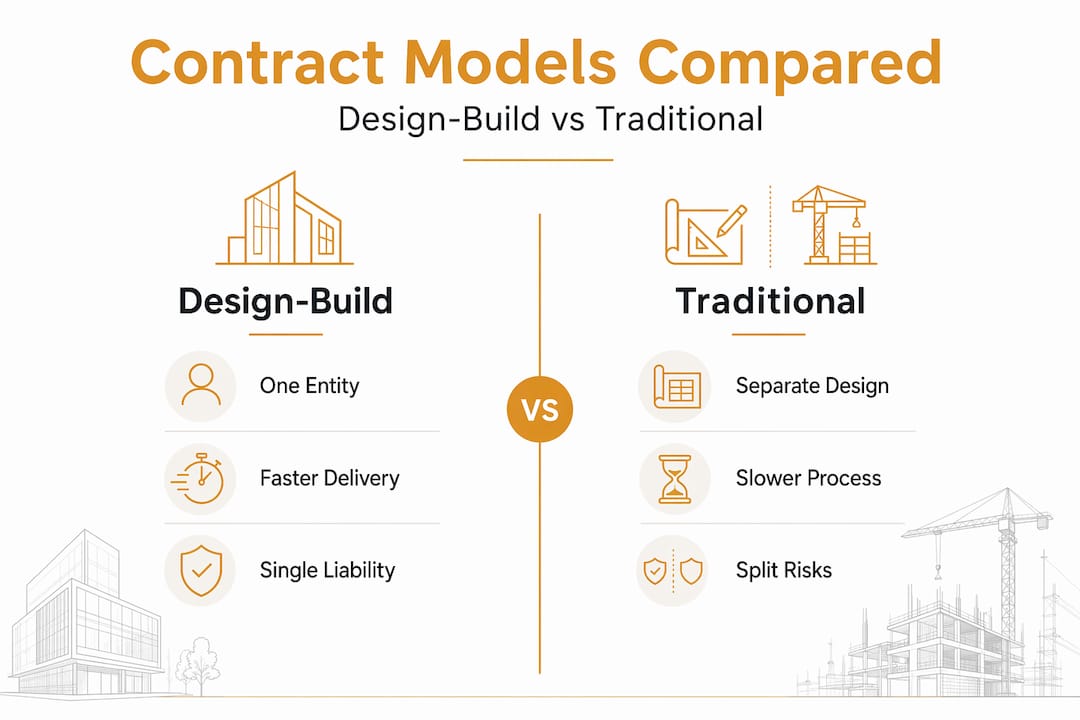
Design-build contracts consolidate design and construction phases under one entity, enabling faster and more collaborative project delivery compared to design-bid-build, which uses separate contracts and roles.
| Factor | Design and build | Design-bid-build |
|---|---|---|
| Accountability | Single contractor holds all liability | Separated between designer and contractor |
| Project timeline | Overlapping design and construction phases allow earlier completion | Sequential phases extend overall duration |
| Cost certainty | Fixed lump sum typical, high certainty | Subject to variations from design changes |
| Design quality control | Employer relies on requirements document; less direct design control | Employer’s consultants maintain direct design oversight |
| Dispute complexity | Fewer parties, simpler dispute chains | Multi-party disputes common |
| Suitability | Best for well-defined scope, time-sensitive projects | Best for complex, client-driven design requirements |
When is each method preferable? Consider these scenarios:
- Design and build suits industrial facilities, standardized residential blocks, government infrastructure, and commercial projects with clear functional briefs and tight delivery schedules.
- Design-bid-build suits projects with complex, bespoke architectural requirements where the employer needs direct control over design quality throughout development.
- Design and build suits developments where cost certainty at commitment is a priority, such as build-to-sell residential projects under REDAS conditions.
- Design-bid-build suits projects where the employer’s consultants have already developed detailed design documentation and the tender is based on near-complete drawings.
Building Information Modeling (BIM) plays a critical role in supporting the integrated design and construction model. Under a design and build contract, BIM serves as the single source of truth for all design and construction coordination, reducing clashes between structural, architectural, and M&E systems before work begins on site.
Practical tips for applying design and build contracts in Singapore projects
Now that the contract types and comparative frameworks are clear, applying this knowledge in practice requires disciplined procurement and project management.
Key actions for Singapore developers and project managers:
- Understand the standard form and variant before tendering: Confirm whether PSSCOC, SIA, or REDAS conditions apply to your project type and whether a lump sum or remeasurement pricing structure best fits your risk tolerance. Contract form choice affects who holds design liability and how variations are managed, making it a critical first procurement decision.
- Adopt BIM for design and construction coordination: BIM adoption in Singapore is increasingly required by BCA for projects above certain floor area thresholds. Even where not mandated, BIM reduces coordination errors and supports authority submission processes.
- Maintain rigorous variation documentation: Issue all variation instructions in writing, require the contractor to submit a cost and time impact notice within a defined period, and obtain written approval before work proceeds. Undocumented variations are the single largest source of final account disputes.
- Ensure BCA and URA compliance is contractually assigned: Under a design and build contract, compliance with building plan submission requirements must be explicitly assigned to the contractor, with clear accountability for the cost and timeline of resubmissions.
- Use Design for Manufacturing and Assembly (DfMA): DfMA methods, which involve prefabricating structural and architectural components off-site, are supported by BCA’s Buildability Framework. Incorporating DfMA requirements into the employer’s requirements document can reduce on-site labor dependency and improve program certainty.
Pro Tip: Engage a qualified engineer or architect to independently review the contractor’s design submissions before authority submission. Even under a full design and build contract, the developer carries reputational and financial risk if substandard design advances to the permit stage.
Why selecting the right design and build contract form changes project outcomes
Many developers approach contract form selection as administrative routine, a required document to be finalized before the real work begins. This underestimates the impact. Standard-form choice effectively changes who carries design liability and how variations are administered; practitioners treat it as a first-order scheduling and claims decision, not just paperwork.
The form selected determines where design liability sits when defects emerge years after completion. Under REDAS conditions, the contractor’s PE bears professional liability for structural design, which provides the developer with a clear route for rectification claims. Under a modified SIA form where design is split between employer consultants and the contractor, liability boundaries become contested the moment a defect appears.
Scheduling is equally affected. A lump sum fixed-price REDAS contract incentivizes the contractor to manage the design program tightly because delays cost them money. A remeasurement contract under PSSCOC creates different incentive structures, where a contractor may have less financial urgency to accelerate design approvals.
Dispute resolution mechanisms also vary materially by form. Developers who discover mid-project that their chosen form requires lengthy arbitration before any interim payment award can be made may find themselves in a cash flow position that delays the project independently of any construction issue.
The recommendation is direct: engage legal and procurement specialists with Singapore construction law experience before selecting a contract form. Aligning the form with your project goals, risk profile, and contractor capabilities from the start is far less costly than renegotiating after disputes arise. Refer to engineering safety best practices as part of your due diligence to ensure contractor standards align with your contract obligations.
How Stellar Structures supports your design and build contract success
Navigating design and build contracts in Singapore requires more than understanding contract forms; it demands technical expertise that aligns design, structural compliance, and regulatory approvals from the earliest project stage.
Stellar Structures brings deep, project-tested experience in civil and structural design checks that support contractors and developers in verifying design adequacy before authority submissions. Our team manages authority submissions across BCA, URA, HDB, JTC, SCDF, PUB, LTA, NEA, and NParks, reducing approval delays that frequently affect design and build programs. We guide clients through the full engineering design process, from concept feasibility through regulatory compliance, ensuring that your design and build contract obligations are met with precision and accountability.
Frequently asked questions
What is a design and build contract in construction?
A design and build contract is a procurement method where one contractor handles both design and construction phases, simplifying management and improving coordination throughout the project. This structure creates a single point of liability for both design adequacy and construction quality.
Which standard form contracts are commonly used for design and build projects in Singapore?
The main standard forms in Singapore are the Public Sector Standard Conditions of Contract (PSSCOC) for public projects, the SIA Conditions for private build-only works, and REDAS Conditions specifically for design and build obligations. Each form allocates design liability and variation management differently.
What contract clauses should Singapore developers focus on when using a design and build contract?
Developers should ensure the contract includes clear project milestones, pricing breakdowns, variation order rules, defects liability warranties, and sustainability compliance clauses. These provisions protect the developer’s schedule, budget, and long-term quality interests.
How does a design and build contract differ from the traditional design-bid-build method?
Design-build contracts consolidate design and construction under one entity, offering faster and more coordinated delivery, while design-bid-build uses separate contracts and parties that can create administrative complexity and extended timelines. The key practical difference is accountability: design and build assigns it to one contractor.
Why is selecting the appropriate design and build contract form critical for Singapore projects?
Because standard-form choice determines who carries design liability, how variations are administered, and how disputes are resolved, it directly affects scheduling, cost control, and risk exposure throughout the project lifecycle.
Recommended
- Integrated design and construction for efficient Singapore projects
- Singapore A&A Works (2025): Essential Guide to Hiring a BCA-Certified Builder
- Mezzanine Floor Approval Guide Singapore 2026
- Temporary Works Design in Singapore: Mastering Safety