




Spalling Concrete 101: Why It’s More Than Just An Aesthetic Issue For Your Building’s Safety
SEO Parameters and Metadata
| SEO Parameter | Assigned Value |
| SEO Title | Concrete Spalling 101: Why It Is More Than An Aesthetic Issue |
| Focus Key Phrase | Concrete Spalling |
| Secondary Keywords | structural safety, concrete repair, rebar corrosion |
| Meta Description |
Concrete Spalling severely threatens building safety. Learn about concrete repair protocols, rebar corrosion mechanics, and advanced structural safety measures. |
| Tags | concrete spalling, concrete repair, structural safety, rebar corrosion, building maintenance |
Introduction to Concrete Spalling and Structural Degradation
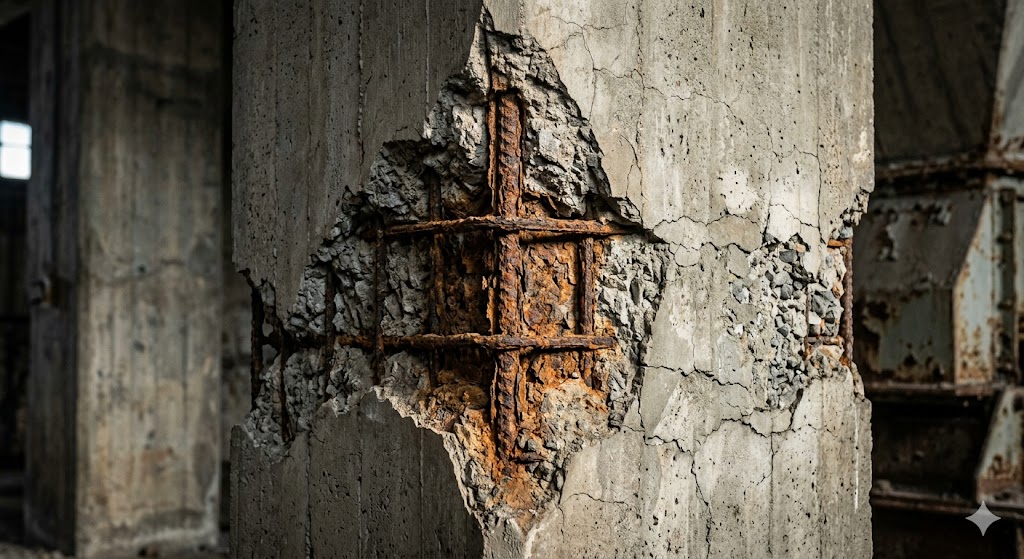
Concrete spalling presents a highly critical threat to structural safety. It is definitively more than a mere cosmetic or aesthetic issue. Specifically, spalling refers to the dangerous detachment of the concrete cover. This detachment occurs prominently on a structure’s exterior surface.1 Internal forces generally cause this aggressive physical separation.1 These destructive forces include deep reinforcement corrosion, fire, and mechanical impact.1 Furthermore, overloading the structure can rapidly trigger widespread concrete spalling.1
Many building owners completely ignore the early signs of concrete damage. They mistakenly assume weathering and small surface cracks are relatively harmless.2 However, this assumption consistently invites catastrophic and deadly structural failures.2 Over time, progressive spalling severely compromises a building’s deep structural integrity.2 Consequently, immediate concrete repair becomes a non-negotiable safety mandate. This comprehensive report explores the fundamental mechanisms behind concrete spalling. It also details advanced diagnostic testing and structural capacity reduction metrics. Finally, we meticulously examine global repair codes, costs, and legal liabilities.
The Fundamental Mechanisms of Deterioration
Concrete is an inherently porous material containing microscopic capillary networks.2 High-quality concrete provides a highly alkaline environment initially.3 This alkalinity naturally passivates embedded steel and prevents dangerous oxidation.3 However, this protective state remains extremely vulnerable to environmental disruption.3 Therefore, structural safety depends entirely on maintaining this internal chemical balance. The two most dominant mechanisms driving spalling are carbonation and chlorides.1
The Chemistry of Carbonation-Induced Failure
Carbonation represents a naturally occurring and highly destructive chemical aging process. Atmospheric carbon dioxide continuously penetrates the porous concrete matrix.2 It reacts directly with the hydration products of the cement paste.4 Unlike chloride attacks, carbonation fundamentally alters the concrete material itself.2 The hydration of Portland cement produces protective calcium hydroxide.4 When carbon dioxide enters, it dissolves in the concrete’s pore water.5 This specific dissolution forms destructive carbonic acid internally.5
Subsequently, carbonic acid attacks the highly alkaline calcium compounds.4 This reaction precipitates solid calcium carbonate and releases excess water.4 Consequently, the pH of the concrete pore solution drops significantly.2 It frequently falls below the critical threshold required for steel protection.2 At this reduced pH, the steel’s passive film breaks down entirely.2 Once depassivated, the steel faces complete exposure to ambient moisture.6 This initiates widespread, uniform rebar corrosion throughout the structural member.6
| Chemical Equation Step | Reaction Formula | Mechanism Description |
| Acid Formation | Carbon dioxide dissolves in pore water. | |
| Calcium Attack | Carbonic acid neutralizes calcium hydroxide. | |
| Silicate Breakdown | Carbonic acid destroys calcium silicate hydrates. |
Interestingly, carbonation initially increases the concrete’s compressive and tensile strength.7 However, this temporary benefit masks severe and impending long-term dangers.7 We must also distinguish between weathering carbonation and early-age carbonation.8 Weathering carbonation harms mature structures slowly over an extended period.8 In contrast, early-age carbonation involves deliberately exposing fresh concrete to carbon dioxide.5 This deliberate process actually creates a denser and significantly stronger concrete.5 Nevertheless, weathering carbonation remains a primary driver of lethal concrete spalling.8
Chloride-Induced Corrosion and Macrocell Kinetics
Chloride-induced corrosion is universally recognized as an incredibly aggressive deterioration mechanism. It heavily targets structures in marine environments and coastal zones.3 Furthermore, winter maintenance introduces massive quantities of destructive de-icing salts.2 These destructive salts dissolve rapidly and penetrate deep into the concrete pores.2 Unlike carbonation, chlorides do not lower the concrete’s bulk pH.2 Instead, they act as specific catalysts destroying the steel’s passive layer.9
Once this passive layer breaks, an intense electrochemical process immediately begins.10 This process is heavily influenced by dangerous macrocell corrosion kinetics.10 In a macrocell system, highly chloride-contaminated rebar regions become anodic.10 Here, the primary anodic reaction oxidizes metallic iron into ferrous ions.11 This oxidation releases electrons that travel through the connected steel reinforcement.11
Adjacent rebar regions with intact passivation act as the cathode.10 At the cathode, available oxygen and water consume these traveling electrons.11 This creates a substantial galvanic current flowing through the structural member.11 The potential difference can reach -780 mV relative to standard electrodes.12 Macrocell corrosion drastically accelerates the dissolution of the anodic rebar.10 It causes severe localized pitting and rapid loss of cross-sectional area.10 Therefore, it is considerably more dangerous than uniform microcell corrosion.10
Alkali-Silica Reaction (ASR)
Beyond electrochemical rebar corrosion, internal chemical distresses also induce concrete spalling.2 The Alkali-Silica Reaction represents a massive threat to structural safety.2 Concrete aggregates are generally engineered to remain chemically inert.2 However, certain siliceous minerals react violently with cement’s alkali hydroxides.2 This reaction produces a highly hygroscopic, gel-like sodium silicate substance.2
When exposed to moisture, this ASR gel absorbs water rapidly.2 Subsequently, the gel undergoes immense and destructive volumetric swelling.2 Over decades, this localized expansion generates severe internal tensile stresses.2 These stresses eventually overcome the tensile strength of the concrete completely.2 This leads directly to characteristic map cracking and extensive concrete spalling.2 Additionally, ASR creates small conical surface fractures commonly called popouts.9 Advanced concrete repair requires aggressive moisture prevention to stop ASR swelling.2
Mechanical Stressors and Blast-Induced Spalling
Chemical attacks cause most spalling, but mechanical stressors are also devastating.1 In colder climates, penetrating water expands by 9% upon freezing.9 This phase change generates hydraulic pressures exceeding concrete’s tensile capacity.9 Repeated freeze-thaw cycles progressively deteriorate the surface, accelerating concrete spalling.9 Furthermore, elevated temperatures during fires cause rapid structural volumetric expansion.9 High-strength concrete is particularly susceptible to explosive spalling under thermal loads.9
Explosive blasts also generate extreme stress waves through concrete walls.13 These violent stress waves cause massive concrete cover detachment internally.13 Research indicates cased bombs cause significantly more spalling than bare bombs.13 Furthermore, thick-cased bombs inflict the most severe structural spalling damage.13 Surprisingly, high-strength concrete suffers worse blast spall damage than weaker mixtures.13 In contrast, fiber-reinforced concrete strongly resists this violent blast spalling.13
Volumetric Expansion Mechanics and Cavity Theory
The physical manifestation of spalling involves massive internal volumetric expansion.14 When embedded steel oxidizes, the resulting rust expands incredibly significantly.14 Rust possesses a substantially larger specific volume than original metallic iron.15 Expanding corrosion products exert massive radial pressure outward against the concrete.14 This internal pressure easily overcomes the weak tensile strength of concrete.2
| Oxidation Product Type | Environment | Volumetric Expansion Rate |
| Standard Rust | Natural atmospheric corrosion | 2.0 to 6.0 |
| Calcium Iron Oxide Chloride | Electrically induced, high chlorides | 6.9 |
Engineers utilize cylindrical cavity expansion theory to model this destructive process.14 Initially, corrosion products expand freely into existing porous boundary layers.14 Subsequently, the expanding rust completely fills all available internal void spaces.14 Once filled, the rust generates intense stress-inducing internal bursting forces.14 The precise volumetric expansion ratio dictates the ultimate concrete cracking severity.16
For example, Calcium Iron Oxide Chloride expands aggressively at a 6.9 multiplier.15 Moreover, the required corrosion depth for cracking increases linearly over time.14 It grows alongside the exact thickness of the concrete protective layer.14 The established growth rate is approximately 0.2366 micrometers per millimeter.14 In contrast, larger reinforcement diameters actively decrease the concrete cracking tolerance.14 Rust expansion forces scale linearly with the rust volume expansion rate.17 Therefore, high chloride environments guarantee rapid, explosive concrete spalling events.15
Impact on Structural Capacity and Integrity
Concrete spalling drastically reduces the overall structural capacity of affected buildings.18 Approximately 80% of existing concrete damage involves deep reinforcement corrosion.18 This corrosion directly attacks the essential load-bearing structural steel components.18 Spalling physically reduces the concrete’s effective cross-sectional area immediately.18 This sudden loss significantly weakens the structure’s ultimate compressive load limits.19
Simultaneously, active rebar corrosion relentlessly consumes the internal steel reinforcement bars.18 This reduces the steel’s effective diameter, destroying its total tensile strength.20 Furthermore, localized chloride pitting severely reduces the steel’s essential structural ductility.18 The accumulating rust layer also destroys the vital concrete interface bond.18 Mechanical bonding is absolutely essential for safe structural load transfer.9 Consequently, bond loss causes dangerous structural flexural stiffness degradation rapidly.18
Finally, concrete spalling severely modifies internal shear strength capacities.21 Engineers calculate spalled concrete shear strength using heavily modified bar areas.21 Elevated longitudinal strain drastically lowers theoretical shear capacity limits.21 Therefore, heavily spalled structures face imminent and catastrophic punching shear failures.21 Proper concrete repair is essential to restore this lost structural safety.
Forensic Diagnostics and Non-Destructive Testing (NDT)
Engineers utilize advanced non-destructive testing for evaluating necessary concrete repair.9 Visual inspections cannot detect hidden subsurface rebar corrosion early enough.9 Therefore, implementing a tiered structural condition assessment is absolutely mandatory.9
Half-Cell Potential Mapping
Half-cell potential mapping is extremely valuable for detecting early rebar corrosion.22 This test measures electrical potential differences across the entire concrete surface.22 It connects a reference electrode directly to the embedded steel reinforcement.23 Low potential readings strongly indicate highly active internal rebar corrosion.23 Engineers frequently use the Elcometer 331 for this specific testing.24 Furthermore, the Proceq Profometer PM8500 offers ultra-fast, AI-powered corrosion mapping.25 These digital NDT methods provide rapid visualization of the exact corrosion state.25
Ground Penetrating Radar (GPR)
Ground penetrating radar provides incredibly detailed subsurface concrete structural profiles.23 This technology emits high-frequency electromagnetic waves directly into the concrete slab.23 It reliably detects hidden voids, severe cracks, and deep concrete delaminations.23 It also determines the exact thickness of the remaining concrete cover.23 ASTM D6087 strictly governs ground penetrating radar structural evaluation protocols.9 Moreover, impact-echo testing detects internal flaws using specialized stress waves.9 ASTM C1383 provides the official standard for executing impact-echo testing.9
Cover Meters and Electromagnetic Testing
Cover meters precisely locate hidden reinforcing bars within the concrete matrix.26 They utilize sophisticated ferromagnetic induction principles for highly accurate detection.26 The equipment induces eddy currents around the internal steel reinforcing bars.26 These unique currents produce a highly measurable localized magnetic field.26 Cover meters successfully determine both exact rebar depth and rebar diameter.26 Insufficient concrete cover practically guarantees premature structural concrete spalling issues.26 The Profometer PM8000 remains an industry-leading cover meter for engineers.27
Global Engineering Standards and Repair Codes
The American Concrete Institute publishes critical engineering standards globally.9 ACI 318 defines strict building code requirements for new structural concrete.28 It outlines specific environmental exposure categories specifically governing long-term durability.28
| ACI 318 Exposure Category | Environmental Condition | Primary Degradation Risk |
| Category F | Freezing and thawing exposures | Internal pressure and spalling. |
| Category S | Water-soluble sulfate exposures | Expansive internal cracking. |
| Category W | Continuous contact with water | Saturation and leaching. |
| Category C | High rebar corrosion risk | Chloride ingress and carbonation. |
However, ACI 318 durability requirements face some justified industry criticism.29 The code does not perfectly harmonize cover with precise corrosion resistance.29 It also lacks integrated considerations for long-term operational service life.29 Therefore, the ACI developed specialized codes for existing aging structures.
ACI 562 Repair Code
ACI 562 specifically addresses comprehensive concrete repair and structural rehabilitation.30 It represents the very first performance-based repair standard from the ACI.30 This progressive code works seamlessly with the International Existing Building Code.30 ACI 562 legally permits repairs restoring the original building code capacity.9 Designers must accurately assess the effective cross-sectional area of remaining rebar.20 They must calculate the precise remaining effective diameter after corrosion occurs.20 Furthermore, they must evaluate the exact depth of the concrete spall.19 Spall depth directly reduces the effective structural concrete section area.19 This evaluation heavily dictates the financial scope of capital improvements.9
BS EN 1504 European Framework
European standards also strictly govern professional concrete repair projects globally.31 BS EN 1504 offers a highly comprehensive ten-part regulatory framework.32 It replaced numerous conflicting national standards across the European continent.32 Part 1 defines the essential key terminology for concrete repair applications.32 Parts 2 through 7 establish rigorous structural product performance requirements.32 Part 8 outlines strict quality control standards for product manufacturers globally.32 Part 9 establishes the fundamental engineering principles of protection and repair.32 Part 10 covers vital site application and operational quality control procedures.32
Furthermore, Part 3 categorizes structural and non-structural repair mortars clearly.32 Class R1 and R2 products handle only non-structural light-duty cosmetic repairs.32 Class R3 products manage moderate structural concrete restorations safely and effectively.32 Class R4 products withstand demanding structural loads and severe environmental exposure.32 Using R1 mortars for primary structural elements is strictly prohibited legally.32 Doing so constitutes a severe and highly dangerous specification non-conformance.32
BS 8102 Waterproofing Guidelines
Preventing water ingress is absolutely paramount for stopping concrete spalling permanently.2 BS 8102 provides incredibly strict structural waterproofing compliance checklists for engineers.32 A qualified waterproofing specialist must join the design team immediately.32 Engineers must conduct extensive site evaluations and detailed structural risk assessments.32 They must classify the environmental water table as high, variable, or low.32
The standard defines highly distinct structural waterproofing performance grades clearly.32 Grade 1a involves basic seepage control, while Grade 3 guarantees dryness.32 Type A represents highly protective barrier waterproofing systems applied externally.32 Type B relies on structurally integral concrete waterproofing using specialized admixtures.32 Type C utilizes sophisticated internally drained cavity systems with active pumps.32 Proper waterproofing completely prevents chloride-laden water infiltration into the matrix.32
Historical Case Studies of Catastrophic Failure
Concrete spalling frequently compounds other distress mechanisms, leading to collapse. For example, severe scour removes essential soil support beneath bridge piers.33 This sudden removal shifts immense loads onto highly compromised concrete columns.33 The Houfeng Bridge collapsed partially due to this severe river scour.33 Similarly, the Schoharie Creek Bridge suffered a catastrophic and deadly collapse.34 These failures emphasize the urgent need for rigorous structural safety inspections.34 However, pure spalling failures are even more terrifying and abrupt.
The Surfside Condominium Collapse
The Surfside condominium collapse illustrates the extreme lethal dangers of spalling.35 Champlain Towers South fell violently on the morning of June 24, 2021.35 This horrific tragedy resulted directly in the sudden deaths of 98 people.35 Severe concrete spalling fatally compromised the massive building’s structural safety.35 Specifically, the basement-level parking garage suffered unprecedented concrete structural degradation.35 Water penetration heavily corroded the primary load-bearing reinforcing steel elements.35
A critical 2018 report warned ownership of major ongoing structural damage.36 The pool deck’s waterproofing membrane had failed completely and leaked massively.36 By 2021, the observed concrete deterioration was accelerating at an exponential rate.37 Internal rebar corrosion destroyed the critical load-bearing capacity of adjacent columns.38 Consequently, the entire eastern residential tower collapsed completely within mere seconds.38
Pipers Row Car Park Failure
The Pipers Row car park collapse provides another extremely grim example.39 This UK parking structure failed completely and suddenly in March 1997.40 A massive 120-tonne upper floor slab collapsed violently during the night.39 Substandard engineering design and poor construction practices initiated the initial failure.39 Deep carbonation penetrated the concrete’s porous microcrack system very aggressively.39 Furthermore, the chemical breakdown of urea released additional carbon dioxide gas.39
This accelerated the severe carbonation-induced reinforcement corrosion exponentially over time.39 Unchecked corrosion completely destroyed the mechanical bond between steel and concrete.39 This massive loss of bond triggered a catastrophic punching shear failure instantly.39 Therefore, regular structural safety inspections utilizing NDT are absolutely vital constantly.39
Ynys-y-Gwas Bridge Collapse
The Ynys-y-Gwas bridge collapse exemplifies the hidden dangers of extreme corrosion.41 This structure utilized advanced post-tensioned segmental concrete construction methods originally.41 Tragically, it collapsed completely without any prior visual warning signs whatsoever.41 Chlorides from aggressive winter de-icing salts penetrated the bridge’s longitudinal joints.41 These highly destructive salts diffused directly into the internal steel tendon ducts.41
Consequently, severe pitting corrosion relentlessly attacked the highly stressed steel tendons.41 The vital steel’s cross-sectional area shrank rapidly until structural failure became inevitable.41 This terrible disaster highlights the profound and dangerous limitations of visual inspections.41 Subsurface concrete spalling and corrosion can easily hide from naked eyes.41
Advanced Repair Methodologies
Effective concrete repair demands absolutely meticulous surface preparation before material application.9 ICRI Guideline 310.2R dictates proper concrete surface preparation protocols for contractors.9 Engineers must actively ensure the contractor achieves the correct Concrete Surface Profile.9 CSP 10 represents a highly aggressive surface profile used for structural repairs.9 ASTM C928 strictly governs rapid-hardening cementitious materials designated for concrete repairs.9 These repair materials must resist severe shrinkage and extreme thermal stresses successfully.9 SpecChem offers highly advanced proprietary solutions like Duo Patch and OverCrete.42 Polymer-modified mortars provide incredibly resilient and durable finishes for spalled surfaces.42
Electrochemical Mitigation Systems
However, simple patching alone rarely solves underlying aggressive rebar corrosion issues.31 Fresh repair mortars can rapidly create highly dangerous incipient anode rings.3 This actually accelerates active corrosion in the adjacent un-repaired concrete areas.3 Therefore, advanced electrochemical mitigation strategies are frequently necessary for permanent fixes.6 Cathodic protection systems halt active corrosion fundamentally by altering internal electrochemistry.31
Engineers install specialized sacrificial galvanic anodes like PatchGuard or proprietary DuoGuard.31 These highly active zinc-based anodes corrode preferentially to protect the structural steel.32 AMPP and NACE standards strictly guide these cathodic protection system designs.9 Furthermore, electrochemical chloride extraction pulls destructive chloride ions from the matrix.6 Finally, advanced re-alkalization restores the protective high pH environment internally.6
Economic Implications and Cost Estimations
Concrete spalling dramatically increases facility maintenance budgets if left entirely unchecked.43 Budgeting accurately for concrete repair projects prevents massive unexpected financial overruns.44 A digital concrete repair cost estimator greatly helps facility managers plan projects.45 Concrete repair costs depend entirely on the specific structural damage severity.46 Simple surface crack filling presents the lowest overall financial burden initially.46 However, deep structural spalling demands highly expensive full concrete slab replacements.43
| Repair Type | Average Cost per Square Foot | Scope of Work |
| Resurfacing | $3.00 – $10.00 | Surface coating and minor cosmetic defect filling. |
| Leveling | $5.00 – $12.00 | Slab jacking and subsurface stabilization procedures. |
| Commercial | $15.00 – $25.00+ | Deep structural repair and Class R4 mortar application. |
A standard two-car residential driveway costs approximately $1,200 to $2,900.47 Large commercial concrete resurfacing projects can easily exceed $20 per square foot.47 Material expenses typically constitute only 20% of the total concrete repair cost.47 Specialized ready-mix concrete resurfacers cost up to $75 per 60-pound bag.47 Protective polyurethane concrete sealers cost between $30 and $80 per gallon.47 Labor completely dominates the remaining concrete repair project expenses without question.47 Extensive surface preparation and precise finishing work heavily drive these labor costs.47 Ignoring early spalling forces incredibly expensive full structural slab replacement eventually.43
Legal Liabilities and Case Law
Concrete spalling creates immense legal liabilities for commercial and residential property owners.48 Premises liability laws mandate maintaining absolutely safe structural environments for occupants.48 Spalled concrete presents severe trip hazards and highly dangerous falling debris risks.48 The California appellate case Good v. OGB Partners highlights this critical issue.48 A plaintiff sued after falling on a highly defective winery patio surface.48 The court analyzed the complex trivial defect doctrine very carefully during proceedings.48 Property owners must repair non-trivial concrete defects immediately to avoid lawsuits.48
Contractors also face massive financial liability for executing poor concrete workmanship.49 In Iannetta v. JDL Concrete, an angry homeowner sued their hired contractor.50 The newly poured driveway began spalling violently within just 18 short months.50 The concrete decayed rapidly due to an incredibly poor structural mix design.50 The trial court ruled the contractor breached the required workmanlike legal standard.50 Consequently, the contractor faced forced financial restitution for the failing concrete driveway.50
The Connecticut Crumbling Concrete Crisis
The Connecticut crumbling concrete crisis recently sparked massive, unprecedented insurance litigation.51 Faulty concrete was used in approximately 35,000 residential structural foundations across Connecticut.51 The poured concrete contained pyrrhotite, which expands chemically and causes severe spalling.51 Affected homeowners faced staggering repair costs exceeding $150,000 per damaged residential home.51 Insurance companies systematically denied these expensive claims under standard policy collapse provisions.51
They argued that gradual concrete spalling did not constitute a sudden collapse.51 Desperate homeowners filed dozens of class-action lawsuits in federal and state courts.51 Courts struggled interpreting ambiguous insurance clauses regarding structural safety and concrete decay.51 This massive ongoing litigation emphasizes the profound financial dangers of concrete deterioration.51 Building owners must prioritize proactive concrete repair to prevent devastating legal battles.51
Conclusion
Concrete spalling remains an aggressive phenomenon transcending simple and minor cosmetic deterioration. Relentless electrochemical kinetics drive deep carbonation and severe chloride-induced rebar corrosion constantly. Alkali-silica reactions also generate immense internal tensile stresses through explosive chemical swelling. Consequently, the expanding internal deterioration products rapidly detach the protective concrete cover. This severe loss directly compromises the structural integrity of the entire building. It violently reduces load-bearing cross-sections and destroys essential structural rebar mechanical bonding. Furthermore, it catastrophically modifies vital shear strength capacities, inviting sudden structural collapse.
Preventing concrete spalling demands rigorous diagnostic oversight utilizing advanced non-destructive testing methodologies. Ground penetrating radar and half-cell potential mapping identify active corrosion incredibly early. Adherence to strict performance-based evaluation codes ensures structural interventions provide long-term reliability. ACI 562 and BS EN 1504 offer robust frameworks for executing permanent repairs. Historical case studies tragically demonstrate the extreme lethal consequences of ignoring spalling. Proper structural stewardship requires recognizing concrete cancer as a deeply destructive process. Facility managers must proactively manage and systematically defeat spalling to guarantee safety.
Works cited
- Concrete Spalling: Comprehensive Guide on Causes and Repairs, accessed May 23, 2026, https://www.amphoraconsulting.co.uk/concrete-edu/detail/spalling
- Understanding Reinforced Concrete Corrosion and Its Impact on …, accessed May 23, 2026, https://hycrete.com/understanding-reinforced-concrete-corrosion-and-its-impact-on-structural-integrity/
- WHAT IS SPALLING? – Dulux Protective Coatings, accessed May 23, 2026, https://www.duluxprotectivecoatings.com.au/media/3015/138-concrete-spallingdoc_web.pdf
- Experimental Methods to Evaluate the Carbonation Degree in Concrete—State of the Art Review – MDPI, accessed May 23, 2026, https://www.mdpi.com/2076-3417/13/4/2533
- Types of Concrete Carbonation – CarbonCure Technologies, accessed May 23, 2026, https://www.carboncure.com/wp-content/uploads/2023/05/CarbonCure20Technical20Note20-20Types20of20Concrete20Carbonation.pdf
- Electrochemical Methods to Restore Concrete Structures, accessed May 23, 2026, https://www.devb.gov.hk/filemanager/en/content_593/6_Part%204_Ian%20Chung_Electrochemical_methods_to_restore_concrete_structures.pdf
- Carbonation and Corrosion Problems in Reinforced Concrete Structures – MDPI, accessed May 23, 2026, https://www.mdpi.com/2075-5309/12/5/586
- Key Differences Between Weathering Carbonation and CarbonCure, accessed May 23, 2026, https://www.carboncure.com/blog/concrete-corner/key-differences-between-weathering-carbonation-and-carboncure/
- Concrete Spalling: Causes, Detection, and Repair for Building Owners, accessed May 23, 2026, https://rimkus.com/article/all-about-concrete-spalling/
- Research Progress of Macrocell Corrosion of Steel Rebar in Concrete – MDPI, accessed May 23, 2026, https://www.mdpi.com/2079-6412/13/5/853
- A review on chloride induced corrosion in reinforced concrete structures: lab and in situ investigation – PMC, accessed May 23, 2026, https://pmc.ncbi.nlm.nih.gov/articles/PMC11580005/
- Rebar Corrosion | Concept and Measurement Techniques – Giatec Scientific Inc., accessed May 23, 2026, https://www.giatecscientific.com/education/rebar-corrosion-concept-and-measurement-techniques/
- Spall Damage of Concrete Structures – DTIC, accessed May 23, 2026, https://apps.dtic.mil/sti/tr/pdf/ADA199225.pdf
- Safety Analysis of Rebar Corrosion Depth at the Moment of Corrosion-Induced Cover Cracking – MDPI, accessed May 23, 2026, https://www.mdpi.com/2071-1050/15/3/2491
- Volumetric expansion ratio of different corrosion products. | Download Table – ResearchGate, accessed May 23, 2026, https://www.researchgate.net/figure/olumetric-expansion-ratio-of-different-corrosion-products_tbl1_303896164
- Analytical model of cracking due to rebar corrosion expansion in concrete considering the structure internal force – AIP Publishing, accessed May 23, 2026, https://pubs.aip.org/aip/adv/article/7/12/125328/997248/Analytical-model-of-cracking-due-to-rebar
- Non-uniform model of relationship between surface strain and rust expansion force of reinforced concrete – PMC, accessed May 23, 2026, https://pmc.ncbi.nlm.nih.gov/articles/PMC8062460/
- Full article: An overview on finite element-modelling techniques for structural capacity assessment of corroded reinforced concrete structures – Taylor & Francis, accessed May 23, 2026, https://www.tandfonline.com/doi/full/10.1080/15732479.2022.2045612
- Code Requirements for Assessment, Repair, and Rehabilitation of Existing Concrete Structures and Commentary, accessed May 23, 2026, https://www.concrete.org/Portals/0/Files/PDF/562-16_Provisional.pdf
- Code Requirements for Assessment, Repair, and Rehabilitation of Existing Concrete Structures (ACI 562-19) and Commentary, accessed May 23, 2026, https://www.pa.gov/content/dam/copapwp-pagov/en/dli/documents/ucc/documents/2018-icc-code-review-public-comments/szoke-562-19-190521.pdf
- A methodology for evaluating the effects of spalling on the structural capacity of reinforced concrete bridge girders – Canadian Science Publishing, accessed May 23, 2026, https://cdnsciencepub.com/doi/10.1139/cjce-2011-0263
- Half-Cell Potential Test: Essential Guide for Concrete Corrosion Assessment, accessed May 23, 2026, https://www.amphoraconsulting.co.uk/concrete-edu/detail/half-cell-potential
- What Is Non-Destructive Testing of Concrete? – Format NDT, accessed May 23, 2026, https://www.formatndt.co.uk/what-is-non-destructive-testing-of-concrete/
- Half-Cell Potential – Elcometer 331 – Hammond Concrete Services, accessed May 23, 2026, https://hammondconcrete.co.uk/half-cell-potential-elcometer-331/
- Profometer | Rebar cover, diameter and corrosion – Protect The Built World – Screening Eagle Technologies, accessed May 23, 2026, https://www.screeningeagle.com/en/product/concrete/rebar-cover-meter
- Concrete Cover Meter Testing: Precision cover depth and reinforcement Analysis, accessed May 23, 2026, https://www.amphoraconsulting.co.uk/concrete-edu/detail/cover-depth-cover-meter
- Rebar Locators and Cover Meters – GPR USA, accessed May 23, 2026, https://www.gprusa.com/rebar-locators-cover-meters
- CIP 44 – Durability Requirements for Concrete – NRMCA, accessed May 23, 2026, https://www.nrmca.org/wp-content/uploads/2021/01/44pr.pdf
- LITERATURE REVIEW OF CONCRETE DURABILITY & SERVICE LIFE REQUIREMENTS IN GLOBAL CODES AND STANDARDS – ACI Foundation, accessed May 23, 2026, https://www.acifoundation.org/Portals/12/Files/PDFs/ACIFDurabilitySLGlobalCodesandStandards-10Aug2020.pdf
- ACI 562 – Structure Magazine, accessed May 23, 2026, https://www.structuremag.org/article/aci-562/
- Concrete Spalling: Causes, Effects and Repair – CP Tech, accessed May 23, 2026, https://cp-tech.co.uk/concrete-spalling-causes-effects-and-repair/
- BS EN 1504 Explained: Plain-English Guide for Building Owners …, accessed May 23, 2026, https://www.mpsconcrete.com/blog/bs-en-1504-explained-building-owners-guide
- A Study of U.S. Bridge Failures (1980-2012), accessed May 23, 2026, https://www.eng.buffalo.edu/mceer-reports/13/13-0008.pdf
- Bridge Failure Cases – William States Lee College of Engineering, accessed May 23, 2026, https://engr.charlotte.edu/asce-failure-case-studies/bridge-failure-cases/
- Surfside condominium collapse – Wikipedia, accessed May 23, 2026, https://en.wikipedia.org/wiki/Surfside_condominium_collapse
- Surfside Condominium/Apartment Collapse Personal Injury Claims – Mannello Law Group, accessed May 23, 2026, https://www.mwpersonalinjury.com/personal-injury/when-a-fl-condo-or-apartment-collapses-is-it-gross-apartment-negligence
- Catastrophic Losses – Insight into the Surfside Condominium Collapse Litigation – International Association of Defense Counsel | IADC, accessed May 23, 2026, https://www.iadclaw.org/assets/1/6/Catastrophic_Losses_%E2%80%93_Insight_into_the_Surfside_Condominium_Collapse_Litigation.pdf
- Engineering Failure Case Study: The Surfside Condominium Collapse – Online-PDH, accessed May 23, 2026, https://www.online-pdh.com/mod/resource/view.php?id=3425
- Pipers Row Car Park Collapse Analysis | PDF – Scribd, accessed May 23, 2026, https://www.scribd.com/doc/293666044/Pipers-Row-Car-Park-Collapse-Shear-Punching
- Corrosion of Steel in Concrete, accessed May 23, 2026, https://www.corrosionengineering.co.uk/knowledge-library/corrosion-of-steel-in-concrete/index.php
- Collapse of a Segmental Post-Tensioned Concrete Bridge – Transportation Research Board (TRB), accessed May 23, 2026, https://onlinepubs.trb.org/Onlinepubs/trr/1989/1211/1211-005.pdf
- Understanding and Addressing Concrete Spalling – SpecChem, accessed May 23, 2026, https://specchem.com/resources/understanding-and-addressing-concrete-spalling-comprehensive-solutions-for-resilient-concrete-surfaces/
- Spot Spalling and Understand Concrete Spalling Repair Cost – National Facility Contractors, accessed May 23, 2026, https://nationalfacilitycontractors.com/articles/concrete-spalling-repair/
- Concrete Repair Costs Explained: What You Need to Know – Euras Technology, accessed May 23, 2026, https://www.eurastechnology.com/blog-posts/concrete-repair-costs-explained-what-you-need-to-know
- Concrete Repair Cost Estimator, accessed May 23, 2026, https://atlasonedayfloors.com/concrete-repair-cost-estimator/
- Concrete Repair Cost Guide: What to Expect for Common Repairs – APS Foundation Repair, accessed May 23, 2026, https://apsfoundationrepair.com/concrete-repair/concrete-repair-cost-guide/
- Concrete Resurfacing Cost Breakdown for 2024, accessed May 23, 2026, https://www.likenuconcrete.com/blogs/concrete-blog-focused-on-concrete-restoration/concrete-resurfacing-cost-breakdown-for-2024
- California Court Holds Injured Woman’s Legal Claim Fails Because Concrete Slabs in Patio Did Not Pose Hazard to Reasonable Person, accessed May 23, 2026, https://www.southerncaliforniainjurylawyer.net/california-court-holds-injured-womans-legal-claim-fails-concrete-slabs-patio-not-pose-hazard-reasonable-person/
- Construction Law – Defects In Concrete | Wolcott Rivers Gates | Virginia Beach | Law Firm | Attorney | Barry Dorans, accessed May 23, 2026, https://www.wolcottriversgates.com/blog/construction-law-defects-in-concrete/
- Don’t Forget the Damages – Frantz Ward LLP, accessed May 23, 2026, https://www.frantzward.com/dont-forget-the-damages/
Connecticut Crumbling Concrete Cases Not Covered Under “Collapse” Provision in Homeowner’s Policy – Saxe Doernberger & Vita, P.C., accessed May 23, 2026, https://www.sdvlaw.com/publications/connecticut-crumbling-concrete-cases-not-covered-under-collapse-provision-in-homeowners-policy/