




Structural submission is the formal process of submitting detailed structural designs, engineering calculations, and technical documents to regulatory authorities for approval before any construction or renovation work begins. In Singapore, this process is mandatory under the Building Control Act, and understanding why structural submission is required before work starts is not optional knowledge for property owners and developers. It is the legal and technical foundation that determines whether your project proceeds safely, on schedule, and within budget. Authorities including the Building and Construction Authority (BCA) and the Singapore Civil Defence Force (SCDF) enforce these requirements to protect occupants, neighboring properties, and the public.
What is the structural submission process in singapore?
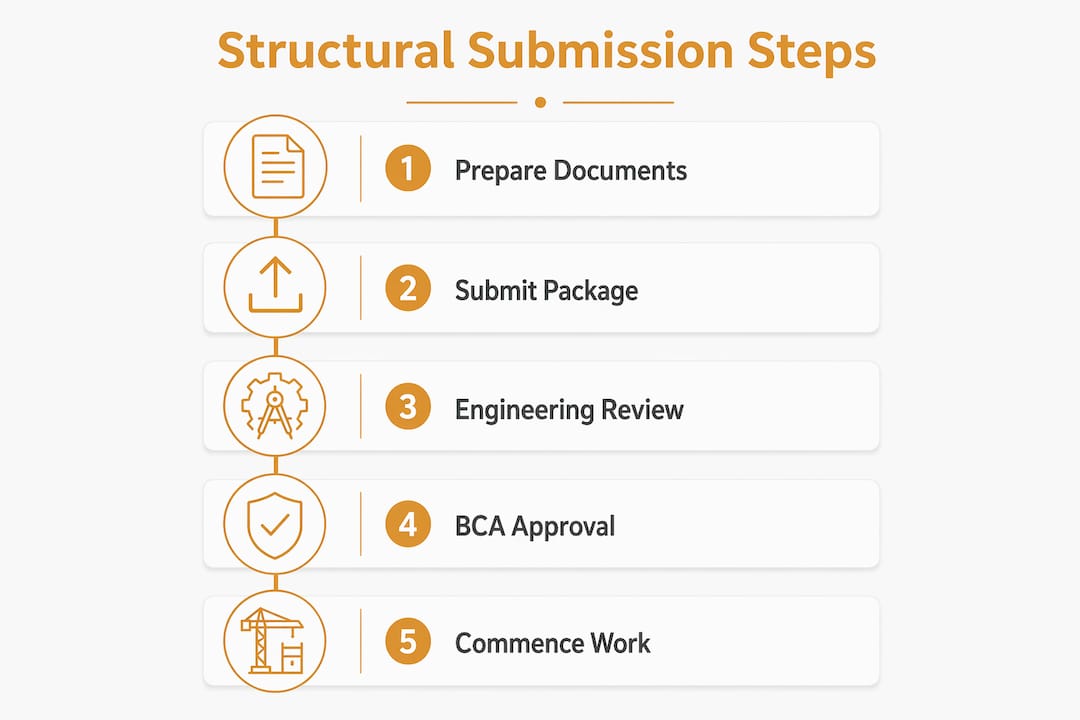
The structural design approval process in Singapore follows a defined sequence that involves multiple parties and regulatory bodies. Submissions ensure compliance with local codes and standards before construction begins. The process requires careful preparation, professional review, and formal authority approval at each stage.
The standard structural submission workflow proceeds as follows:
- Preparation of structural drawings and calculations. A licensed structural engineer prepares detailed drawings, connection designs, and engineering calculations that demonstrate the proposed structure meets Singapore’s building codes and load requirements.
- Internal review by the design team. The structural engineer and architect cross-check drawings against architectural plans to identify conflicts before submission. Shop drawings must match structural design documents to pass approval. Misalignment at this stage causes rejections and fabrication delays.
- Submission to BCA for structural plan approval. The qualified person (QP), typically a professional engineer, submits the package to BCA. BCA reviews structural integrity, compliance with the Building Control Regulations, and adherence to approved codes of practice.
- SCDF review for fire safety compliance. For commercial and industrial projects, SCDF submission requirements run in parallel with BCA review. Fire safety provisions must be integrated into the structural design from the outset.
- Approval and permit issuance. Once all authorities are satisfied, written approval is granted. Only after this approval can physical construction work legally commence.
The submission package itself must include detailed shop drawings, material specifications, geotechnical data where relevant, and method statements for complex works. Incomplete submissions are returned without approval, adding weeks to the project timeline.
Why is structural approval necessary for safety and compliance?
Structural approval is necessary because it verifies that a proposed building or renovation meets Singapore’s mandatory safety standards before any irreversible construction work takes place. Proper permits ensure all design aspects meet engineering standards and legal requirements, preventing delays and safety risks downstream.
The consequences of skipping or bypassing this step are severe:
- Structural failure risk. Without independent review, design errors can go undetected until a building element fails under load. This puts occupants, workers, and the public at direct physical risk.
- Legal penalties and stop-work orders. BCA has the authority to issue stop-work orders and impose fines on projects that commence without approved structural plans. Demolition of unauthorized works may also be required at the owner’s expense.
- Operational problems post-completion. Without proper structural submissions, buildings may fail to obtain a Temporary Occupation Permit (TOP) or Certificate of Statutory Completion (CSC), making them legally uninhabitable or unsellable.
- Insurance and liability exposure. Structural failures in buildings without approved plans expose owners to unlimited civil liability. Insurance policies routinely exclude coverage for unauthorized construction.
Pro Tip: Request written confirmation from your structural engineer that all BCA and SCDF approvals are in place before allowing any contractor to mobilize on site. A verbal assurance is not sufficient protection.
The structural design check stages built into the approval process exist precisely to catch errors that are invisible to non-engineers. A beam undersized by 15% may look identical to a correctly sized one but will behave very differently under full occupancy loads.
What are the benefits of structural submission for project quality?
The benefits of structural submission extend well beyond regulatory compliance. The submission process functions as a quality assurance system that protects owners and developers from fabrication errors, cost overruns, and contractual disputes throughout the project lifecycle.
The table below compares project outcomes with and without a properly managed structural submission process:
| Project Factor | With Structural Submission | Without Structural Submission |
|---|---|---|
| Error detection | Conflicts caught pre-fabrication, saving weeks and significant cost | Errors found post-installation, requiring costly demolition and rework |
| Regulatory standing | Full BCA and SCDF approval, clear path to TOP and CSC | Risk of stop-work orders, fines, and permit refusal |
| Audit trail | Documented record of approved designs for all parties | No formal record, disputes resolved without evidence |
| Material quality | Specified materials verified before procurement | Substitutions may go undetected, compromising structural integrity |
| Stakeholder alignment | All parties working from approved, coordinated drawings | Misalignment between design intent and site execution |
Submittals prevent errors and maintain alignment from the design office to the job site, reducing risk and maintaining quality. This is not a theoretical benefit. Catching an error in a shop drawing before steel is fabricated saves weeks of delay and avoids costs that can reach tens of thousands of dollars. Finding the same error after installation requires demolition, refabrication, and reinstallation.

The submission process also creates a documented audit trail. Every approved drawing, calculation, and material specification becomes part of the project record. This record protects owners if a contractor later claims a design change was authorized, or if a dispute arises over material substitutions. Submittals are not merely paperwork but the backbone of quality assurance, ensuring all parties share a documented design record.
For modular or prefabricated construction, the stakes are even higher. In offsite and modular construction, submittals are critical because onsite fixes are impossible once modules are fabricated. A structural submission error discovered after factory production means the entire module must be scrapped or expensively modified.
How does a submittal schedule protect owners contractually?
A submittal schedule is a formal document that identifies every required structural submission, assigns responsible parties, and sets binding dates for preparation, review, and approval. Most owners and developers underestimate its contractual importance. A poorly managed submittal schedule causes costly project delays and removes owners’ leverage to claim damages when reviews run over time.
The schedule works as a contractual protection mechanism in the following ways:
- Locks in review timelines. When a submittal schedule is agreed upon at contract award, it establishes the maximum time the design team has to review and return submissions. Without a schedule, owners have no contractual leverage if design team reviews exceed reasonable timeframes.
- Identifies long-lead items early. Structural steel shop drawings, precast concrete designs, and foundation systems require extended lead times. Critical path structural submittals must be identified and prioritized early to avoid construction start delays.
- Tracks deferred submittals. Some specialty systems are approved for deferred submission. Deferred submittals require written acknowledgment and scheduling equal to standard submittals. Without tracking, deferred items become forgotten items.
- Provides evidence in disputes. If a contractor claims a delay was caused by slow approvals, the submittal schedule provides a dated record of when submissions were made and when reviews were completed. This evidence is decisive in adjudication or arbitration.
Pro Tip: Require your contractor to submit the structural submittal schedule within 7–14 days of contract award. This window is the standard industry practice and gives you maximum lead time to identify critical path items before they affect your construction program.
The top causes of submission delays in Singapore projects are almost always traceable to missing or poorly managed submittal schedules. Owners who treat the schedule as an administrative formality consistently face the same outcome: delayed approvals, extended construction programs, and inflated final accounts.
Key takeaways
Structural submission is a mandatory, legally enforced prerequisite in Singapore that protects project safety, regulatory standing, and contractual rights before a single construction activity begins.
| Point | Details |
|---|---|
| Mandatory before work starts | BCA and SCDF require approved structural plans before any construction or renovation can legally commence. |
| Prevents costly errors | Catching design conflicts in shop drawings pre-fabrication avoids demolition, rework, and significant cost overruns. |
| Creates a legal audit trail | Approved submissions document every design decision, protecting owners in disputes over materials or scope changes. |
| Submittal schedule is contractual protection | An agreed schedule locks in review timelines and gives owners leverage if approvals are delayed by the design team. |
| Non-compliance has serious consequences | Unauthorized construction risks stop-work orders, fines, failed TOP or CSC applications, and civil liability. |
Why rushing structural submission always costs more in the end
From direct experience working with property owners and developers across Singapore, the most damaging misconception I encounter is that structural submission is a bureaucratic hurdle to clear as quickly as possible. Owners push engineers to submit incomplete packages to save a few days. Contractors start preliminary works before approvals are granted, betting that the paperwork will catch up. It rarely does.
The projects that run smoothly are the ones where the structural submission process is treated as a design quality event, not an administrative task. When engineers, contractors, and owners coordinate closely during the preparation stage, conflicts between structural and architectural drawings are resolved before they reach BCA. That coordination saves weeks, not days.
The civil and structural design checks that form part of the submission process are where the real value sits. They force every party to confront the actual buildability of the design before money is committed to materials and labor. Owners who invest time in this stage consistently deliver projects closer to budget and on schedule. Those who skip it pay for it twice: once in rework costs, and again in the time lost to stop-work orders and resubmissions.
— Aman
How stellar structures manages structural submissions for singapore developers
Stellar Structures handles the full structural submission process for property owners and developers across Singapore, from preparation of engineering calculations and detailed drawings to authority approvals with BCA, SCDF, URA, and HDB. The firm’s engineers coordinate directly with contractors and architects to resolve design conflicts before submission, reducing rejection rates and approval timelines. For developers managing multiple concurrent projects, Stellar Structures provides integrated design engineering services that align structural submissions with project schedules from contract award through to TOP. Explore the firm’s authority submission services to understand how professional submission management protects your project from day one.
FAQ
What does structural submission mean in singapore?
Structural submission is the formal process of submitting engineering drawings, calculations, and technical documents to BCA and other relevant authorities for approval before construction begins. It is a legal requirement under the Building Control Act for all structural works in Singapore.
What happens if you start work without structural approval?
Starting construction without BCA approval exposes the owner to stop-work orders, financial penalties, and mandatory demolition of unauthorized works. The building may also fail to obtain a TOP or CSC, making it legally uninhabitable.
Who is responsible for preparing structural submissions?
A licensed professional engineer, acting as the qualified person for structural works, is responsible for preparing and submitting structural plans and calculations to BCA. The owner is responsible for appointing a qualified person before work begins.
How long does structural plan approval take in singapore?
BCA’s review timeline varies by project complexity, but straightforward residential submissions typically take 3–6 weeks. Complex commercial or industrial projects may require longer review periods, particularly where SCDF and other agencies are involved.
Why is a submittal schedule important for developers?
A submittal schedule locks in binding review timelines for all structural submissions and identifies long-lead items like steel shop drawings early in the program. Without one, developers lose contractual leverage if design team reviews cause construction delays.
Recommended
- Authority Submissions for Trellis construction such as URA, BCA and SCDF – Stellar Structures
- Authority Submission Services Explained – Stellar Structures
- Submitting for Structural Retention: How to Legalize an Old Alteration
- What Are The Requirements For Building Plan Submission In Singapore – Stellar Structures