





A structural drawing compliance check in Singapore is the formal process of verifying that building designs meet the Building and Construction Authority’s regulatory standards, digital submission requirements, and engineering codes before construction begins. Architects, engineers, and contractors who skip this process risk receiving Written Directions from BCA, which trigger weeks of permit delays. Singapore’s CORENET X platform has raised the bar significantly. Submissions now require BIM models formatted to the IFC+SG standard, and unverified BIM models average 5,000 errors before correction. Getting compliance right the first time is not optional. It is the difference between a project that moves forward and one that stalls at the approval gate.
What does a structural drawing compliance check require?
A compliant submission under CORENET X demands more than accurate drawings. It requires a fully parameterized BIM model, correct IFC+SG classification, and coordinated federated models across all disciplines.
Mandatory IFC+SG parameter requirements
CORENET X requires BIM submissions in IFC+SG format, which is Singapore’s customized version of the international Industry Foundation Classes standard. Every structural element must carry the correct property sets, classification codes, and material data. Missing or incorrectly mapped parameters are the most common cause of failed submissions.
The core requirements for a compliant structural BIM submission include:
- IFC+SG format compliance: All model elements must use Singapore’s customized IFC schema, not generic IFC4 exports.
- Complete property sets: Structural elements require material specifications, load classifications, and fire resistance ratings mapped to the correct IFC property sets.
- SG classification codes: Each element must carry the correct Singapore-specific classification code aligned with BCA’s coding framework.
- Federated model coordination: Architecture, structure, and MEP disciplines must be combined into a single coordinated federated model for regulatory review.
- Green Mark documentation: Building owners must also apply for Green Mark certification at the design stage, which requires coordinated drawing and document submissions.
Validation tools for Singapore submissions
| Tool | Type | Key Function | Cost |
|---|---|---|---|
| Bimeco Validator | Web-based | IFC+SG parameter checks, bulk editing | Free |
| BCA CORENET X Portal | Government platform | Official submission and review | Free |
| Navisworks | Desktop software | Clash detection in federated models | Paid |
The Bimeco Validator is a free, web-based tool built specifically for Singapore’s CORENET X submissions. It checks for missing IFC+SG parameters, flags classification errors, and allows direct in-browser editing without any software installation. For teams managing large models, its bulk correction feature is the most practical way to address thousands of parameter errors before submission.
Pro Tip: Run the Bimeco Validator on your structural model before coordinating the federated model. Fixing individual discipline models first reduces the complexity of cross-discipline error resolution later.
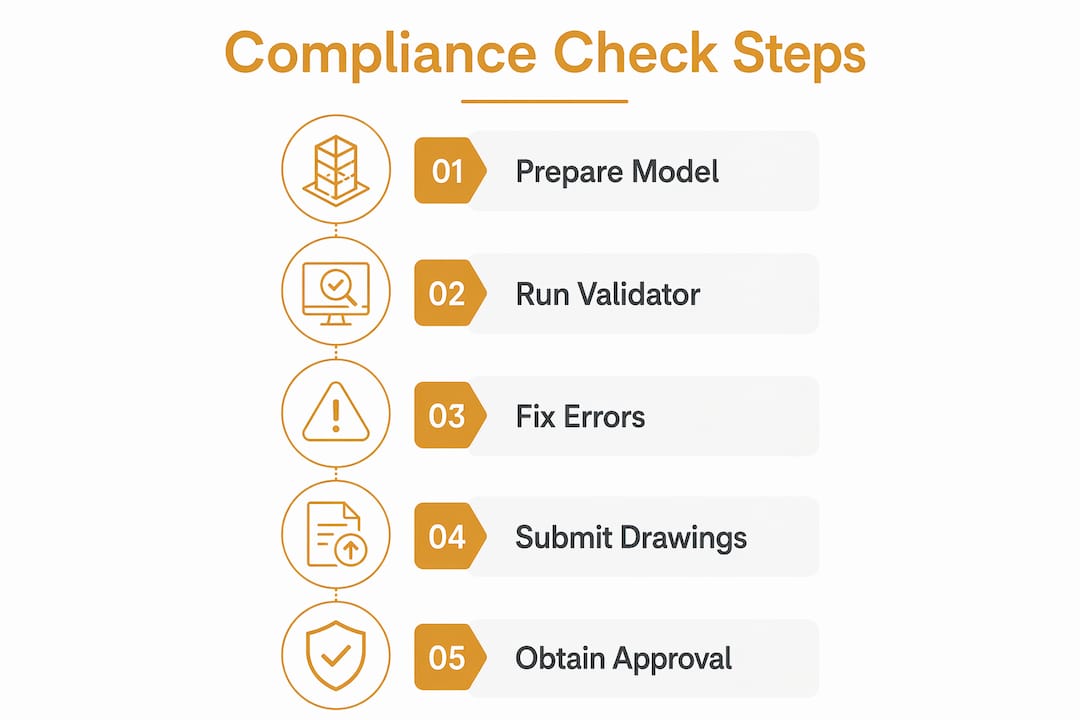
How to perform a structural drawing compliance check step by step
A structured review process reduces revision cycles and prevents the most common causes of Written Directions from BCA.
-
Create the structural BIM model. Build the structural model in Revit, ArchiCAD, or equivalent BIM authoring software. Model all structural elements, including columns, beams, slabs, walls, and foundations, at the correct level of detail for regulatory submission.
-
Add IFC+SG parameters. Map all required Singapore-specific parameters to each structural element. This includes material grades, fire resistance ratings, load classifications, and SG classification codes. Use your BIM authoring tool’s IFC export settings to confirm the correct schema is applied.
-
Export to IFC+SG format. Export the model using the IFC+SG export configuration. Verify the export settings match BCA’s current CORENET X submission specifications before proceeding.
-
Run automated validation. Upload the IFC+SG file to the Bimeco Validator for automated checking. The tool’s integrated 3D viewer lets you locate errors spatially within the model. Use the bulk edit function to correct repeated parameter errors across multiple elements simultaneously.
-
Interpret the validation report. The validator generates a report listing every missing or incorrect parameter by element type and location. Prioritize errors by category: classification errors affect the most elements and should be resolved first, followed by missing property sets.
-
Coordinate the federated model. Combine the corrected structural IFC+SG model with the architectural and MEP models. Run clash detection using Navisworks or equivalent software to identify geometric conflicts before submission.
-
Conduct manual engineering review. Have a registered Professional Engineer review the coordinated model for structural design intent, load path continuity, and compliance with Singapore’s Building Control Act. Automated tools confirm data formatting. They do not confirm structural soundness.
-
Submit through CORENET X. Upload the federated model and all required documentation through the BCA CORENET X portal. Retain all validation reports and correction logs as part of your project audit trail.
Pro Tip: Save your Bimeco Validator session before closing. The tool’s save-in-progress feature lets you return to a partially corrected model without restarting the validation from scratch.
The table below summarizes the most common error types and their resolution methods:
| Error Type | Cause | Resolution |
|---|---|---|
| Missing IFC+SG parameters | Incomplete property set mapping | Bulk edit in Bimeco Validator |
| Incorrect classification codes | Wrong SG code assigned | Reclassify elements using BCA’s coding guide |
| Federated model clashes | Misaligned discipline models | Clash detection and model coordination |
| Incomplete material data | Missing grade or specification | Update element properties in BIM authoring tool |

What are the most common compliance mistakes and how do you avoid them?
The majority of failed structural submissions share a small set of recurring errors. Knowing them in advance prevents the delays that follow a Written Direction from BCA.
-
Incomplete IFC+SG parameter mapping: Teams often export IFC files without verifying that all Singapore-specific property sets are populated. A generic IFC4 export does not satisfy CORENET X requirements. Always use the IFC+SG export configuration and validate before submission.
-
Assuming automation covers everything: Automated tools validate data formatting and parameter presence. They do not confirm that the structural design is safe or code-compliant. Teams that rely solely on automated validation without a Professional Engineer’s review expose themselves to regulatory liability under the Building Control Act.
-
Skipping federated model coordination: Submitting individual discipline models without coordination is a frequent source of Written Directions. Federated BIM models must be clash-free and geometrically aligned before submission. Unresolved clashes between structural and architectural elements signal incomplete design coordination to BCA reviewers.
-
Poor documentation and audit trails: BCA reviewers expect complete records of validation checks, correction logs, and engineer sign-offs. Projects that cannot produce these records during review face additional scrutiny and delays.
Failing to validate BIM models before submission causes Written Directions from BCA, leading to weeks of construction permit delays. A single round of pre-submission validation with the Bimeco Validator eliminates the most common causes of these directions.
Pro Tip: Maintain a compliance checklist that tracks each IFC+SG parameter category, the date it was verified, and the engineer responsible. This document becomes your primary defense if BCA requests clarification during review.
Understanding your legal obligations under the Building Control Act is a prerequisite for any compliance review. Section 28 of the Act defines the specific responsibilities of qualified persons and Professional Engineers during the submission process.
How do automated compliance tools fit into Singapore’s regulatory framework?
Automated validation tools occupy a defined and limited role within Singapore’s building approval process. Understanding that role prevents teams from misapplying them.
The CORENET X platform requires BIM submissions that satisfy two distinct layers of compliance. The first layer is data compliance: every element must carry the correct IFC+SG parameters, classification codes, and property sets. Automated tools like the Bimeco Validator address this layer directly and effectively.
The second layer is design compliance: the structural system must satisfy Singapore’s Building Control Act, the Singapore Standard CP65 for reinforced concrete, and other applicable engineering codes. This layer requires Professional Engineer responsibility and cannot be delegated to software. A model that passes automated validation may still contain structural design errors that only a qualified engineer can identify.
Key distinctions between automated and manual compliance checks:
- Automated tools check: Parameter presence, classification accuracy, data formatting, and IFC schema conformance.
- Manual engineering review checks: Structural load paths, design adequacy, code-specific calculations, and construction feasibility.
- Both are required: A submission that passes automated validation but lacks a Professional Engineer’s endorsement does not satisfy BCA’s requirements.
Automated IFC+SG checks should be supplemented with expert manual review to verify structural design intent and compliance with Singapore’s Building Control Act and engineering codes.
Singapore’s regulatory framework is also expanding to include AI-assisted plan checking. BCA has been piloting automated plan review technology that cross-references submitted drawings against code requirements. These tools accelerate the review cycle but do not replace the Professional Engineer’s stamp. Teams that adopt BIM early and maintain clean, well-parameterized models are best positioned to benefit from these emerging review technologies.
The building plan submission requirements in Singapore extend beyond structural drawings to include architectural, MEP, and geotechnical documentation. Structural compliance review is one component of a coordinated submission package.
Key Takeaways
A structural drawing compliance check in Singapore requires both automated IFC+SG validation and a Professional Engineer’s manual review to satisfy BCA’s CORENET X submission standards.
| Point | Details |
|---|---|
| IFC+SG format is mandatory | All CORENET X structural submissions must use Singapore’s customized IFC schema, not generic IFC4 exports. |
| Unverified models average 5,000 errors | Run the Bimeco Validator before submission to catch and bulk-correct parameter errors efficiently. |
| Automation has defined limits | Automated tools confirm data formatting only. Structural design soundness requires a registered Professional Engineer. |
| Federated models must be coordinated | Architecture, structure, and MEP models must be clash-free and geometrically aligned before submission. |
| Written Directions cause permit delays | Non-compliant submissions trigger BCA Written Directions, which delay construction permits by weeks. |
What I’ve learned from watching teams get compliance wrong
Working across structural and civil engineering projects in Singapore, the pattern I see most often is not ignorance of the rules. It is overconfidence in automation. Teams run the Bimeco Validator, see a clean report, and treat the submission as ready. They are solving the wrong problem first.
The Bimeco Validator is genuinely excellent at what it does. It catches parameter errors that would otherwise take days to find manually. But a clean validation report means your data is formatted correctly. It does not mean your structure works. I have reviewed models that passed every automated check and still had load paths that would not satisfy a first-year structural engineering course.
The teams that consistently get first-pass approvals from BCA share one habit: they run automated validation early and often, then bring in a Professional Engineer for a thorough design review before the federated model is assembled. They do not treat these as sequential steps. They run them in parallel, with the engineer reviewing design intent while the BIM coordinator resolves parameter errors.
My advice for federated model coordination is specific. Assign one person as the federated model owner. That person is responsible for clash detection, model alignment, and the final IFC+SG export. When coordination is distributed across disciplines without a single owner, errors fall through the gaps and surface only after submission.
The regulatory direction in Singapore is toward more automation, not less. BCA’s AI plan-checking pilots signal that data quality will become even more critical. Teams that build clean, well-structured BIM models now will have a significant advantage when those tools become standard.
— Aman
How Stellar Structures supports your compliance process

Stellar Structures provides civil and structural design checks for architects, engineers, and contractors navigating Singapore’s CORENET X submission requirements. The firm’s team of registered Professional Engineers reviews structural BIM models for design soundness, IFC+SG parameter compliance, and Building Control Act conformance. Stellar Structures also manages the full authority submission process, coordinating with BCA, URA, HDB, JTC, and other regulatory bodies on your behalf. For teams that need end-to-end support from design check through permit approval, Stellar Structures delivers a coordinated, technically rigorous service across residential, commercial, and industrial project types.
FAQ
What is a structural drawing compliance check in Singapore?
A structural drawing compliance check is the process of verifying that structural BIM models and drawings meet BCA’s CORENET X submission standards, IFC+SG parameter requirements, and Singapore’s Building Control Act before permit application.
What happens if my BIM model fails the compliance check?
BCA issues a Written Direction, which formally requires corrections before the submission can proceed. This delays construction permits by weeks and requires a full resubmission of the corrected model.
Is the Bimeco Validator sufficient for full compliance?
The Bimeco Validator confirms IFC+SG parameter presence and data formatting. It does not verify structural design adequacy or Building Control Act compliance, which requires a registered Professional Engineer’s review and endorsement.
What is IFC+SG and why does it matter?
IFC+SG is Singapore’s customized version of the international Industry Foundation Classes standard. CORENET X requires all BIM submissions in this format, and models exported in generic IFC4 format will fail the submission validation.
Does Green Mark certification affect structural drawing submissions?
Green Mark certification must be applied for at the design stage and is coordinated with building compliance submissions. Structural drawings that support sustainability standards must align with the Green Mark documentation requirements set by BCA.
Recommended
- Structural & Façade Inspections in Singapore
- Section 28 Building Control Act: Your Legal Obligations Summary
- Temporary Works Design in Singapore: Mastering Safety
- Periodic Structural Inspection of Singaporean Places of Worship: Regulatory Compliance, Pathology, and Heritage.