





A building plan submission is the formal process of submitting architectural and structural drawings to a local authority for official approval before construction or major renovation begins. In Singapore, this process is mandatory under the Building Control Act, and no construction work can legally start without it. The Building and Construction Authority (BCA) oversees this process, along with agencies such as URA, HDB, JTC, SCDF, and PUB depending on the project type. Understanding what is a building plan submission, and what it requires, protects you from costly delays, legal penalties, and unsafe structures.
What is a building plan submission and why does it matter?
A building plan submission is defined as the formal review of architectural and structural drawings against building codes, safety regulations, zoning laws, and environmental guidelines before construction begins. That definition carries real legal weight in Singapore. Starting work without approved plans exposes property owners and developers to stop-work orders, fines, and mandatory demolition of unauthorized structures.
The submission process exists to protect both the public and the building owner. Authorities verify that a proposed structure is structurally sound, fire safe, and compliant with land use controls before a single foundation pile is driven. This review catches design errors early, when corrections cost far less than fixing problems on site.

The importance of building plan submission also extends to financing and insurance. Banks and insurers in Singapore require proof of approved plans before releasing construction loans or issuing policies. A project without approved drawings carries financial risk that most lenders will not accept.
Structural submission is a distinct component within the broader plan approval process. It focuses specifically on load calculations, foundation design, and structural member sizing, and it must be certified by a registered Professional Engineer (PE) before BCA will grant approval.
What documents are required for a building plan submission?
The requirements for construction plans in Singapore fall into three broad categories: technical drawings, professional certifications, and administrative documents.
Technical drawings form the core of any submission package:
- Architectural drawings showing floor plans, elevations, sections, and site layout
- Structural drawings covering foundation details, beam and column schedules, and reinforcement plans
- Mechanical and Electrical (M&E) drawings where required by the project scope
- A site plan showing the property boundary, setbacks, and access points
Professional certifications are non-negotiable. Registered architects and licensed engineers are the only professionals authorized to prepare and submit building plans in Singapore. Their professional stamps and signatures confirm that the drawings meet technical standards and that a qualified individual accepts accountability for the design.
Administrative documents include owner consent forms, proof of title or lease, compliance checklists, and payment receipts for submission fees. Procedural compliance documents such as proof of architect registration and owner consent, though non-technical, can stop approval progress if missing and usually trigger a full application rejection or resubmission requirement.
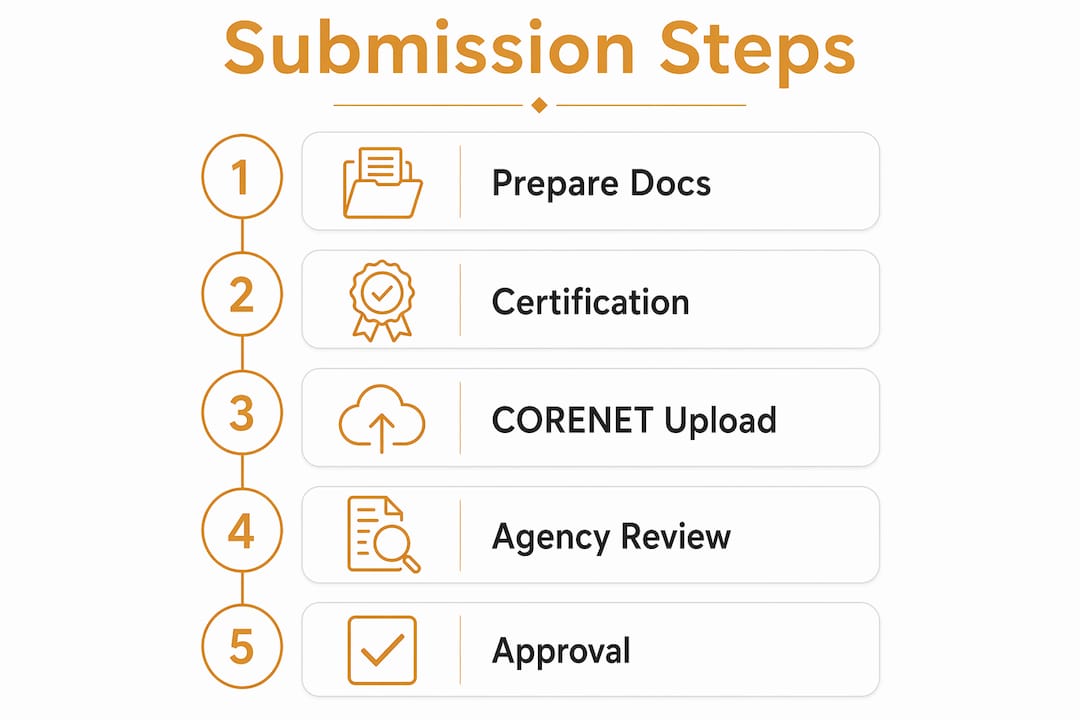
Singapore accepts submissions through the CORENET eSubmission system, which integrates drawings, checklists, and fee payment into a single digital workflow. Physical submissions are still accepted in limited cases, but digital submission is the standard for most project types in 2026.
Pro Tip: Before uploading to CORENET, run every drawing file against the BCA format checklist. File naming errors and incorrect PDF layer settings are among the most common reasons for administrative rejection at the first completeness check.
How to submit a building plan in Singapore: step-by-step process
The steps for building plan submission in Singapore follow a defined sequence. Skipping or rushing any step adds weeks to the review timeline.
-
Appoint qualified professionals. Engage a registered architect and a PE before any drawings are produced. Their registration numbers must appear on every submitted document.
-
Prepare the full application package. Compile architectural drawings, structural drawings, M&E drawings, site plans, compliance checklists, and all administrative documents. Cross-check every item against the authority’s submission checklist.
-
Submit via CORENET or the relevant portal. Upload all documents in the required format. For projects involving multiple agencies such as SCDF for fire safety or PUB for drainage, coordinate submissions across each portal simultaneously where possible.
-
Pay submission fees. Fee payment is processed online through the submission portal. Retain the payment receipt as part of your administrative record.
-
Administrative completeness check. Authorities first verify that all required documents are present and correctly formatted. This check happens before any technical review begins. A missing document at this stage pauses the entire process.
-
Technical review. The plan review involves both an administrative completeness check and a thorough technical review, often conducted by multiple departments simultaneously, requiring coordination across disciplines for approvals. BCA structural engineers, URA planners, and SCDF fire safety officers may each review different aspects of the same submission.
-
Respond to queries. Authorities issue Requests for Information (RFIs) when drawings are unclear or non-compliant. Respond within the stipulated timeframe. Delayed responses are a leading cause of extended approval timelines.
-
Receive approval. Once all departments are satisfied, BCA issues a formal approval notice. Construction may begin only after this notice is received and any conditions attached to it are addressed.
Pro Tip: Submit to all relevant agencies at the same time rather than sequentially. Parallel submissions can cut total approval time significantly compared to waiting for one agency before approaching the next.
Common reasons for building plan submission delays and how to avoid them
Incomplete or inaccurate documentation is the single most common cause of building plan delays. Timely and clear communication with authorities reduces processing time, but prevention is more effective than correction.
The most frequent delay triggers include:
- Missing professional seals or signatures. Every drawing sheet must carry the stamp and signature of the responsible registered professional. A single unsigned sheet can cause the entire submission to fail the completeness check.
- Inconsistent information across documents. Floor areas stated in the architectural drawings must match figures in the structural calculations and the BCA submission form. Mismatches trigger immediate queries.
- Non-compliance with zoning or building bylaws. Proposed designs that exceed plot ratio limits, breach setback requirements, or violate fire safety separation distances will fail technical review regardless of how well the drawings are prepared.
- Failure to respond to authority queries promptly. Authorities set response deadlines. Missing a deadline can reset the review clock or require a full resubmission.
- Conflating planning permission with building plan approval. Planning permission and building plan approval are separate regulatory processes. Planning permission governs land use and aesthetics; building plan approval ensures structural and safety compliance. Holding one does not guarantee the other.
Submitting a complete application is the single most effective way to accelerate approval. Authorities suspend the review process for any missing administrative or technical document, and restarting that review adds weeks or months to the project timeline.
For a detailed breakdown of what causes review bottlenecks, the top causes of submission delays resource covers procedural issues and documentation gaps that affect projects of all scales.
Pro Tip: Conduct an internal peer review of the full submission package before uploading. Have a second registered professional check every drawing for consistency, completeness, and code compliance. This single step catches the majority of errors that would otherwise surface during the authority’s completeness check.
What happens after a building plan is approved?
Plan approval is not the end of the regulatory process. It is the authorization to begin construction under defined conditions. Several obligations follow approval and must be met before a building can be legally occupied.
- Commencement certificate. After plan approval, authorities may issue a formal commencement certificate allowing construction to start. In Singapore, BCA issues a permit to carry out structural works, which must be displayed on site.
- Inspections during construction. The PE of record is required to conduct periodic site inspections and submit inspection reports to BCA at defined construction stages. These inspections confirm that work on site matches the approved drawings.
- Handling amendments. If design changes are needed during construction, a formal amendment submission must be made and approved before the changed work proceeds. Proceeding with unapproved changes is a regulatory offense.
- Occupancy Certificate (OC). The Occupancy Certificate confirms that the completed building matches the approved plans and is safe for occupation. In Singapore, this is issued as the Temporary Occupation Permit (TOP) or Certificate of Statutory Completion (CSC) depending on the project stage.
- Legal implications of non-compliance. Deviating from approved plans without authorization can result in stop-work orders, mandatory rectification works, financial penalties, and in serious cases, prosecution under the Building Control Act.
Understanding the full cycle from submission to CSC helps property owners and developers plan project timelines accurately and avoid surprises at the final inspection stage.
Key Takeaways
A successful building plan submission in Singapore requires complete documentation, qualified professional endorsement, and timely responses to authority queries at every stage of the approval process.
| Point | Details |
|---|---|
| Submission is legally mandatory | Construction cannot begin in Singapore without BCA approval of building plans. |
| Professional endorsement is required | Only registered architects and licensed PEs can prepare and submit building plans. |
| CORENET is the standard platform | Singapore uses the CORENET eSubmission system for digital plan submission and fee payment. |
| Completeness prevents delays | Missing documents or inconsistent drawings suspend the review and add weeks to approval timelines. |
| Approval leads to further obligations | Post-approval inspections, amendment submissions, and a final OC or CSC are all required before legal occupation. |
Why the submission process rewards preparation, not speed
From my experience working across residential, commercial, and industrial projects in Singapore, the most consistent pattern I see is this: applicants who treat the submission package as a formality pay for it later. They rush the drawings, skip the internal review, and assume that minor inconsistencies will be overlooked. They are not.
The BCA completeness check is systematic. A missing owner consent form or an unsigned structural drawing sheet will stop the review just as effectively as a major design error. I have seen projects delayed by three months because a single document was uploaded in the wrong file format.
What actually works is treating the submission package like a legal contract. Every figure must match across every document. Every professional stamp must be present on every sheet. Every agency requirement must be addressed before the first file is uploaded. That level of preparation feels slow at the start, but it is consistently faster than the alternative.
The trend in 2026 is toward stricter digital format compliance within CORENET. BCA has tightened file naming conventions and drawing layer standards. Firms that have not updated their internal templates to match the current requirements are finding their submissions rejected at the administrative stage before a single technical reviewer sees the drawings.
My recommendation is to engage professionals who submit regularly and know the current portal requirements. The authority submission process is not static. It changes, and staying current with those changes is a professional discipline, not a one-time exercise.
— Aman
How Stellar Structures supports your building plan submission
Stellar Structures is a Singapore-based design and engineering firm that handles the full range of civil and structural design checks required for building plan approval. The firm manages authority submissions to BCA, URA, HDB, JTC, SCDF, PUB, LTA, NEA, and NParks, covering residential, commercial, industrial, and infrastructure projects.
Their team of registered architects and licensed PEs prepares submission packages that meet current CORENET format requirements and agency-specific checklists. For property owners and developers who need to avoid delays and get approvals right the first time, Stellar Structures provides consultation from design stage through to final certification. Contact the team to discuss your project requirements and submission timeline.
FAQ
What is a building plan submission in Singapore?
A building plan submission is the formal process of submitting architectural and structural drawings to BCA and relevant authorities for approval before construction or renovation begins. It is a legal requirement under the Building Control Act.
Who can submit building plans in Singapore?
Only registered architects and licensed Professional Engineers are authorized to prepare and submit building plans in Singapore. Their professional stamps and signatures must appear on all submitted documents.
How long does building plan approval take in Singapore?
Approval timelines vary by project complexity and submission completeness. Complete applications with no queries from authorities are processed faster; incomplete submissions can add weeks or months due to resubmissions.
What is the difference between planning permission and building plan approval?
Planning permission governs land use and the aesthetic impact of a development, while building plan approval confirms structural and safety compliance. Holding planning permission does not guarantee building plan approval, as each addresses different regulatory concerns.
What happens if I build without approved plans in Singapore?
Building without approved plans is an offense under the Building Control Act. Authorities can issue stop-work orders, require demolition of unauthorized structures, and impose financial penalties on the property owner and the professionals involved.
Recommended
- What Are The Requirements For Building Plan Submission In Singapore – Stellar Structures
- Planning Permission in Singapore: 2026 Developer’s Guide
- Mezzanine Floor Approval Guide Singapore 2026
- Structural & Façade Inspections in Singapore