





A structural assessment report is a formal technical document prepared by a licensed structural engineer that evaluates a building’s load-bearing systems, including foundations, walls, columns, and roof structures. This definition matters because it immediately separates the report from a general building inspection, which covers finishes, fittings, and non-structural systems. Property owners and real estate professionals who understand what a structural assessment report contains are better positioned to make sound decisions about safety, compliance, and property value. The report does not certify a building as safe. It records observed conditions and provides engineering judgment to guide next steps.
What is a structural assessment report and what does it include?
A structural assessment report is defined as a formal technical document focused exclusively on load-bearing elements. These elements include foundations, ground slabs, structural walls, columns, beams, and roof framing. General building inspections cover cosmetic and non-structural items; structural reports do not.

The term “structural survey” has no formal definition in engineering practice. “Structural assessment” is the preferred term because it signals technical rigor and a defined scope of work. Using the correct terminology matters when submitting reports to regulatory bodies such as BCA, URA, or HDB in Singapore.
A structural inspection report typically contains the following elements:
- Property details and inspection date
- Purpose and defined scope of the assessment
- Visual observations with photographs and sketches
- Structural analysis findings and calculations
- Classification of any movement identified
- Recommendations for repair, monitoring, or further investigation
- The engineer’s qualifications and professional registration
The level of detail in a report depends directly on the scope and purpose agreed upon before the assessment begins.
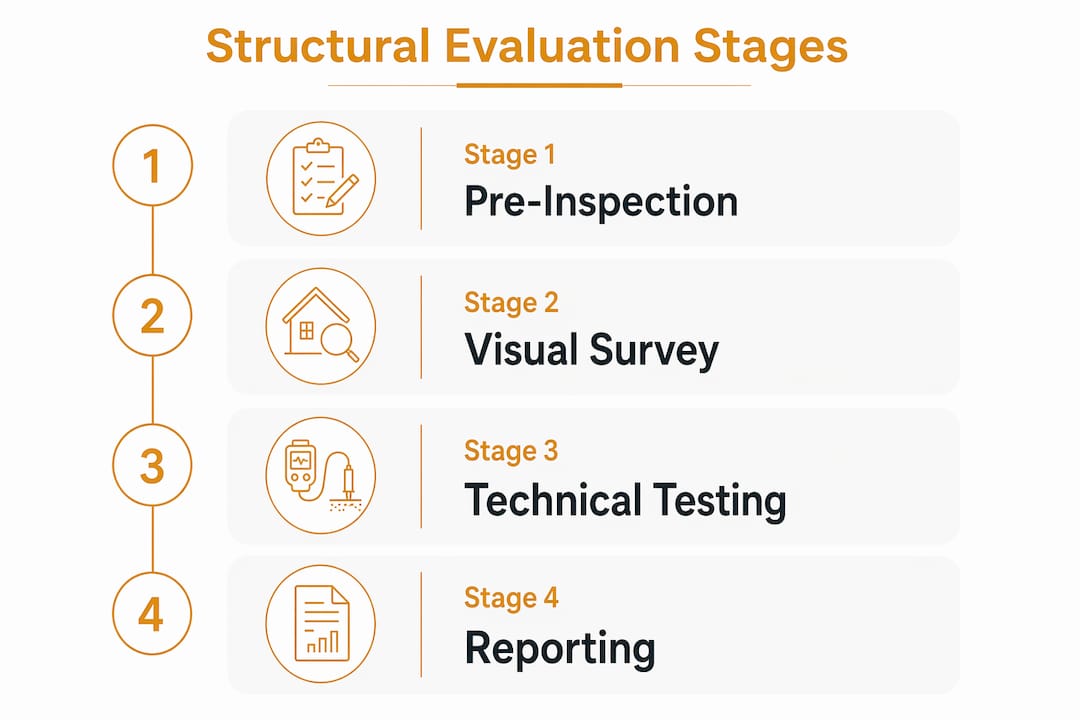
The four stages of the structural evaluation process
The structural evaluation process follows a defined sequence. Each stage builds on the previous one, and skipping stages produces unreliable findings.
- Site visit and visual inspection. The engineer examines accessible structural elements, documents cracks, deformation, corrosion, or settlement, and records observations with photographs.
- Intrusive investigation (if required). This may involve opening up wall or floor finishes, extracting material samples, or conducting ground investigation to examine hidden structural elements.
- Structural analysis. The engineer performs mathematical calculations of internal forces to confirm whether the structure meets safety tolerances under specified loads. Without this step, no report can definitively confirm structural adequacy.
- Report with recommendations. The engineer compiles findings, classifies any movement, and provides clear recommendations.
Movement is classified into three categories: historic and stable, active and manageable, and active and serious. This classification directly determines whether monitoring, repair, or immediate intervention is required.
Pro Tip: Before commissioning a report, define the scope in writing with your engineer. Inadequate scoping produces reports that are too general for regulatory or insurance purposes, which means you pay for a document that cannot be used.

Why are structural assessments necessary for property owners?
Structural assessments protect property owners from financial and legal exposure. A building with undetected structural defects can lose significant value, become uninsurable, or require emergency remediation at far greater cost than early intervention. The importance of structural assessments is clearest at three decision points: purchase, renovation, and dispute.
The practical reasons to commission a structural safety assessment include:
- Pre-purchase due diligence. A surveyor or home inspector may flag concerns without the technical authority to quantify them. A structural engineer’s report provides the engineering judgment needed to negotiate price, request repairs, or walk away.
- Visible defects. Cracks in structural walls, sagging floors, differential settlement, or bowing columns all warrant a formal assessment before any remediation work begins.
- Regulatory compliance. Authority submissions to bodies such as BCA or URA for renovation or addition and alteration works often require a structural engineer’s report as part of the application package.
- Insurance claims. Insurers require documented engineering evidence after storm damage, vehicle impact, or fire before processing structural repair claims.
- Dispute resolution. Courts and arbitration panels treat a licensed engineer’s report as objective technical evidence. A well-scoped report carries weight that a general inspection does not.
Structural reports also serve as records of a building’s condition at a specific point in time. This baseline becomes valuable when monitoring progressive movement or defending against third-party claims about pre-existing damage.
How to read a structural report effectively
A structural report is not a pass or fail document. Reports record observed conditions and provide engineering judgment; they do not certify a building as structurally sound or condemn it. Property owners who expect a simple verdict are often confused by the nuanced language engineers use.
Understanding the executive summary
The executive summary states the purpose of the assessment, the scope of inspection, and the engineer’s principal findings. Read this section first. If the summary references limitations, such as areas that were inaccessible or elements that were not inspected, those limitations define the boundaries of the engineer’s conclusions.
Interpreting observations and movement classifications
The body of the report documents specific observations, supported by photographs and diagrams. Each observation is linked to a finding and a recommendation. The table below shows how movement classifications translate into practical actions.
| Movement classification | What it means | Typical action required |
|---|---|---|
| Historic and stable | Movement occurred in the past and has stopped | Monitor periodically; no urgent repair |
| Active and manageable | Movement is ongoing but within acceptable limits | Monitor at defined intervals; plan repair |
| Active and serious | Movement is ongoing and poses structural risk | Immediate engineering intervention required |
Active movement does not always signal immediate danger, but it requires a defined monitoring program before any transaction or major repair proceeds. This nuance is frequently misunderstood by buyers and sellers alike.
Distinguishing facts from engineering judgment
Observations are factual: a crack measures 3 mm wide and runs diagonally across a structural wall. The cause and significance of that crack are engineering judgments. Both appear in the report, but they carry different levels of certainty. When recommendations use language such as “further investigation is advised,” the engineer is signaling that the current scope is insufficient to reach a definitive conclusion.
Pro Tip: If any section of the report is unclear, contact the engineer directly before acting on the findings. Engineers are required to explain their conclusions to clients. A brief consultation call can prevent costly misinterpretation.
When do you need a structural assessment report?
Specific triggers make a structural assessment report necessary rather than optional. Recognizing these scenarios early prevents delays in transactions, regulatory submissions, and insurance claims.
- Pre-purchase inspection following surveyor concerns. A general surveyor identifies cracking or settlement but cannot quantify the risk. A structural engineer’s assessment provides the technical basis for a purchase decision.
- Visible structural distress. Diagonal cracks at window and door corners, floor deflection, or wall separation from the roof structure all indicate potential load-bearing failure. These conditions require a site inspection before any repair work begins.
- Renovation requiring authority approval. Any addition and alteration work that affects load-bearing elements in Singapore requires a licensed structural engineer and a formal report as part of the BCA submission.
- Insurance claims after damage events. Storm, flood, vehicle impact, and fire all require documented structural evidence. An engineer’s report prepared immediately after the event establishes the baseline for the claim.
- Monitoring progressive movement. Where a previous report classified movement as active and manageable, a follow-up assessment at a defined interval confirms whether conditions have stabilized or deteriorated. This sequence of reports protects owners from liability and informs the timing of permanent repairs.
Each of these scenarios involves a different scope of work. A pre-purchase assessment may require only a visual inspection and basic analysis. A renovation submission may require full structural calculations and design checks. Defining the correct scope before commissioning the report determines whether the document will serve its intended purpose.
Key takeaways
A structural assessment report is the definitive technical record of a building’s load-bearing condition, and its value depends entirely on the scope, the engineer’s qualifications, and the correct interpretation of movement classifications.
| Point | Details |
|---|---|
| Report definition | A structural assessment report evaluates load-bearing elements only, not finishes or non-structural systems. |
| Four-stage process | Every credible report follows site visit, investigation, structural analysis, and written recommendations. |
| Movement classification | Historic, active manageable, and active serious classifications determine urgency and required action. |
| Not a pass or fail | Reports record conditions and provide engineering judgment; they do not certify or condemn a building. |
| Scope defines value | Clearly defined scope before commissioning determines whether the report meets regulatory or insurance requirements. |
Why I think most property owners misread structural reports
Most property owners approach a structural report expecting a verdict. They want the engineer to say the building is safe or unsafe. That expectation leads to two common mistakes: dismissing a report because it contains no urgent findings, or panicking over language that signals caution rather than danger.
The most valuable reports I have seen are the ones that classify movement clearly and set a monitoring timeline. A finding of “active and manageable” movement is not bad news. It is precise information. It tells you what to watch, when to check it again, and what conditions would trigger repair. That is far more useful than a clean report that inspects only accessible surfaces and misses a deteriorating foundation.
The second mistake is commissioning a report without defining the scope. A general visual inspection costs less than a full structural investigation with intrusive testing and finite element analysis. But if you need the report for a BCA submission or an insurance claim, a visual inspection will not meet the standard. You end up paying twice: once for the insufficient report and once for the correct one.
My recommendation is to engage an independent licensed engineer, define the purpose of the report in writing before the site visit, and read the limitations section before the findings. The limitations tell you exactly what the engineer did not inspect. If those uninspected areas are relevant to your decision, request an expanded scope. A full structural investigation costs more upfront but prevents far larger costs downstream.
Early assessments consistently prevent the most expensive outcomes. A crack investigated at 3 mm is a monitoring task. The same crack ignored for two years can become a foundation underpinning project. The report is not the cost. Delayed action is.
— Aman
Stellar Structures: structural assessment and inspection services in Singapore
Stellar Structures provides structural assessment, inspection, and design check services for property owners, developers, and real estate professionals across Singapore.

The firm’s licensed engineers conduct periodic structural inspections for commercial, industrial, and shophouse properties in compliance with BCA regulations. Stellar Structures also handles authority submissions to BCA, URA, HDB, JTC, SCDF, and other regulatory bodies, supporting clients from initial assessment through to approval. For property owners planning renovations or managing structural concerns, the team offers professional engineer inspections with clearly defined scopes and actionable reports. Contact Stellar Structures to discuss your assessment requirements and receive a scoped proposal.
FAQ
What is the difference between a structural report and a building inspection?
A structural assessment report is prepared by a licensed structural engineer and evaluates load-bearing elements such as foundations, columns, and beams. A general building inspection covers non-structural systems, finishes, and fittings, and does not require engineering qualifications.
Does a structural assessment report certify that a building is safe?
No. A structural report records observed conditions and provides engineering judgment. It does not certify or approve a building as structurally sound.
When is a structural assessment report required by law in Singapore?
Authority submissions for addition and alteration works affecting load-bearing elements require a licensed structural engineer’s report as part of BCA and URA approval applications.
How long does a structural assessment take?
The duration depends on the scope. A visual inspection of a residential property may take a few hours. A full structural investigation with intrusive testing and analysis can take several days to weeks before the report is finalized.
What does “active movement” mean in a structural report?
Active movement means structural displacement is ongoing at the time of inspection. It does not always require immediate repair, but it requires a defined monitoring program and follow-up assessment to determine whether conditions are stabilizing or worsening.
Recommended
- Section 28 Building Control Act: Your Legal Obligations Summary
- What Is a Structural Drawing? A Guide for Property Owners
- Site Inspection for Landed Property Settlement: The 2025 Ultimate Guide
- What Happens During a Structural Engineer Inspection? Expert Guide