





Constructability reviews materially reduce cost, schedule risk, and safety exposures by aligning design documents with field reality before a single bid is issued. For U.S. project owners, managers, engineers, and contractors, the constructability review process is one of the highest-leverage quality interventions available during the design phase.
Primary business outcomes:
- Fewer change orders and reduced contingency drawdown during construction
- Improved bid competitiveness through clearer, more complete contract documents
- Reduced RFIs and addenda, which directly compress schedule and administrative burden
- Earlier identification of sequencing conflicts, access constraints, and specification ambiguities
- Improved site safety by resolving constructability issues before mobilization
A conservative savings estimate from the Kentucky Transportation Cabinet analysis places the value of constructability reviews at a small but meaningful percentage of total project budget, attributable primarily to reduced change orders.
Recommended timing: The most impactful window for a major review is mid-design, before significant rework costs accumulate but after enough design detail exists for meaningful comment. Research from the North Carolina Department of Transportation recommends conducting reviews before 60% completion of the design phase, with follow-up checks as design finalizes.
Table of Contents
- What does constructability mean in a project context?
- How do constructability reviews deliver measurable project value?
- What problems do constructability reviews typically uncover?
- What does a constructability review actually look like?
- Who should participate in a constructability review?
- When should you run constructability reviews during design?
- What practices and tools make constructability reviews more effective?
- What does the research say about constructability review outcomes?
- How do constructability reviews differ from value engineering?
- Key Takeaways
- The case for treating constructability as a program, not a checkpoint
- Stellar Structures brings structured constructability expertise to your project
- Useful sources and further reading
What does constructability mean in a project context?
The term “constructability” — referred to as “buildability” in the United Kingdom — describes the degree to which a project’s design can be efficiently and safely executed in the field using standard construction methods, materials, and techniques. The concept emerged in the United States in the early 1980s as a formal discipline for integrating construction knowledge into the design process.

The AASHTO Subcommittee on Construction defines a constructability review as “a process that utilizes construction personnel with extensive construction knowledge early in the design stages of projects to ensure that the projects are buildable, while also being cost-effective, biddable, and maintainable.” The Construction Management Association of America (CMAA) frames it as an independent, structured examination by construction professionals to verify clarity, coordination, and reduced project impacts.
Three core goals define the discipline: confirming that the project can be built using standard methods; verifying that contract documents give contractors the clear, concise information needed to prepare competitive bids; and confirming that the completed work can be maintained cost-effectively over its service life.
Constructability review is frequently confused with value engineering, but the objectives differ. Value engineering asks whether a function can be delivered at lower cost through design alternatives. A constructability review asks whether the design, as documented, can actually be built as intended. The two practices complement each other but operate on different questions and are best sequenced separately.
How do constructability reviews deliver measurable project value?
The CMAA primer on constructability reviews documents that properly conducted, independent reviews reduce RFIs, addenda, and change orders. Each of those outcomes maps directly to a stakeholder KPI.
Core benefits by stakeholder priority:
- Reduced change orders: Design conflicts caught before bidding cost a fraction of what they cost to resolve during construction, where field conditions, subcontractor schedules, and contract claims compound the impact.
- Fewer RFIs: Ambiguous specifications and missing details generate RFIs that consume engineering and project management hours. Resolving ambiguities at the review stage eliminates that downstream burden.
- Improved bid competitiveness: When contract documents are complete and unambiguous, contractors can price work accurately. Owners receive tighter, more comparable bids and spend less time resolving addenda.
- Faster startup and schedule predictability: Sequencing conflicts and procurement lead-time issues identified during review allow teams to adjust the schedule before mobilization rather than after.
- Improved safety and maintainability: Access constraints, confined-space conditions, and fall-hazard exposures identified in review can be designed out or mitigated before workers arrive on site.
Research finding: The Kentucky Transportation Cabinet analysis estimated constructability review savings at a small but meaningful percentage of total project budget on a conservative basis, driven primarily by reduced change orders.
IPA research correlates higher-quality constructability review practices with better cost and schedule predictability. Specific practices, including owner construction manager involvement and site visits, are linked to higher-impact reviews. The AASHTO Best Practices Guide further notes that effective reviews enhance early planning, minimize scope changes, reduce design-related change orders, improve contractor productivity, and decrease construction and maintenance costs.
What problems do constructability reviews typically uncover?
Recurring constructability issues fall into predictable categories, and understanding them helps project teams recognize where standard design QA/QC processes tend to fall short.
Discipline coordination conflicts are among the most common findings. Structural members that penetrate mechanical ductwork, plumbing runs that conflict with beam depths, and electrical conduit routed through inaccessible ceiling cavities are all issues that appear routine on individual discipline drawings but create significant field problems when trades converge. These conflicts are often missed during standard QA/QC because each discipline reviews its own documents in isolation.
Inaccessible equipment is a sequencing and maintenance issue that constructability reviewers catch regularly. Mechanical equipment specified for a location that cannot be reached for installation, or that cannot be removed for future replacement without demolishing adjacent construction, generates change orders and long-term maintenance cost. The CMAA primer identifies errors, omissions, and ambiguous language as the primary categories of constructability deficiencies, and equipment access falls squarely within the omissions category.
Specification ambiguities create bid risk for contractors and claims risk for owners. When a specification section references a standard that has been superseded, or when performance requirements conflict with prescriptive requirements in the same section, contractors either price in contingency or submit RFIs that delay award and startup.
Omitted site constraints are particularly consequential on urban infill or phased projects. Crane radius limitations, haul-route restrictions, utility conflicts, and staging area constraints that are not reflected in the contract documents force contractors to develop workarounds that affect cost, schedule, and safety. Identifying these constraints during review allows the design team to incorporate them into the documents before bidding.
Each of these issues, left unresolved, generates a predictable downstream consequence: an RFI, a cost-risk flag, a sequencing note, or a formal change order. The common design coordination challenges that engineers encounter in practice closely mirror these categories, reinforcing the value of structured review before documents are released for bid.
What does a constructability review actually look like?
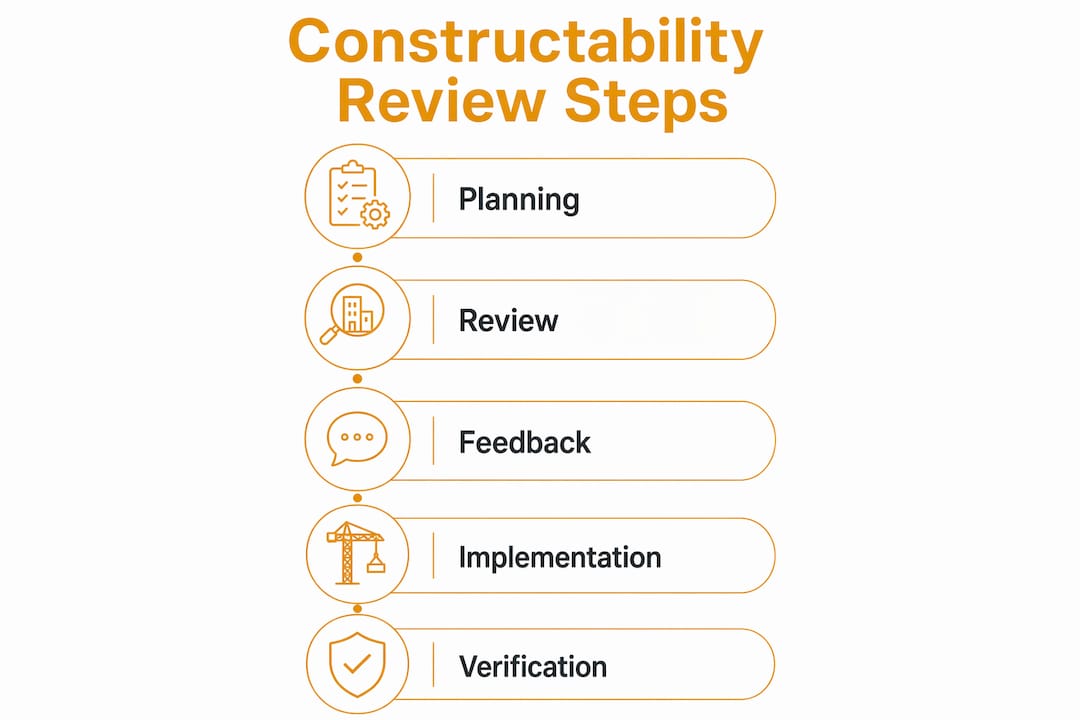
A well-structured constructability review follows a defined sequence from document preparation through back-check. The process below reflects AASHTO best practices and CMAA guidance adapted for project teams of varying size.
-
Prepare the review package. Assemble the complete set of documents to be reviewed: drawings, specifications, bid form, schedule, vendor data, and any special provisions. Confirm the design maturity level and communicate the review scope to all participants in advance.
-
Conduct discipline-by-discipline document review. Reviewers examine documents for errors, omissions, ambiguities, coordination conflicts, and constructability concerns. Each comment is logged with the discipline, document reference, issue description, and recommended resolution.
-
Conduct a site visit where feasible. IPA research identifies site visits as a characteristic of high-quality constructability reviews. A site visit allows reviewers to verify that site constraints, access conditions, and existing conditions are accurately reflected in the documents.
-
Consolidate and prioritize comments. The review facilitator compiles all comments into a structured log, removes duplicates, and assigns a preliminary impact rating (cost, schedule, safety, or quality) to each item.
-
Owner and construction manager finalization. The owner’s representative and construction manager review the consolidated log, confirm priorities, and determine which recommendations require design changes versus clarifications or addenda.
-
Issue the recommendations log. The formal deliverable is a structured log containing: issue description, discipline, document reference, impact category, recommended resolution, estimated cost or schedule impact, and owner decision or disposition.
-
Back-check. After the design team incorporates responses, a focused back-check confirms that accepted recommendations were implemented correctly and that no new conflicts were introduced.
Typical review scope checklist:
- Drawings: civil, structural, architectural, mechanical, electrical, plumbing, fire protection
- Specifications: all divisions, with particular attention to Division 01 (General Requirements) and technical sections with performance-prescriptive conflicts
- Bid form: unit price items, alternates, allowances, and ambiguous scope descriptions
- Schedule: construction sequence, long-lead procurement items, phasing constraints
- Special provisions and geotechnical report: site-specific conditions and constraints
Who should participate in a constructability review?
Team composition determines whether review comments are adopted or ignored. A review conducted entirely by the design team lacks the independent construction perspective that gives the process its value. A review conducted without design-team participation produces comments that may be technically uninformed or contractually impractical.

The recommended participant structure draws from AASHTO guidance and NCDOT research, which recommends a minimum of three general contractors alongside the project designer and project manager for a formal review meeting.
Owner’s representative provides project context, budget constraints, and decision authority. Without an owner representative present, recommendations lack a decision-maker and tend to stall.
Owner’s construction manager (CM) contributes the constructability lens. IPA research links owner CM involvement to higher-impact reviews. The CM translates design intent into field execution questions and can assess whether proposed sequences are realistic.
Design leads (architect and engineer of record) provide technical context for design decisions and can immediately identify which comments are feasible to incorporate. Their presence reduces the back-and-forth cycle between review and response.
Experienced field superintendent brings sequencing and logistics knowledge that no amount of office-based review replicates. A superintendent who has built similar work can identify access constraints, crane picks, and concrete pour sequences that create field problems.
Specialty contractors or fabricators add value on technically complex scopes: structural steel, mechanical systems, precast concrete, or curtain wall. Their input on fabrication tolerances and installation sequences prevents specification requirements that are technically unbuildable.
Procurement lead contributes lead-time data for long-lead equipment and materials. Procurement constraints that are not reflected in the construction schedule generate delays that no amount of field productivity can recover.
A neutral facilitator, independent of the design team, manages the review session, maintains the comments log, and prevents the dynamic where designers become defensive about their work. Keeping the team focused on document quality rather than design criticism is the facilitator’s primary function.
When should you run constructability reviews during design?
Timing is the variable that most directly determines whether review comments are cost-effective to implement. Comments made when design is 20% complete are inexpensive to incorporate; comments made at 90% complete may require significant rework and can conflict with permits already in process.
AASHTO guidance and NCDOT research both recommend conducting the primary review before 60–65% design completion. At that stage, enough detail exists for meaningful comment, but the design team retains flexibility to incorporate changes without prohibitive rework cost.
IPA research finds that reviews in both FEL Phase 2 (concept/schematic) and FEL Phase 3 (detailed design) produce better outcomes than a single review at either stage alone. Despite this, only about half of projects use constructability reviews in both phases.
| Design Phase | Review Type | Recommended Timing | Primary Focus | Expected Output |
|---|---|---|---|---|
| Concept / Schematic (FEL 2) | Preliminary constructability review | mid-design | Site constraints, major systems, sequencing feasibility | Issues list, scope clarifications |
| Design Development (FEL 3) | Major constructability review | 50–65% design completion | Coordination conflicts, specification completeness, bid-ability | Formal recommendations log |
| Construction Documents | Final check | 90–95% design completion | Remaining ambiguities, bid form, special provisions | Addenda items, final comment disposition |
| Post-Award | Back-check | After design response | Confirm accepted recommendations were incorporated | Back-check report |
For smaller projects, a single review at 50–65% design completion with a focused back-check at 90% is a practical minimum. Larger, more complex projects benefit from all three review points plus specialty-scope reviews for technically demanding systems.
What practices and tools make constructability reviews more effective?
Operational best practices:
- Early contractor involvement: Engaging experienced contractors during schematic design, even informally, surfaces constructability concerns before they are locked into the design. The integrated design and construction approach embeds this principle from project inception.
- Owner CM on final review: IPA research consistently links owner CM participation to higher-impact reviews. The CM’s presence on the final review ensures that recommendations are evaluated against construction reality, not just design preference.
- Mandatory site visits: Where the project site exists (renovation, phased construction, or infrastructure work), a site visit before or during the review is a high-value practice. A structural engineer site visit conducted as part of the review process can surface existing-condition conflicts that drawings alone do not capture.
- Documented lessons-learned database: Effective programs capture review findings in a lessons-learned database that informs future projects. Without this step, the same issues recur across projects.
- Formal back-check process: A back-check that confirms accepted recommendations were implemented closes the loop and prevents the common failure mode where comments are acknowledged but not incorporated.
Tools that improve review quality and throughput:
BIM clash detection, using platforms such as Autodesk Navisworks or Bentley ProjectWise, automates the identification of hard and soft conflicts between discipline models. This does not replace human review judgment, but it compresses the time required to identify coordination conflicts and allows reviewers to focus on sequencing, specification, and bid-ability issues.
Shared comment platforms, such as Bluebeam Revu or Procore, allow reviewers to mark up drawings digitally, assign comments to disciplines, and track resolution status in a single environment. This eliminates the version-control problems that plague paper-based review processes.
AI-assisted specification cross-checks can flag missing data, inconsistent references, and superseded standards at scale. The most effective application constrains AI agents to flagging potential issues for human review rather than generating suggested fixes, which preserves reviewer judgment and avoids compounding errors.
Pro Tip: When integrating AI-assisted review tools, configure them to flag missing data and inconsistent references only. Agents that generate suggested specification language can introduce new ambiguities that are harder to detect than the original issue.
Integrating review comments into design workflows requires assigning an owner to each comment, establishing a response deadline, and linking accepted recommendations to the change control log. Without this discipline, comments accumulate without disposition and the back-check becomes unmanageable.
What does the research say about constructability review outcomes?
The evidence base for constructability reviews spans agency studies, peer-reviewed research, and industry organization guidance. The findings consistently support the practice, though direct cost-savings documentation remains challenging because avoided costs are inherently counterfactual.
The Kentucky Transportation Cabinet analysis provides the most-cited conservative savings estimate in U.S. practice: approximately 1.25% of total project budget, attributable to reduced change orders. The study is widely referenced in agency guidance because it quantifies a floor-level benefit that most practitioners regard as achievable on well-run reviews.
IPA research correlates specific review practices with improved cost and schedule predictability. Site visits and owner CM involvement are the two practices most consistently linked to higher-impact reviews. The finding that only about half of projects conduct reviews in both FEL Phase 2 and FEL Phase 3 identifies a clear adoption gap, given that multi-phase reviews produce better outcomes.
A peer-reviewed synthesis notes that constructability reviews infuse construction knowledge into design and that institutional resistance often arises when savings are not directly documented. This underscores the importance of maintaining a recommendations log and tracking disposition, so that avoided costs can be at least partially attributed to the review process.
| Metric | Finding | Source |
|---|---|---|
| Conservative savings estimate | ~1.25% of total project budget | Kentucky Transportation Cabinet |
| Projects using CRs in both FEL 2 and FEL 3 | ~50% | IPA Research |
| Recommended design completion for primary review | Before 60–65% | NCDOT / AASHTO |
| Minimum contractor participants (formal review) | 3 general contractors | NCDOT Research |
AASHTO and NCHRP guidance establishes that biddable and buildable plans are a policy objective for transportation agencies, not merely a best practice. Agencies that have formalized constructability review programs report reductions in design-related change orders, fewer contractor claims, and improved schedule conformance.
How do constructability reviews differ from value engineering?
The two practices are frequently conflated in procurement documents and project planning, but they address fundamentally different questions and should be sequenced accordingly.
| Dimension | Constructability Review | Value Engineering |
|---|---|---|
| Primary question | Can this design be built as documented? | Can this function be delivered at lower cost? |
| Focus | Buildability, coordination, bid-ability, maintainability | Function-cost optimization, design alternatives |
| Participants | Construction professionals, field personnel, CM | Multi-discipline team, often with VE facilitator |
| Timing | Mid-design through near-complete documents | Typically concept or schematic phase |
| Output | Recommendations log, comment disposition | Value proposals, cost-benefit analysis |
| Risk addressed | Execution risk, change orders, RFIs | Scope and cost risk, over-specification |
| Relationship to design | Evaluates the design as written | May propose design alternatives |
In practice, value engineering is most productive early, when design alternatives are still open and the cost of change is low. Constructability review is most productive at mid-design maturity, when enough detail exists for meaningful comment but rework is still manageable. Running value engineering after constructability review risks reopening coordination issues that the review resolved; running constructability review before value engineering risks reviewing a design that will be substantially altered.
The practical sequencing recommendation: conduct value engineering at concept or schematic phase, incorporate accepted proposals into the design, then conduct the primary constructability review at 50–65% design completion. When procurement documents require both, specify them as distinct scopes with separate deliverables and different participant compositions to prevent scope confusion.
Key Takeaways
Constructability reviews reduce cost, schedule risk, and safety exposures by embedding construction expertise in design decisions before documents are released for bid.
| Point | Details |
|---|---|
| Schedule reviews at mid-design | Conduct the primary review before 60–65% design completion, when comments are actionable and rework costs are manageable. |
| Require owner CM participation | IPA research links owner construction manager involvement to higher-impact reviews and better cost and schedule outcomes. |
| Mandate site visits where feasible | Site visits surface existing-condition conflicts and access constraints that document review alone cannot detect. |
| Track recommendations formally | Maintain a structured log with issue, discipline, impact, recommended fix, and owner decision to enable back-check and lessons-learned capture. |
| Stellar Structures engagement | Stellar Structures delivers structured civil and structural design checks with formal recommendations logs and back-check support for commercial and infrastructure projects. |
The case for treating constructability as a program, not a checkpoint
The most persistent misconception about constructability reviews is that a single, late-stage document check constitutes a program. It does not. Late-stage reviews, conducted after 80–90% design completion, produce comments that are expensive to incorporate, disruptive to the design team, and frequently dismissed as impractical given the schedule pressure to issue for bid. The defensiveness that results from late-stage review is well-documented in industry research, and it undermines the collaborative dynamic that makes reviews effective.
An effective constructability program embeds construction expertise across planning, design, and procurement rather than concentrating it in a single checkpoint. That means early contractor involvement during schematic design, a formal mid-design review with a structured recommendations log, a focused final check before bid issuance, and a back-check after the design team responds. Each stage serves a different purpose and catches different categories of issues.
The evidence from IPA, AASHTO, and the Kentucky Transportation Cabinet study converges on a consistent conclusion: the return on constructability investment is real, measurable, and achievable on projects of all sizes. The 1.25% conservative savings estimate is a floor, not a ceiling, and it does not capture the schedule and claims-avoidance benefits that are harder to quantify but often larger in practice.
Project owners who treat constructability reviews as an administrative requirement to be satisfied at the lowest possible cost consistently underperform relative to those who treat them as a structured investment in execution quality. The difference shows up in change order rates, schedule conformance, and contractor claims frequency, not in the review budget itself.
Stellar Structures brings structured constructability expertise to your project
Stellar Structures delivers focused constructability and design check services for commercial, residential, and infrastructure projects, giving owners and project managers a structured path from document review to formal recommendations log to back-check confirmation.
The firm’s civil and structural design check services address the coordination conflicts, specification ambiguities, and sequencing issues that generate the most costly change orders. Engagements include document review, site-visit assessment where applicable, a structured recommendations log with impact ratings and owner decision fields, and a back-check report confirming accepted recommendations were incorporated.
When evaluating a constructability review provider, ask for a sample recommendations log, a description of the back-check process, and evidence of prior engagement on projects of comparable scale and complexity. Providers who cannot produce these deliverables are offering document review, not a constructability program.
To request a scoped pilot review on your next project, contact Stellar Structures directly through the design check services page.
Useful sources and further reading
The following sources underpin the evidence and guidance in this article. Each is directly accessible and suitable for teams building or refining an internal constructability program.
AASHTO Constructability Best Practices Guide
The foundational policy document for U.S. transportation agencies. Covers the definition of constructability review, program development guidance, timing recommendations, and participant roles. Available through WSDOT and NCDOT document repositories. Useful for agencies and owners establishing a formal program.
CMAA Constructability Reviews Primer
The Construction Management Association of America’s practical primer on constructability review scope, deliverables, and independence requirements. Directly applicable to commercial and institutional projects. Available at cmaanet.org.
Kentucky Transportation Cabinet Analysis (University of Kentucky)
The source for the 1.25% conservative savings estimate. Provides the most-cited quantitative baseline for constructability review ROI in U.S. practice. Available through the University of Kentucky institutional repository.
IPA: What Constructability Review Practices Help Projects Most?
IPA’s research linking specific review practices (site visits, owner CM involvement, multi-phase reviews) to improved cost and schedule outcomes. The source for the finding that only about half of projects use reviews in both FEL Phase 2 and FEL Phase 3. Available at ipaglobal.com.
NCDOT Constructability Effectiveness Review (RP 2020-41)
North Carolina DOT’s formal research report on constructability review meeting best practices. Provides the 60–65% design completion timing recommendation and minimum participant guidance. Available through the NCDOT research document portal.
ScienceDirect: Benefits from Constructability Reviews
Peer-reviewed synthesis of constructability review evidence, including discussion of institutional resistance and the challenge of documenting avoided costs. Useful for teams making the internal case for program investment.
Datagrid: Constructability Review Guide
Practical industry guide covering the case for early and repeated reviews and the risks of late-stage-only approaches. Useful as a project-team reference alongside agency guidance.
Recommended
- Structural Design Check Stages for Construction Professionals
- Why Engage a Structural Checker for Your Project
- Structural Engineer Site Visit Review – Stellar Structures
- Temporary Structure Design Check Explained – Stellar Structures