





A term contract for engineering services is a long-term master agreement that establishes the legal and commercial framework between an owner and an engineering firm, allowing the owner to issue individual task orders for specific work assignments throughout the contract period. No single project is defined at execution; instead, the master agreement sets the rules, and each task order activates a discrete engagement. Public agencies, universities, and large developers rely on this structure to maintain vetted, on-call technical capacity without re-procuring for every project.
The master agreement typically contains these core elements:
- Parties and authorized representatives with signature authority
- Contract term (duration, renewal options, and termination rights)
- Scope categories covering anticipated service types (civil, structural, geotechnical, M&E, inspections)
- Billing methodology and pre-agreed rate schedules
- Insurance requirements with specified limits and certificate obligations
- Liability and indemnity provisions, including caps and consequential-damage exclusions
- Intellectual property ownership and license-back rights
- Confidentiality obligations
- Work-order mechanics, including the requirement that each task order be signed to become binding
One legal principle governs the entire structure: “on-call” does not mean “without contract.” Work does not begin, and fees are not owed, until a signed task order exists. A master agreement alone creates no obligation to perform or pay.
Table of Contents
- What is a term contract in engineering, and how does it work?
- Which clauses should every master term contract include?
- How do pricing and budget controls work under term contracts?
- When should you use a term contract for engineering services?
- How do you procure and implement a term contract in the U.S.?
- What risk-management and negotiation points matter most?
- What must a work order include to be binding and billable?
- Key Takeaways
- Why the work-order mechanics matter more than the master agreement itself
- Authoritative U.S. sources and templates for term contracts
What is a term contract in engineering, and how does it work?
The master agreement creates the framework; a task order or work authorization, accepted in writing, triggers the specific engagement. That distinction is the operational core of the term agreement program model used by public authorities and institutions across the U.S.
The transaction flow proceeds in sequence:
- Draft scope categories and estimated spend — the owner defines the service types and anticipated annual volume before advertising.
- Issue RFQ or RFP — solicit qualifications, key personnel, and rate schedules from qualified firms.
- Evaluate and select — score submissions by experience, personnel, rates, and compliance.
- Negotiate and execute the master agreement — finalize terms, insurance, and rate schedules.
- Register the contractor and complete onboarding — collect insurance certificates, professional licenses, and a signed task-order template.
- Issue task orders as projects arise — the owner issues a written request; the engineer returns a signed acceptance; work begins and invoicing follows the task order terms.
Each task order must include: scope of work, deliverables, not-to-exceed (NTE) fee or fixed fee, schedule, key personnel, and an authorized signature. Common administrative attachments include current insurance certificates and relevant personnel resumes.
Term contracts may be structured as single-authority or multi-authority assignments, and as exclusive or non-exclusive arrangements. Contract periods typically run one to three years, with one or two renewal options. Renewals usually require written notice within a defined window before expiration.
Pro Tip: Require a short acceptance window (five to ten business days) and explicit fee ceiling language in every task order. Both provisions protect against scope creep and billing disputes before work begins.
Which clauses should every master term contract include?
These clauses form the master risk and commercial framework. Leaving any of them vague exposes both parties to disputes that a well-drafted task order cannot resolve.
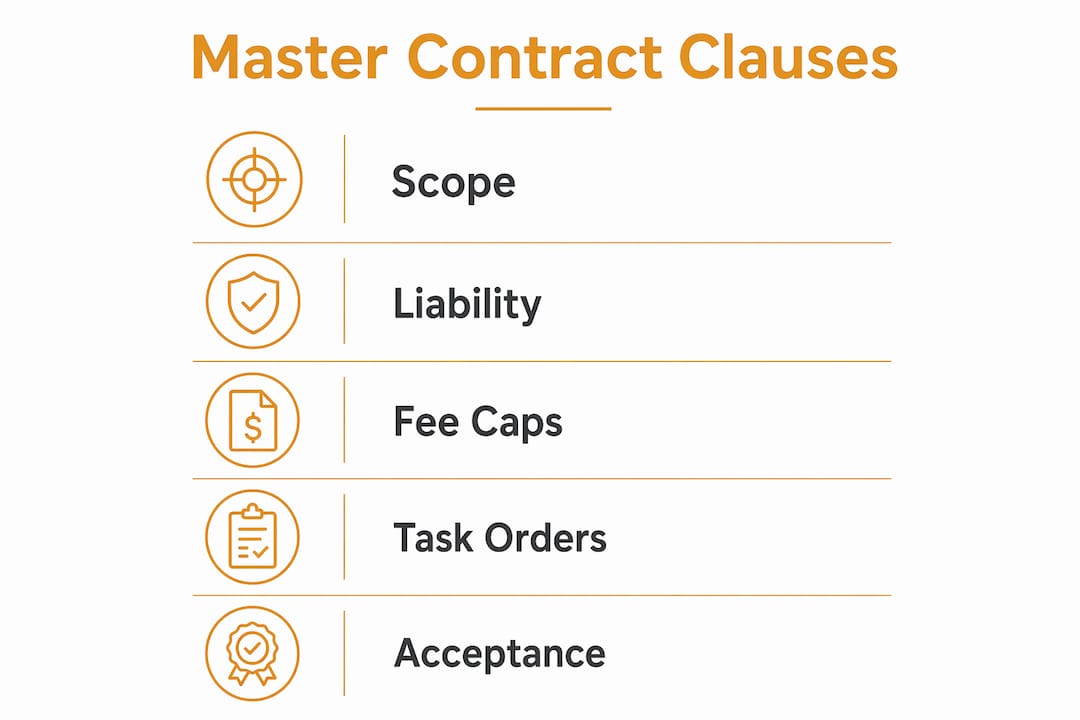
| Clause | Purpose |
|---|---|
| Scope of services (categories) | Defines the service types the engineer may be tasked with; prevents disputes over out-of-scope requests |
| Term and renewal mechanics | Sets contract duration, renewal notice periods, and expiration triggers |
| Work-order acceptance | Confirms that a task order is binding only upon written acceptance by an authorized representative |
| Compensation and rate schedules | Establishes hourly rates, unit prices, and escalation triggers for the contract period |
| Insurance requirements | Specifies required coverages (general liability, professional liability/E&O, workers’ compensation) and certificate obligations |
| Indemnity and liability caps | Allocates risk and limits aggregate liability to a defined amount, typically tied to fees paid |
| Limitation of consequential damages | Excludes indirect, incidental, or consequential losses from both parties’ exposure |
| Intellectual property | States who owns deliverables and grants the owner a license to use them |
| Confidentiality | Protects project data, site information, and proprietary owner materials |
| Subconsultant approval | Requires owner consent before the engineer engages subconsultants; flows down master terms |
| Termination rights | Addresses termination for convenience and for cause, with notice periods and payment on termination |
| Change-order procedure | Defines how scope or fee changes are documented and approved |
| Dispute resolution and choice of law | Sets the governing state law and preferred resolution method (mediation, arbitration, litigation) |
| Audit and records access | Gives the owner the right to review timesheets, invoices, and project records |
A critical structural rule: task orders cannot amend master agreement terms. Any project-specific change to liability caps, insurance limits, or indemnity language requires a formal written amendment to the master agreement, executed by both parties. Sample public-agency language confirms that requests for services are not binding until accepted in writing and cannot alter core master terms.
Red-flag clauses to reject: overbroad indemnities that extend beyond the engineer’s own negligence, open-ended fee liability with no cap, and automatic renewal provisions that activate without advance written notice.
How do pricing and budget controls work under term contracts?
Term contracts commonly use pre-agreed rate schedules combined with a mix of fee models, each controlled at the task-order level. The master agreement sets the rates; the task order sets the ceiling.
Common pricing approaches include:
- Hourly rate cards with annual escalation tied to a published index (CPI or ENR Construction Cost Index)
- NTE task orders — the engineer bills hourly against a defined ceiling; the owner approves any increase before the ceiling is reached
- Fixed fee per deliverable — used for well-defined, repeatable tasks such as structural inspections or permit drawings
- Retainer plus task billing — a monthly retainer covers availability; individual tasks are billed separately against the rate card
- Unit pricing — a per-unit rate for repeated services (e.g., per inspection, per drawing sheet)
A sample NTE task order might authorize 40 hours at a blended rate of $175 per hour, establishing a fee ceiling of $7,000. The engineer invoices against actual hours; if the scope expands, a written amendment raises the NTE before additional hours are worked.
Invoicing should require backup documentation: timesheets, progress reports, and a summary of hours by task. Owners managing multi-site portfolios or public programs benefit from milestone-based payments and retainage provisions that tie final payment to accepted deliverables.
When should you use a term contract for engineering services?
Use term contracts when you need vetted, on-call professional support across multiple small-to-medium projects or for recurring maintenance and emergency work. For a single, large, unique project, a project-specific contract is the better vehicle.
Advantages:
- Faster procurement: pre-vetted firms allow task orders to be issued in days rather than weeks
- Continuity of key personnel across related projects
- Predictable administrative costs and standardized contract terms
- Simplified onboarding for recurring or emergency assignments
- Reduced procurement burden for public agencies managing multiple sites
Trade-offs:
- Master terms may become outdated if the contract period extends without review
- Per-project pricing may be less competitive than a fully bid single-project contract
- Highly unique or large-scale projects may not fit the pre-defined scope categories
- Managing multiple concurrent task orders requires disciplined administrative tracking
Typical U.S. use cases include public authorities and universities managing rehabilitation and maintenance programs, large developers overseeing multi-site portfolios, facility managers requiring on-call inspection and small-repair design, and emergency structural assessments. The term agreement model covers design projects with estimated construction values up to $8 million under some public programs.
Pro Tip: For multi-site developers, pair the term contract with a standardized task-order log that tracks NTE balances, invoiced amounts, and completion status across all active assignments. That single document prevents budget overruns before they occur.
How do you procure and implement a term contract in the U.S.?
Follow a standard procurement path adapted for master agreements: advertise, evaluate qualifications, negotiate master terms, execute the contract, then issue task orders as projects arise.
- Draft scope categories and estimated annual spend.
- Issue an RFQ or RFP focused on qualifications, key personnel, and rate schedules.
- Evaluate submissions using a weighted scoring rubric (experience, personnel, rates, compliance).
- Select the firm and negotiate master terms, minimizing unnecessary amendments.
- Verify insurance certificates and professional licensure for the target state.
- Execute the master agreement and register the contractor in your procurement system.
- Onboard with a documented task-order template and a defined acceptance workflow.
Procurement checklist items:
- Signed master agreement with all exhibits
- Current certificates of insurance meeting specified limits
- Proof of professional licensure in the applicable state
- Completed task-order template reviewed by legal counsel
- DBE, SDVOB, or other public-compliance documentation if required
- Audit and records-access acknowledgment
For public owners, the DASNY sample term contract illustrates the chaptered contract structure, work authorization process, and licensure requirements used by a major New York State authority. Public-records and amendment-log obligations apply throughout the contract period.
Pro Tip: Have legal counsel review the master agreement before execution. Procurement efficiency is the goal, but a single ambiguous indemnity clause can cost more to litigate than the entire contract value.

What risk-management and negotiation points matter most?
Focus negotiation on clear work-order mechanics, liability caps, insurance coverages aligned to likely exposures, and a defined change-management procedure. The trade-off between procurement efficiency and project-level flexibility is the central strategic tension owners must resolve before signing.
Key negotiation questions:
- How and when are hourly rates updated, and to which index are escalations tied?
- Who approves subconsultants, and do master terms flow down to them?
- How is unforeseen site work priced when it falls outside the task-order scope?
- What are the aggregate liability cap and the professional indemnity (E&O) coverage limit?
Red flags to address before execution:
- Ambiguous work-order acceptance language that does not require a countersigned document
- No aggregate liability cap or a cap set below anticipated task-order values
- Missing professional liability (errors and omissions) insurance
- Unilateral amendment rights that allow one party to modify master terms without consent
- Evergreen auto-renewal clauses without a defined notice period
Practical owner controls: require explicit NTEs on every task order, pre-approve rate escalation triggers in the master agreement, retain audit rights over timesheets and subconsultant invoices, and include a fast-track dispute-resolution clause for time-critical projects. Firms providing on-call engineering services across multiple sectors routinely operate under these controls as standard practice.
What must a work order include to be binding and billable?
A binding work order must reference the master agreement, define the scope, state the fee or NTE amount, include a schedule, list deliverables, and show signed acceptance by an authorized representative. Missing any of these elements creates ambiguity about whether a valid contract exists for that assignment.
Minimum checklist:
- Master agreement reference — title, date, and contract number
- Task order ID — unique identifier for tracking and invoicing
- Scope of work — specific services to be performed and explicit exclusions
- Fee model and ceiling — hourly NTE, fixed fee, or unit price with a stated maximum
- Schedule and milestones — start date, key deliverable dates, and completion date
- Key personnel — named individuals responsible for the work
- Deliverables and acceptance criteria — what constitutes a complete, accepted deliverable
- Invoicing instructions — billing cadence, required backup, and payment address
- Insurance and permit responsibilities — which party holds which obligations
- Signature block — authorized representative with title and date
Sample binding-acceptance clause: “This Task Order is not effective until countersigned by an authorized representative of both parties. No work shall commence and no fees shall accrue prior to full execution.”
Sample fee-cap clause: “The total fee for this Task Order shall not exceed [NTE amount] without a written amendment executed by both parties prior to the NTE being reached.”
Pro Tip: Include an explicit statement in every task order that it does not amend the master agreement. Without that language, a party may later argue that task-order-specific terms modified the master indemnity or insurance provisions.
Key Takeaways
A term contract for engineering services is only as effective as the work-order mechanics and clause structure that govern each individual assignment.
| Point | Details |
|---|---|
| Master agreement sets the framework | The master contract establishes rates, insurance, liability, and IP terms; task orders activate specific work. |
| Signed task orders are mandatory | Work does not begin and fees are not owed until a task order is countersigned by authorized representatives of both parties. |
| NTE ceilings control budget exposure | Every task order should state a not-to-exceed fee ceiling; increases require a written amendment before the ceiling is reached. |
| Public owners follow structured procurement | Agencies must advertise, evaluate by weighted criteria, verify licensure and insurance, and maintain amendment records for audit compliance. |
| Periodic review prevents stale terms | Schedule a review of master terms and rate schedules at least annually to keep the agreement aligned with current project requirements. |
Why the work-order mechanics matter more than the master agreement itself
Most procurement disputes under term contracts do not originate in the master agreement. They originate in task orders that were issued informally, verbally, or without a countersigned acceptance. The master agreement can be perfectly drafted, with airtight indemnity language and current insurance requirements, and still produce costly disputes if the task-order process is treated as an administrative formality rather than a legal trigger.
The highest-impact change any owner can make is standardizing the task-order template and enforcing the acceptance requirement without exception. A streamlined, one-page template with a clear NTE ceiling and a mandatory countersignature field eliminates the most common sources of billing disputes and scope disagreements. Owners who implement that single governance step typically find that the administrative burden of managing multiple task orders drops significantly, because the boundaries of each engagement are unambiguous from day one.
Rate tables deserve the same attention. A master agreement executed with rate schedules that are two or three years old creates friction at every task order, particularly when market labor costs have shifted. Building a defined escalation mechanism into the master agreement, tied to a published index, removes the need to renegotiate rates at renewal and keeps the commercial relationship stable.
A quarterly review of active task orders, NTE balances, and utilization against the master agreement’s scope categories takes less than an hour and surfaces problems before they become disputes. That routine, more than any single contract clause, is what separates well-managed term agreements from ones that generate claims.
Authoritative U.S. sources and templates for term contracts
These resources provide sample language, procurement frameworks, and contract structures directly applicable to U.S. engineering term agreements.
-
State University Construction Fund — Term Agreement Program: A working public-sector term agreement program covering design projects up to $8 million in estimated construction value. Useful for understanding scope categories, procurement criteria, and task-order administration in a university-authority context.
-
DASNY Sample Term Contract for Professional Services: A chaptered sample contract from the Dormitory Authority of the State of New York, covering work authorization processes, licensure requirements, and contract amendment procedures. Directly applicable as a drafting reference for public-agency master agreements.
-
Hyrum City Municipal Engineering Services Template: A municipal master contract template showing standard articles: description of work, term and schedule, and compensation tied to per-task scope and compensation documents. Useful for smaller public owners drafting their first term agreement.
-
Law Insider — Continuous Services Agreement Sample: Annotated sample master contract language showing how requests for services are structured, why they are not binding until accepted in writing, and how they are prevented from amending core master terms.
-
FAR Part 2 — Definitions of Words and Terms (Acquisition.GOV): The federal regulatory definition of architect-engineer services and engineering and technical services contracts. Authoritative reference for federal procurement compliance and for understanding how the FAR classifies term-based professional services agreements.
Recommended
- Top Contractors for Your Next Home Renovation Project in Singapore
- Design and build contracts: Singapore developer guide
- Value Engineering Design Build Projects: A Practical Guide
- Design and build contracts: Singapore developer guide