





Civil engineering construction companies deliver design, regulatory submissions, and end-to-end construction project management across the full project lifecycle. Engage them during pre-construction to lock in cost, program, and compliance before ground breaks.
The core value proposition is straightforward: these firms transfer technical, regulatory, and delivery risk from the owner to specialists who can anticipate code requirements, manage authority submissions, and coordinate multidisciplinary teams. Key deliverables include:
- Design checks and structural calculations reviewed against applicable codes before submission
- Authority submissions to BCA, URA, SCDF, PUB, NEA, and other relevant agencies
- Site supervision and QA to verify that construction conforms to approved drawings
Table of Contents
- What services do civil engineering construction companies provide?
- How does a typical project engagement unfold from start to finish?
- Why do owners hire civil engineering construction companies?
- How do professional firms manage projects across six constraints?
- What compliance requirements will your firm manage in Singapore?
- How do you choose the right civil engineering construction company?
- What project types benefit most from specialist civil engineering firms?
- Key Takeaways
- What experienced engineers actually watch for on complex projects
- Stellar Structures: specialist engineering and authority submissions in Singapore
- Useful sources and further reading
What services do civil engineering construction companies provide?
Civil engineering firms manage the entire project lifecycle from pre-construction planning through regulatory compliance, execution, and closeout. Owners should expect a firm to cover at least four core service categories.
| Service Category | Typical Deliverables | When to Engage | Value to Owner |
|---|---|---|---|
| Civil Engineering | Earthworks design, drainage, roads, site infrastructure | Feasibility and detailed design | Ensures site is buildable and code-compliant |
| Structural Engineering | Structural calculations, drawings, design checks | Schematic design onward | Confirms load paths, reduces structural risk |
| Geotechnical Engineering | Soil investigation, foundation design, ERSS for excavations | Pre-design and deep basement work | Prevents costly foundation failures |
| M&E Engineering | Mechanical, electrical, plumbing coordination | Detailed design and construction | Integrates building services with structure |
Beyond these four categories, experienced firms also provide temporary works design for shoring and formwork, façade and periodic inspections for existing buildings, and value engineering reviews that identify cost savings without compromising structural integrity.
How does a typical project engagement unfold from start to finish?
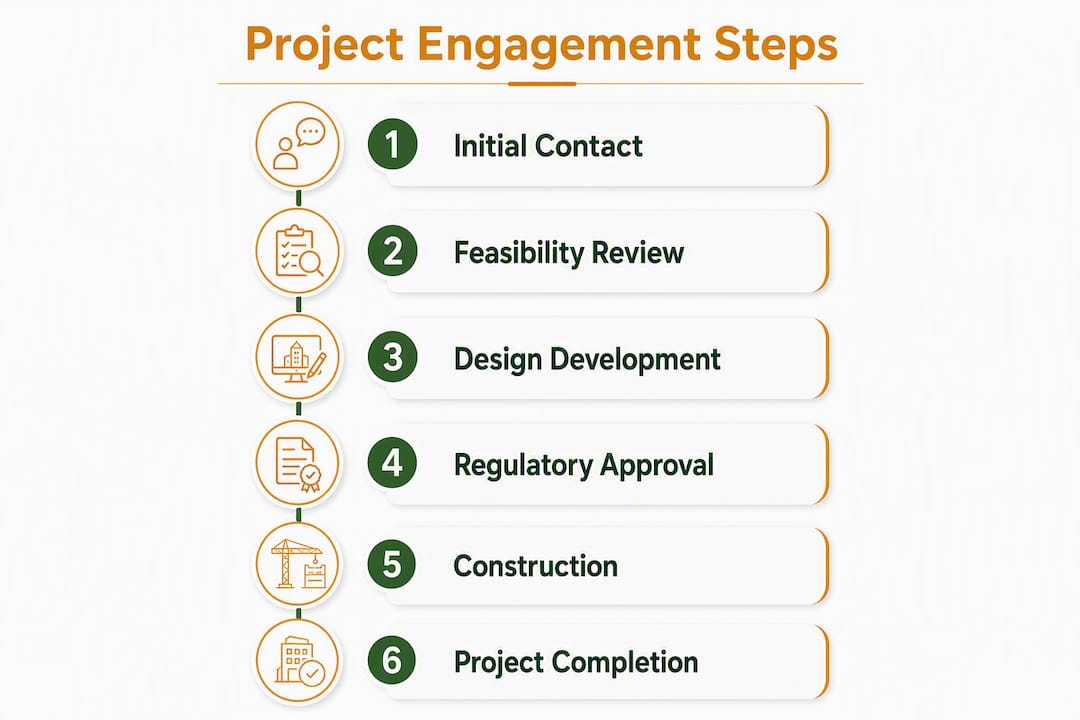
The engagement follows five sequential stages: feasibility, schematic and detailed design, authority submission, construction supervision, and closeout. For small-to-medium commercial or residential projects, owners should plan for the following approximate durations.
- Feasibility: Site assessment, preliminary cost estimate, and a feasibility report confirming buildability and regulatory constraints
- Schematic and detailed design (6–16 weeks): Structural calculations, architectural coordination, M&E integration, and structural drawing compliance checks
- Authority submission: Preparation and lodgment of building plan submissions to BCA, URA, SCDF, PUB, and other relevant agencies; response to queries
- Construction supervision (duration of build): QA inspections, site supervision, change-order management, and progress reporting
- Closeout: As-built documentation, final inspections, and handover package
Industry guidance recommends carrying a 10–15% contingency in early-stage budgets to account for design development and unforeseen site conditions. Milestones at each stage should be contractually defined so that deliverables, review periods, and payment triggers are unambiguous.
Why do owners hire civil engineering construction companies?
Hiring shifts technical, regulatory, and delivery risk to specialists and creates clearer accountability across the project. Owners who engage a qualified firm early gain accurate cost forecasting, smoother authority approvals, fewer change orders, and better constructability in the final design.

The pre-construction phase is the most critical for cost control. Baseline design decisions and value engineering made before construction begins reduce the frequency and size of change orders during execution. A structural or civil consultant engaged at feasibility can flag foundation risks, drainage constraints, or authority submission requirements that would otherwise surface as expensive surprises during construction.
Pro Tip: During contract negotiation, confirm that the firm carries professional indemnity insurance and public liability insurance, is bonded where required, and has explicitly scoped authority submission services. Vague scope on submissions is one of the most common sources of cost disputes.
Qualified, licensed engineers and formal QA processes are the foundation of reduced owner risk across authority approvals and construction. Owners should treat these not as optional credentials but as minimum requirements.
How do professional firms manage projects across six constraints?
Top firms balance cost, quality, schedule, scope, function, and safety using formal controls applied at every project stage. Each constraint maps to a specific set of firm practices.
- Cost: Earned value tracking, early value engineering, and a defined change-order process
- Quality: BIM coordination to detect clashes before construction, QA inspection checklists, and non-conformance reporting
- Schedule: Critical Path Method (CPM) scheduling, milestone tracking, and look-ahead programs
- Scope: Formal change-order procedures with written owner approval before proceeding
- Function: Design reviews against the owner’s brief at schematic and detailed design stages
- Safety: Method statements, temporary works design, and compliance with site safety regulations
Modern delivery methods vary by project complexity. Design-Build suits owners who want a single point of accountability and faster delivery. Integrated Project Delivery (IPD) aligns contractor, designer, and owner incentives from the outset, reducing adversarial dynamics. Lean Project Delivery reduces waste in time, cost, and effort by focusing on owner value during design and procurement, and is increasingly adopted on larger commercial and infrastructure projects.
Pro Tip: When reviewing proposals, ask specifically about BIM capability, cloud-based document control, and real-time budget dashboards. Firms that offer these tools provide owners with live visibility into project status rather than periodic written reports. Digital capability is a direct signal of process maturity.
What compliance requirements will your firm manage in Singapore?
Singapore’s regulatory framework involves multiple authorities, each with distinct submission requirements. A competent firm manages these submissions strategically, not administratively. Successful authority submission depends on early code checks and staged engagement with agencies to prevent project delays.
Building and Construction Authority (BCA) governs building plan approval, structural plan submissions, and the Qualified Person (QP) framework. All structural and architectural plans require a licensed QP to submit and take professional responsibility.
Urban Redevelopment Authority (URA) controls land use, development control parameters (plot ratio, height, setbacks), and planning permission. Any change of use or development exceeding baseline parameters requires URA clearance before BCA submission.
Singapore Civil Defence Force (SCDF) reviews fire safety compliance including fire compartmentation, means of escape, and fire protection systems. SCDF approval is a prerequisite for occupation.
Public Utilities Board (PUB) regulates drainage, sewerage, and water supply connections. Drainage impact assessments and drainage plans must be submitted for most new developments.
National Environment Agency (NEA) and National Parks Board (NParks) cover environmental approvals and tree conservation orders respectively. Projects affecting protected trees or generating significant waste require separate clearances.
Owners should prepare the following before authority submissions begin:
- Certified survey plan and title documents
- Geotechnical investigation report for sites with deep excavations
- Completed architectural and structural drawings signed by the QP
- Drainage and M&E drawings coordinated with the structural scheme
- Fire safety drawings reviewed against SCDF requirements
How do you choose the right civil engineering construction company?
Pick the firm that proves capability on the project’s dominant risks: site conditions, authority submission complexity, and structural or geotechnical challenges specific to the project type. Capability on paper is not the same as demonstrated experience on comparable projects.
Selection checklist:
- Licensed QP (Architect or Engineer) registered with BCA and the relevant professional board
- Professional indemnity and public liability insurance certificates, current and adequate for project value
- Documented authority submission track record with BCA, URA, SCDF, and PUB
- BIM capability and cloud document control platform
- Portfolio of projects with comparable scale, typology, and regulatory complexity
- Verifiable client references from completed projects, not just project lists
Interview questions to ask shortlisted firms:
- Which QP will be personally responsible for this project’s submissions, and what is their current workload?
- Can you walk through a recent authority submission for a project of similar complexity?
- How do you manage change orders, and what is your written approval process?
- What BIM software and document control platform does your team use?
- How do you handle a QA non-conformance discovered during construction?
- What is your process if an authority raises a query or requests design revisions post-submission?
- Who is the single point of contact for the owner throughout the project?
Red flags to watch for: contractual scope that excludes authority submissions without explicit carve-outs; no documented QA workflow; references that cannot be independently verified; a change-order process that relies on verbal agreement; and a firm that cannot name the specific QP assigned to the project.
What project types benefit most from specialist civil engineering firms?
Civil engineering construction companies are most commonly engaged for residential developments, commercial buildings, industrial facilities, and infrastructure projects. Each project type has a distinct risk profile that determines where specialist input adds the most value.
Residential projects (landed homes, multi-unit developments) typically require structural design for foundations and slabs, geotechnical input for sites with soft ground or slope constraints, and BCA/URA submissions for additions and alterations. Mezzanine floor additions and pool construction are common elements requiring specialist structural review.
Commercial buildings demand coordinated M&E and structural design, fire safety submissions to SCDF, and URA development control clearance. Façade design and periodic inspections become relevant for mid-rise and high-rise assets.
Industrial facilities often involve heavy floor loadings, deep excavations for basements or pits, and JTC or HDB submission requirements for tenanted sites. Temporary works design for shoring and strutting is frequently required.
Infrastructure projects such as roads, drainage networks, and utilities require civil design, PUB drainage submissions, and LTA coordination. These projects carry the highest geotechnical and interface risk and benefit most from early specialist engagement.
Key Takeaways
Engaging a qualified civil engineering construction company during pre-construction is the single most effective way to control cost, reduce authority submission delays, and transfer technical risk before it becomes a construction problem.
| Point | Details |
|---|---|
| Engage during pre-construction | Early involvement locks cost, program, and compliance before design decisions become expensive to reverse. |
| Verify authority submission scope | Confirm BCA, URA, SCDF, and PUB submissions are explicitly included in the contract, not assumed. |
| Check QP credentials and insurance | A licensed QP and current professional indemnity insurance are minimum requirements, not optional extras. |
| Use digital capability as a trust signal | BIM, cloud document control, and real-time dashboards indicate process maturity and owner visibility. |
| Stellar Structures delivers end-to-end | Stellar Structures covers civil, structural, geotechnical, M&E design, inspections, and full authority submissions across Singapore. |
What experienced engineers actually watch for on complex projects
The gap between a technically compliant submission and a project that runs smoothly on site is almost always a documentation problem, not a design problem. Poor documentation of decisions is the most common reason for communication failure on construction projects. Firms that maintain a central source of truth and mandatory decision logs for every major design choice resolve disputes faster and produce fewer change orders.
Two watchpoints worth keeping in mind: first, document every design decision in writing at the time it is made, not retrospectively. Change orders that lack a clear paper trail become contractual disputes. Second, manage change orders by requiring written owner approval before any variation proceeds, regardless of how minor it appears. Small undocumented changes accumulate into significant scope and cost overruns.
The most common owner mistake is delaying design checks and geotechnical investigations to save upfront cost, then encountering foundation or drainage issues during construction when correction is far more expensive. Engaging specialists at feasibility, not after design is complete, is the decision that separates projects that close on budget from those that do not.
Stellar Structures: specialist engineering and authority submissions in Singapore
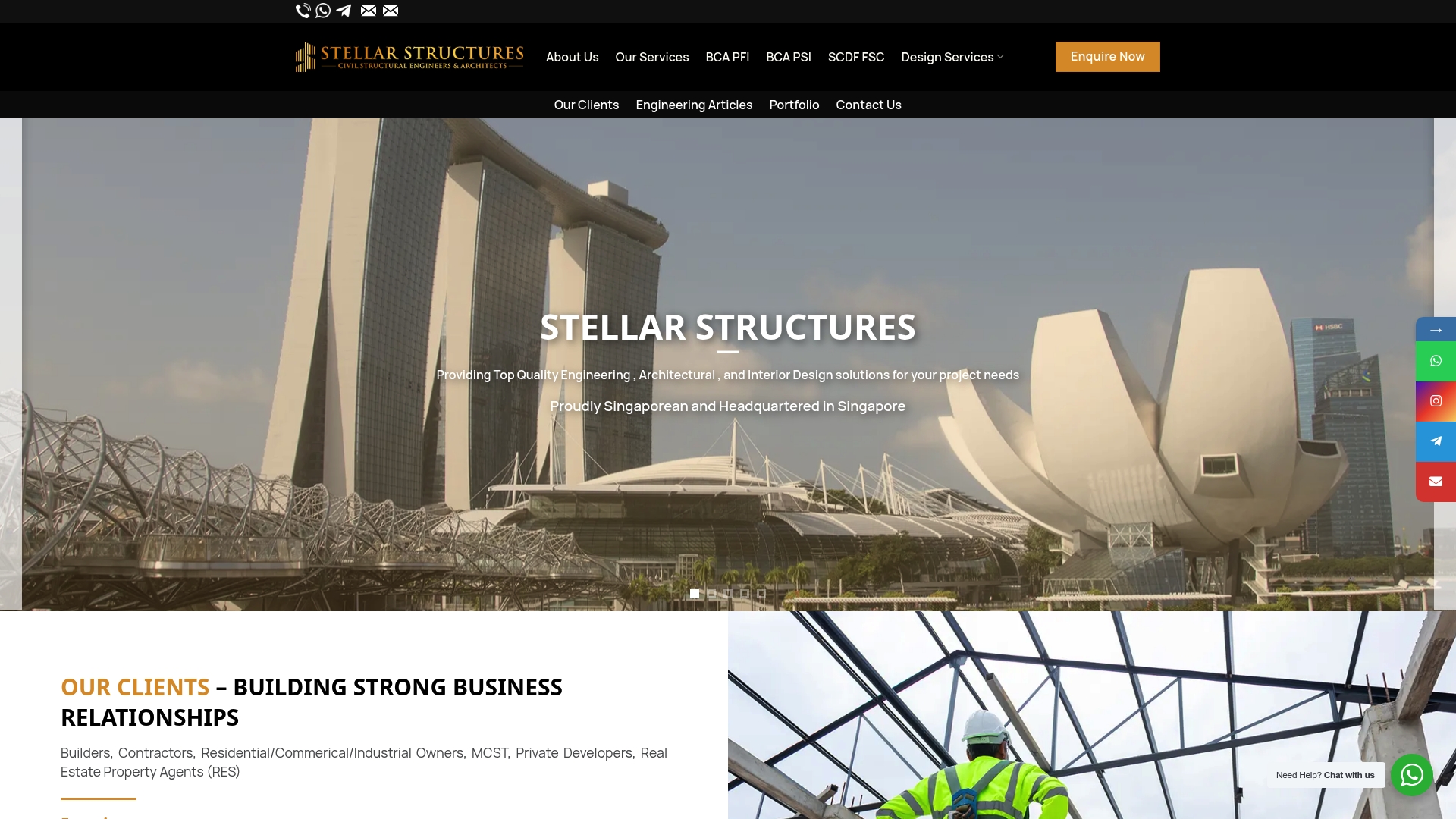
Stellar Structures provides civil, structural, geotechnical, and M&E engineering design alongside comprehensive authority submission management and periodic inspections for residential, commercial, industrial, and infrastructure projects across Singapore. The firm’s value to owners is specific: a single team that handles design checks, QP submissions, and multi-agency approvals without requiring the owner to coordinate separate consultants.
Depending on your project stage, the most relevant services are:
- Civil and structural design checks for pre-construction review and authority-ready deliverables
- Authority submission services covering BCA, URA, SCDF, PUB, NEA, NParks, HDB, and JTC
- Integrated design engineering for developers needing end-to-end coordination
Contact Stellar Structures for a feasibility review of your project. The team will assess your site constraints, identify the authority submissions required, and provide a scoped proposal before design begins.
Useful sources and further reading
These references cover project management best practice, Lean delivery, BIM adoption, and Singapore-specific regulatory guidance. They back the technical claims in this article and provide structured learning for owners and design teams.
- Construction Project Management (CMU) — foundational text on PM methods, QA, and risk allocation for construction projects
- Construction Industry Institute (CII) — research on pre-construction value, cost control, and best practices for owner-contractor engagement
- Lean Construction Institute — guidance on Lean Project Delivery, waste reduction, and owner-value alignment in design and procurement
- Autodesk Construction Blog — practical overview of construction project management tools, BIM, and digital delivery methods
- Atlassian Construction PM Guide — covers project controls, contingency planning, and schedule management for construction teams
- Construction Project Management (Coursera) — structured learning module covering Lean delivery, BIM, and sustainability for construction professionals
- Stages of new build construction in Singapore — practical guide to project phases and consultant activities at each stage
- Building plan submission requirements in Singapore — checklist of documents and owner responsibilities for BCA authority submissions
Recommended
- Essential Guide to Becoming a Construction Engineer: Skills and Salary
- Top Contractors for Your Next Home Renovation Project in Singapore
- The Future of Construction in Singapore: Trends and Insights for 2026
- Civil Engineering Consultancy Services Explained – Stellar Structures