




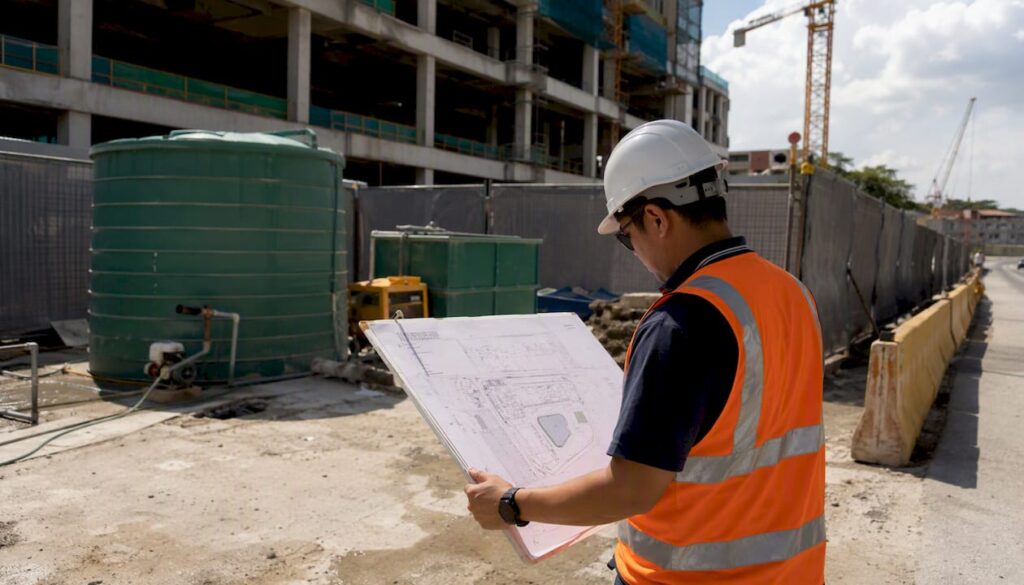
NEA environmental submission requirements in Singapore follow a fixed sequence: Industrial Siting Consultation (ISC, where applicable) → Environmental Information (EI) before Development Control (DC) → DC clearance → Building Plan (BP) clearance → noise and environmental clearances prior to Temporary Occupation Permit (TOP) → Certificate of Statutory Completion (CSC). The Qualified Person (QP) appointed for the project is responsible for preparing and filing most of these submissions. Per the Guidelines for Building Plan Submission, the sequence applies to both industrial and non-industrial developments, with specific triggers at each stage.
Required NEA submissions and who files each:
- ISC (Industrial Siting Consultation): Developer or QP files for industrial proposals before any DC submission; NEA reviews nuisance buffers under SS 593:2013.
- EI (Environmental Information): QP applies to NEA’s Development Control Department (DCD) before submitting DC plans; NEA returns height constraints and health/safety buffer requirements.
- DC (Development Control): QP submits plans to NEA DCD; NEA checks pollution control and environmental health compliance.
- BP (Building Plan): QP submits detailed plans; NEA verifies solid waste, cooling tower, and pollution control systems against Codes of Practice.
- TOP (Temporary Occupation Permit): QP obtains NEA clearance on noise and environmental health systems before occupation.
- CSC (Certificate of Statutory Completion): Final sign-off confirming all NEA conditions are met.
Immediate next steps: Apply for EI through the NEA ePORTAL before lodging DC plans. Download and complete the NEA DC checklist before any plan submission. For industrial projects, initiate the Industrial Allocation System (IAS) pre-consultation first.
Table of Contents
- How do NEA environmental submissions fit into the development control workflow?
- What core environmental topics does NEA review for building submissions?
- Who must submit NEA applications, and what are QP responsibilities?
- How do you prepare and file an Environmental Information submission?
- What are the most common NEA review deficiencies, and how do you fix them?
- How do NEA requirements map to U.S. regulatory equivalents?
- Stellar Structures handles NEA authority submissions end to end
- Key Takeaways
- Why early NEA engagement is the most underrated compliance decision
- Authoritative NEA sources and referenced standards
How do NEA environmental submissions fit into the development control workflow?
NEA’s Development Control Department sits at the center of Singapore’s building approval process, reviewing environmental and public health compliance at the EI, DC, and BP stages before any occupation permit is issued. Understanding where each NEA check falls in the overall timeline prevents costly sequencing errors.
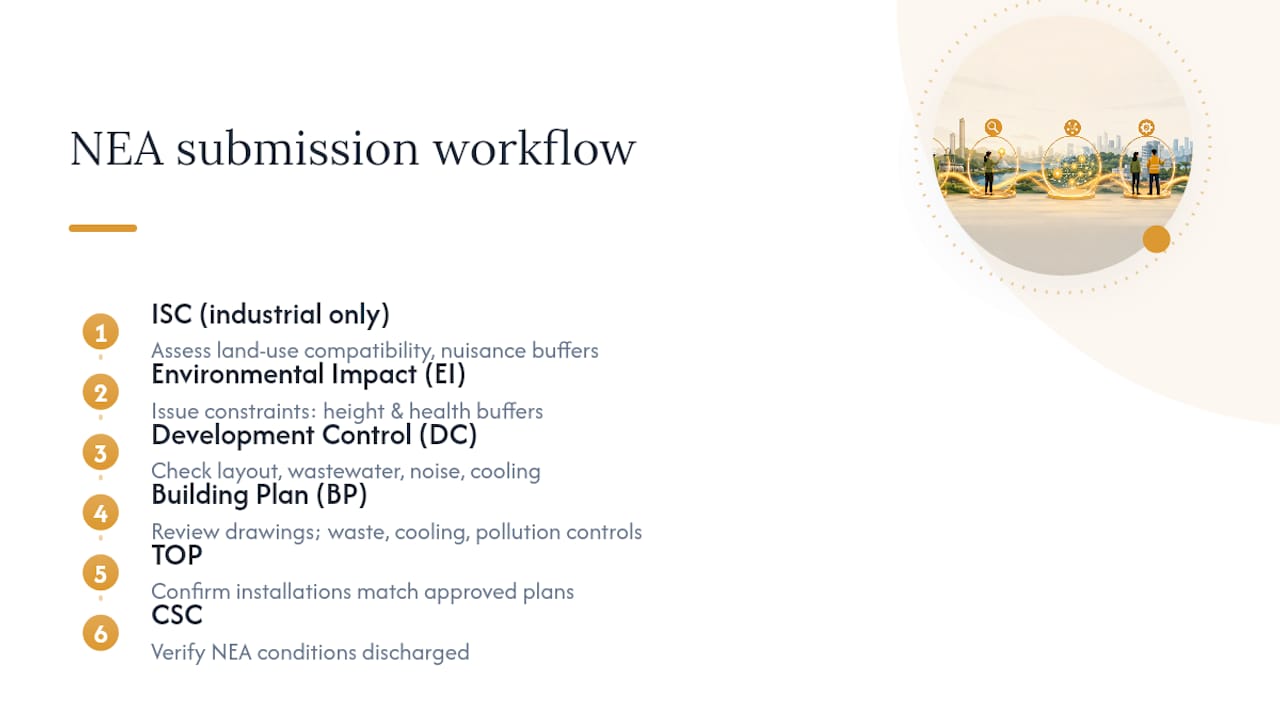
The ISC stage applies only to industrial developments. At this point, NEA assesses whether the proposed industrial use is compatible with surrounding land uses, applying nuisance buffer criteria from SS 593:2013. Non-industrial projects skip ISC and proceed directly to EI.
EI is a mandatory prerequisite to DC submissions where applicable. NEA returns the EI with environmental constraints, including building height limits and health and safety buffer distances, that the QP must incorporate into DC plans. Submitting DC plans before receiving EI clearance will result in rejection.
At the DC stage, NEA checks submitted plans for compliance with pollution control and environmental health requirements. This is where site layout, wastewater disposal, noise mitigation, and cooling tower placement are reviewed. QPs should treat DC as the most document-intensive NEA checkpoint.
The BP stage follows DC approval. NEA reviews detailed engineering drawings for solid waste management systems, cooling towers, and pollution control installations. Checklists supplied by NEA must accompany BP submissions. TOP and CSC clearances confirm that installed systems match approved plans and that all NEA conditions have been discharged.
For a full picture of how these stages align with the broader construction timeline, the stages of new build construction in Singapore guide provides scheduling context that helps QPs plan deliverable windows.
What core environmental topics does NEA review for building submissions?
NEA’s environmental review covers five primary topic areas: pollution control, environmental health (including Legionella and vector control), waste management, boundary noise, and water hygiene. Each triggers specific documentation requirements that the QP must prepare before DC or BP submission.
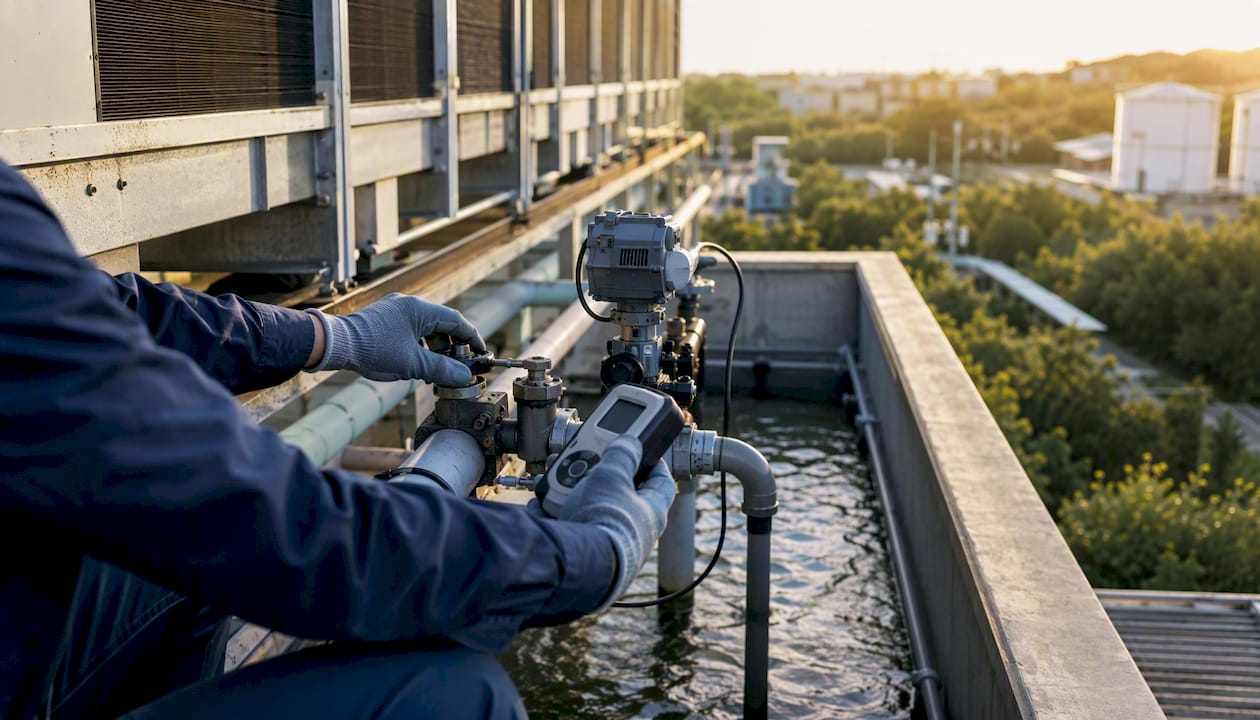
The NEA Guide on Environmental Requirements for New Developments is the primary reference document and lists the Codes of Practice and Singapore Standards that govern each topic.
Cooling towers and Legionella control
- Cooling tower schematic showing location, capacity, and access provisions
- Legionella control plan referencing the Code of Practice for Control of Legionella in Cooling Towers
- Water treatment and maintenance schedule
- QP declaration that the design meets NEA’s water hygiene requirements
Vector control (mosquito breeding prevention)
- Site drainage plan demonstrating no stagnant water accumulation
- Landscape design review confirming no mosquito-breeding features
- Statement of compliance with NEA’s vector control guidelines
Waste management and recycling
- Waste management plan specifying refuse storage, collection points, and recycling provisions
- Compliance with the Code of Practice on Environmental Health for refuse chute and bin center design
- For industrial developments: hazardous waste handling and disposal details
Boundary noise and air-conditioning/ventilation systems
- Noise Impact Assessment (NIA) summary for developments near sensitive receptors
- Mechanical and electrical (M&E) drawings showing AC/V system placement relative to boundary
- Compliance statement against NEA’s Technical Guidelines on Boundary Noise Limit for AC/V systems
Pollution control and wastewater
- Wastewater disposal details (trade effluent, if applicable)
- Drainage and sewer connection plan
- For industrial uses: pollution control measures for air emissions and trade effluent pre-treatment
SS 593:2013 governs nuisance buffer distances for industrial developments. The Code of Practice on Environmental Health applies to refuse handling and food establishments. QPs should confirm which codes apply to their specific development category before preparing documentation.
Who must submit NEA applications, and what are QP responsibilities?
The appointed QP carries primary responsibility for all NEA environmental submissions at the EI, DC, and BP stages. This is not a delegable administrative task: the QP must certify that submitted plans comply with NEA pollution control and environmental health requirements before lodging them with DCD.
At the EI stage, the QP applies to DCD on behalf of the developer or owner. The EI application must precede DC plan submission, and the QP must incorporate the returned environmental constraints into all subsequent drawings. At DC, the QP signs off on plans confirming compliance with the applicable Codes of Practice and Singapore Standards. At BP, the QP uses NEA’s Building Plan checklists to verify that solid waste, cooling tower, and pollution control systems are fully detailed and compliant.
Owners and developers retain responsibility for ensuring that a suitably qualified QP is appointed and that all NEA conditions imposed at each stage are addressed before the next submission. Retaining copies of all NEA correspondence, returned EI documents, and approved plans is a legal and practical necessity for TOP and CSC clearances.
For M&E-intensive submissions, coordinating QP deliverables across civil, structural, and M&E disciplines early reduces the risk of conflicting drawings at the DC stage. The integrated design and construction approach used by experienced Singapore firms reflects this coordination requirement.
Pro Tip: Book a pre-consultation appointment with NEA’s DCD through the NEA ePORTAL before preparing EI or DC documents. NEA officers will identify project-specific requirements and flag likely review issues before you invest time in full documentation. This single step eliminates the most common cause of first-round rejections.
How do you prepare and file an Environmental Information submission?
The QP files the EI application directly with NEA’s DCD through the NEA ePORTAL, and this must happen before DC plans are lodged. For industrial projects, the IAS pre-consultation should be completed first to confirm the industrial allocation and identify any nuisance buffer requirements under SS 593:2013.
Step-by-step EI and DC submission workflow:
- Pre-consultation (industrial projects only): — Submit an IAS pre-consultation request via NEA ePORTAL. Receive confirmation of industrial allocation and applicable buffer distances. Estimated time: 2–4 weeks.
For a detailed breakdown of building plan submission requirements, including forms and evidence checklists, the Stellar Structures guide covers the full documentation scope.
| Document | Purpose | Typical Author |
|---|---|---|
| EI request form | Initiates EI application; triggers NEA review for constraints | QP |
| Site location and layout plan | Shows proposed development footprint and surrounding uses | QP / Architect |
| Noise Impact Assessment (NIA) | Demonstrates compliance with boundary noise limits | Acoustic specialist |
| Legionella control plan | Details cooling tower water treatment and maintenance regime | M&E engineer / specialist |
| Waste management plan | Specifies refuse storage, collection, and recycling provisions | QP / Architect |
| Cooling tower schematic | Shows location, capacity, and access for maintenance | M&E engineer |
| Wastewater disposal details | Confirms trade effluent or sewer connection arrangements | Civil / M&E engineer |
| DC checklist (NEA-supplied) | QP sign-off confirming plan compliance at DC stage | QP |
| BP checklist (NEA-supplied) | QP sign-off confirming detailed system compliance at BP stage | QP |
What are the most common NEA review deficiencies, and how do you fix them?
Incomplete documentation is the leading cause of first-round rejections. NEA’s DCD will return plans when required items are absent from the submission package, when mitigation measures are described in general terms without supporting drawings, or when maintenance plans for cooling towers and waste systems are missing entirely.
Missing or vague mitigation details are the most frequently cited deficiency at the DC stage. A noise impact assessment that identifies exceedances but provides no specific mitigation design, or a Legionella control plan that references the Code of Practice without specifying treatment chemicals, dosing schedules, and monitoring frequencies, will not pass review. The remedy is to prepare mitigation documentation to the level of detail NEA’s checklists specify, not merely to the level that satisfies the QP’s own judgment.
Inadequate maintenance plans for cooling towers are a persistent BP-stage issue. NEA expects a documented maintenance regime, not a general statement of intent. The plan should name responsible parties, specify inspection intervals, define water quality parameters, and reference the applicable Code of Practice for Legionella control.
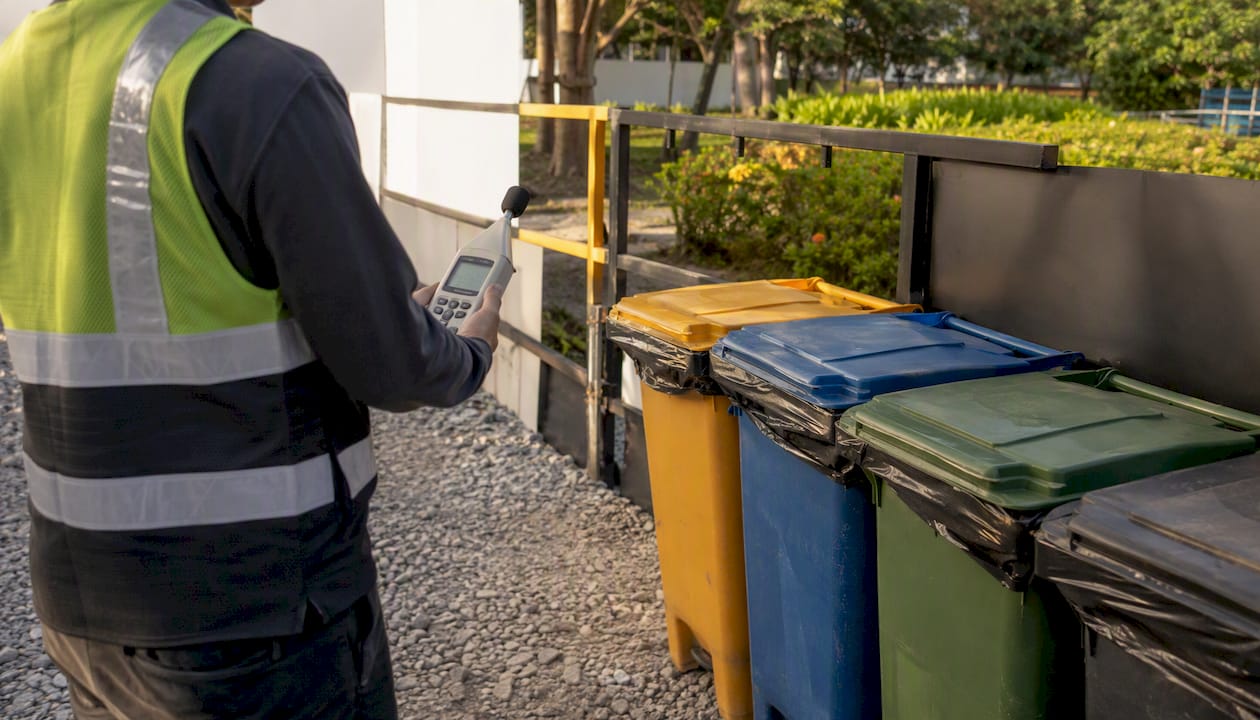
Drawings that conflict across disciplines cause DC rejections when M&E cooling tower locations differ from architectural plans or when drainage layouts contradict civil drawings. A pre-submission internal review that cross-checks all discipline drawings against each other, and against the NEA checklist, catches these conflicts before they reach DCD.
Failure to incorporate EI constraints into DC plans is a procedural error that results in immediate rejection. Every height limit and buffer distance returned in the EI must appear explicitly in the DC submission drawings.
Quality-control steps before any NEA submission should include: a complete run-through of the applicable NEA checklist by the QP, a cross-discipline drawing review, and confirmation that all specialist reports (NIA, Legionella plan) are signed by the appropriate professional. The engineering safety best practices framework used in Singapore construction provides a useful internal QC reference for this process.
How do NEA requirements map to U.S. regulatory equivalents?
Most NEA environmental submission topics have direct conceptual counterparts in U.S. federal and state regulatory frameworks, though the specific agencies, standards, and procedural steps differ. U.S.-based professionals advising on Singapore projects, or firms preparing transnational compliance deliverables, can use the mapping below as a practical translation reference.
NEA’s Legionella controls for cooling towers align conceptually with guidance from the Centers for Disease Control and Prevention (CDC) and ASHRAE Standard 188 (Legionellosis: Risk Management for Building Water Systems). Where NEA references Singapore’s Code of Practice for Control of Legionella in Cooling Towers, U.S. practitioners should map design and maintenance requirements to ASHRAE 188 as the closest technical equivalent. No direct federal regulatory counterpart to NEA’s mandatory Legionella control plan exists in the U.S., making ASHRAE 188 the practical benchmark.
Boundary noise limits and air-conditioning/ventilation system controls reviewed by NEA at the DC and BP stages correspond to state-level noise ordinances and nuisance controls administered by state Departments of Environmental Protection (DEP) or equivalent agencies. The U.S. Environmental Protection Agency (EPA) provides general noise policy guidance, but enforcement sits with state and local authorities.
| NEA Requirement | Closest U.S. Equivalent | Practical Action for U.S. Professionals |
|---|---|---|
| EI application (height and buffer constraints) | State DEP pre-application consultation / environmental site assessment | Request pre-application meeting with state DEP; prepare Phase I ESA |
| Legionella control plan (cooling towers) | CDC Legionella guidance + ASHRAE 188 | Prepare Water Management Program per ASHRAE 188; document monitoring protocols |
| Noise Impact Assessment (boundary noise) | State noise ordinance compliance report | Commission noise study per applicable state DEP noise standards |
| Waste management plan | EPA solid waste regulations (RCRA) + local municipal solid waste ordinances | Prepare waste management plan per EPA Resource Conservation and Recovery Act requirements |
| Pollution control / trade effluent | EPA Clean Water Act NPDES permit + state DEP discharge permits | Apply for NPDES permit; prepare stormwater pollution prevention plan (SWPPP) |
| Vector control (mosquito breeding) | State health department vector control programs | Consult state health department guidelines; document drainage design compliance |
| Industrial nuisance buffer (SS 593:2013) | EPA / state DEP land use compatibility assessments | No direct equivalent standard; prepare technical equivalence statement referencing EPA guidance |
SS 593:2013 and Singapore’s Code of Practice on Environmental Health have no direct U.S. regulatory counterparts. U.S. firms preparing compliance deliverables for Singapore projects must demonstrate technical equivalence rather than citing U.S. standards as substitutes. For Legionella specifically, ASHRAE 188 is widely accepted as the technical benchmark when Singapore-specific documentation is being prepared by a U.S.-based team.
U.S. firms bidding on Singapore projects should prepare, in addition to standard U.S. deliverables: a Legionella Water Management Program structured to ASHRAE 188, a noise impact assessment that addresses NEA’s boundary noise limits (not just U.S. state thresholds), and a waste management plan that meets NEA’s Code of Practice on Environmental Health requirements for refuse storage and recycling.
Stellar Structures handles NEA authority submissions end to end
Navigating NEA environmental submission requirements across the EI, DC, and BP stages demands precise documentation, disciplinary coordination, and familiarity with NEA’s review expectations. Stellar Structures provides end-to-end authority submission services covering NEA, BCA, URA, SCDF, PUB, and other Singapore authorities, acting as QP or coordinating QP deliverables across all disciplines on a single project.
Where most submission delays originate from incomplete first-round packages, Stellar Structures applies a pre-submission QC process that cross-checks all discipline drawings against NEA checklists before lodging. The firm prepares EI applications, Legionella control plans, NIA summaries, waste management plans, and pollution control documentation, then manages the DCD review process through to DC and BP clearances. The result is fewer resubmission cycles and more predictable TOP and CSC timelines. For developers and QPs who need a single point of accountability across all authority submissions, civil engineering consultancy services from Stellar Structures cover the full technical scope from EI through CSC.
Contact Stellar Structures to discuss your project’s NEA submission requirements and get a clear scope of work before your next DC lodgment.
Key Takeaways
NEA environmental submission requirements in Singapore follow a mandatory sequence, and the QP bears direct responsibility for certifying compliance at every stage from EI through CSC.
| Point | Details |
|---|---|
| EI before DC is mandatory | Apply for Environmental Information through NEA ePORTAL before lodging any DC plans. |
| QP signs off at every stage | The appointed QP must certify compliance at EI, DC, and BP; this responsibility cannot be delegated to the developer. |
| Five core NEA topics | Cooling towers/Legionella, vector control, waste management, boundary noise, and pollution control each require specific documentation. |
| U.S. equivalents exist but differ | Map NEA Legionella controls to ASHRAE 188 and CDC guidance; map noise and waste requirements to state DEP and EPA frameworks. |
| Stellar Structures for submissions | Stellar Structures provides end-to-end NEA authority submission services, from EI preparation through TOP and CSC clearances. |
Why early NEA engagement is the most underrated compliance decision
The conventional wisdom treats NEA submissions as a documentation exercise: gather the forms, fill them in, submit. What practitioners consistently underestimate is how much the sequence matters and how early NEA’s constraints shape design decisions that are expensive to reverse.
The EI stage is not a formality. The height constraints and health and safety buffers NEA returns at EI directly affect building massing, mechanical plant locations, and site layout. QPs who treat EI as a box to check after design is substantially complete routinely face redesign costs that dwarf the time saved by deferring the application. The same logic applies to pre-consultation for industrial projects: a 30-minute DCD appointment before preparing documentation can eliminate weeks of rework.
Authoritative NEA sources and referenced standards
The following official NEA pages and Codes of Practice were used to prepare this guide and are the primary references for QPs preparing environmental submissions.
- Guidelines for Building Plan Submission
- Development Control (DC) — Singapore
- GUIDE ON ENVIRONMENTAL REQUIREMENTS FOR NEW DEVELOPMENTS
- Environmental Information (EI)
Referenced Singapore standards and codes: SS 593:2013 (nuisance buffer distances for industrial developments); Code of Practice for Control of Legionella in Cooling Towers; Code of Practice on Environmental Health; Technical Guidelines on Boundary Noise Limit for AC/V Systems.
Referenced U.S. entities: U.S. Environmental Protection Agency (EPA); Centers for Disease Control and Prevention (CDC), Legionella guidance; ASHRAE Standard 188 (Legionellosis: Risk Management for Building Water Systems); State Departments of Environmental Protection and Health (as U.S. equivalents to local environmental permitting authorities).
Recommended
- What Are The Requirements For Building Plan Submission In Singapore – Stellar Structures
- Achieving Compliance with JTC Regulations for Industrial and Commercial Properties – Stellar Structures
- The Ultimate Guide: Qualified Person (QP) Supervision in SG
- Mezzanine Floor Approval Guide Singapore 2026