




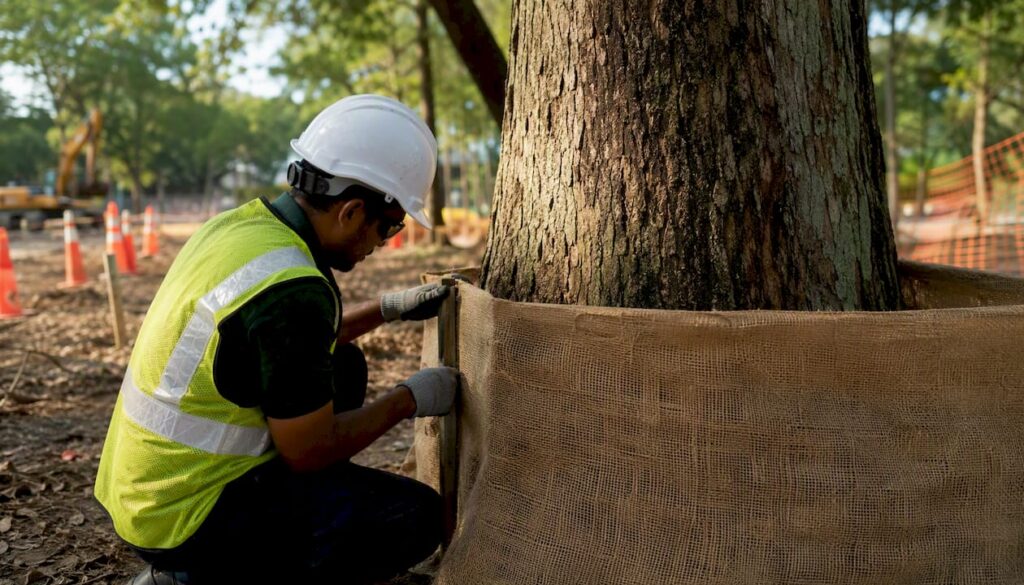
If your project involves tree removal, transplanting, major pruning, planting on public parkland, or any works within a Tree Conservation Area (TCA), NParks approval is required before mobilization. The immediate next action is to confirm your submission route: development-related works go through CORENET 2.0, while non-development requests are handled via NPARKS_Registry@nparks.gov.sg or the OneService App.
NParks’ Greenery and Development Planning (GDP) Branch reviews submissions at three project stages: Development Control (DC), Building Plan (BP), and Certificate of Statutory Completion (CSC). Each stage has defined submission requirements and service-level timelines. Missing any one of them adds weeks to your program. For arboricultural assessments, the GDP Branch expects reports prepared by or in consultation with arborists holding International Society of Arboriculture (ISA) credentials, which sets the professional benchmark for tree impact methodology in Singapore.
Before your first submission, two actions reduce the most common sources of delay:
- Verify whether any trees on or adjacent to your site fall within a TCA or carry a tree protection order, using NParks mapping tools or direct enquiry to the GDP Branch.
- Schedule a pre-submission consultation via CORENET 2.0 (select “Pre-Consultation (PC)” under Submission Type) to confirm required documents and applicable submission type before you package anything.
Table of Contents
- How do you confirm whether your site falls under NParks jurisdiction?
- What is the step-by-step NParks application process?
- What do NParks reviewers look for in your application documents?
- Which other agencies do you need to coordinate with?
- What are the NParks review timelines and what causes delays?
- What penalties apply for unauthorized tree or parkland works?
- How does an authority-submission consultant speed up NParks approvals?
- Key Takeaways
- The real cost of a late NParks submission
- Official NParks resources and submission contacts
- Stellar Structures handles NParks submissions for contractors and developers
How do you confirm whether your site falls under NParks jurisdiction?
Confirming jurisdiction before mobilization is not optional. Proceeding without it is the single most common reason contractors face stop-work orders on tree-related works.
- Check NParks mapping and TCA boundaries — NParks publishes TCA boundaries and tree protection information through its online resources. Cross-reference your site boundary against these maps before any site preparation begins. Where mapping is ambiguous, contact the GDP Branch directly for written confirmation.
- Review the GDP handbook. The GDP handbook sets out qualifying developments, submission thresholds, and the criteria NParks uses to determine whether a development triggers GDP review. Read the qualifying-development criteria before assuming your project is exempt.
- Request a pre-submission consultation. For complex sites, multi-tree removals, or any works within a TCA, submit a Pre-Consultation (PC) request via CORENET 2.0 before you submit your development plan. NParks reviewers will clarify the applicable submission type and required documents, which prevents resubmissions.
Pro Tip: Engage an ISA-credentialed arborist to verify tree girth measurements and condition ratings on-site before the survey is finalized. GBH measurements that differ from NParks’ own records by more than a minor margin trigger automatic RFIs, and correcting them after submission costs more time than getting them right initially.
What is the step-by-step NParks application process?
The GDP Branch evaluates development plan submissions at DC, BP, and CSC stages to confirm that mature trees are not removed without documented consideration of alternatives. The submission sequence follows the broader development approval timeline.
- Pre-submission consultation (recommended). Submit a Pre-Consultation (PC) request via CORENET 2.0. NParks will review your proposed approach and confirm the submission type, required documents, and any site-specific requirements. This step is not mandatory but consistently reduces review cycles.
- Development Control (DC) stage submission. Package your tree survey, arborist report, tree protection plan, and landscape plans. Submit via CORENET 2.0 under the appropriate DC submission type. Application fees are payable at this stage.
- Building Plan (BP) stage submission. If NParks requires further review at BP stage (triggered by conditions set at DC or by the nature of the works), submit updated drawings and any revised tree protection methodology. Fees apply at BP stage as well. For projects using the Self-Declaration (SD) scheme at BP stage, the QP declares compliance with NParks’ requirements without a full review, subject to eligibility criteria in the GDP handbook.
- Certificate of Statutory Completion (CSC) clearance. Before CSC is issued, NParks confirms that tree protection measures were implemented as approved and that any required planting has been completed. Submit CSC documentation via CORENET 2.0.
- Non-compliance applications. Where a project cannot comply with NParks’ requirements at DC or BP stage, a non-compliance application may be submitted via CORENET 2.0. NParks evaluates these case by case; approval is not guaranteed, and the GDP handbook outlines the grounds on which non-compliance may be accepted.
For non-development works, the submission route bypasses CORENET entirely. Submit via NPARKS_Registry@nparks.gov.sg or the OneService App, and note that QPs may act on behalf of developers for development-related works only.
Key documents to attach at DC submission:
- Completed tree survey with GPS coordinates and condition ratings
- ISA-qualified arborist report with impact assessment and mitigation measures
- Tree protection plan with construction methodology
- Landscape plans including planting schedules and species lists
- Site plan showing tree locations relative to proposed works
What do NParks reviewers look for in your application documents?
Document quality is where most applications succeed or fail. Reviewers in the GDP Branch are not checking boxes; they are evaluating whether the QP and contractor have genuinely assessed tree impact and proposed credible mitigation.
Tree survey requirements:
- Species identification (common and scientific name), GBH measurement, precise GPS coordinates, crown spread, and condition rating for every tree within and adjacent to the site
- Survey methodology must be stated; desktop surveys without site verification are routinely rejected
- Mapping must be at a scale that allows individual trees to be located relative to proposed works
Arborist report scope:
- Impact assessment covering both above-ground and below-ground effects of proposed works
- Transplant feasibility assessment where transplanting is proposed, including root ball specifications and post-transplant monitoring protocol
- Mitigation measures must be specific: generic statements (“tree protection fencing will be installed”) without dimensions, materials, or monitoring frequency are a common RFI trigger
- The report author must hold ISA credentials or equivalent recognized qualification; the credential must be stated in the report
Tree protection plan and construction methodology:
- Protective barrier specifications: material, height, setback from root protection zone
- Root zone protection during excavation: hand-digging requirements, root pruning methodology, and backfill specifications
- Construction sequencing that identifies when tree protection measures are installed relative to site clearance and excavation
- Named site supervisor responsible for tree protection compliance and contact details
Landscape plans:
- Planting schedules with species, sizes at planting, and spacing
- Soil and growing medium specifications, particularly where works affect public land or parkland
- Maintenance handover provisions where NParks or a public agency will take over management
| Document | Common Deficiency | Quick Fix |
|---|---|---|
| Tree survey | Missing GPS coordinates or GBH measurements | Conduct full on-site survey with ISA arborist before submission |
| Arborist report | Vague mitigation measures, no monitoring plan | Specify barrier dimensions, monitoring frequency, and responsible party |
| Tree protection plan | No construction sequencing | Add a phased program showing when protection is installed vs. excavation |
| Landscape plans | Missing soil specifications | Include growing medium depth, composition, and drainage details |
| All documents | QP signoff absent or unsigned | Confirm QP signs and dates every document before CORENET packaging |
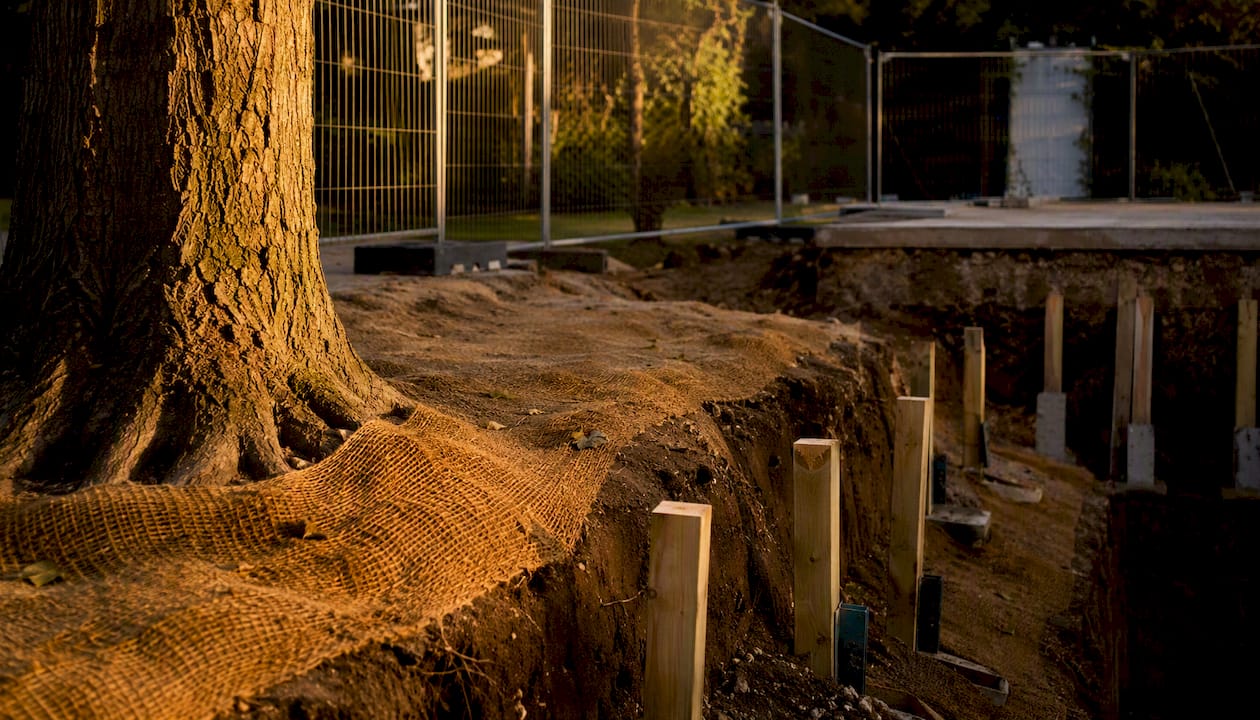
For projects involving excavation near tree root zones, temporary works design must account for root protection requirements and be coordinated with the tree protection plan.
Which other agencies do you need to coordinate with?
NParks clearance rarely stands alone. Most development projects affecting trees or parkland also require sign-off from one or more other authorities, and the sequencing of those approvals affects your overall program.
- Urban Redevelopment Authority (URA) and Building and Construction Authority (BCA): — DC and BP approvals from URA and BCA are typically required before or concurrent with NParks submissions. NParks’ GDP review is integrated into the broader development approval process via CORENET 2.0. Understanding building plan submission requirements in parallel with NParks requirements avoids sequencing conflicts.
For projects where works involve multi-agency submissions, packaging documents consistently across agencies reduces review friction. The authority submission workflow for multi-agency projects follows a similar sequencing logic: confirm which agency’s clearance is a prerequisite for others, and submit in that order.
What are the NParks review timelines and what causes delays?
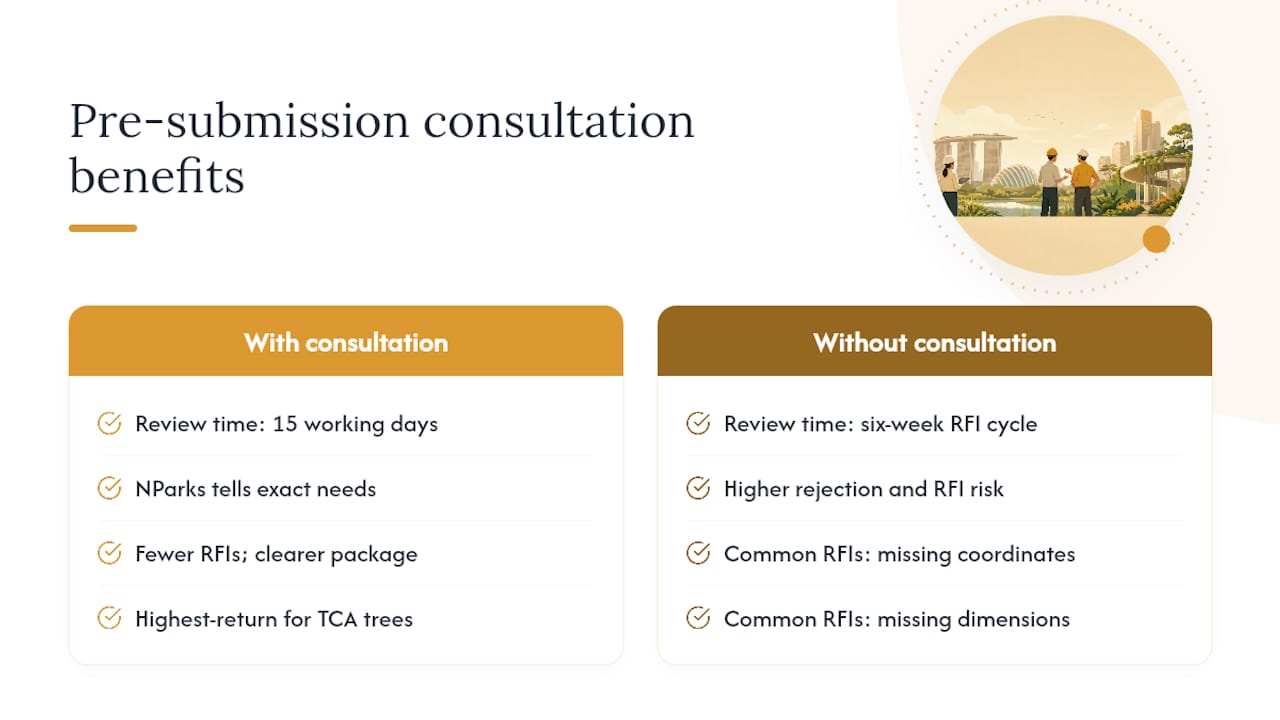
NParks publishes service-level timelines for each submission stage. Per the after-submission guidance, the targets are:
These timelines apply when all submission requirements are fully complied with. An incomplete submission resets the clock from the date a complete resubmission is received.
The most frequent causes of delay:
- Cross-agency coordination gaps: — Where NParks’ approval depends on a concurrent LTA or PUB clearance, delays in those agencies cascade into the NParks timeline.
Pro Tip: Build a minimum of six weeks into your program for DC clearance on any site with TCA trees or multiple tree removals, even if the service-level target is 15 working days. RFI cycles, resubmissions, and cross-agency dependencies routinely extend actual turnaround beyond the published target.
What penalties apply for unauthorized tree or parkland works?
Unauthorized tree removal or damage to protected trees in Singapore carries serious enforcement consequences. NParks has statutory authority to issue stop-work orders, require full restoration, impose fines, and refer cases for prosecution under the Parks and Trees Act.
Typical enforcement sequence for unauthorized works:
- Restoration requirement: — NParks will specify remediation works, which may include replanting with trees of equivalent or greater value, soil remediation, and ongoing monitoring at the contractor’s cost.
If unauthorized works have already occurred, the immediate steps are:
- Submit the remedial plan to NParks via CORENET or the GDP Branch contact, depending on whether the project is development-related
Do not continue works while seeking retrospective approval. Continuing after an unauthorized act is discovered significantly worsens the enforcement outcome. NParks treats ongoing works post-discovery as an aggravating factor in penalty assessment, and it eliminates the goodwill that a voluntary stop and prompt notification would otherwise generate.
Contractor legal responsibilities in Singapore extend well beyond tree protection; the builder responsibility framework covers the broader liability context that applies when works affect public assets.
How does an authority-submission consultant speed up NParks approvals?
An authority-submission consultant does not simply prepare documents. The value is in knowing exactly what NParks reviewers will flag before the submission is packaged, which eliminates the RFI cycles that extend review timelines.
Specific deliverables a consultant provides for NParks submissions:
- NParks-format drawings and CORENET digital packaging: — Preparing drawings at the correct scale, with the correct layer conventions and title block information, and packaging the CORENET submission with the correct submission type and fee calculation.
These deliverables shorten review cycles in concrete ways. Correct submission types eliminate routing delays. Accurate fee calculations prevent payment holds. Pre-validated arborist reports with specific mitigation measures avoid the most common RFI trigger. For projects involving civil and structural design checks alongside NParks submissions, a consultant who handles both workstreams ensures that structural drawings and tree protection plans are consistent with each other.
Pro Tip: Engage an authority-submission consultant at the pre-submission consultation stage, not after your first RFI. The cost of a consultant scoping engagement is a fraction of the program cost of a four-week RFI cycle on a live construction site.
For complex sites, TCAs, or projects requiring coordination with three or more agencies, the case for early consultant engagement is straightforward. The building authority submission consultant guide outlines how to scope an engagement and what to expect at each stage.
Key Takeaways
Contractors and developers must complete jurisdiction checks, pre-submission consultation, and full document preparation before submitting to NParks via CORENET 2.0, with DC and BP reviews each having a service-level target of 15 working days and CSC stage a service-level target of 7 working days when submissions are complete.
| Point | Details |
|---|---|
| Confirm jurisdiction first | Check TCA boundaries and tree protection orders before any site preparation or mobilization. |
| Use CORENET 2.0 for development works | All development-related NParks submissions must go through CORENET 2.0; non-development requests use NPARKS_Registry@nparks.gov.sg or OneService. |
| Service-level timelines | DC and BP: 15 working days each; CSC: 7 working days (when submissions are complete). |
| Document quality determines speed | Missing GPS coordinates, vague mitigation measures, or absent QP signoffs are the leading causes of RFIs and timeline overruns. |
| Stellar Structures for complex submissions | Stellar Structures prepares validated surveys, ISA-arborist-coordinated reports, and cross-agency CORENET packages that reduce RFI cycles. |
The real cost of a late NParks submission
The GDP submission process is well-documented, but the gap between knowing the steps and executing them correctly is where most contractors lose time. The documents that cause the most RFIs are not the complex ones. They are the tree survey with missing coordinates, the arborist report that lists mitigation measures without specifying dimensions, and the tree protection plan that describes barriers without a construction sequence. These are not difficult to fix; they are simply easy to overlook when a QP is coordinating multiple agency submissions simultaneously.
The Self-Declaration scheme is another area where contractors frequently misjudge eligibility. Not every BP-stage submission qualifies, and submitting under SD when a full review is required results in a rejection that costs more time than the full submission would have taken. The GDP handbook’s eligibility criteria are specific; reading them before selecting a submission type is not optional.
For projects with TCA trees, the pre-submission consultation is the single highest-return action available before CORENET packaging. NParks reviewers at that stage will tell you exactly what they need. That conversation, documented and acted on, is the difference between a 15-working-day review and a six-week RFI cycle.
When the site is complex, the trees are significant, and the program is tight, the question is not whether to engage a consultant. It is whether to engage one before the first submission or after the first rejection.
Official NParks resources and submission contacts
The following official sources cover every stage of the GDP submission process:
- Development plan submission
- How to submit your development plan
- After submitting your development plan
- Before you submit your development plan
- GDP handbook (PDF)
Submission contacts and routes:
Search terms that retrieve the most current NParks forms and checklists: “NParks GDP submission requirements,” “CORENET NParks submission type,” “NParks tree conservation area map,” and “NParks pre-submission consultation.”
Stellar Structures handles NParks submissions for contractors and developers
Contractors and developers who need NParks clearance alongside BCA, URA, LTA, or PUB approvals face a document coordination challenge that compounds with every additional agency. Stellar Structures manages the full authority submission workflow for development projects in Singapore, including NParks GDP submissions at DC, BP, and CSC stages.
The firm prepares validated tree surveys coordinated with ISA-qualified arborists, NParks-format drawings packaged for CORENET 2.0, and consolidated cross-agency submission sets that keep document versions consistent across all authorities. For projects involving deep excavations near tree protection zones or structural works that interact with landscape requirements, Stellar Structures integrates engineering and authority submission deliverables into a single coordinated package.
For contractors working on tight programs, the practical benefit is fewer RFI cycles and a submission that arrives at the GDP Branch ready for review on day one. Contact Stellar Structures to scope an authority submission engagement before your next CORENET submission.
Recommended
- What Are The Requirements For Building Plan Submission In Singapore – Stellar Structures
- Stages of New Build Construction in Singapore: 2026 Guide
- PE design check and Authority approvals such as JTC, URA, BCA and SCDF for your industrial and commercial business – Stellar Structures
- Mezzanine Floor Approval Guide Singapore 2026