




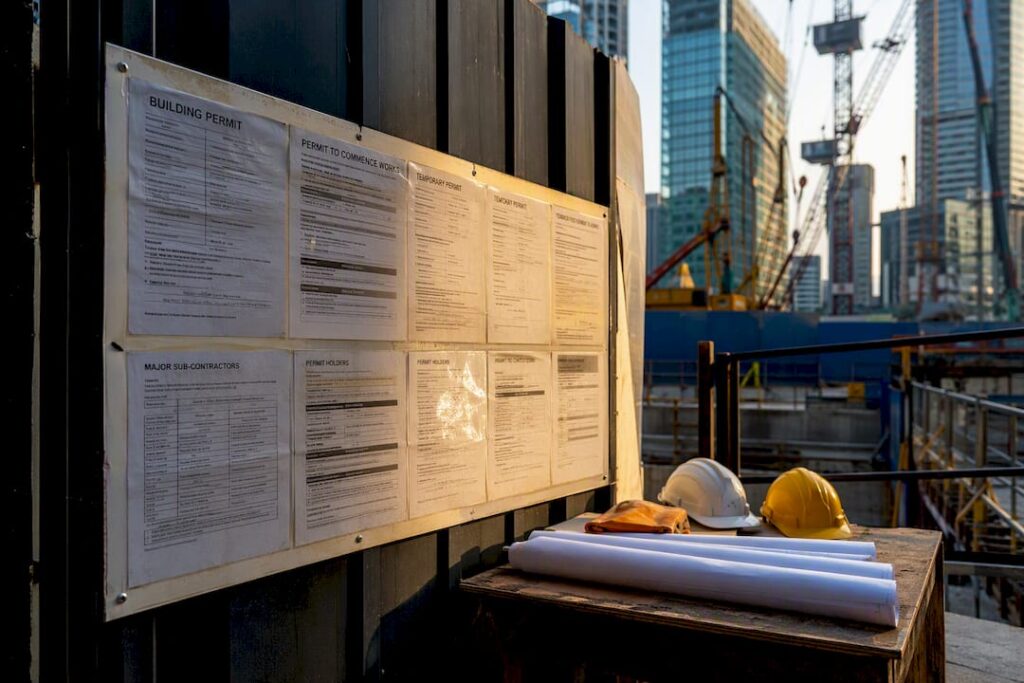
The Temporary Occupation Permit (TOP) allows you to move into a unit deemed safe for occupation. The Certificate of Statutory Completion (CSC) is the final, later sign-off confirming the entire development meets every statutory requirement. The Building and Construction Authority (BCA) issues both, and under a typical Progressive Payment Scheme, TOP commonly triggers your 25% payment milestone.
- TOP means you can collect keys and move in, even with minor works outstanding
- CSC arrives months later, once every clearing agency signs off
- Your right to report defects survives both permits
Key Takeaways
| Point | Details |
|---|---|
| TOP enables occupancy | BCA issues TOP once essential safety requirements are met, allowing key collection and move-in. |
| CSC is the final sign-off | CSC requires clearance from URA, SCDF, PUB, NParks, LTA, and NEA before BCA grants it. |
| Payment milestones follow permits | TOP commonly triggers the 25% payment; final completion or CSC usually aligns with the last 15%. |
| Defect rights survive both permits | Buyers can still report defects after CSC under their S&P terms. |
| Verify phase-specific documents | Confirm your unit’s block or phase is named on the issued TOP, not assumed from a neighboring block. |
Table of Contents
- TOP vs CSC: The Core Difference Explained
- What Is a Temporary Occupation Permit (TOP)?
- What Is a Certificate of Statutory Completion (CSC)?
- How TOP and CSC Differ in Practice
- Who Applies for TOP and CSC, and How Long It Takes
- Phased TOPs, Occupied Blocks, and Sub-Sales
- Your Checklist From TOP to CSC
- What Engineers Look For Before TOP and CSC Are Issued
- Where to Verify TOP and CSC Details
- An Editorial Take on Reading TOP and CSC Correctly
- Frequently Asked Questions
- Sources
TOP vs CSC: The Core Difference Explained
The gap between these two permits confuses even seasoned buyers, and it matters because it dictates when you get keys, when you pay, and how much recourse you have if something is wrong. TOP is a safety threshold, not a finish line. BCA issues it once a development meets essential structural and fire safety requirements for occupation, according to its official TOP/CSC application guidance. CSC is the finish line. It confirms every statutory agency involved in the project, not just BCA, has cleared the works.
This is why a TOP vs CSC comparison isn’t really about which permit is “better.” They serve different purposes at different points in a project’s life, and understanding both protects your cash flow and your legal position as a buyer.
What Is a Temporary Occupation Permit (TOP)?
A TOP confirms your development has cleared the essential safety bar for occupation, per BCA’s own criteria. It does not mean every last item on the project is finished. Structural stability, fire safety systems, and basic services usually need to be in place before BCA signs off, but plenty of secondary work often trails behind.
Common items still outstanding at TOP:
- Landscaping and communal garden works
- Non-critical common-area finishes, such as lobby décor or signage
- Clubhouse or facility fit-outs not tied to unit occupation
Large projects often receive TOP in phases. One block might be cleared for occupation while another, still under construction, waits its turn. That phasing is exactly why the permit is block or phase specific rather than a blanket approval for the whole site.
Pro Tip: Never assume your unit is covered by a TOP issued for a “neighboring” block. Ask your developer or solicitor to confirm the exact phase named on the document, and request written proof rather than relying on a marketing notice.
What Is a Certificate of Statutory Completion (CSC)?
CSC is the final BCA-issued certificate confirming full statutory compliance, granted only after every relevant technical agency has cleared its portion of the project. It closes the loop that TOP leaves open.
Agencies commonly involved in CSC clearance include:
- Urban Redevelopment Authority (URA) for planning compliance
- Singapore Civil Defence Force (SCDF) for fire safety systems
- PUB for drainage and water supply
- NParks for landscaping compliance
- Land Transport Authority (LTA) for access and traffic works
- National Environment Agency (NEA) for environmental clearances
CSC typically follows TOP by several months, sometimes close to a year, depending on how much outstanding work remains and how quickly each agency processes its clearance.
How TOP and CSC Differ in Practice
The theoretical difference between TOP and CSC matters less to most buyers than what each permit actually triggers in their day-to-day dealings with the developer, the bank, and the law firm handling their purchase.
- Occupation and keys. TOP grants vacant possession right away. CSC arrives later and changes nothing about your ability to live in the unit, since you’re already there.
- Payment milestones. Under a standard Progressive Payment Scheme, TOP commonly triggers a quarter of the payment milestone, while the final 15% usually aligns with legal completion or CSC. Always verify the exact schedule against your Sale and Purchase agreement with your solicitor, since minor variations exist between projects.
- Conveyancing status. Whether you bought a new sale unit, a sub-sale, or a resale can affect how strata title issuance and legal completion play out around CSC timing.
- Defect handling. Receiving CSC does not cancel your contractual right to report defects, an obligation that continues under the terms of your S&P regardless of which certificate has been issued.
TOP and CSC processing itself moves fairly fast on BCA’s end. Complete submissions are typically processed within 7 working days, which means most of the delay you experience as a buyer comes from outstanding works, not bureaucratic backlog.
Who Applies for TOP and CSC, and How Long It Takes
The application doesn’t come from you. A Qualified Person (QP), typically the project’s appointed architect or engineer, submits the application to BCA on the developer’s behalf, and the developer carries ultimate responsibility for compliance.
Typical documents in a complete submission include:
- Builder’s certificate of completion
- Certificate of supervision from the QP
- Clearance letters from relevant technical agencies
- Completed CSC/TOP application forms.pdf)
BCA generally processes complete applications within 7 working days. Incomplete submissions, missing agency sign-offs, or unresolved defects are what stretch this timeline, sometimes by weeks or months. If you want a deeper walkthrough of the submission pathway from building plan approval onward, this guide to BCA submissions covers the full sequence.
Phased TOPs, Occupied Blocks, and Sub-Sales
Large mixed-use or multi-block developments rarely get TOP all at once. One tower might be cleared for occupation while the clubhouse, a connecting walkway, or a neighboring block remains under construction, and none of that stops residents in the cleared block from moving in.
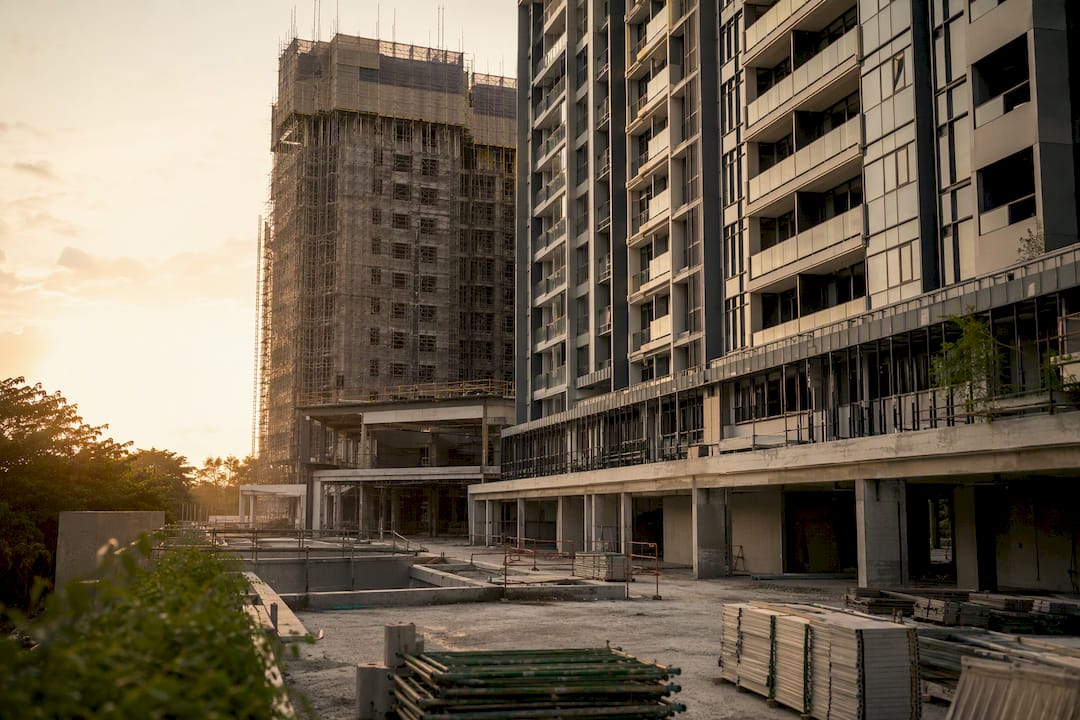
This staggered timing has a market effect: sub-sales often happen before CSC is granted, since TOP alone is enough to unlock resale activity in many cases. If you’re buying a sub-sale unit, confirm contractually whether the seller’s obligations extend past TOP and who carries responsibility for any defects discovered before CSC.
Your Checklist From TOP to CSC
- Request documentary proof that the issued TOP names your specific block or phase, not a neighboring one.
- Confirm your progressive payment notice and bank loan disbursement timing with your solicitor before the 25% milestone falls due.
- At key collection, check approved plans, unit inventory, the developer’s defect list, MCST fee obligations, utility account setup, and whether you need a renovation permit before starting work.
- Log every defect in writing with dated photos, and escalate through your solicitor if the developer stalls on rectification.
- Budget for TOP-day cash outflows beyond the payment milestone, including advance maintenance fees, survey and admin charges, and utility deposits.
Pro Tip: Keep every defect report dated and in writing, even minor ones. A verbal complaint to a sales office has no paper trail; an emailed defect list with photos does, and it protects you if disputes drag past CSC.
What Engineers Look For Before TOP and CSC Are Issued
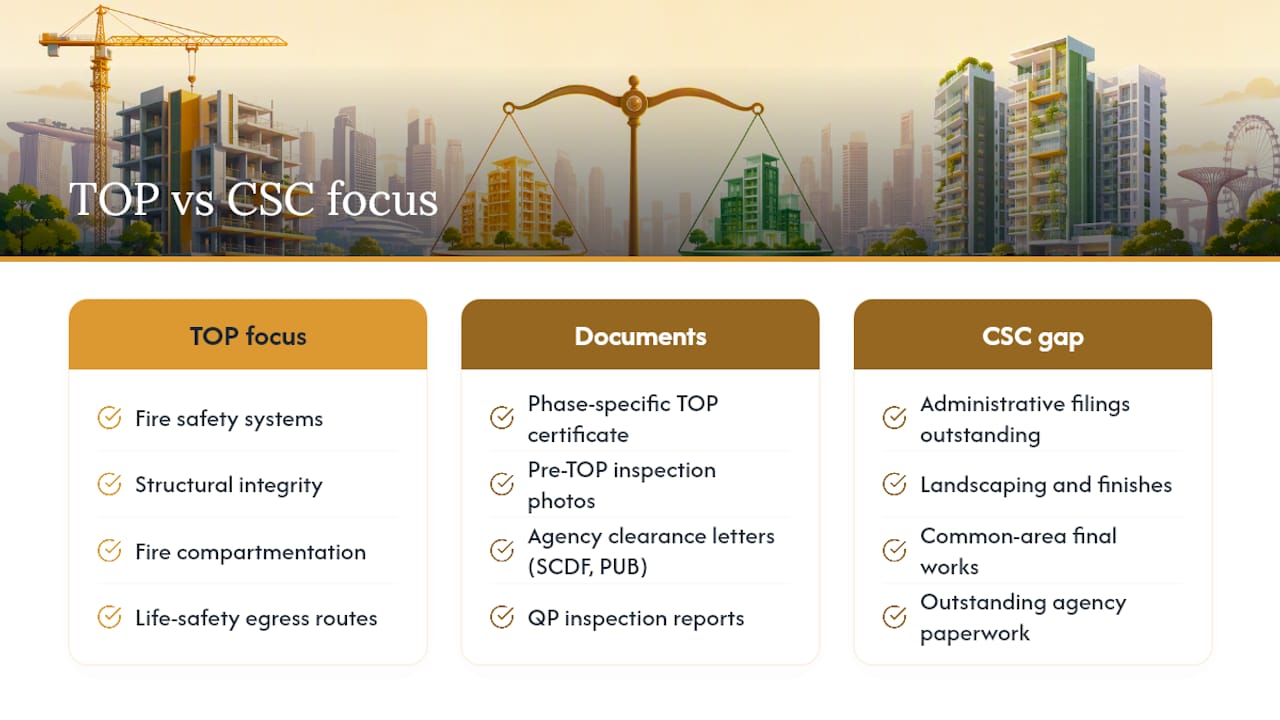
TOP marks a safety threshold, not a finished product, and that distinction shapes what a competent inspection actually checks for. Fire safety systems, structural stability, and life-safety egress routes get priority scrutiny, while cosmetic and landscaping items are correctly left for later.
Documents worth requesting from your developer or QP include the phase-specific TOP itself, inspection photos from the pre-TOP walkthrough, and copies of agency clearance letters from bodies like SCDF and PUB.
An engineering consultant reviewing a development before TOP is looking for the same things BCA’s inspectors check: structural integrity, fire compartmentation, and egress. The gap to CSC is almost always administrative work, landscaping, common-area finishes, and outstanding agency paperwork rather than anything that affects whether the building is safe to live in.
Firms handling structural design checks and periodic inspections work through this exact sequence with developers, tracking which clearances remain outstanding and helping resolve them before CSC filing.
If your purchase involves complex ground conditions or phased authority submissions, it’s worth engaging a geotechnical engineering consultant early, since foundation and site issues are among the slower items to clear during the TOP-to-CSC window. Com works alongside developers, QPs, and property owners on exactly this kind of authority coordination, from BCA submissions through to final agency clearance, so buyers and stakeholders aren’t left guessing about what’s actually outstanding.
Where to Verify TOP and CSC Details
- BCA’s official TOP/CSC application page for forms and requirements
- BCA CSC inspection guidance for inspection scope
- ScamShield to verify suspicious payment or document requests
An Editorial Take on Reading TOP and CSC Correctly
Most guides treat TOP and CSC as a simple sequence: one permit, then the other, done. That framing undersells what actually matters to a buyer, which is that the gap between them is almost entirely administrative, not structural. The building you move into at TOP has already cleared the safety bar that counts. What’s often still missing is paperwork and cosmetic finishing, not anything that should worry you about living there.
Where conventional advice falls short is in treating CSC as an afterthought once keys are in hand. It isn’t. Your defect liability period, your final payment milestone, and your legal completion timeline all hinge on it, and buyers who stop paying attention after move-in often miss the window to flag issues cleanly.
Prioritize two things: get written, phase-specific proof of your TOP status, and keep a dated defect log from day one. Everything else, the landscaping, the clubhouse, the final agency sign-offs, will resolve on its own timeline. Your paperwork won’t fix itself.
Frequently Asked Questions
Does TOP mean my unit is fully finished?
No. TOP confirms the development meets essential safety requirements for occupation. Minor works like landscaping or common-area finishes often remain outstanding.
Can I resell my unit before CSC is issued?
Yes, sub-sales frequently happen before CSC is granted, since TOP alone permits occupation and transfer in many cases. Confirm the seller’s remaining obligations contractually.
How long does it typically take to go from TOP to CSC?
It varies by project, often several months and sometimes close to a year, depending on how many agency clearances and outstanding works remain.
Do I still have defect rights after CSC is issued?
Yes. CSC does not cancel your contractual defect liability rights under your Sale and Purchase agreement.
Who is responsible for submitting the TOP and CSC applications?
The Qualified Person appointed on the project submits both applications to BCA, with the developer holding ultimate responsibility for compliance.
Sources
- Application for TOP/CSC | Building and Construction Authority
- Property Unpacked: The connection between TOP, CSC and sub-sales (EdgeProp)
Recommended
- Singapore Marine Clay & Property Settlement: Guide for Homeowners (2025)
- Planning Permission in Singapore: 2026 Developer’s Guide
- How to Get BCA Approval for Landed Property Reconstruction in Singapore
- BCA Fines vs Regularisation Costs: Why Early Plan Submission is Cheaper