





If your development sits above the Land Transport Authority’s intensity thresholds, sits near a major transport node, or occupies a site already carrying heavy traffic, a traffic impact assessment is very likely required before LTA will clear your plans. The first move is not hiring a consultant. It is booking a pre-consultation or scoping meeting with LTA to confirm whether your project triggers a full study and, if so, which classification applies.
Do this before finalizing your design brief:
- Request a scoping meeting with LTA to confirm TIA applicability and classification.
- Appoint a consultant registered under the LTA Registration Scheme for TIA Consultancy Firms.
- Gather baseline data early: site access points, gross floor area figures, and any existing traffic counts.
- Reference the LTA TIA Guidelines (2019 edition and its January 2020 addendum) before your consultant scopes the study.
Key Takeaways
A traffic impact assessment succeeds when scoping is confirmed with LTA early, the classification matches the true network complexity, and the consultant demonstrates calibrated modeling and WCP experience.
| Point | Details |
|---|---|
| Scope before you design | Book an LTA pre-consultation to confirm whether a TIA is needed and which classification applies. |
| Classification sets the clock | Type 1 studies run roughly three months for Phase 1; Type 2 and Type 3 need micro-simulation and longer timelines. |
| Report structure is fixed | Existing conditions, trip generation, modal split, junction analysis, and WCP are non-negotiable components. |
| Calibration prevents queries | Poorly validated models are the most common trigger for LTA review comments and rework. |
| Registered consultants reduce risk | LTA-registered TIA firms have proven track records and a qualified Principal Consultant on record. |
| Coordinate across agencies | Stellar Structures aligns TIA submissions with BCA, URA, SCDF, and other authority reviews to cut rework. |
Table of Contents
- What Is a Traffic Impact Assessment and When Does LTA Require One?
- How Does the LTA Scoping and Classification Process Work?
- What Should a TIA Report Actually Contain?
- How Do You Choose the Right TIA Consultant?
- What Causes LTA Queries and How Do You Reduce Review Cycles?
- How Do TIA Findings Address Environmental and Social Impact?
- How Should Developers Handle Stakeholder Engagement?
- How Do Land Use Changes Affect Traffic Projections?
- What Other Legal Frameworks Govern TIAs Beyond LTA Rules?
- Why Integrated Authority Coordination Changes TIA Outcomes
- Get Scoping-Ready Before You Approach LTA
- Where to Verify LTA Requirements and Next Steps
- Sources
What Is a Traffic Impact Assessment and When Does LTA Require One?
A transportation impact study, known in Singapore as a Transport Impact Assessment or traffic impact assessment, is a formal technical study LTA requires for developments that meet specific intensity thresholds. Its job is to quantify how much new traffic a project will generate, distribute that traffic across the surrounding road network, and identify measures that mitigate the impact before the development opens, according to LTA’s development and construction specifications.
The study does more than count cars. It has to prioritize walking, cycling, and public transport ahead of private vehicle trips, a stance LTA has built directly into its guidelines rather than treated as an afterthought.
Three situations commonly trigger a requirement:
- Development intensity exceeds LTA’s published gross floor area or unit-count thresholds for the relevant land use.
- The site sits near an MRT station, major bus interchange, or expressway interchange where added trips could strain existing capacity.
- The surrounding road network already runs close to capacity, in which case LTA can mandate a TIA regardless of the project’s size.
A related but distinct requirement is the Walking & Cycling Plan (WCP), which LTA asks for when a development meets separate criteria tied to pedestrian and cyclist volumes. Many Type 2 and Type 3 TIAs fold WCP analysis directly into the main report rather than treating it as a bolt-on document.
How Does the LTA Scoping and Classification Process Work?
Everything starts with a pre-consultation meeting, and skipping this step is the single most common way developers waste months on a traffic analysis report that gets sent back for rework.
- Pre-consultation and scoping meeting. You and your consultant meet with LTA to define the study area, the assessment years (typically opening year plus a design horizon year), and the methodology. LTA confirms which junctions and road segments fall within scope.
- Classification is assigned. LTA sorts the study into Type 1, Type 2, or Type 3 based on the scale of impact and the complexity of the surrounding network.
- Phase 1 begins. This covers data collection, base model construction, and background traffic forecasting.
- Phase 2 follows, once Phase 1 is accepted, covering full impact analysis, mitigation design, and the WCP where applicable.
Type 1 studies typically cover only a few junctions and rely on SIDRA Intersection software, with a Phase 1 duration usually lasting a few months. Type 2 and Type 3 studies require micro-simulation modeling for more complex networks, which stretches Phase 1 to roughly four months and adds review rounds, according to the Addendum to the 2017 TIA Guidelines for Developers.
Pro Tip: Ask for classification confirmation in writing at the scoping meeting. A consultant’s fee proposal built on the wrong classification almost always underestimates both cost and calendar time, and that gap tends to surface only after work has started.
What Should a TIA Report Actually Contain?
LTA does not accept a generic traffic study repackaged with a new cover page. A compliant transportation planning analysis follows a structure built around specific technical components:
- Executive summary stating conclusions and proposed mitigation up front.
- Existing traffic conditions, including junction counts and current levels of service.
- Background traffic forecasts for the assessment years, independent of your development.
- Trip generation and distribution, showing how many trips your project adds and where they go.
- Modal split, breaking down car, public transport, walking, and cycling shares.
- Junction capacity analysis at each affected intersection.
- Pick-up and drop-off (PUDO) provisions and site access design.
- A traffic operation plan covering internal circulation.
- The Walking & Cycling Plan, when your site meets the trigger criteria.
For Type 2 and Type 3 studies, LTA expects micro-simulation modeling rather than intersection-level software alone, and every model has to be calibrated against real-world counts before it is submitted. Calibration means adjusting the model’s parameters until its outputs match observed traffic patterns closely enough that LTA reviewers can trust the forecast built on top of it. Submission packages typically need to include the model files themselves, not just summary charts, so LTA can reproduce your scenarios independently.
Traffic surveys feeding the model matter just as much as the software. Counts taken on a public holiday, during school vacation, or right after a nearby road closure skew results in ways that are hard to defend later. Bus service frequency, dwell times, and route data belong in the survey scope too, since a road usage evaluation that ignores public transport supply tends to understate how much capacity already exists for the modal shift LTA wants to see.
How Do You Choose the Right TIA Consultant?
Registration under the LTA Registration Scheme for TIA Consultancy Firms is not mandatory, but it tells you something concrete: registered firms have demonstrated a track record of acceptable TIAs, maintain staff training plans, and employ a Principal Consultant with at least a relevant bachelor’s degree and seven years of experience. That is a meaningfully higher bar than “has done traffic studies before.”
When comparing proposals, ask for:
- A list of past LTA-approved TIAs, ideally for projects of similar scale or land use.
- Sample calibration reports showing how they validated a previous model.
- The Principal Consultant’s CV and direct involvement in your project, not just a firm bio.
- A realistic timeline broken into Phase 1 and Phase 2, with review rounds budgeted in.
- Demonstrated WCP experience if your site is likely to trigger that requirement.
Pro Tip: Put the TIA classification you confirmed at scoping directly into your tender documents. Consultants who quote against the wrong classification will underbid, and you will pay the difference later in change orders and schedule slippage.
What Causes LTA Queries and How Do You Reduce Review Cycles?
Most rework traces back to a small set of recurring problems, and nearly all of them are avoidable with earlier decisions rather than better writing in the final report.
- Poor model calibration. Reviewers spot mismatches between observed conditions and model outputs quickly, and unexplained gaps generate queries almost automatically.
- Incomplete study area. Leaving out a junction that later shows congestion forces a scope expansion mid-review.
- Weak trip distribution justification. Assigning traffic to routes without a clear, evidence-based rationale invites pushback.
- Omitted PT or WCP details. A report that treats public transport and active mobility as an afterthought contradicts LTA’s stated priorities and gets flagged for it.
A short pre-submission checklist helps: confirm the study area matches what was agreed at scoping, exclude atypical survey days, keep growth assumptions conservative rather than optimistic, and state the reasoning behind every mitigation measure you did not implement, not just the ones you did.
How Do TIA Findings Address Environmental and Social Impact?
A traffic impact assessment is not purely a capacity exercise. LTA’s guidelines push developers toward measures that cut private vehicle trips, and that push has environmental weight behind it: fewer car trips generated per development means lower localized vehicle emissions and reduced idling at congested junctions near residential blocks, schools, and hospitals.
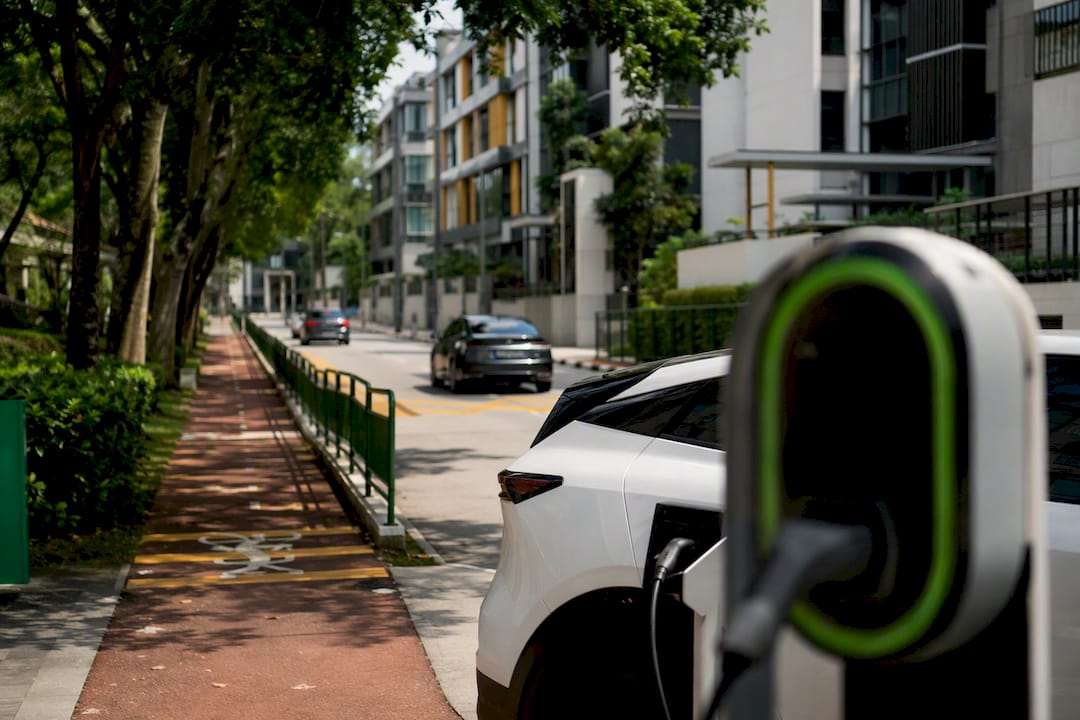
The social dimension shows up in how a TIA treats pedestrians and cyclists relative to drivers. A development that widens a road to accommodate more cars, without improving footpaths or crossing points, shifts risk onto the people least protected in traffic: pedestrians, children walking to school, and older residents. LTA’s Walk Cycle Ride priorities exist partly to correct that imbalance, requiring mitigation measures that make walking and cycling safer and more attractive rather than simply making driving easier.
Noise and severance are part of the picture too, though they get less attention than raw trip counts. A new access road or a redesigned junction can cut off an established pedestrian route or increase noise along a previously quiet street. A well-scoped TIA flags these effects during the assessment years being modeled, not after complaints arrive post-completion. For developers, building a credible mitigation narrative around these social effects, not just the traffic numbers, tends to move a report through review with fewer objections, since LTA reviewers are evaluating community impact alongside pure vehicle throughput.
How Should Developers Handle Stakeholder Engagement?
LTA’s own scoping meeting functions as the first stakeholder consultation, but it is not the only one you should plan for. Larger developments, particularly those near schools, hospitals, or established residential estates, often benefit from informal engagement with grassroots organizations, town councils, or residents’ committees before the TIA reaches final submission.
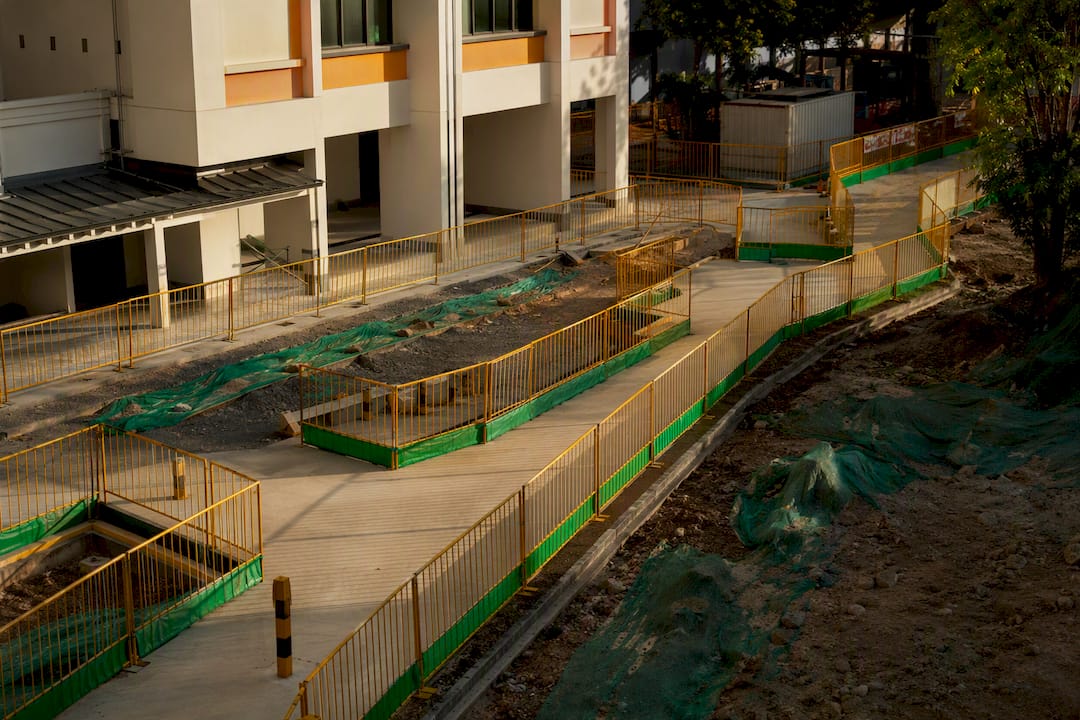
This is not a regulatory requirement in the way the scoping meeting is, but it serves a practical purpose. Residents living near a proposed access point or a widened junction usually notice construction-phase disruption long before opening day, and raising concerns after the TIA is locked in makes changes far costlier. Engaging early lets a developer adjust access design, PUDO placement, or construction traffic routing while the report is still in draft form.
For projects near other authority touchpoints, such as sites requiring parallel approvals from URA or HDB, coordinating stakeholder conversations across those channels avoids sending residents conflicting messages about timelines or scope. A consultant experienced in multi-agency submissions, similar to the coordination described in guidance on building plan submission requirements, typically knows which stakeholder concerns tend to resurface at each authority review stage, and can build responses into the TIA narrative before LTA even raises them.
How Do Land Use Changes Affect Traffic Projections?
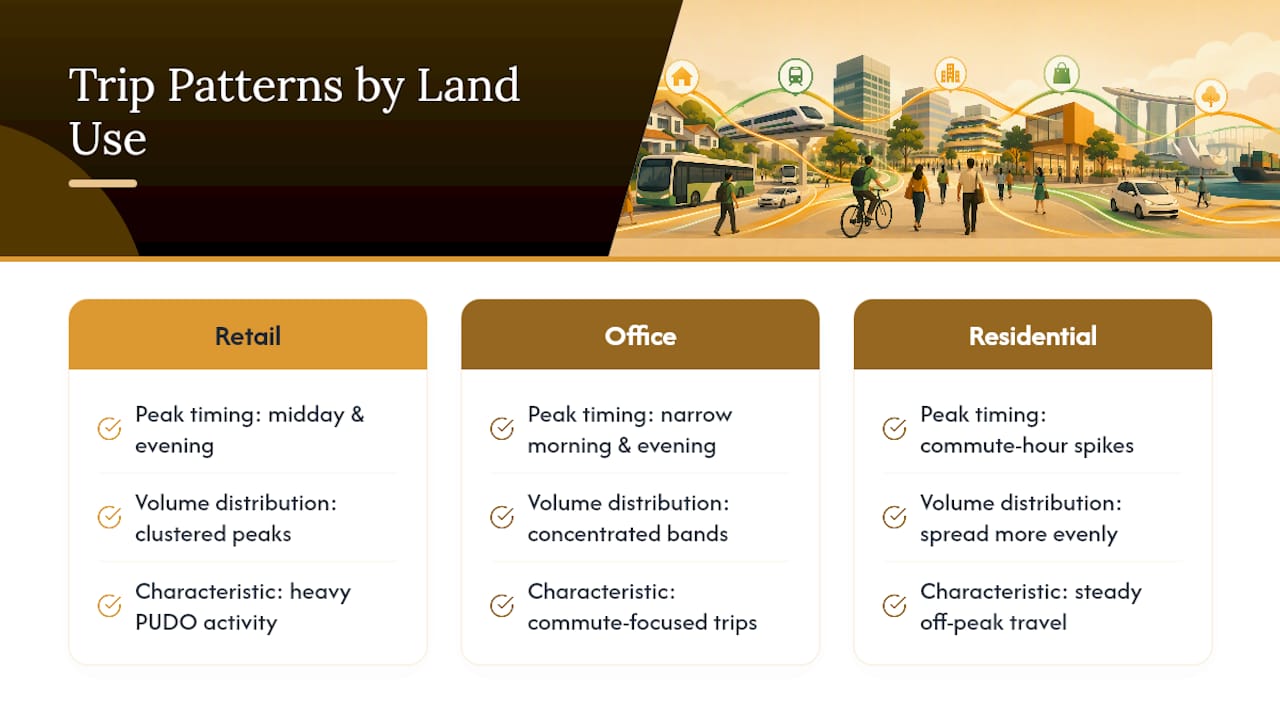
Every trip generation figure in a TIA starts with a land use assumption, and getting that assumption wrong undermines everything downstream. A site zoned for retail generates a different trip profile, in both volume and timing, than the same gross floor area used for offices or residential units. Retail trips cluster around midday and evening peaks with heavy PUDO activity; office trips concentrate in narrow morning and evening bands; residential trips spread more evenly but still spike at commute hours.
When a developer changes the intended use partway through planning, whether shifting from purely residential to mixed-use with ground-floor commercial space, the trip generation rates applied in the TIA have to change with it. This is one of the more common reasons a previously scoped study needs revisiting. A modest addition of commercial floor area can add enough peak-hour trips to push a project from Type 1 into Type 2 classification, extending both timeline and modeling requirements.
Background growth matters just as much as the development’s own trips. LTA’s assessment years account for how the surrounding area is expected to develop independently of your project, so a TIA for a site near other approved but not-yet-built developments has to layer your trips on top of forecasts that already assume that growth. Ignoring known nearby projects, or using outdated background traffic figures, produces a model that understates future congestion and invites exactly the kind of review query that stalls approval.
What Other Legal Frameworks Govern TIAs Beyond LTA Rules?
LTA sets the technical standards, but a traffic impact evaluation in Singapore does not exist in a regulatory vacuum. Most developments large enough to trigger a TIA are also subject to review under the Planning Act, administered by URA, since land use intensity and zoning compliance sit upstream of any traffic question. A project cannot generate LTA-relevant trip volumes without first securing the land use approval that makes those volumes possible.
Where a development involves environmental considerations, such as construction near waterways or sensitive green corridors, NEA and NParks requirements can run in parallel with the TIA timeline, and mitigation measures agreed with one agency sometimes affect design choices reviewed by another. Fire and life-safety access requirements from SCDF also intersect with TIA site access planning, since emergency vehicle routes and civilian access points often use the same junctions and driveways being modeled.
For public infrastructure works or utility crossings tied to a development’s access design, PUB’s requirements on drainage and water infrastructure can shape where an access road or PUDO bay can physically sit. None of these frameworks replace LTA’s TIA process. They run alongside it, and a project that treats them as separate silos usually discovers the conflicts late, when changing an access point to satisfy one agency forces a fresh look at the trip distribution already submitted to LTA.
Why Integrated Authority Coordination Changes TIA Outcomes
Stellar Structures handles civil, structural, geotechnical, and authority submissions under one roof, covering BCA, URA, HDB, JTC, SCDF, PUB, LTA, NEA, and NParks. That structure matters for TIAs specifically because access design, PUDO placement, and drainage tie-ins get resolved during design coordination rather than discovered during LTA review. Catching a conflict between a proposed access point and a geotechnical constraint before submission, rather than after a query, is what shortens review cycles in practice.
— Aman
Get Scoping-Ready Before You Approach LTA
A traffic impact assessment that starts with a rushed scoping meeting rarely finishes on schedule. Stellar Structures supports developers through the full sequence: preparing for the LTA pre-consultation, briefing consultants on classification and study area, coordinating TIA report preparation and modeling requirements, and folding Walking & Cycling Plan design into the broader authority submission strategy.
Because Stellar Structures already manages multi-agency submissions across BCA, URA, HDB, JTC, SCDF, PUB, LTA, NEA, and NParks, a TIA rarely lands as an isolated document. It gets coordinated against structural, civil, and geotechnical inputs before LTA ever sees the first draft, which is where most avoidable review queries get caught early. If your project involves structural works tied to the same submission, our guide on navigating the BCA Permit to Commence Structural Works covers how these approval tracks run in parallel.
Request a scoping consultation with Stellar Structures to confirm your TIA classification and get a realistic timeline before you commit to a consultant proposal.
Where to Verify LTA Requirements and Next Steps
- LTA development and construction specifications resources
- Addendum to the 2017 TIA Guidelines for Developers
- LTA Registration Scheme for TIA Consultancy Firms
- Temporary Traffic Diversions in Singapore: LTA Compliance Guide
Sources
- LTA development & construction specifications resources
- Addendum to 2017 TIA Guidelines for Developers (LTA)
- LTA | Registration Scheme for TIA Consultancy Firms
Recommended
- Temporary Traffic Diversions in Singapore: The Definitive LTA Compliance Guide
- Seismic and Wind Load Considerations for Industrial Superstructures in Singapore
- Temporary Works Design in Singapore: Mastering Safety
- Why Structural Submission Is Required Before Work