




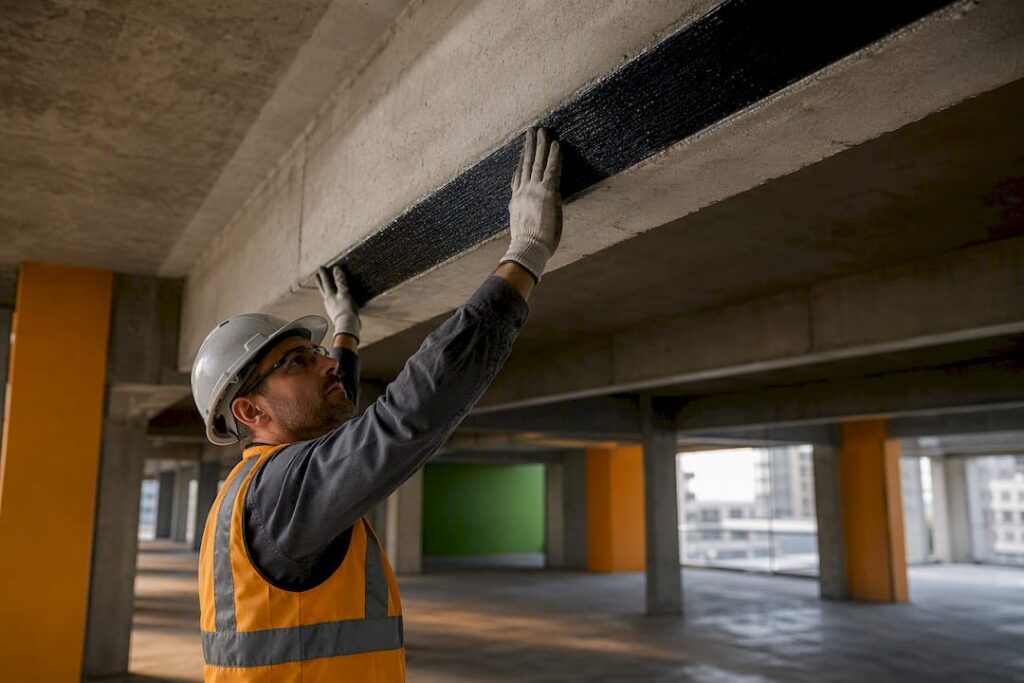
The main structural strengthening method families are externally bonded FRP (EBR), near-surface mounted FRP (NSM), steel or concrete jacketing, external prestressing, and TRM/FRCM composites. NSM suits bond-critical upgrades needing high FRP utilization, external prestressing addresses immediate serviceability problems like excessive cracking or deflection, and jacketing remains the default when a member needs genuine section enlargement rather than added tensile reinforcement.
TL;DR:
- External jacketing permanently increases the cross-sectional area, making it essential for addressing axial or seismic capacity deficiencies.
- FRP systems, whether epoxy-bonded (EBR) or near-surface mounted (NSM), generally have lower costs and installation times than jacketing but may lack capacity for large cross-sectional demands.
- External prestressing provides immediate serviceability improvements by reducing cracks and deflections through actively tensioned tendons or FRP strips.
- Compatibility testing of existing concrete, including bond and chloride assessments, prevents premature failure and ensures the longevity of the strengthening system.
- Regular long-term monitoring, including visual inspections and strain gauges, is critical to verify structural performance and address degradation over the structure’s lifespan.
Table of Contents
- An Overview of Structural Strengthening Methods and Where Each One Fits
- How Does Externally Bonded FRP (EBR) Strengthen Concrete?
- What Makes Near-Surface Mounted (NSM) Reinforcement Different?
- When Should You Choose Steel or Concrete Jacketing?
- Why Does External Prestressing Deliver Immediate Serviceability Gains?
- Are TRM and FRCM Better Than Epoxy-Bonded FRP?
- How Do You Choose the Right Strengthening Method?
- What QA and Durability Checks Belong in Every Strengthening Spec?
- How Do You Assess a Structure Before Strengthening It?
- Do Strengthening Materials Actually Bond Well to Old Concrete?
- How Do You Monitor a Strengthened Structure Over Time?
- How Much Do Structural Strengthening Methods Cost?
- What Do Real Strengthening Projects Reveal About Method Selection?
- Stellar Structures Perspective: Applying These Methods on Real Projects
- Get Expert Structural Design and Compliance Support
- Sources
An Overview of Structural Strengthening Methods and Where Each One Fits
Every strengthening method falls into one of three mechanical categories: externally applied reinforcement bonded to the concrete surface, reinforcement embedded into the substrate, or section enlargement that adds new concrete or steel around the existing member. A separate distinction matters just as much: passive systems only activate once the structure deflects or cracks further, while active systems like external prestressing change the stress state the moment they’re installed.
Element type drives the shortlist fast:
- Beams typically need flexural strengthening (EBR or NSM on the tension face) or shear strengthening (U-wraps or side-bonded strips).
- Columns usually call for confinement, whether FRP wraps or jacketing, to boost axial capacity and ductility.
- Slabs facing punching shear or negative-moment deficiencies often respond well to NSM strips or bonded FRP grids.
- Walls under out-of-plane loading or seismic retrofit frequently use FRP laminates or shotcrete overlays.
Composites (FRP, TRM) win when access is tight, added weight is unacceptable, or downtime has to stay minimal. Metallic jacketing wins when the deficiency is fundamentally about cross-sectional area or when fire-rated, code-recognized bulk is non-negotiable.
How Does Externally Bonded FRP (EBR) Strengthen Concrete?
Externally bonded reinforcement, EBR for short, bonds carbon fiber sheets, pultruded plates, or woven fabrics directly to a prepared concrete surface using structural epoxy. EBR and NSM remain the two most prevalent techniques for upgrading reinforced concrete elements today, with EBR favored where speed and minimal surface disruption matter most. CFRP sheets wrap columns for confinement, plates strengthen beam soffits in flexure, and fabric strips applied diagonally or as U-wraps address shear deficiencies.
A typical EBR installation sequence looks like this:
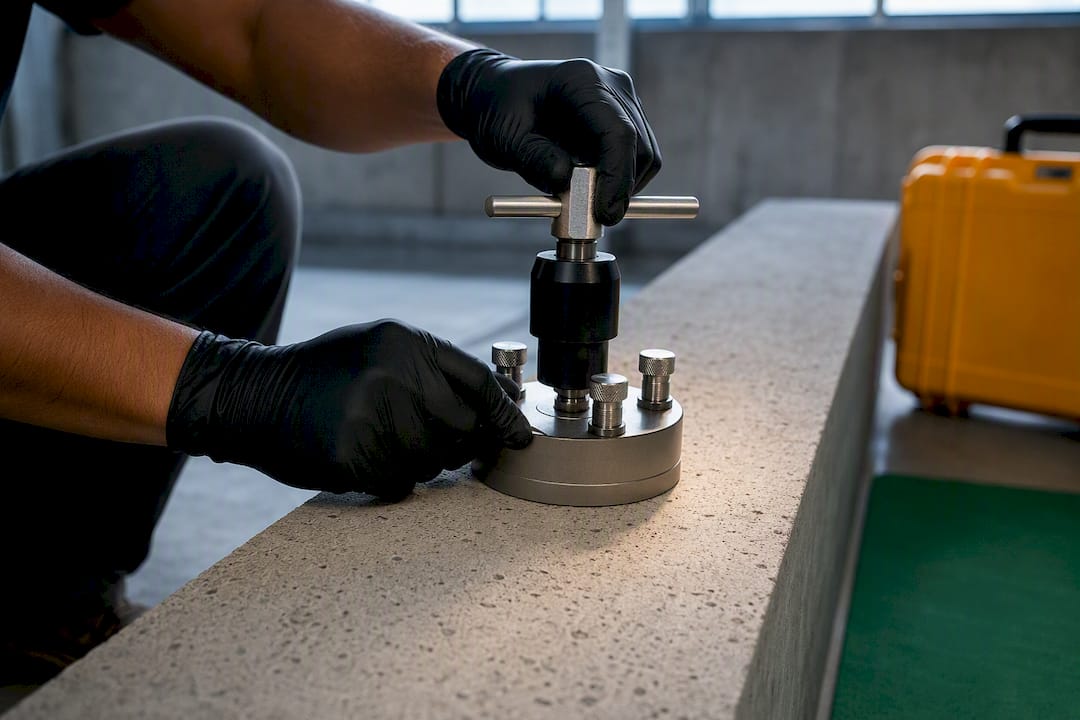
- Grind and profile the substrate to a sound, laitance-free surface, then verify surface tensile strength with a pull-off test.
- Round any sharp corners (columns especially) to a minimum radius before wrapping, to prevent fiber damage.
- Select an epoxy adhesive with a glass transition temperature (Tg) safely above the expected in-service and fire-exposure temperature range.
- Apply primer and adhesive per the manufacturer’s open time, then lay CFRP with a roller to remove voids and maintain fiber alignment.
- Add mechanical end-anchorage (fan anchors, near-surface anchors, or steel plates) where debonding at the plate end is a governing failure mode.
Debonding, not fiber rupture, is the failure mode that dominates EBR designs, and it typically initiates at the plate end or at flexural cracks where shear stress concentrates in the adhesive layer. Protective overlays, such as a cementitious render or UV-stable topcoat, extend service life against moisture and ultraviolet degradation.
Pro Tip: Never accept an EBR installation without a documented pull-off test on the actual substrate. Surface tensile strength below roughly 1.0 to 1.5 MPa is a common threshold below which bond failure risk rises sharply, and it’s cheaper to find that out before the epoxy cures than after.
EBR earns its place when the retrofit needs to happen fast, section geometry can’t change, and access to only one face of the member is available.
What Makes Near-Surface Mounted (NSM) Reinforcement Different?
NSM strengthening cuts grooves into the concrete cover, inserts FRP bars or thin strips into those grooves, and fills the void with epoxy or cement grout. The reinforcement sits embedded rather than surface-bonded, which changes the bond mechanics fundamentally.
- Embedding the FRP into a groove engages far more of the surrounding concrete in resisting bond stress, which improves bond efficiency and utilization of the FRP’s tensile capacity compared with surface-only EBR.
- Debonding risk drops accordingly, since the reinforcement is protected on three sides by concrete rather than relying entirely on an adhesive layer exposed to peel stress.
- Groove dimensions typically run at roughly 1.5 to 2 times the bar or strip thickness, sized to leave a consistent epoxy or grout annulus around the reinforcement.
- Anchorage at groove ends and careful alignment during cutting both influence whether the system reaches its designed capacity.
- Grooving and anchorage refinements, including additional ribs and wire mesh mortar protection layers, have produced bond strength improvements of up to roughly 114% in combined-anchorage laboratory testing.
The trade-off is precision. Groove cutting demands accurate layout and clean edges, and rebar clashes inside the cover zone can force redesign mid-installation. Many engineers now specify NSM combined with EBR on the same member, using the embedded bars for primary flexural capacity and surface-bonded fabric for supplemental shear or redundancy.
When Should You Choose Steel or Concrete Jacketing?
Jacketing adds material around the existing member rather than adding a thin external reinforcement layer, and it remains the right call whenever the real deficiency is cross-sectional area, not just tensile reinforcement.
- Steel plate bonding wraps or bolts steel plates to a column or beam, useful where fire rating or impact resistance matters more than minimizing added weight.
- Full concrete jacketing pours a new reinforced concrete shell around the existing section, the standard approach for columns needing significant axial or seismic capacity gains.
- Shotcrete overlays apply sprayed concrete over new reinforcing mesh, common for walls, slabs, and irregular geometries where formwork would be impractical.
Choose jacketing when axial capacity, eccentric loading, or foundation-level deficiencies are driving the retrofit, since FRP and composite systems generally can’t add the raw cross-sectional area these cases demand. The construction impact is real: added self-weight, the need to maintain reinforcement continuity through slabs and beams, formwork or spray access, and typically a full authority submission given the change in structural form. Projects following this path often run in parallel with a structural retrofit program for aging infrastructure, where multiple jacketed elements get sequenced across a single building.
Why Does External Prestressing Deliver Immediate Serviceability Gains?
External prestressing tensions steel tendons or prestressed FRP strips against anchorage points outside the original section, actively compressing the member rather than passively waiting for it to deflect further under load.
- Tendons or prestressed FRP bars are threaded along deviators outside the concrete section and anchored at each end.
- A hydraulic jack tensions the system to a target force, immediately inducing compressive stress and camber into the member.
- That active stress state closes existing cracks and reduces deflection from the moment tensioning finishes, not after years of additional loading.
This is the critical distinction from passive FRP: bonded FRP increases ultimate capacity but has limited immediate effect on crack widths or deflections, while prestressed systems improve serviceability the instant they’re installed. Specify external prestressing whenever crack control or deflection limits, not just ultimate strength, are the governing design criteria. The complexity trade-off is real: tensioning equipment, robust anchorage detailing, and a monitoring plan for long-term prestress losses all add cost and schedule that passive FRP systems avoid. Readers evaluating this path may want the fundamentals covered in prestressed concrete design and application before committing to a tensioning scheme.
Are TRM and FRCM Better Than Epoxy-Bonded FRP?
Textile-reinforced mortar (TRM) and fiber-reinforced cementitious matrix (FRCM) systems replace the epoxy resin in a bonded composite with an inorganic cementitious or lime-based matrix, changing the performance profile in ways that matter for specific project types.
- TRM/FRCM systems suit masonry strengthening, fire-exposed structures, and heritage conservation work where epoxy resins raise compatibility or reversibility concerns.
- These systems offer materially better temperature and fire performance than epoxy-bonded FRP, along with stronger compatibility with breathable, moisture-permeable substrates.
- The trade-off is stiffness and strength: TRM/FRCM composites generally deliver lower tensile stiffness than CFRP, meaning larger reinforcement areas or more layers to hit an equivalent capacity target.
- Detailing follows a similar logic to EBR (surface prep, primer coats, mesh embedment) but with mortar cure times and application windows that differ from epoxy systems.
TRM/FRCM systems become the practical answer where epoxy-bonded systems run into regulatory or durability limits, particularly on unreinforced masonry or where a fire strategy rules out resin-based bonding.
How Do You Choose the Right Strengthening Method?
Selecting among these families comes down to matching performance drivers, site constraints, and budget against what each method actually delivers.
- Identify the governing performance driver. Is this an ultimate capacity problem (strength deficit under factored loads) or a serviceability problem (cracking, deflection, vibration)? The answer often eliminates half the shortlist immediately.
- Assess environmental exposure. Hot, humid, or thermally cycled environments affect adhesive durability and fatigue performance of bonded systems differently than they affect jacketed concrete.
- Map access and program constraints. Can the structure stay in service during works? Is one face accessible, or all sides? How much downtime can the client absorb?
- Set the budget envelope, understanding that material cost is rarely the dominant driver. Labor, access, formwork, and authority submission timelines usually decide the final number.
- Interrogate the contractor’s technical package before award: request bond test data specific to the substrate, a physical mock-up, full anchorage detailing, the epoxy’s Tg rating and chemical compatibility with the existing concrete, and a written warranty tied to a QA inspection plan.
Red flags worth walking away from: no bond test data for the actual substrate, no anchorage detail on the drawings, or no fire protection strategy for an epoxy-bonded system in an occupied building. Manufacturer and industry expert guides provide the material specifications and design equations that should back every one of these answers, not verbal assurances from an installer.
Pro Tip: Ask every FRP contractor for their pull-off test protocol before you ask about price. A contractor who can’t describe their bond verification method in detail usually can’t produce reliable bond strength on your project either.
What QA and Durability Checks Belong in Every Strengthening Spec?
Specifications that skip verification steps are the single biggest cause of premature strengthening failures, and most of the checks that prevent it cost little relative to the retrofit itself.
- Require pull-off bond testing on the actual substrate before and after installation, not just on a reference panel.
- Detail anchorage explicitly on drawings, including embedment depth, spacing, and edge distance, rather than leaving it to installer discretion.
- Mandate a physical mock-up panel for any project over a modest scale, inspected before full production work begins.
- Specify protective coatings and periodic monitoring where moisture, chloride exposure, or UV degradation are credible long-term risks.
- Address fire performance explicitly for epoxy-bonded FRP in occupied buildings, since environmental exposure including hot-wet climates and temperature cycling significantly affects the durability and fatigue performance of CFRP-strengthened members, and epoxy systems lose structural performance well before concrete does in a fire scenario. TRM overlays, sprayed insulation, or intumescent coatings are the standard mitigations.
Bond performance is not automatic. Combined anchorage systems, adding ribs and a wire mesh mortar protection layer to NSM installations, have shown bond strength improvements of up to approximately 114% in laboratory testing compared with unanchored systems. Omitting anchorage detailing to save installation time forfeits a significant bond strength margin.
How Do You Assess a Structure Before Strengthening It?
Strengthening design starts with an honest diagnosis, and skipping this step is how engineers end up specifying the wrong method entirely. A condition survey comes first: visual inspection for cracking patterns, spalling, corrosion staining, and deflection, cross-referenced against as-built drawings where they exist and against a cover meter survey where they don’t.

Concrete cores and rebound hammer testing establish in-situ compressive strength, since design assumptions from decades-old drawings routinely overstate or understate actual material properties. Carbonation depth testing and half-cell potential surveys reveal whether reinforcement corrosion is active, which matters enormously: strengthening a member with ongoing corrosion without first addressing the corrosion source is a common and costly mistake.
Load testing, whether static proof loading or more targeted diagnostic loading with strain gauges and deflection transducers, verifies actual structural behavior against analytical predictions. This step is particularly valuable when original design documentation is incomplete or when the structure has already been modified once before, since assumptions compound across successive interventions.
Ground-penetrating radar and rebar locators map existing reinforcement layout without destructive coring, which matters directly for NSM design, since groove cutting has to avoid existing bars entirely. Skipping this step is how contractors discover a rebar clash mid-groove-cut, forcing a redesign on-site.
The output of this phase should be a condition report that assigns a residual capacity estimate and identifies every deficiency mechanism (corrosion, overload, design error, deterioration) separately, because each deficiency type points toward a different strengthening family. A structure weakened by corrosion needs corrosion remediation before FRP goes anywhere near it; a structure simply under-designed for current loads may only need capacity addition.
Do Strengthening Materials Actually Bond Well to Old Concrete?
Compatibility between a new strengthening material and decades-old concrete is not automatic, and it’s the single most common source of underperformance in otherwise well-designed retrofits. Old concrete often carries carbonation at the surface, residual formwork release agents, efflorescence, or micro-cracking invisible to the eye, all of which compromise epoxy or cementitious bond if left untreated.
Alkalinity mismatch matters for cementitious systems like TRM and FRCM: a substrate with high surface carbonation has a different pH profile than fresh concrete, which can affect the curing chemistry of a lime or cement-based matrix applied over it. Moisture content at the time of application matters just as much, since epoxy adhesives generally require a dry substrate while some cementitious systems tolerate, or even require, a damp surface for proper cure.
Thermal expansion mismatch is a subtler compatibility issue. Steel jacketing and concrete share a broadly similar coefficient of thermal expansion, but CFRP’s expansion behavior differs along and across the fiber direction, which can generate localized stress at the bond interface under large temperature swings, particularly on unshaded exterior members.
Chloride contamination in the existing concrete, common near coastal exposure or in structures that have seen deicing salts, accelerates reinforcement corrosion beneath any new strengthening layer, whether that layer is FRP, jacketing concrete, or shotcrete. Testing chloride content before design finalization avoids specifying a strengthening system over concrete that will keep corroding underneath it regardless of what’s bonded to the surface.
The practical fix in every case is the same: substrate preparation and compatibility testing, not just bond strength testing, need to appear in the specification as a distinct line item, verified before the strengthening material goes on rather than assumed.
How Do You Monitor a Strengthened Structure Over Time?
A strengthening intervention is not a one-time event that closes the file. Every method discussed here changes how the structure behaves, and that change needs verification over years, not just at handover.
Periodic visual inspection remains the baseline, checking for coating degradation, edge lifting on FRP laminates, corrosion staining bleeding through jacketing concrete, or visible anchorage movement. Annual inspection intervals are typical for most strengthened elements, tightened to biannual for structures in aggressive exposure or carrying safety-critical loads.
Instrumented monitoring adds real data where visual inspection alone isn’t enough. Strain gauges on FRP laminates or prestressing tendons track whether the reinforcement is carrying load as designed or whether debonding has begun redistributing stress elsewhere in the member. Crack width monitoring, using simple crack gauges or more sophisticated digital image correlation, catches serviceability deterioration before it becomes visible to the naked eye.
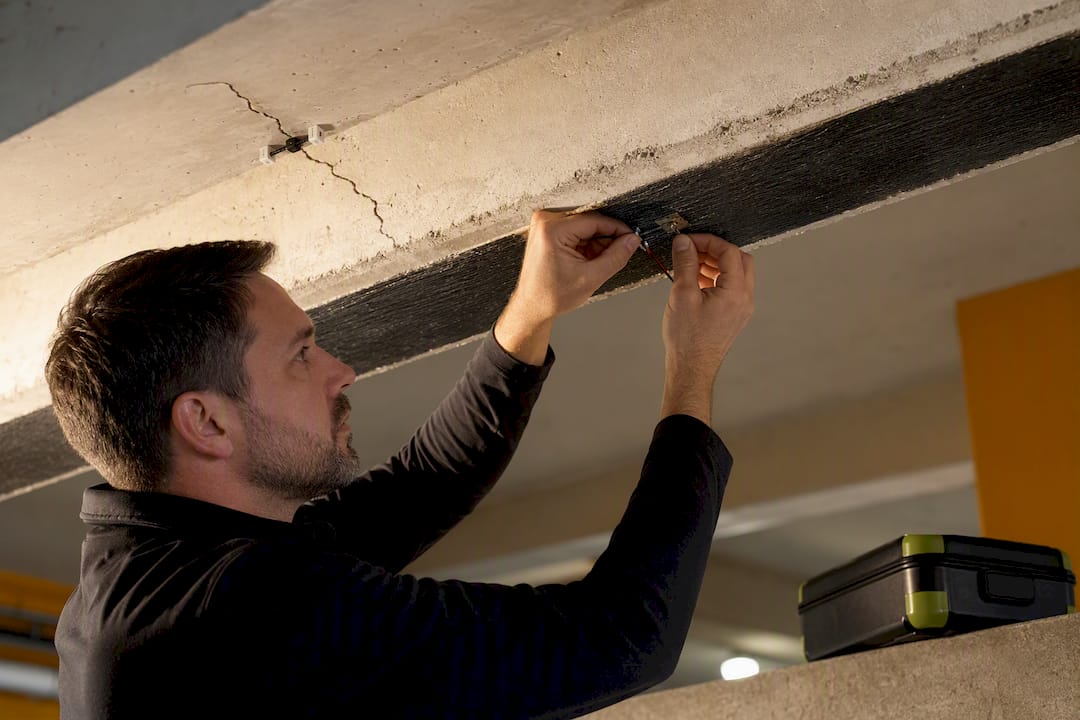
For external prestressing specifically, monitoring needs to track long-term prestress losses from creep, shrinkage, and anchorage seating, since these losses compound over the structure’s remaining service life and can erode the serviceability benefit the prestressing was installed to achieve in the first place.
Maintenance itself is mostly preventive: reapplying protective coatings on schedule, resealing joints and edges where FRP meets the substrate, and addressing minor corrosion or moisture ingress before it undermines the bond interface beneath a strengthening layer. Building owners who fold this into a broader periodic building inspection program tend to catch degradation while it’s still a minor repair rather than a full re-strengthening.
How Much Do Structural Strengthening Methods Cost?
Cost comparisons across these methods rarely come down to material price alone, and engineers who compare only per-square-meter FRP cost against per-cubic-meter concrete jacketing cost are missing most of what actually drives the number.
FRP systems, whether EBR or NSM, typically carry lower material and labor cost than jacketing for equivalent flexural or shear capacity gains, largely because they avoid formwork, new reinforcement cages, and the extended cure time a concrete jacket requires. That advantage shrinks or disappears once anchorage detailing, surface preparation, and protective overlays get priced in properly, particularly on projects with extensive corrosion damage requiring concrete repair before any FRP goes on.
Jacketing costs more upfront in most cases, driven by formwork, additional reinforcement, and the labor to maintain continuity through slabs and beams, but it adds genuine cross-sectional capacity that composite systems structurally cannot replicate. Where the deficiency is axial capacity, comparing jacketing against FRP on cost alone is comparing two products that don’t solve the same problem, and the cheaper option that doesn’t fix the actual deficiency has no real value.
External prestressing sits at the higher end of installation complexity and equipment cost, driven by tensioning hardware, anchorage fabrication, and specialist labor, but it delivers a serviceability benefit no passive method offers regardless of price. TRM/FRCM systems generally price between EBR and full jacketing, trading lower material stiffness for reduced skilled labor requirements and no epoxy-specific fire mitigation cost.
The economics that matter most over a building’s remaining service life are downtime cost and disruption, not just installed price. A strengthening scheme that keeps a commercial building fully operational during works often justifies a higher unit cost through avoided lost revenue, a calculation that rarely appears in a simple materials comparison but frequently decides the final method selection.
What Do Real Strengthening Projects Reveal About Method Selection?
Method selection in practice rarely comes down to a single technical criterion. A column strengthening project in an occupied commercial building, for instance, typically rules out full concrete jacketing early, since the added weight and formwork disruption to tenants make it impractical, pushing the design toward CFRP wrapping for confinement and axial capacity gains instead, where installation happens in a fraction of the time with no wet trades.
A beam retrofit addressing excessive long-term deflection tells a different story. If the deflection has already occurred and continues to worsen under sustained load, passive FRP alone won’t reverse it, since bonded reinforcement only resists future load increments. External prestressing, by contrast, actively lifts the member and closes existing cracks immediately, making it the technically correct choice even though it costs more to install and requires tensioning expertise on-site.
A masonry facade retrofit exposed to fire code requirements illustrates why TRM/FRCM exists as a distinct category rather than a lesser substitute for CFRP. Epoxy-bonded FRP on that same facade would fail a fire rating review outright, while a cementitious TRM system passes because its matrix doesn’t lose structural integrity at the temperatures epoxy resin softens at.
Foundation-level strengthening, where a footing needs additional bearing area or a pile cap needs more capacity, almost always leads back to concrete jacketing or underpinning, since no surface-bonded composite can add the bearing area a foundation deficiency actually requires. Projects following a full retrofit program for aging infrastructure frequently combine two or three of these methods across a single building, reflecting the fact that different elements in the same structure often have entirely different governing deficiencies.
Stellar Structures Perspective: Applying These Methods on Real Projects
The methods covered here only matter if the design gets built and approved, and that’s where Com’s structural engineering practice does its work. The firm brings civil, structural, and geotechnical expertise together with the authority submission process itself, managing approvals through BCA, URA, HDB, JTC, and SCDF alongside the strengthening design. That combination, code-compliant detailing paired with the compliance path to build it, is what separates a technically sound spec from one that actually gets permitted. A performance-first, QA-focused approach applies across every method family discussed above, from CFRP column wraps to prestressed retrofits.
— Aman
Get Expert Structural Design and Compliance Support
Choosing between FRP, jacketing, and prestressing is only half the job. Getting the design checked, detailed correctly, and approved by the relevant authority is where most retrofit projects actually stall. Com works as the design and compliance partner for property owners, developers, and contractors who need a strengthening scheme that’s both structurally sound and ready for BCA or URA submission without the back and forth that comes from an incomplete package.

Whether the project calls for CFRP column strengthening, a jacketing scheme with foundation impacts, or an external prestressing retrofit that needs tensioning documentation for approval, Com’s team handles the structural design check and the authority submission as one coordinated process. For drilling and coring work tied to post-tensioning installations, specialist partners like Vic Sawing’s concrete drilling services cover the physical installation side of tendon duct formation. Start by requesting a structural design check for your project, and get a scoped assessment of which strengthening method fits your building’s actual deficiency before committing to a contractor.
Sources
- PMC — state-of-the-art review on FRP strengthening techniques (Materials, MDPI)
- Fischer expert guide for structural strengthening (ACI/ICC referenced)
Recommended
- How Civil Engineers Strengthen Aging Infrastructure Using Rehabilitation Technologies
- How to Validate Structural Alterations
- Can Existing Structures Support Renovations?