




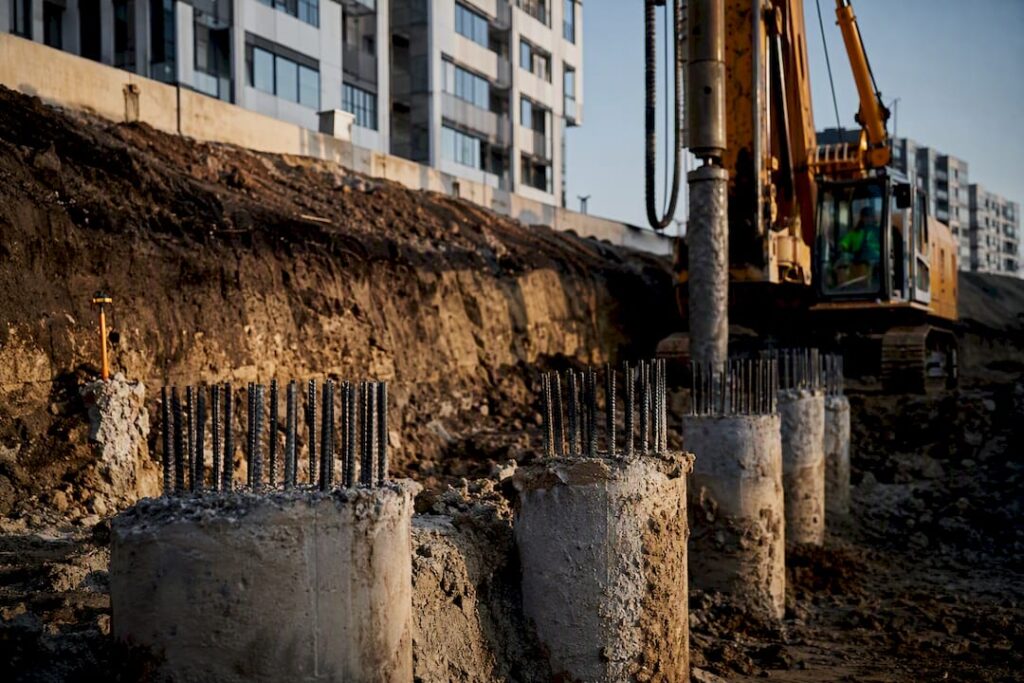
Six pile categories cover nearly every deep foundation problem: driven piles, bored (drilled) piles, micropiles, screw or helix piles, sheet or soldier piles, and composite piles. As a rule of thumb, driven piles suit granular soils where speed and cost matter, bored piles handle rock socketing and vibration-sensitive sites, micropiles solve constrained or retrofit access, and sheet piles hold back soil during excavation.
TL;DR:
- Driven piles are typically more cost-efficient and faster to install in granular soils, but they generate more noise and vibration during installation.
- Bored piles offer better control over vibration and noise, making them ideal near sensitive structures, though they generally incur higher labor and material costs.
- The selection between driven and bored piles depends heavily on site conditions, load requirements, and long-term cost considerations, not just initial expenditure.
- Testing methods such as PDA during driving and static load tests after pouring are essential for verifying pile capacity and preventing disputes.
- Accurate geotechnical investigations and site constraints analysis are critical to choosing the proper pile type and avoiding costly redesigns or delays.
Table of Contents
- Pile Foundation Types by Function: End-Bearing, Friction, and Anchor
- Material and Construction Classification of Piles
- How Each Pile Foundation Type Gets Installed
- Bored Pile vs Driven Pile: Which Wins on Cost and Disturbance?
- Selection Criteria: A Checklist for Choosing Pile Foundation Types
- Pile Testing and Quality Assurance Methods
- Matching Pile Foundation Types to Project Applications
- What Stellar Structures Checks Before Recommending a Pile System
- The Real Lesson Behind Every Pile Foundation Decision
- Sources
- FAQ
Pile Foundation Types by Function: End-Bearing, Friction, and Anchor
Every pile foundation transfers structural load to the ground through one of three mechanical actions, and understanding this distinction matters more than memorizing a list of pile names. End-bearing piles carry load through their tip, resting on rock or a dense stratum far below grade. Friction piles (also called skin-friction or floating piles) transfer load along the shaft through resistance between the pile surface and surrounding soil, useful where competent bedrock sits too deep to reach economically. Tension or anchor piles resist uplift or overturning forces rather than pure compression, common in structures exposed to wind loads, water tables, or seismic uplift.
Most named pile types perform one function, but some do both. A bored pile socketed into rock is a pure end-bearing system. A driven timber pile in soft clay behaves mostly as a friction pile because it never reaches a hard stratum. Continuous flight auger (CFA) piles often combine both mechanisms, picking up moderate end-bearing capacity while relying heavily on shaft friction for the bulk of their design load.
A few terms come up constantly in specifications and tender documents:
- Pile cap: the reinforced concrete slab connecting multiple piles into a single load-bearing unit.
- Batter piles: driven or bored at an angle rather than vertically, used to resist lateral or uplift forces.
- Under-reaming: a bulb-shaped enlargement at the base of a bored pile that increases end-bearing area without increasing shaft diameter.
- Socketing: extending a bored pile shaft into rock to anchor it mechanically rather than relying on soil friction alone.
- Pile group: multiple piles working together under a shared cap, where combined capacity is rarely the simple sum of individual pile capacities because of overlapping stress zones.
Material and Construction Classification of Piles
Material choice drives quality control, corrosion risk, and long-term durability as much as soil conditions do.
Precast and prestressed concrete piles are cast off-site under controlled conditions, then driven into place. Because curing happens in a factory rather than a borehole, defect rates are typically lower than cast-in-place methods, though transport and handling can crack a pile before it ever reaches the ground. Cast-in-place bored piles, by contrast, are formed by pouring concrete directly into a drilled shaft on site, which allows larger diameters and custom lengths but shifts quality control to field conditions, concrete mix consistency, and how quickly the pour follows drilling.
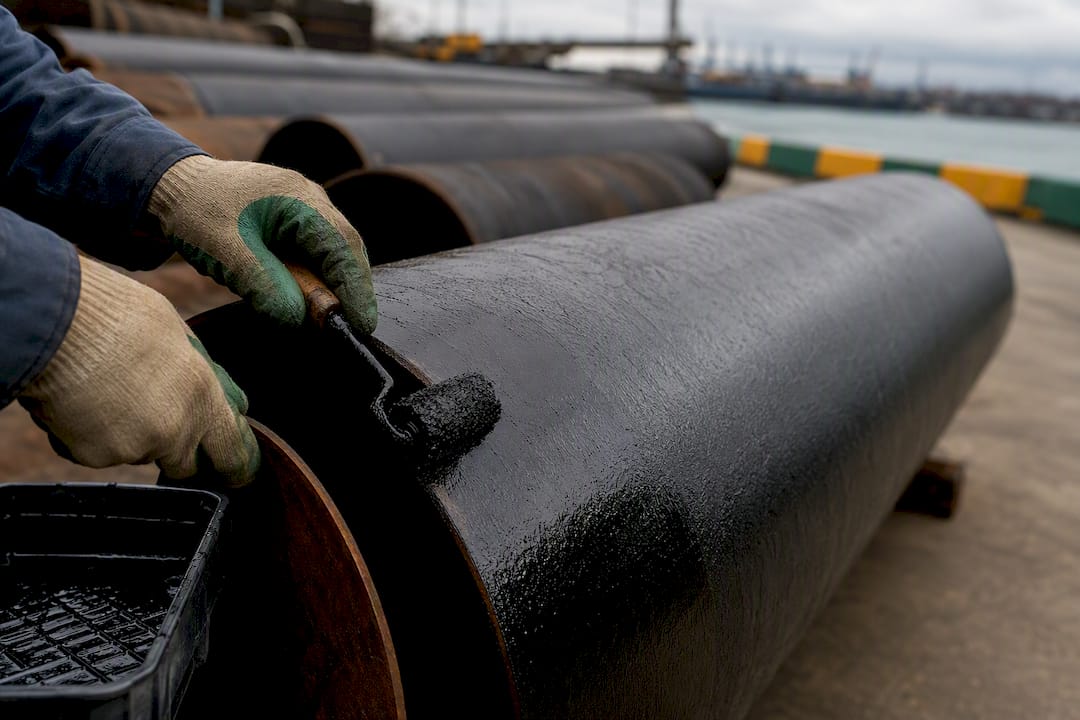
Steel pipe piles and H-piles offer high strength-to-weight ratios and can be driven through obstructions that would shatter concrete, but they need corrosion protection in aggressive soils or marine environments, usually through coatings, cathodic protection, or added wall thickness as a sacrificial allowance.
Timber piles saw heavy use in low-rise construction before the mid-20th century and still appear in temporary works or light structures today, though decay above the water table limits their modern application.
Composite piles combine materials, such as a concrete upper section over a steel or timber lower section, to optimize cost and durability by material zone. Sheet piles, soldier piles, and fender piles serve retention and marine protection roles rather than vertical load-bearing, interlocking or standing independently to resist lateral earth or wave pressure.
How Each Pile Foundation Type Gets Installed
Installation method shapes everything from noise complaints to construction schedule, and choosing a pile foundation design without understanding the installation sequence is where many budgets go wrong.
- Driven piles go in with impact or vibratory hammers, displacing soil as they advance. Displacement densifies granular soil around the shaft, often boosting skin friction, and crews track real-time blow counts alongside PDA testing to confirm capacity as the pile advances.
- Bored shafts (drilled shafts) use rotary boring with temporary casing or drilling slurry to keep the hole open, generating substantial spoil that needs disposal. Crews run cross-hole sonic logging (CSL) after concreting to check shaft integrity.
- CFA piles advance a continuous flight auger into the ground and pump concrete through the hollow stem as the auger withdraws, favored where groundwater or loose soils make open boring risky, though CFA has depth and obstruction limitations that bored methods handle better.
- Micropiles use compact rigs to drill and grout small-diameter shafts, generally 100 to 300 millimeters, making them the standard choice for underpinning and retrofit work where headroom or access rules out larger equipment.
- Screw or helix piles thread into the ground under torque monitoring, installing in minutes per pile with light equipment, though their load capacity tops out well below driven or bored options.
- Sheet piling and soldier piles interlock or space out with lagging boards between them, forming cofferdams and temporary retention walls for excavation support.
Pro Tip: On bored pile work, ask the contractor how long they plan to leave the borehole open before concreting. Extended exposure can trigger what practitioners call borehole relaxation, where the surrounding soil loosens and shaft friction drops, a risk experienced crews manage by minimizing that window and cleaning the base thoroughly before the pour.
Bored Pile vs Driven Pile: Which Wins on Cost and Disturbance?
The bored pile vs driven pile decision comes down to five variables, and no single answer applies universally.
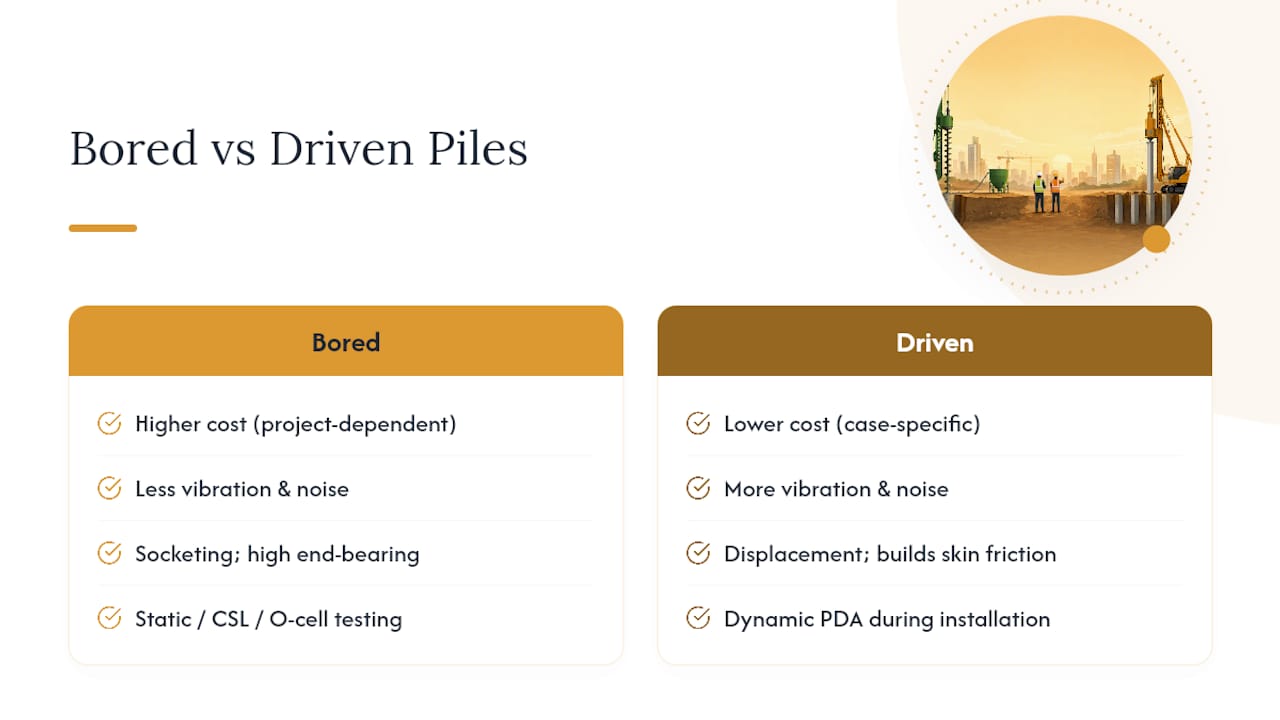
Cost and schedule. In one 2024 project analysis, driven piles ran about 29.1% more cost-efficient than bored piles on that specific job. A separate 2026 case study on the Butuh Bridge Phase II project in Sragen recorded driven piles costing less than bored piles, with driven installation finishing faster. Those figures are project-specific and shouldn’t be treated as a universal price ratio, since local labor rates, ground conditions, and equipment availability all shift the math.
Environmental and neighbor impact runs the opposite direction. That same Sragen case study found bored piles caused noticeably less vibration and noise, making them the preferable choice near sensitive structures or occupied buildings.
Load mechanics split along displacement versus replacement lines: driven piles compact soil and build skin friction, while bored piles allow socketing and under-reaming into rock for higher end-bearing capacity.
Testing and QA differ too. Driven piles rely on dynamic PDA testing during installation, while bored piles typically need CSL or static load testing (including O-cell methods) after the pour to confirm shaft integrity.
Some projects split the difference, using bored piles for tower footings near neighboring structures and driven piles across open areas of the same site, capturing cost savings where disturbance isn’t a concern.
Selection Criteria: A Checklist for Choosing Pile Foundation Types
A geotechnical report only helps if you know what to pull from it. Before comparing pile foundation types on a tender, work through this sequence:
- Confirm the ground profile. Request boring logs, groundwater depth, rockhead depth, soil description, and SPT or CPT results, since these numbers determine which pile types are even feasible.
- Map site constraints. Note access width, working area, neighboring structures sensitive to vibration, permitted working hours, and spoil disposal routes.
- Identify load type. Concentrated column loads point toward large-diameter bored piles or socketed piles, while distributed slab loads across a wide footprint often favor driven pile groups or CFA.
- Weigh program against whole-life cost. A faster driven pile install can save weeks, but if it risks damage claims from vibration, the bored alternative may cost less overall once mitigation and insurance are factored in.
- Interrogate the tender. Ask contractors what plant they intend to mobilize, their anticipated peak particle velocity (PPV) for vibration, their testing plan, and how contingency pricing handles unexpected obstructions.
Pro Tip: Always ask for anticipated PPV figures in writing before driven piling starts near existing buildings. Regulatory vibration limits vary by structure type and age, and a contractor who can’t quote an expected PPV range hasn’t done the homework yet.
Pile Testing and Quality Assurance Methods
Testing proves what a design calculation only predicts, and skipping it on higher-risk foundations is how disputes start.
- Dynamic testing (PDA) happens during driving, measuring stress waves through the pile to estimate capacity and integrity in real time.
- Static load tests, including CSL and O-cell methods, apply sustained load directly and remain the gold standard for high-risk or unusual foundation designs, though they cost more and take longer than dynamic methods.
- Integrity testing on bored piles, primarily CSL and pile integrity testing (PIT), checks for bulging, necking, or poor concrete consolidation that visual inspection can’t catch below grade.
- Contract structuring matters. Building testing requirements and pay-items into the contract upfront, rather than negotiating them mid-project, heads off disputes over who pays when a pile fails acceptance criteria.
- Independent inspection by a third party separate from the piling contractor adds a layer of accountability that self-certification can’t match, particularly on foundations supporting critical structures.
The CIRIA guidance remains a widely used reference for structuring these testing regimes on real projects.
Matching Pile Foundation Types to Project Applications
Different structures push toward different pile solutions, and the pattern holds across most markets:
- High-rise towers with concentrated column loads typically call for large-diameter bored shafts or rock-socketed piles capable of carrying tens of thousands of kilonewtons per column.
- Large-footprint, repetitive loads, like warehouses or industrial slabs, often favor driven precast piles or CFA groups, where speed and repeatable quality control matter more than individual pile capacity.
- Retaining structures and cofferdams rely on sheet piles or contiguous bored pile walls to hold back soil or water during excavation.
- Underpinning and constrained retrofit work almost always points to micropiles or jacked pile solutions, since existing structures rarely leave room for large drilling rigs.
- Slope remediation often comes down to bored pile walls versus A-frame micropile systems, and the deciding factor is usually how deep competent rock sits below the slip surface.
What Stellar Structures Checks Before Recommending a Pile System
During project scoping, Com reviews the required geotechnical deliverables, the realistic pile options given site access, and any authority constraints tied to utilities or protected structures nearby before a single pile type gets recommended.
Once construction starts, verification should be routine rather than reactive:
- Daily pile logs recording depth, blow counts, or torque readings against design assumptions.
- PDA reports and test certificates matched against the number of piles actually installed.
- Spoil disposal receipts confirming material left the site through approved channels.
- Authority sign-off documentation where piling work interacts with utilities, drains, or NParks-protected trees.
Unexpected obstructions, bedrock depth that varies sharply from the borehole logs, or piles reaching refusal well short of design depth all warrant an immediate call for specialist testing or redesign, not a field decision made under schedule pressure.
The Real Lesson Behind Every Pile Foundation Decision
Every pile foundation type comparison starts and ends with the geotechnical investigation. Skip that step or treat it as a formality, and the cost and disturbance trade-offs discussed here become guesswork. Balance cost, vibration, and schedule against what the soil report actually says, then ask your consultant which pile type fits before asking which one is cheapest.
— Aman
Sources
- Comparative analysis of driven vs. bored pile foundations: cost and time (IOP, 2026)
- Recapitulation of Driven Piles Costs (ResearchGate figure)
- Geotechnical notes on piles (UWE)
- CIRIA guidance (industry reference)
FAQ
What are the three main types of pile foundations?
Most classifications group piles as driven, bored (drilled), and micropiles, though some frameworks separate them by function instead: end-bearing, friction, and tension or anchor piles.
What are the two main types of piles?
At the broadest level, piles split into displacement piles (driven, which compact soil as they enter the ground) and replacement piles (bored, which remove soil to form the shaft before concreting).
Which pile foundation is best?
There’s no single best pile type. Driven piles tend to win on cost and speed in granular soils, while bored piles win where vibration control, rock socketing, or large diameters matter more than schedule.
What are the 7 types of foundation?
Common foundation categories include strip, pad, raft, pile, pier, basement, and combined footings, with pile foundations covering the driven, bored, micropile, screw, and sheet pile types discussed throughout this guide.
Is a bored pile always more expensive than a driven pile?
Not always, but project data tends to favor driven piles on raw cost. One 2024 analysis found driven piles about 29.1% cheaper on a specific project, though bored piles can still be the better whole-life choice where vibration damage claims or access constraints would otherwise drive up driven pile costs.
Recommended
- SS 723:2026 Pile Test Checklist for Singapore QPs to Avoid BCA Queries
- The Importance of Deep Foundation Design for Commercial Skyscrapers in Downtown Singapore
- When to Hire a Foundation Assessment Consultant