




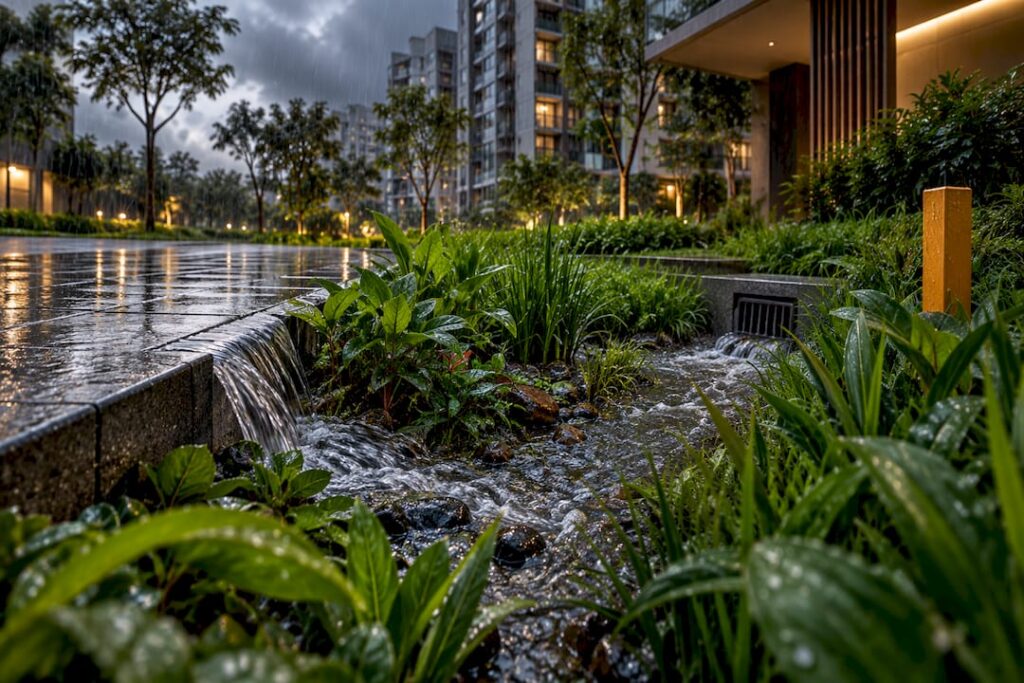
Singapore manages stormwater through the Source‑Pathway‑Receptor framework, and any new or redeveloped site of 0.2 hectares or larger must control peak runoff through on‑site detention before it reaches public drains. Project teams need to calculate peak discharge early, engage a Qualified Person to certify the design against the Code of Practice on Surface Water Drainage, and prepare PUB submissions covering detention sizing, overflow provisions, and rainwater harvesting where applicable.
TL;DR:
- Projects exceeding 0.2 hectares must incorporate on-site detention to control peak runoff, with tanks needing to empty within four hours after a storm.
- Detention tanks are the default solution, but combining ABC Waters features and rainwater harvesting can optimize space and water quality, provided volumes are managed separately.
- Public drainage systems are continuously upgraded through widening, diversion, and catchment-level detention, which influence the allowable site discharges.
- Developers must pre-define platform and crest levels early and ensure flood protection devices are specified at all vulnerable openings to prevent flooding in extreme events.
- Early coordination among agencies and integrating green infrastructure with detention sizing from concept stage significantly reduce delays and improve stormwater resilience.
Table of Contents
- What the Source-Pathway-Receptor Framework Means for Your Design
- On-Site Measures: Detention Tanks, ABC Waters Features, and Rainwater Harvesting
- How Public Drainage Upgrades Work Alongside Private Site Controls
- Receptor Protections: Platform Levels, Crest Levels, and Flood Barriers
- Design, Modelling, and the Compliance Checklist Under COP Clause 7.1.5
- Keeping Detention Systems Working After Handover
- A Practitioner’s View on Turning Policy Into a Buildable Project
- Singapore’s Broader Stormwater Policy Landscape
- Building Climate Resilience Into Singapore’s Drainage System
- New Technology Reshaping Stormwater Systems in Singapore
- How Singapore’s Communities Engage With Stormwater Management
- Where Conventional Advice on Stormwater Falls Short
- Where Stellar Structures Fits Into Your Stormwater Compliance Process
- Sources
- FAQ
What the Source-Pathway-Receptor Framework Means for Your Design
PUB structures every flood-resilience decision around three linked terms: Source, Pathway, and Receptor. Understanding what each one covers, and who is responsible for each, determines how a design team allocates space and budget on a project.
A Source is where rain first hits a built surface and starts to run off, meaning a roof, a car park, a paved courtyard, or a landscaped podium. A Pathway is the conveyance system that carries that runoff away, meaning drains, canals, and culverts, most of which sit within public infrastructure but some of which run through private land. A Receptor is the point of exposure if the system is overwhelmed, meaning a building entrance, a basement ramp, or a low‑lying room that would flood if water rose past a certain level.
PUB adopted this three‑part model because Singapore cannot simply keep enlarging public drains to match urban growth. Land is scarce, existing canals run through dense catchments where widening means resettlement or heavy civil works, and rainfall intensity projections tied to climate change keep pushing design storms upward. Shifting part of the burden to the Source, meaning to individual developments, lets the public network absorb growth without constant capacity upgrades everywhere at once.
That shift changes what a designer prioritizes compared with older, pathway‑only thinking:
- Detention at the Source becomes a design requirement, not a value‑add, once a site crosses the 0.2 hectare trigger.
- Pathway capacity is treated as a shared, finite resource that development-level controls are meant to protect, not a bottomless drain a project can simply discharge into.
- Receptor protections, such as raised platform levels, function as the last line of defense, assumed to activate only if Source and Pathway measures underperform in an extreme event.
The practical result: a QP now needs to think about attenuation volume and discharge rate at concept stage, not as a late addition once the architectural layout is fixed.
On-Site Measures: Detention Tanks, ABC Waters Features, and Rainwater Harvesting
Every site crossing the 0.2 hectare threshold needs a detention strategy, and most projects combine two or three complementary tools rather than relying on a single tank.
Detention tanks remain the default engineering solution. They hold back peak runoff and release it at a controlled rate, either by gravity through an orifice plate sized to the site’s allowable discharge, or by pump where site levels don’t permit gravity flow. PUB’s technical guide on detention tank systems requires the tank to empty and restore its full detention volume within four hours of a storm event, so it’s ready for the next one. Every tank also needs a fail‑safe overflow path that bypasses the outlet control in case of blockage or pump failure, and this overflow route has to be shown explicitly in the submission drawings.
ABC Waters design features offer a different mechanism. Bioretention basins, rain gardens, and vegetated swales slow runoff and filter it through engineered soil media before it reaches the drain. Properly sized ABC Waters systems can detain a large share of annual rainfall volume from minor storms while improving water quality at the same time, which gives a development amenity value that a buried concrete tank never will.
Rainwater harvesting adds a third layer, but it runs on separate rules. Systems require PUB approval under Section 31, harvested water is restricted to non‑potable uses such as irrigation or flushing, and larger systems trigger Water Balance Table metering thresholds. Crucially, harvesting volume and detention volume must be accounted separately when the two share a tank, because the detention portion still has to be restored within four hours regardless of how much rainwater the site wants to keep for reuse.
For teams weighing which combination fits a constrained site, the sequence usually runs:
- Confirm the site area against the 0.2 hectare trigger and estimate peak runoff for the design storm.
- Assess whether ABC Waters features can carry part of the detention load, freeing up tank volume.
- Decide whether rainwater harvesting is viable given roof area and downstream non‑potable demand.
- Size the remaining detention tank and choose gravity or pumped discharge based on invert levels.
- Confirm overflow and control logic before finalizing tank dimensions.
Space‑constrained sites increasingly turn to green roofs, planter‑box detention, and underground tanks stacked beneath car parks to avoid sacrificing landscaped area. Underground tanks cost more to inspect and maintain than surface basins, since access chambers and pump rooms need regular clearing, but they free up ground‑level space that a dense urban site often can’t spare.
Pro Tip: Model the ABC Waters and detention tank together, not sequentially. Treating bioretention as free extra capacity after the tank is sized almost always under-uses the site’s most cost-effective attenuation option.
How Public Drainage Upgrades Work Alongside Private Site Controls
Site-level detention only works if the public network it discharges into has capacity to spare, so PUB runs parallel programs to keep the pathway itself performing.
Pathway interventions at the public infrastructure level typically include:
- Widening and deepening existing canals and drains where catchment growth has outpaced original capacity.
- Building diversion canals that reroute flow away from constrained sections of a catchment.
- Constructing catchment‑level detention, essentially large public tanks or ponds that hold back flow from multiple developments before it reaches a downstream bottleneck.
- Dredging and clearing to maintain the conveyance capacity a drain was originally designed for.
- Deploying litter traps and Quick Response Teams that clear blockages during storm events.
PUB has framed this as a long-term, systems-level commitment. Parliamentary briefings note roughly S$2.5 billion invested in drainage improvement works since 2011, alongside a marked reduction in flood-prone areas across the island. That scale of public investment is also the reason PUB expects private developments to hold up their end through on-site detention. A drainage network sized for yesterday’s rainfall intensity cannot absorb unlimited new impervious area without private-side controls doing part of the work.
For large developments or precinct-scale masterplans, stormwater tunnels and underground storage caverns are becoming part of the toolkit where surface land simply isn’t available. These are public works, not something an individual developer builds, but they matter to project teams because they change the downstream capacity assumptions a QP can rely on when sizing a site’s discharge rate. A smart water management approach that accounts for real-time monitoring data increasingly informs how these catchment-scale works get prioritized and phased.
Project teams should treat pathway capacity as something that shifts over review cycles. PUB periodically reassesses catchments as rainfall intensity data and urbanization patterns change, which means a discharge rate approved five years ago on an adjacent site is not a reliable benchmark for a new submission today.
Receptor Protections: Platform Levels, Crest Levels, and Flood Barriers
Even a well-designed Source and Pathway system can be overwhelmed in an extreme event, which is why Receptor measures function as the backstop that protects the building itself.
Current practice sets minimum platform levels for building entrances and site levels, with some locations requiring levels around 4 meters above Singapore Height Datum depending on flood history and catchment risk. These minimums directly affect architectural planning: a raised entry platform changes ramp gradients, accessibility compliance, and how a basement carpark ramp has to be designed to avoid becoming a low point where water collects.
Key receptor-level considerations for project teams:
- Confirm the required minimum platform and crest level for the specific site early, since it can force a redesign of ground-floor levels if checked too late in the process.
- Specify flood protection devices, such as removable flood barriers or automatic floodgates, at vulnerable openings like basement ramps and loading bays.
- Coordinate crest level requirements with fire escape routes and accessibility ramps so flood protection doesn’t inadvertently violate egress or barrier-free access rules under the building code.
- Treat temporary flood barriers as a supplement to, not a substitute for, adequate platform levels, since a barrier that isn’t deployed in time offers no protection.
Enforcement happens through the authority submission process itself. A QP has to demonstrate on drawings that platform levels meet the applicable minimum and that flood protection devices are specified at every vulnerable opening, and this gets checked alongside structural and architectural submissions. Sites near the coast or in low-lying catchments often need additional coordination with broader building resilience strategies to address wind, surge, and rainfall risk together rather than as separate line items.
Design, Modelling, and the Compliance Checklist Under COP Clause 7.1.5
Meeting the 0.2 hectare detention trigger is straightforward to identify; proving compliance to PUB’s satisfaction is where most submission delays happen.
The core requirement under COP Clause 7.1.5 is that a development must not increase peak discharge beyond what the site produced in its pre-development state, or beyond a PUB-specified allowable rate for the catchment. Calculating that allowable peak discharge is the first technical step, and it depends on catchment characteristics, existing downstream drain capacity, and the design storm return period PUB specifies for that location.
For sizing methodology, teams generally choose between two approaches:
- The Modified Rational Method, which PUB’s own guidance treats as suitable for preliminary sizing on smaller catchments, generally under 8 hectares, and which tends to produce conservative, slightly oversized results.
- Hydrologic and hydraulic modelling, used where catchments are larger, more complex, or where a design team wants to optimize tank volume rather than accept the Rational Method’s built-in conservatism.
A typical PUB submission package includes the detention calculation worksheet, drawings showing tank location and overflow path, control system logic for pumped systems, and a QP endorsement. Detention tank discharge controls should be linked to a level sensor or rain gauge with a documented fail-safe overflow, and the submission should describe the control logic and testing procedure PUB can expect to see commissioned on site, not just modelled on paper.
Endorsement responsibility splits by system type: a gravity detention system is typically certified by the civil or structural PE of record, while a pumped system requires sign-off from a mechanical PE covering the pump, control, and electrical elements. Missing that split endorsement is a common reason submissions bounce back for revision.
Pro Tip: Check the current edition of the Code of Practice before finalizing calculations. PUB updates design standards periodically to reflect newer rainfall intensity data, and a design finalized against an outdated COP edition risks rework at submission stage.
Keeping Detention Systems Working After Handover
A detention system that passes PUB submission review is only half the job. The other half is making sure it still works five, ten, or twenty years after handover, and that responsibility usually falls to the building owner or Management Corporation Strata Title (MCST) committee, not the original design team.
A workable operations and maintenance plan should cover:
- A named responsible party for inspections, whether that’s building management, an appointed term contractor, or the MCST’s engineer.
- A fixed inspection frequency, typically at minimum before and after the monsoon season, with more frequent checks for pumped systems.
- Recordkeeping that logs each inspection, any clogging or debris removal, and pump test results, since PUB and BCA inspectors may ask to see this history.
- A clear escalation path for control system faults, so a sensor failure doesn’t go unnoticed until the next storm.
The most common failure modes are predictable: sediment and debris clogging inlet screens and orifice plates, pumps failing from lack of routine testing, and control systems drifting out of calibration without anyone noticing until a storm exposes the problem. Designing for maintainability, meaning accessible inlet screens, testable pump systems, and control panels that log faults rather than fail silently, reduces how often these issues turn into actual flooding incidents.
A basic MCST checklist should include: verifying the overflow path is clear of obstruction, confirming the tank empties within the required four-hour window after a storm, testing pump start-up under simulated high-level conditions, and checking that any co-located rainwater harvesting compartment still maintains separate storage from the detention volume.

Pro Tip: Build the inspection checklist into the operations manual handed over at TOP, not as a separate document created later. An O&M plan that exists only in the QP’s files rarely survives the first change of building management.
A Practitioner’s View on Turning Policy Into a Buildable Project
Translating PUB’s framework into a workable design usually follows a consistent sequence: confirm the site trigger and catchment discharge rate, test how much detention ABC Waters features can realistically absorb, size the remaining tank, resolve platform and crest levels with the architectural team, and only then lock the submission package for QP endorsement.
Coordinating that sequence across agencies is often the harder part. A single development might need PUB approval for detention and rainwater harvesting, BCA sign-off on structural aspects of the tank, URA clearance if the layout affects setback or landscaping requirements, NEA input where the site handles trade effluent, and SCDF review where fire access routes intersect with flood barrier locations. Authority submission coordination across these agencies, run in parallel rather than sequentially, is usually what separates a submission that clears in one round from one that bounces between departments for months.
A few early decisions are worth locking down before detailed design starts:
- Confirm the site footprint and impervious area assumptions before committing to tank volume, since late layout changes often force a resize.
- Decide gravity versus pumped discharge based on actual invert levels, not assumed ones, before specifying the PE sign-off pathway.
- If co-locating detention and rainwater harvesting, document the separate storage compartments and refill logic at concept stage rather than retrofitting it into a near-final tank design.
— Aman
Singapore’s Broader Stormwater Policy Landscape
PUB’s technical frameworks sit inside a wider national policy structure aimed at keeping Singapore livable as both the population and rainfall intensity grow. The National Climate Change Secretariat frames drainage and flood prevention as one pillar of a broader adaptation strategy that also covers coastal protection and water resource planning, treating stormwater not as an isolated engineering problem but as one part of national resilience planning.
That broader framing shows up in how policy connects across agencies. URA’s land use planning decisions, such as where higher-density development is permitted, directly affect how much impervious surface a catchment will carry, which in turn affects the discharge rates PUB has to manage downstream. NParks’ green space planning intersects with ABC Waters implementation, since many bioretention and wetland features double as public park infrastructure. NEA’s environmental health mandate overlaps where stagnant water in detention features could become a mosquito breeding concern if maintenance lapses.
The objective underlying all of this isn’t simply flood prevention in the narrow sense. Singapore’s stated ambition is a water-sensitive urban environment where stormwater infrastructure contributes to biodiversity, recreational space, and water security simultaneously, not just conveyance capacity. That’s a meaningfully different design brief than a purely drainage-focused approach, and it’s part of why ABC Waters features get weighted so heavily in PUB’s guidance rather than treated as optional landscaping.
For project teams, the practical takeaway is that a stormwater submission reviewed in isolation from URA planning parameters or NParks green space requirements is likely to hit friction. Early coordination across these agencies tends to save far more time than treating PUB approval as a standalone hurdle.
Building Climate Resilience Into Singapore’s Drainage System
Singapore’s rainfall intensity has been trending upward, and PUB’s design standards are not static in response. The Code of Practice gets revised periodically to reflect updated rainfall projections, meaning a detention tank sized against an older design storm could be undersized against current climate assumptions even if it complied fully when built.
This is where the Source‑Pathway‑Receptor framework earns its long-term relevance. Rather than betting on a single fixed design storm forever, the model distributes resilience across three layers, so if climate projections push rainfall intensity higher than expected, the system has Receptor-level protections such as platform levels acting as a buffer while Pathway and Source measures get updated over subsequent review cycles.
Practically, this shows up in a few recurring adaptation moves. Minimum platform and crest levels have been raised over time in higher-risk catchments. Detention sizing guidance has been adjusted to account for more intense short-duration storms rather than only longer, gentler design events. And PUB’s catchment-level review cycles increasingly factor climate projections rather than solely historical rainfall records, which is part of why NCCS treats drainage investment as an ongoing adaptation program rather than a completed infrastructure project.
For a design team, the practical implication is straightforward: don’t treat today’s COP figures as fixed for the life of the building. A development with a 50 or 60-year design life will likely see at least one, possibly several, revisions to the rainfall intensity assumptions its original detention system was sized against. Designing with a margin of flexibility, such as a tank layout that could accommodate a future volume increase without a full rebuild, is worth considering on longer-life assets.
New Technology Reshaping Stormwater Systems in Singapore
Sensor-based monitoring is probably the most consequential shift happening in Singapore’s stormwater infrastructure right now, even if it’s less visible than a new canal or tank. Real-time water level sensors in canals and detention facilities let PUB track conditions across the island continuously, rather than relying on periodic manual inspection, and that data increasingly feeds into how catchment-level interventions get prioritized.
At the site level, this shows up in smarter detention tank controls. Instead of a simple float-switch outlet, newer systems link discharge control to rain forecast data and real-time downstream drain levels, releasing water earlier and more gradually ahead of a forecast storm rather than reacting only once the tank is already full. That kind of predictive control reduces peak discharge more effectively than a purely reactive system, though it does add complexity to the control logic a QP has to document in the PUB submission.
Modelling tools have also matured. Hydraulic modelling software that can simulate an entire catchment’s response to a design storm, rather than just a single site in isolation, gives design teams a far better picture of how a development’s discharge interacts with everything else feeding into the same drain. This matters most on dense, already-built-up catchments where a marginal increase in one site’s peak discharge can tip a downstream pinch point into overflow.
Green infrastructure design has also advanced past the earliest ABC Waters installations. Newer bioretention media specifications, better plant selection for Singapore’s climate, and improved understanding of long-term infiltration performance have made these features more reliable and lower-maintenance than the first generation built over a decade ago. None of this replaces the fundamentals of the Source‑Pathway‑Receptor framework, but it changes how precisely a design team can meet those fundamentals without over-engineering the result.
How Singapore’s Communities Engage With Stormwater Management
Public awareness plays a bigger role in stormwater performance than most engineering discussions acknowledge. ABC Waters features only function as designed if residents and building users don’t treat bioretention basins as ordinary landscaping to be mown flat or blocked with paving, and litter dumped into canals directly undermines the pathway capacity PUB works to maintain.
PUB has run public education around this for years, encouraging residents to keep drains and waterways clear of litter and highlighting ABC Waters sites as demonstration spaces where the public can see how a rain garden or wetland actually functions during a storm. Many of these sites double as recreational parks, which is a deliberate design choice meant to build public buy-in for green infrastructure rather than treating it as fenced-off utility land.
For MCSTs and building management, community engagement has a more direct operational dimension. Residents who understand why an on-site detention basin can’t be repaved or a swale can’t be filled in for extra parking are far less likely to request changes that quietly degrade the system’s performance. Building this understanding into resident handbooks and MCST briefings, alongside the formal O&M plan, tends to prevent the kind of well-intentioned modification that later shows up as an unexplained flooding complaint.
Community-level rain gauges and citizen reporting have also started supplementing PUB’s own monitoring network in some catchments, giving the agency a denser picture of localized flooding that formal sensor networks alone might miss.
Where Conventional Advice on Stormwater Falls Short
Most guidance on this topic treats compliance as a checkbox exercise: hit the 0.2 hectare trigger, size a tank, get it endorsed, move on. That reading misses what the Source‑Pathway‑Receptor framework is actually asking for, which is a shift in how a design team thinks about responsibility from the very first site plan, not a calculation bolted on after the architecture is fixed.
The bigger failure I see in how this topic gets discussed is treating ABC Waters features as landscaping that happens to also manage water, rather than the reverse. Sites that size detention tanks first and squeeze bioretention into whatever space is left consistently underperform sites that model the two together from concept stage. The tank ends up oversized, the landscape budget ends up fighting the engineering budget, and everyone loses.
If there’s one thing worth prioritizing above all else, it’s coordination timing. Confirm platform levels, catchment discharge limits, and agency touchpoints before the architectural layout locks. Retrofitting flood resilience into a finished design is where projects lose months.
Where Stellar Structures Fits Into Your Stormwater Compliance Process
Getting a detention tank sized correctly, an ABC Waters feature integrated without fighting the landscape plan, or a PUB submission cleared without three rounds of resubmission usually comes down to having civil, structural, and geotechnical input in the room from day one, not brought in after the layout is fixed. That’s the gap Stellar Structures is built to close for Singapore project teams.

A firm can provide civil, structural, and geotechnical engineering consultation alongside comprehensive authority submission support across PUB, BCA, URA, NEA, SCDF, and other statutory boards, enabling a detention tank design to be carried from concept sketch through QP endorsement and inter-agency coordination without handoffs between separate consultants. That matters most on sites where detention sizing, rainwater harvesting, and platform level requirements all interact, since a design decision on one almost always affects the other two.
If your project is approaching the 0.2 hectare threshold or you’re unsure whether your current drainage layout will clear PUB review, Stellar Structures’ service overview outlines how the firm supports detention design, structural checks, and authority submissions from a single point of contact. Reach out to scope your project’s stormwater requirements before your architectural layout locks in.
Sources
- Stormwater Management | PUB, Singapore’s National Water Agency
- Oral Reply to Parliamentary Question on Drainage Improvement | Ministry of Sustainability and the Environment
FAQ
What triggers the on-site detention requirement in Singapore?
Any new or redevelopment project of 0.2 hectares or larger must implement on-site stormwater detention to control peak runoff, under PUB’s Code of Practice. This applies across industrial, commercial, institutional, and residential project types.
How quickly must a detention tank empty after a storm?
A detention tank must restore its full detention volume within four hours of a storm event, as set out in PUB’s technical guide. This ensures the tank has capacity available before the next rainfall event.
Can rainwater harvesting share a tank with stormwater detention?
Yes, but the two volumes must be accounted separately. PUB’s guidance notes require the detention portion to be restored within four hours regardless of how much water the harvesting compartment retains for non‑potable reuse.
Who signs off on a pumped versus a gravity detention system?
A gravity discharge system is typically endorsed by the civil or structural Professional Engineer of record, while a pumped system requires a mechanical PE to certify the pump, control, and electrical components under PUB’s rainwater and detention guidance.
Does Stellar Structures help with PUB stormwater submissions?
Stellar Structures supports civil and structural engineering design alongside authority submission coordination across PUB, BCA, URA, and other agencies. Details on scope are available through the firm’s service overview, since pricing is quoted per project engagement rather than published as a fixed rate.
Recommended
- Erosion Control Plan Singapore: What Contractors Must Submit to PUB
- QP Design vs QP Supervision: Why One Engineer Might Not Be Enough
- Checklist for Developers Contractors Choosing the Right QP S and Supervision Team for Your Next Build in Singapore
- Managing High-Risk Construction in Urban Singapore: How QP(S) Oversight Mitigates Site Risk