




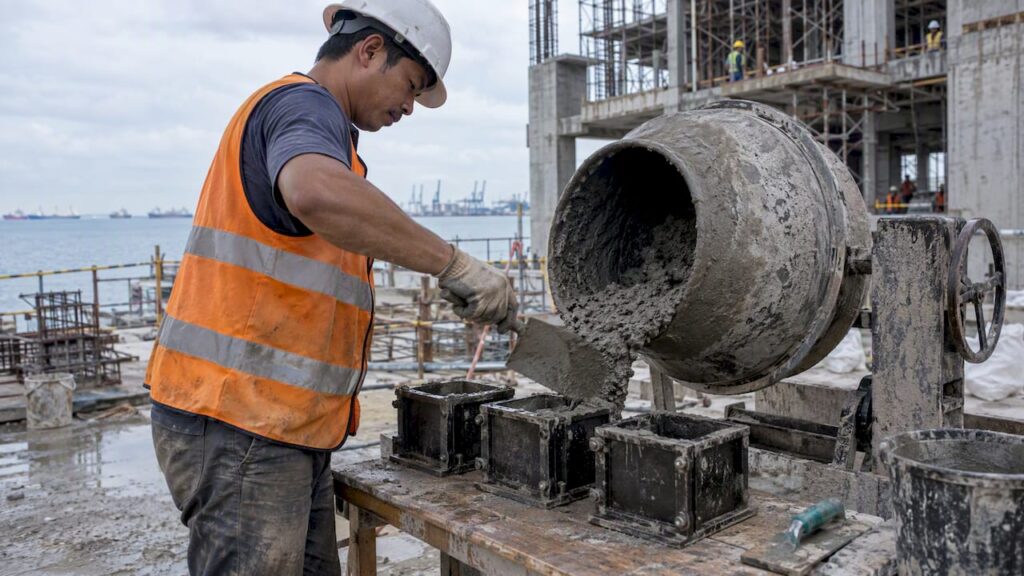
In tropical coastal climates, chloride ingress combined with high time-of-wetness accelerates reinforcement corrosion, and the dominant answer is to control permeability through tighter mix design and layer multiple protection systems rather than relying on cover depth alone. Singapore’s SS 544 addresses this directly by requiring a higher exposure class than temperate codes assume, and field data show rebar depassivation near 0.42% chloride content, a threshold reached far faster in marine climates than in cooler regions.
TL;DR:
- Tropical concrete structures are more susceptible to chloride depassivation near 0.42% chloride content, which occurs faster than in temperate environments.
- Controlling permeability through low water-to-cement ratios and using SCMs significantly extends service life, but requires tailored curing and mix design adjustments.
- Cover depth alone is insufficient; combining proper coatings, pore fillers, and cathodic protection depends on exposure severity and asset importance.
- Site practices such as precooling ingredients, extending curing, and monitoring internal temperatures are crucial in hot, humid climates to prevent cracking and long-term deterioration.
- Relying solely on accelerated tests can misrepresent tropical performance; regional field data should calibrate service-life models for accurate durability predictions.
Table of Contents
- Primary deterioration mechanisms in tropical and coastal environments
- Mix design choices that cut permeability and slow corrosion
- Protective measures: cover, coatings, inhibitors and cathodic protection
- Construction practices that protect concrete in hot, humid climates
- Service-life prediction and monitoring for tropical structures
- Implementation notes for durable tropical concrete projects
- Adapting durability testing for accelerated tropical exposure
- Aggressive soil and groundwater chemistry in tropical sites
- UV radiation and surface degradation in tropical concrete
- Priority ladder for durability interventions under budget constraints
- Build durable tropical structures with experienced design oversight
- FAQ
- Sources
Primary deterioration mechanisms in tropical and coastal environments
Reinforced concrete in tropical coastal zones faces a cluster of deterioration mechanisms that compound each other rather than acting in isolation. Chloride ingress drives most reinforcement corrosion in splash and tidal zones, and the chloride threshold that triggers depassivation of steel in tropical marine environments sits near 0.42%, compared with roughly 0.89% reported for temperate conditions. That gap means structures designed to temperate assumptions corrode sooner than expected once relocated to a tropical coastline.
High humidity extends time-of-wetness, keeping the pore network saturated long enough to sustain the electrochemical corrosion cell once chlorides reach the rebar. Elevated ambient temperatures also raise the heat of hydration during casting, which can produce early-age microcracking if thermal gradients are not managed, weakening the concrete’s resistance to later chloride and moisture attack.
- Splash and tidal zones carry the highest chloride-driven corrosion risk because wetting and drying cycles pump salts deeper into the cover.
- Continuously immersed zones see less oxygen but sustained saturation, which still supports corrosion once chlorides accumulate.
- Mass pours in high ambient heat raise the risk of thermal cracking unless the internal temperature gradient is actively controlled.
Natural, long-term carbonation data gathered from tropical exposure over periods of up to eleven years show carbonation depths diverging from what accelerated laboratory tests predict, a gap that matters when calibrating service-life models to tropical field conditions rather than temperate assumptions.
Mix design choices that cut permeability and slow corrosion
Permeability control is the single lever with the largest effect on tropical durability, and it starts with the water-to-cement ratio. For severe marine exposure, a target w/c near 0.35 aligns with the stricter exposure classes that SS 544 assigns to tropical coastal conditions, which call for at least one exposure class higher than the equivalent UK-based requirement.
Supplementary cementitious materials, including slag, fly ash and volcanic ash, reduce pore connectivity and slow chloride diffusion, but they bring a carbonation tradeoff: SCM-rich mixes carbonate differently over the long term and need curing regimes matched to their slower early strength gain. Long-term exposure testing on islands and reefs in the South China Sea found that high-performance concrete formulated with effective rust inhibitors extended service life beyond 50 years under splash-zone conditions, a result that depended on disciplined mix proportioning rather than cement content alone.
- Keep w/c at or below 0.35 for splash and tidal exposure, and specify minimum cementitious content per the applicable exposure class.
- Select SCM blends based on trial-mix chloride diffusivity results, not compressive strength alone.
- Use low-heat cement types or set-retarding admixtures where mass sections risk high internal temperature gradients.
- Match aggregate selection to avoid reactive silica content that could interact with high alkalinity over time.
Pro Tip: Request trial-mix chloride diffusion coefficients before finalizing any SCM percentage, since compressive strength results alone will not reveal how a mix performs against long-term ion ingress.
Protective measures: cover, coatings, inhibitors and cathodic protection
Cover depth remains necessary but is not sufficient on its own in severe marine exposure. SS 544 sets cover requirements by exposure class, but specifying the right number only pays off when in-situ quality control confirms the cover was actually achieved during placement. Beyond cover, several protective layers are worth combining depending on exposure severity.
- Coatings matched to exposure zone: epoxy or polyurethane coatings suit above-splash surfaces exposed to wetting and UV, while nanoparticle-enhanced polymer systems are better suited to extreme splash and tidal exposure where bench performance must be validated against field conditions such as salt spray and abrasion.
- Corrosion inhibitors and hydrophobic pore fillers: field exposure testing on reef structures found hydrophobic pore-filling agents cut surface chloride content by roughly 60% compared with untreated concrete, making them a practical mid-cost intervention for splash-zone elements.
- Cathodic protection for critical or already-corroding assets: sacrificial anode and impressed current systems are mature, effective technologies for marine reinforced concrete, and sacrificial anode systems in particular suit splash and tidal zones because they need no external power and carry low ongoing maintenance.
The decision rule follows exposure severity: low-risk above-splash elements rely on cover and coatings, splash and tidal zones add inhibitors or pore fillers, and immersed or already-deteriorating critical structures justify the added lifecycle cost of cathodic protection. Our corrosion control guidance for marine and coastal industrial zones covers how these layers interact across different asset types.
Construction practices that protect concrete in hot, humid climates
Durability specifications only deliver results when site practices match them. Tropical heat changes how concrete behaves between batching and final set, so several controls matter more here than in temperate climates.
- Precool ingredients and cap placement temperature to limit early-age thermal gradients, particularly in mass pours where internal peak temperatures can otherwise climb sharply.
- Extend curing duration for mixes containing SCMs, since their slower hydration means short curing cycles leave the pore structure open to early chloride and carbon dioxide ingress.
- Use curing methods suited to high ambient humidity, such as curing compounds or continuously saturated coverings, rather than relying on ambient moisture alone.
- Schedule concrete delivery and placement to avoid segregation and delayed compaction, both of which create voids that compromise effective cover.
- Monitor permeability and chloride diffusion coefficients on trial batches, and track internal temperature during mass pours to confirm gradients stay within safe limits.
Mass-concreting guidance for tropical climates consistently points to ingredient precooling and low-heat cement selection as the two most cost-effective controls against thermal cracking in large pours.
Service-life prediction and monitoring for tropical structures
Predicting how long reinforced concrete will last in a tropical coastal environment depends on feeding local exposure data into diffusion-based models rather than defaulting to temperate assumptions. Empirical chloride diffusion models, including approaches such as ChaDuraLife, estimate the time to depassivation from inputs like the chloride diffusion coefficient (Dcl), cover depth, the depassivation threshold, and the surface chloride concentration at the exposure site.
Using regional field data, drawn from island, reef or local coastal exposure studies, changes predicted initiation times meaningfully compared with models calibrated on temperate datasets.
- Chloride profiling at intervals confirms whether actual ingress tracks the model’s predicted diffusion rate.
- Half-cell potential surveys flag areas where corrosion has likely initiated, ahead of visible cracking or spalling.
- Polarization resistance testing quantifies active corrosion rate where half-cell results indicate risk.
- Inspection frequency should tighten once chloride profiling approaches the depassivation threshold, triggering remedial steps such as coating renewal or cathodic protection commissioning.
Implementation notes for durable tropical concrete projects
Translating this guidance into a buildable specification means applying SS 544’s exposure-class step-up, requiring trial mixes with documented chloride diffusivity, and specifying extended curing schedules for SCM blends in the contract itself, not left to contractor discretion. Tender documents should fix w/c ratio limits, SCM percentage ranges, curing duration, and acceptance criteria tied to in-situ testing rather than compressive strength alone.
Structural and geotechnical design checks, periodic structural inspections, and façade inspections can verify these durability measures hold up after construction, alongside authority submissions across BCA, URA and related boards. Before awarding a contract, ask suppliers for production certification, trial-mix evidence, and a written curing plan rather than a verbal assurance.
Adapting durability testing for accelerated tropical exposure
Standard accelerated durability tests were largely developed around temperate exposure cycles, and applying them unmodified to tropical projects risks misleading conclusions. Long-term natural exposure data from tropical sites, including a multi-year carbonation study in Chennai, found carbonation depths that diverged from what accelerated carbonation chambers predicted for the same mixes, which means service-life calibration built purely on accelerated results can understate or overstate real field performance.
Accelerated chloride migration tests still have value for comparing mix designs relative to one another, but absolute service-life numbers should be anchored to field exposure data wherever it exists, such as the South China Sea island and reef exposure program that tracked high-performance concrete performance over extended real-world splash-zone conditions. Practically, this means running accelerated tests for mix ranking during design, then validating the shortlisted mix against the closest available regional field dataset before finalizing service-life claims in a specification or warranty. Where no regional field data exists, specifiers should apply a conservative safety margin rather than trusting accelerated results at face value, particularly for structures with design lives beyond 50 years.

Aggressive soil and groundwater chemistry in tropical sites
Tropical soils and groundwater often carry chemical profiles that attack concrete from below as well as from marine spray above. High sulfate content, acidic groundwater from organic-rich tropical soils, and elevated chloride in coastal water tables all threaten foundations and substructure elements that never touch salt spray directly. These exposures demand their own sulfate-resisting cement selection and, in some cases, a barrier system between the concrete and surrounding soil.

Groundwater chemistry in reclaimed or coastal land can also carry chloride concentrations comparable to seawater, meaning substructure elements face a depassivation risk similar to splash-zone members above ground, even without direct wave exposure. Geotechnical investigation should therefore include groundwater chemical analysis as a standard input to foundation durability design, not an optional add-on. Our guidance on designing near the sea and salty groundwater covers how these subsurface exposures change foundation specification decisions.
Where soil or groundwater aggressiveness is confirmed, the practical responses mirror the above-ground playbook: lower w/c ratios, sulfate-resisting cement blends, and protective membranes sized to the measured chemical concentration rather than a generic assumption.
UV radiation and surface degradation in tropical concrete
Tropical latitudes deliver consistently high ultraviolet exposure year-round, and this accelerates surface degradation of exposed concrete and any applied coatings well beyond what temperate climates produce. UV breaks down polymer binders in coatings over time, which is why coating selection matters as much as the base concrete mix for above-splash surfaces exposed to direct sun.
Epoxy coatings tend to chalk and lose protective performance under sustained UV faster than polyurethane topcoats, which is part of why many specifications pair an epoxy primer with a UV-stable polyurethane finish coat for exposed tropical facades. Nanoparticle-enhanced coating systems are being evaluated specifically for their resistance to combined UV, salt spray and abrasion exposure, since bench testing alone does not reliably predict field performance under this combination of stresses.

Surface degradation from UV also compounds with carbonation at the exposed face, since a chalked or cracked coating stops acting as a barrier against both carbon dioxide and chloride-laden moisture. Facades and other sun-exposed elements in tropical coastal projects benefit from a maintenance plan that includes periodic coating inspection on a shorter cycle than the structural inspection interval, since coating failure typically precedes any visible structural distress.
Priority ladder for durability interventions under budget constraints
When budgets force tradeoffs, mix design and curing discipline deliver the largest durability gain per dollar spent, since they address the root cause of chloride ingress rather than adding a layer on top of a permeable substrate. Coatings for splash-zone elements come next, and cathodic protection should be reserved for structures where failure consequences or inspection access justify its higher lifecycle cost. Contracts should lock in certified production control and a documented maintenance schedule from day one, and specifiers, contractors and testing labs should coordinate before the first pour rather than after a durability problem surfaces.
— Aman
Build durable tropical structures with experienced design oversight
Specifying the right exposure class, mix parameters and curing protocol only protects a structure when those requirements survive into the built project, which is where design checks and construction-stage verification earn their cost. Structural and geotechnical engineering consultation, design checks, and periodic structural and façade inspections can confirm a tropical coastal project’s durability specification was actually followed on site, alongside the authority submissions (BCA, URA, JTC, SCDF, PUB, LTA, NEA, NParks) that keep a project compliant from plan approval through completion.
For projects already facing visible salt-driven spalling or cracking, our façade design and periodic façade inspection services identify where protective layers have failed and what remedial scope is needed before damage reaches the reinforcement. Review our full service list or get in touch to scope a design check, inspection, or authority submission for your next coastal or tropical project.
FAQ
What chloride level triggers rebar corrosion in tropical concrete?
Field studies in tropical marine environments report rebar depassivation occurring near a 0.42% chloride content, notably lower than the roughly 0.89% threshold reported for temperate regions. This means tropical structures reach the corrosion trigger point faster for the same cover and mix design than their temperate counterparts.
Does SS 544 require different concrete specifications for coastal projects?
Yes, SS 544 recommends selecting a concrete exposure class higher than that used in UK conditions to address the effects of higher ambient temperatures and tropical marine chloride exposure. This affects minimum cover, cementitious content and permissible water-to-cement ratio for a given exposure condition.
Is cathodic protection worth the cost for tropical marine structures?
Cathodic protection, whether sacrificial anode or impressed current, is a mature and effective technology for marine reinforced concrete, and sacrificial anode systems are often preferred for splash and tidal zones because they need no external power and carry low maintenance. It tends to be most cost-effective for critical assets or structures already showing active corrosion rather than as a blanket measure on every element.
Can supplementary cementitious materials reduce tropical concrete durability problems?
Slag, fly ash and volcanic ash reduce pore connectivity and slow chloride diffusion, which helps against the dominant tropical coastal corrosion mechanism. They require extended curing schedules and introduce a different long-term carbonation behavior than plain cement mixes, so curing protocols and carbonation expectations need adjustment rather than treating SCMs as a drop-in substitute.
How do engineers predict service life for tropical coastal concrete?
Engineers use diffusion-based models, such as approaches like ChaDuraLife, that estimate the time to rebar depassivation from inputs including the chloride diffusion coefficient, cover depth, the depassivation threshold, and surface chloride concentration. Regional field exposure data changes these predictions meaningfully compared with models built on temperate datasets, so local or regional exposure data should feed the calculation whenever it is available.
Sources
- Durability requirements for reinforced concrete structures placed in a hostile tropical coastal environment
- Concrete – Complementary Singapore Standard to SS EN 206-1 (SS 544-1-2009)
- Service life of high-performance concretes based on durability exposure test of islands and reefs in the South China Sea
- Review of cathodic protection technology for steel rebars in concrete structures in marine environments
- 10-year natural carbonation data of concretes with limestone, fly ash and other SCMs (tropical exposure)
Recommended
- Precast Singapore: One Checklist for SS 677, BCA DfMA and CORENET X
- Prestressed Concrete Design and Application in Singapore
- Concrete Spalling 101: Why It Is More Than An Aesthetic Issue
- How Coastal Salt Air Affects Structural Integrity: Sentosa & East Coast Guide