




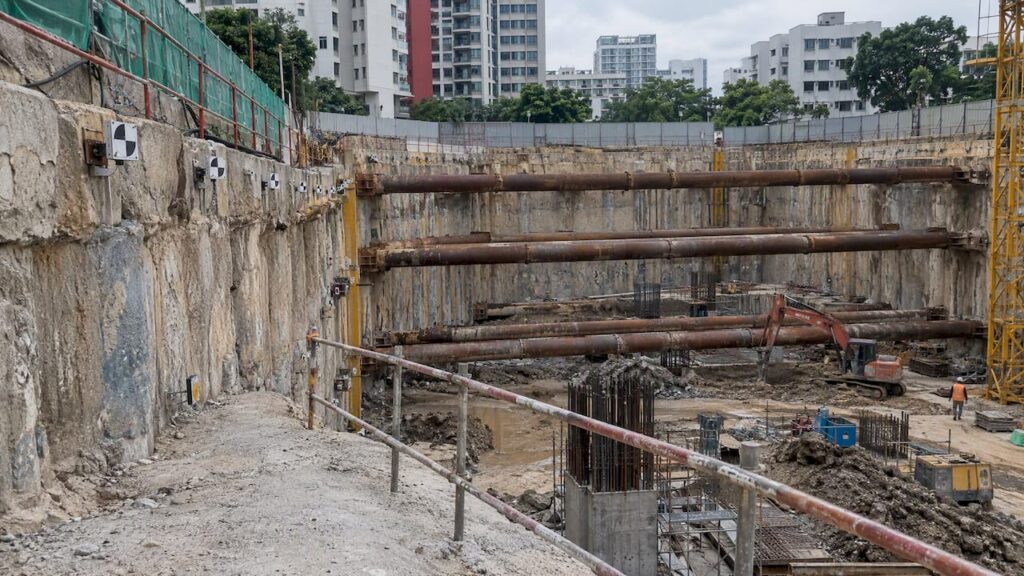
Deep excavation monitoring in Singapore applies once an excavation reaches a retained depth of 6 meters or more, with additional triggers for shallower works near sensitive structures, poor ground, or groundwater drawdown. A Specialist Accredited Checker must review the instrumentation proposal and ongoing results. The purpose is straightforward: track wall displacement, pore pressure, strut loads, and adjacent structure movement closely enough to confirm the design is behaving as predicted and to support safe, informed decisions on site.
TL;DR:
- Shallower excavations still require monitoring near vulnerable buildings, utilities, or rail assets, in poor ground, or when dewatering could cause surrounding soil settlement.
- A Specialist Accredited Checker reviews instrument choice, reading frequency, and reporting; teams should establish a shared datum and average three readings before excavation begins.
- Near tunnels, LTA requires points no more than 3 meters apart, at least four per ring, and arrays extending 20 meters beyond the influence zone.
- Critical instruments near deep cuts or rail assets often log continuously; secondary points may be read daily or weekly, with soft level crossings verified immediately.
- The Observational Method can support omitting a planned strut only when denser monitoring confirms measured behavior stays within design levels set before excavation.
Table of Contents
- Regulatory and Standards Framework for Deep-Excavation Monitoring in Singapore
- Key Instruments and What They Measure
- Monitoring Arrays, Placement Rules, and Examples for Tunnels and Adjacent Buildings
- Reading Frequency, Data Management, and Review Levels
- When and How to Use the Observational Method in Singapore
- Real-Time Systems, Automation, and Advanced Sensing
- Interpreting Monitoring Results and Setting a Trigger-Response Framework
- Case Study: Observational-Method Monitoring on a Singapore Deep Excavation
- Priorities for Monitoring Deep Excavations in Singapore
- How We Support Monitoring Plans, ERSS Design, and Authority Submissions
- FAQ
- Sources
Regulatory and Standards Framework for Deep-Excavation Monitoring in Singapore
The 6-meter threshold is a baseline rather than a ceiling. Excavations shallower than that still require formal monitoring when adjacent buildings, utilities, or MRT structures are vulnerable, when ground conditions are poor, or when dewatering risks consolidation settlement in surrounding soil, as set out in Singapore Standard guidance on instrumentation and monitoring. Every instrumentation plan for such works is reviewed by a Specialist Accredited Checker, whose statutory role includes verifying the adequacy of the instruments proposed, the frequency of readings, and the reporting of results under the Building Control (Accredited Checkers and Accredited Checking Organisations) Regulations.

For works near rail infrastructure, LTA’s engineering requirements add specific technical conditions, including piezometric pressure limits within the Railway Protection Zone.
A typical submission package includes:
- An instrumentation plan showing instrument type, location, and depth relative to the excavation and nearby structures.
- A base-set protocol establishing pre-construction readings before any excavation activity begins.
- Datum coordination confirming every instrument ties back to a single, stable project grid and reduced level.
Key Instruments and What They Measure
Choosing the right instrument mix depends on what the excavation threatens and how fast that risk can change. Singapore’s soft marine clay and fill conditions make redundancy and calibration discipline especially important.
- In-wall and automated inclinometers track lateral wall displacement along the depth of the ERSS, flagging bulging or tilting before it becomes visible at the surface.
- Piezometers and standpipes record pore pressure and groundwater change, which matters directly for consolidation settlement risk in compressible clay.
- Settlement markers, total stations, and GNSS receivers measure surface and structural settlement around the excavation perimeter and on adjacent buildings.
- Vibrating-wire strain gauges and load cells monitor strut and anchor loads, confirming the earth retaining and stabilising structure is carrying load as designed.
- Fiber Bragg grating (FBG) sensing provides dense, continuous multi-depth readings across wall displacement, strut force, and soil heave in a single integrated array, as documented in recent automated monitoring research.
Pro Tip: Pair at least one automated instrument type with manual backup readings at every critical cross-section; automated systems can fail silently, and manual checks catch that early.
Monitoring Arrays, Placement Rules, and Examples for Tunnels and Adjacent Buildings
Array design follows prescriptive rules once rail infrastructure or sensitive structures sit within the zone of influence. Our own ERSS design work in Singapore starts from these placement rules before any strutting scheme is finalized.
- Tunnel monitoring: LTA requires monitoring points at intervals of 3 meters or less within the predicted zone of influence, with at least four points around each tunnel ring, extending the array at least 20 meters beyond the zone boundary.
- Retaining wall arrays: case-history practice places in-wall inclinometers at roughly 25-meter intervals along the wall, each coordinated to the project grid and reduced level so readings are comparable across the full length.
- Adjacent building and utility zones: monitoring typically covers a minimum distance of twice the excavation depth from the wall, with a base set established before any excavation starts.
- Access and redundancy: route cabling and protect instrument heads from construction traffic, and duplicate critical points so a damaged sensor does not create a monitoring gap.
Reading Frequency, Data Management, and Review Levels
A base set is the average of three independent readings taken before excavation begins, giving every later reading a fixed reference point. Frequency then scales with risk: critical instruments near deep cuts or rail assets often run continuous or real-time logging, while secondary points are read daily or weekly based on the excavation stage.
- Soft, alert, and stop levels are fixed in advance, each tied to a specific notification route to the design engineer and Specialist Accredited Checker.
- Any reading beyond the soft level triggers immediate re-verification before escalation.
- Reports present base sets in tabular form, relative movement in millimeters, and time-history graphs for trend review.
Automated fiber-optic monitoring systems have shown agreement with manual inclinometer readings within about 5 millimeters in recent field studies, supporting their use as a primary data source where continuous coverage is needed.
When and How to Use the Observational Method in Singapore
The Observational Method lets a design proceed with conservative elements held in reserve rather than built in from day one, provided monitoring data confirms actual ground behavior stays within pre-agreed limits. A Singapore case history documents an OM decision stage where measured wall deflections stayed well under the OM design level, allowing a planned strut level to be omitted and delivering time and cost savings without compromising safety.
- OM design levels are fixed before excavation starts, each paired with a documented decision stage reviewed against live monitoring data.
- Instrumentation density under OM is typically higher than a conventional scheme, since the decision to omit or modify structural elements depends entirely on monitoring evidence.
- Instrument suites supporting OM commonly combine in-wall and in-ground inclinometers, piezometers, vibrating-wire strain gauges on struts, settlement markers, and automated monitoring for adjacent structures, all tied to one project datum.
- Every OM decision requires a documentation trail linking the measured data directly to the design level it is being compared against, for authority review.
Real-Time Systems, Automation, and Advanced Sensing
FBG and automated total station systems extend coverage beyond what manual rounds can achieve, logging wall displacement, strut load, soil heave, and layered earth pressure at multiple depths simultaneously. Field comparisons against manual readings show agreement within about 5 millimeters, which supports their use for continuous coverage on sensitive sites.
- Telemetry and alarm logic should trigger notification the moment a soft level is crossed, not at the next scheduled reading round.
- Redundant power and data paths prevent a single fault from creating a monitoring blackout during critical excavation stages.
- Routine calibration and sensor-head inspection remain necessary even on automated systems, since drift can go unnoticed without manual cross-checks.
Pro Tip: Confirm vendor calibration certificates and local support availability before committing to an automated system; a sensor that cannot be serviced quickly in Singapore defeats the purpose of real-time monitoring.
Interpreting Monitoring Results and Setting a Trigger-Response Framework
Reading instruments in isolation misses the picture. Wall deflection, strut load, and pore pressure usually move together, and a spike in one without a corresponding change in the others often points to an instrument fault rather than genuine ground movement.
- Compare the flagged reading against correlated instruments nearby to rule out an isolated sensor error.
- Re-check the datum and reference points before accepting the reading as real movement.
- Take a second reading and, where feasible, a visual inspection of the affected zone.
- Escalate to the Specialist Accredited Checker for formal review once soft or alert levels are confirmed.
- Document the finding, the verification steps taken, and any remedial action for the authority record, with clear sign-off on who approved continuing or halting works.
Case Study: Observational-Method Monitoring on a Singapore Deep Excavation
On a deep excavation project supported by our geotechnical and structural engineering team, the monitoring scope was built around an ERSS scheme with multiple strutting levels and a basement excavation exceeding the 6-meter threshold. The instrumentation plan followed the standard decision chain: Specialist Accredited Checker review, base-set establishment, and a defined reading cadence tied to excavation stage.
- In-wall inclinometers and vibrating-wire strain gauges on struts formed the primary array, with piezometers monitoring pore pressure through each excavation lift.
- Settlement markers covered adjacent structures within the influence zone, read on a schedule that tightened as excavation approached critical depths.
- Measured deflections and strut loads tracked within the predicted design range throughout, giving the project team confidence to proceed without additional conservative measures.
- The key lesson for other Singapore teams: establish the base set and datum coordination before mobilization, not after, since a late or inconsistent reference point undermines every reading that follows.
Priorities for Monitoring Deep Excavations in Singapore
Engage a Specialist Accredited Checker early and settle the instrumentation plan before excavation mobilizes, since retrofitting arrays after work starts leaves gaps in the base-set record. A disciplined datum, instrument redundancy, and real-time alarms matter more on sensitive sites than any single sensor choice. Thorough documentation, tied directly to OM design levels where applicable, is what carries a project through authority review without delay.
— Aman
How We Support Monitoring Plans, ERSS Design, and Authority Submissions
We handle the full chain behind a compliant deep-excavation project: ERSS design, instrumentation planning, and coordination with the Specialist Accredited Checker who reviews it, alongside BCA, URA, and building consent agencies submissions for works near rail infrastructure.

Before reaching out, it helps to have a soil investigation report, preliminary ERSS drawings, and a rough list of structures or utilities near the excavation footprint. We review these against the applicable thresholds and triggers, then build an instrumentation and submission package suited to the site.
- Structural and geotechnical engineering consultation for ERSS and instrumentation design.
- BCA, URA, and LTA submission coordination for excavation works near sensitive assets.
- Specialist Accredited Checker liaison throughout the monitoring and review process.
Reach out through our services page to start a project review.
FAQ
What depth triggers mandatory excavation monitoring in Singapore?
An excavation with a retained depth of 6 meters or more requires formal monitoring in Singapore. Shallower excavations near vulnerable structures, in poor ground, or with significant groundwater drawdown risk also require monitoring under the same guidance.
Who reviews a deep excavation monitoring plan in Singapore?
A Specialist Accredited Checker reviews the adequacy of instrumentation, reading frequency, and reporting under the Building Control regulations. This review applies throughout the works, not only at the submission stage.
How close together do monitoring points need to be near MRT tunnels?
LTA requires monitoring points at 3-meter intervals or less within the predicted zone of influence, with at least four points around each tunnel ring. The array must extend at least 20 meters beyond the zone boundary.
What is a base set and why does it matter?
A base set is the average of three independent readings taken before excavation work begins, establishing the reference point every later reading is compared against. Without a reliable base set, movement calculations during excavation lose their accuracy.
How does the Observational Method affect monitoring requirements?
The Observational Method generally requires a denser instrumentation array because structural decisions, such as omitting a conservative strut level, depend directly on monitoring data staying within pre-agreed design levels. A Singapore case history shows monitoring confirming deflections well under OM design levels, supporting that kind of decision.
Sources
- Building Control (Accredited Checkers and Accredited Checking Organisations) Regulations – Singapore Statutes Online
- LTA circular: Enhanced technical requirements in code of practice for railway protection
- Automated monitoring of deep excavations using fiber Bragg grating technology (Frontiers in Earth Science, 2026)
Recommended
- ERSS Design for Excavation works in Singapore
- Depth Report on Underground Cavern Development Singapore
- Geotechnical Site Investigation in Singapore: