




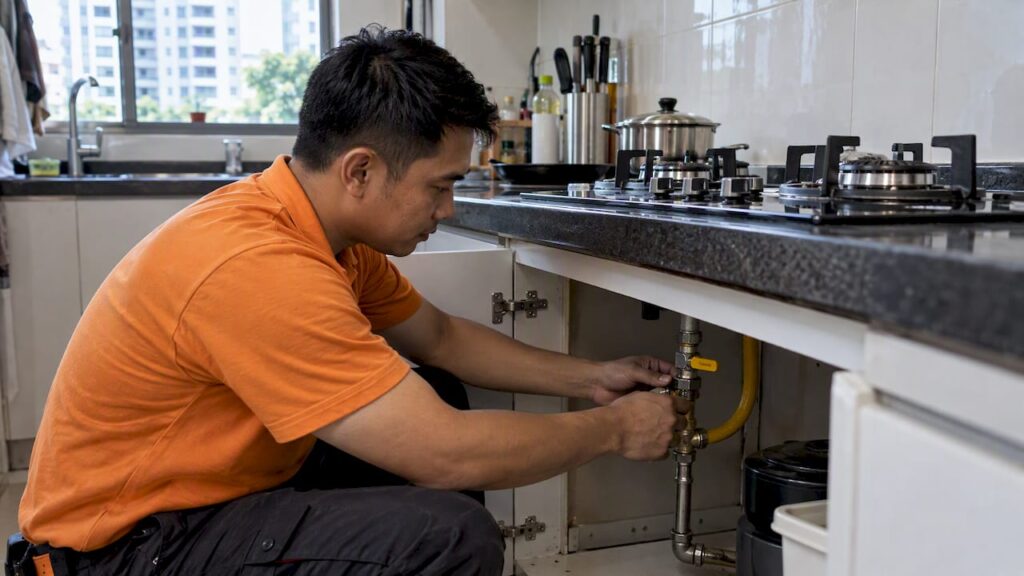
Singapore does not issue a single “gas installation licence” to a building or a company. Licensing attaches to the person who performs the work: gas service work must be carried out by a Licensed Gas Service Worker (LGSW) holding a licence from the Energy Market Authority (EMA), and installations beyond a defined scope require a Professional Engineer (PE) in mechanical engineering. LPG storage and piping carry a separate fire safety track under the Singapore Civil Defence Force (SCDF). This article sets out how the two regimes divide responsibility, what the LGSW licence costs and permits, and how owners, developers and design teams should sequence approvals.
TL;DR
- Gas installation work in Singapore is licensed by worker, not by premises: only an EMA-licensed LGSW, or a mechanical PE for larger systems, may design, construct or alter gas pipes and fittings.
- The LGSW licence costs S$50 to apply (non-refundable) and S$30 on approval, and is applied for through the EMA’s ELISE portal.
- A standard LGSW licence covers operating pressures of 30 mbars or less; boosters, leakage detection interlocked with safety cut-off valves and higher pressures need a PE, with the LGSW working under supervision.
- Since 1 September 2025, SS 608:2024 is the code of practice referenced for gas installation work.
- LPG cylinder installations are governed by the SCDF Fire Code, so a gas approval does not replace fire safety submissions.
Table of Contents
- How gas installation is regulated in Singapore
- The Gas Service Worker licence
- When a Professional Engineer is required
- SS 608:2024 and the technical standard
- LPG: a separate fire safety route
- Periodic inspection obligations after installation
- Sequencing approvals on a project
- Our perspective
- How we can support your project
- FAQ
- Sources
How gas installation is regulated in Singapore
The Gas Act and the Gas (Supply) Regulations came into operation on 14 February 2008, creating a competitive framework for the piped gas industry and setting out the duties of licensed workers. The EMA regulates gas supply, technical standards and worker licensing. The practical consequence for a property owner is simple: there is no application a landlord files to be “licensed to install gas”. Instead, the owner engages a licensed person, and that person carries the legal responsibility for the work.
Two distinctions help when reading the rules.
First, piped gas and LPG are treated differently. Piped town gas is produced by City Energy and transported through pipelines owned by PowerGas, the licensed gas importer, as described on the EMA gas market page. Natural gas for power generation is a separate market, which is not relevant to a typical building installation. LPG delivered in cylinders sits primarily under fire safety legislation.

Second, the party who certifies the work matters. The EMA states that all piped gas appliances must be installed by a licensed worker, who then issues a written statement certifying that the appliance has been tested and is safe to use. That statement is the document owners should retain, since it evidences compliance if the installation is later inspected or questioned.
The Gas Service Worker licence
What an LGSW may do
According to the EMA’s licence page, a Gas Service Worker Licence entitles the holder, where the operating pressure is not more than 30 mbars, to:
- construct, fix, alter, repair and renew gas pipes and fittings;
- install, maintain, repair and test gas appliances; and
- install or remove gas meters and turn on the gas supply on behalf of a gas licensee.
A Restricted licence is narrower. Its holder is limited to appliance maintenance and meter works and may not construct or alter gas pipes and fittings, as set out in the EMA circular to licensed workers. Owners and contractors should therefore confirm which class of licence a worker holds before assigning pipework.
Qualifications
The EMA lists several qualification routes. One is a Builder Certificate in Plumbing and Pipefitting from the BCA Academy together with a Gas Service Workers Course certificate from the BCA Academy, plus at least two years of relevant experience, per the EMA licence page. Other routes, including polytechnic diploma pathways, are listed on the same page together with their experience requirements. Applicants should read the current table there, because eligibility criteria can be amended.
Fees and application
| Item | Amount | Notes |
|---|---|---|
| Application fee | S$50 | Non-refundable |
| Licence fee | S$30 | Payable on approval |
| Channel | ELISE portal | EMA e-Licence Information Services |
The fees and the portal requirement are stated on the EMA gas service worker licence page, and the application itself is filed through the ELISE worker licence application service. The EMA also notes that it issues the licence only if the applicant’s MediSave contributions are up to date, so applicants should settle that before submitting.
Checking that a worker is licensed
Consumers can search for licensed persons on the ELISE portal, according to the EMA’s guidance on engaging licensed workers. For a developer or main contractor, the check belongs in the subcontractor appointment process, before any pipework is priced or scheduled.
When a Professional Engineer is required
The 30 mbar boundary is the practical dividing line between a routine installation and an engineered one. Under the supervision of a mechanical PE, an LGSW may carry out works involving gas booster systems, leakage detection interlocked with a safety cut-off valve, or pressures above 30 mbars. In those cases the PE designs, endorses and submits the plans, and the LGSW assists under direct supervision rather than acting independently.
The Gas (Supply) Regulations also contemplate design by licensed workers for certain installations: the Gas (Supply) Regulations on Singapore Statutes Online should be consulted for the exact wording, as the scope depends on the gas supply code. Projects that typically cross the threshold include:
- commercial kitchens in food courts, hotels and central kitchens with high-capacity equipment;
- multi-storey developments with gas risers and distribution piping;
- industrial premises using gas in processes, with boosters to maintain pressure;
- facilities that require gas leakage detection tied to automatic shut-off.
For design teams, the appointment of a mechanical PE should be fixed during schematic design. Gas riser positions, meter rooms and plant spaces consume floor area and interact with structural and architectural layouts, so late appointment tends to generate abortive drawings.
SS 608:2024 and the technical standard
The EMA issued Circular RD/G02/2025 on 1 September 2025, addressed to all LGSWs and Professional Engineers, amending the Gas (Supply) Regulations in relation to the reference to Singapore Standard SS 608. The effect is that work is to follow SS 608:2024, the Code of Practice for Gas Installation. Anyone who designed to an earlier edition on a long-running project should confirm with the appointed PE which version governs the remaining works.
LPG: a separate fire safety route
The most common error in gas projects is to treat EMA licensing as the whole of the compliance picture. For LPG, the governing instrument is the SCDF Fire Code 2023, Clause 10.1 on LPG cylinder installations. Points that regularly affect rejected submissions include:
- cylinder housing built to the steel cabinet specification in the Fire Code, with a thickness of 2.5 mm;
- location in naturally ventilated areas;
- manifold positions kept clear of manholes, drains and building openings, in line with the prescribed separation distances.
Eating outlets receive specific treatment. Annex 10.1B allows LPG cylinders to be used or stored inside a building only if conditions are met, including that the outlet is on or above ground level and naturally ventilated. Certification of safety checks on LPG manifold systems is also documented in an SCDF LPG manifold checklist.
In short, EMA worker licensing and SCDF fire safety approval run concurrently. A technically sound gas pipe design does not stand in for the fire safety certification of an LPG store. Further background on manifold systems is available in our guide to gas cylinder storage compliance and SCDF manifold regulations, and on the wider fire framework in our note on key fire safety duties under the Fire Safety Act and Fire Code 2023.
Periodic inspection obligations after installation
Licensing does not end at turn-on. The Gas Supply Code (version dated 7 October 2024) sets out the periodic inspection programmes managed through the gas transporter. In summary:
| Premises | Inspection basis |
|---|---|
| Residential units | 15-year programme |
| Non-residential or multi-storey premises | Annual inspection of common gas risers and piping by a PE or LGSW, depending on pressure and system complexity |
| Inaccessible installations | Soundness test every 3 years |
These are statutory programmes and are distinct from routine maintenance. Non-compliance can lead to regulatory consequences, including possible disconnection of supply. Owners of multi-tenanted buildings should record inspection dates in the building’s compliance calendar alongside other statutory cycles, such as the BCA periodic structural inspection and façade inspection.
Sequencing approvals on a project
For an A&A, rebuild or new build that includes gas, the following order limits rework:
- Define the gas load and pressure. Establish the appliance schedule and whether any element exceeds 30 mbars or requires boosters or leakage detection.
- Appoint the right person. An LGSW for routine low-pressure work; a mechanical PE for engineered systems.
- Fix the LPG strategy early. Cylinder location, cabinet and manifold positions go on the architectural plans before SCDF submission.
- Coordinate the authority submissions. Gas works often touch BCA, SCDF and, for industrial estates, JTC consent, so the drawings should be consistent across agencies.
- Obtain the LGSW certification. The written statement of safety is retained before the supply is turned on.
- Diarize inspections. Record the periodic inspection obligations from handover.
A developer planning gas-fired heating or cooking in a hospitality or residential scheme may find it useful to compare equipment choices early, such as in this overview of investing in gas heaters, because appliance rating drives gas load and therefore the pressure category and the appointment decision above.
Our perspective

We see gas compliance go wrong less often from a lack of technical skill than from sequencing. A kitchen tenant orders equipment, the LPG store is shown in a position that conflicts with a drain or opening, and the fire safety submission is returned after the fit-out programme has been fixed. Where a project has an A&A or change-of-use component, we recommend that the gas strategy, LPG location and authority matrix are settled in the first design coordination meeting, not after the tender.
Our practice covers architectural, structural, geotechnical and M&E engineering design, and we handle submissions to the BCA, URA, JTC, SCDF, PUB, LTA, NEA, NParks and HDB. That breadth matters here, because a gas installation seldom sits in isolation: riser openings affect structure, store positions affect the layout approved by the URA, and the SCDF submission depends on both. The most useful discipline is to maintain one consolidated register of approvals, each with a named responsible party.
— Aman
How we can support your project
If your project involves LPG storage, flammable materials or multi-agency submissions, our team can coordinate the design and the filings. Details of the services we offer, including SCDF/FSSD submissions and M&E engineering design, are on our services page. For a related process, see our explanation of the SCDF P&FM submission for petroleum and flammable materials. Pricing is not published and is scoped per engagement.
FAQ
Can a company obtain a gas installation licence in Singapore?
The EMA licenses individuals as Gas Service Workers, not premises or installations. A company carries out gas work by employing or engaging LGSWs and, where the scope requires it, a mechanical PE. Owners should verify the worker’s licence on the ELISE portal before work starts.
How much does a gas service worker licence cost?
The application fee is S$50 and is non-refundable. A further S$30 licence fee is payable once the application is approved. Applications are made through the EMA’s ELISE portal.
Can I install a gas pipe myself?
No. Piped gas appliances must be installed by a licensed worker, who certifies in writing that the appliance has been tested and is safe to use. For faults in an existing appliance, the EMA advises consulting the appliance supplier or a licensed worker, or calling City Energy on 1800 555 1661.
When is a Professional Engineer needed instead of an LGSW?
A mechanical PE is required for installations above 30 mbars and for systems involving gas boosters or leakage detection interlocked with a safety cut-off valve. In these projects the LGSW may assist only under the PE’s supervision.
Does an EMA-licensed installation also satisfy SCDF requirements for LPG?
No. LPG cylinder installations are governed by the SCDF Fire Code, so fire safety submissions must be made in addition to any gas works. Cabinet construction, ventilation and manifold separation distances are assessed under that Code.
Sources
- EMA: Gas Service Worker Licence
- EMA ELISE: Worker Licence Application
- EMA: Engaging Licensed Workers
- EMA: Circular to LGSW on the Act and Regulations
- EMA Circular RD/G02/2025 on SS 608
- EMA: Gas Market
- EMA: Gas Supply Code, 7 October 2024
- SCDF Fire Code 2023, Clause 10.1
- SCDF Fire Code 2023, Annex 10.1B
- SCDF LPG manifold safety checklist
Recommended
- Petroleum and Flammable Materials Storage License SCDF submission
- Singapore Fire Safety Certificate Requirements For Building Owners
- SCDF P&FM Submission for Petroleum and Flammable materials in Singapore
- Gas Cylinder Storage Compliance: SCDF Manifold System Regulations for LPG, Acetylene, and Industrial Gases