




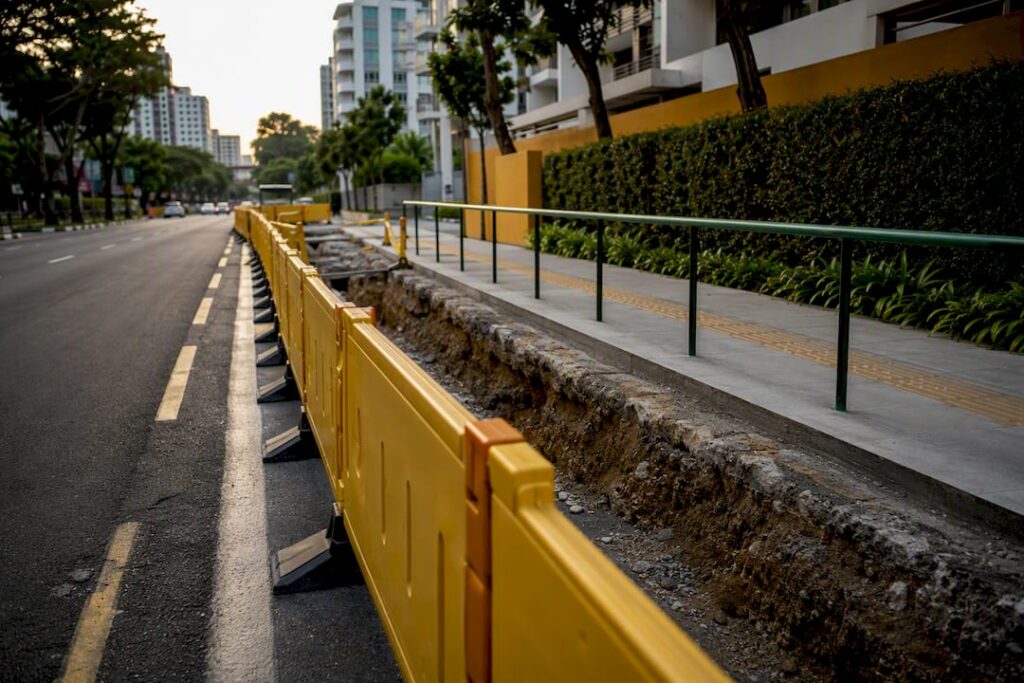
Apply through LTA.PROMPT, registering as the correct account type (contractor, professional engineer, or site supervisor) before you submit. Have your traffic control plan, method statement, site plans, and a public liability insurance policy of at least S$1,000,000 ready before you start the application. Multi-agency works require simultaneous submissions across LTA, PUB, JTC, HDB, SLA, or NParks, so confirm which agencies manage your site early.
TL;DR:
- Over half of applications are rejected due to mismatched traffic plans and on-site photos, so thorough alignment before uploading is critical.
- For works affecting more than one agency or involving large-scale excavation, early consultation and multi-agency approval streamline the process.
- Permit applications, especially for deep excavation or structural works, benefit from professional engineer sign-off and early structural certification.
- Submitting your plans, insurance, and site evidence a full week before deadlines reduces the risk of delays or rejection.
Table of Contents
- What a Street Works Permit Covers in Singapore
- Which Permit or Notification Applies to Your Works?
- How to Apply for Street Works: Registration, Documents, and Timelines
- Which Agencies Manage Which Locations?
- What Insurance and Financial Guarantees Does LTA Require?
- Duties, Completion Reporting, and the Defects Liability Period
- Practitioner Checklist: How Stellar Structures Avoids Permit Delays
- When Should Project Owners Bring in Specialist Help?
- How Stellar Structures Supports Your Permit Application
- Sources
What a Street Works Permit Covers in Singapore
The Street Works Act 1995 defines street works broadly: excavation, utility installation, lane occupation, hoarding, scaffolding over footpaths, and any temporary structure that touches a public street. If your project breaks ground, occupies road space, or restricts pedestrian access, it likely falls under this framework regardless of project size.
Responsibility for applying rests with whoever controls the work, not necessarily the property owner. That usually means the main contractor, but a professional engineer or an authorized agency officer may also lodge the application depending on the works category.
A useful distinction: works confined entirely within private land, with no encroachment onto a public road, footpath, or drain reserve, typically need no street works permit at all. The moment equipment, hoarding, or excavation crosses that boundary, whether by a few centimeters or a full lane closure, the permit requirement kicks in. Key categories to check against your scope:
- Excavation for utilities, drainage, or foundation works near a public street
- Lane or footpath occupation for hoarding, scaffolding, or storage
- Crane operations or boom-lift work that swings over a carriageway
- Temporary structures erected on or adjacent to state land bordering a road
Which Permit or Notification Applies to Your Works?
Not every job needs the same paperwork. LTA.PROMPT sorts applications into distinct categories, and picking the wrong one is a common cause of rejected submissions.
- Permit to Carry Out Works covers any physical intervention that occupies or affects a road, footpath, or drain reserve, including excavation, hoarding erection, and utility tie-ins. This is the core roadwork permit most contractors will file.
- Notification of Road or Lane Closure applies when you need to close a lane or section of road temporarily but aren’t disturbing the pavement structure itself. Minimum notice periods generally run several days ahead of the closure date, and straightforward closures may only require notification rather than a full permit review.
- Oversized Vehicle or Vehicle Movement Permits cover mobile cranes, low-bed trailers, or any conveyance exceeding standard dimensions traveling on public roads.
- Temporary Directional Signage approvals apply when diversion signs or traffic control devices need to go up ahead of works.
Common real-world triggers include mobile crane hoisting over a live carriageway, boom-lift access for façade repairs, and open-cut excavation for utility connections, each falling into a different permit lane depending on how it touches the street.
How to Apply for Street Works: Registration, Documents, and Timelines
Registration comes first, and the account type you choose determines what LTA.PROMPT will ask for later. Contractors need a company authorization letter, ACRA or ROC registration certificate, and identification for the responsible officer. Site supervisors must hold a CITI Pavement Certificate or a recognized civil engineering diploma or degree, with diploma holders generally needing around five years of relevant experience to qualify. Professional engineers register under their own account category and take on structural sign-off duties for more complex works.
Once registered, the application itself needs a defined document set:
- Traffic control plan showing lane configurations, signage, and diversion routes
- Method statement describing the sequence and technique of works
- Site or location plans, including a cadastral plan if the works affect state land
- Photographic evidence of existing site conditions before works begin
- Public liability insurance with a minimum sum assured of S$1,000,000
- Workmen’s compensation coverage, where the works involve on-site labor
Pro Tip: Scan your traffic control plan against the actual site photos before uploading. Reviewers reject a striking number of applications simply because the plan shows a lane configuration that doesn’t match what the photos reveal on the ground.
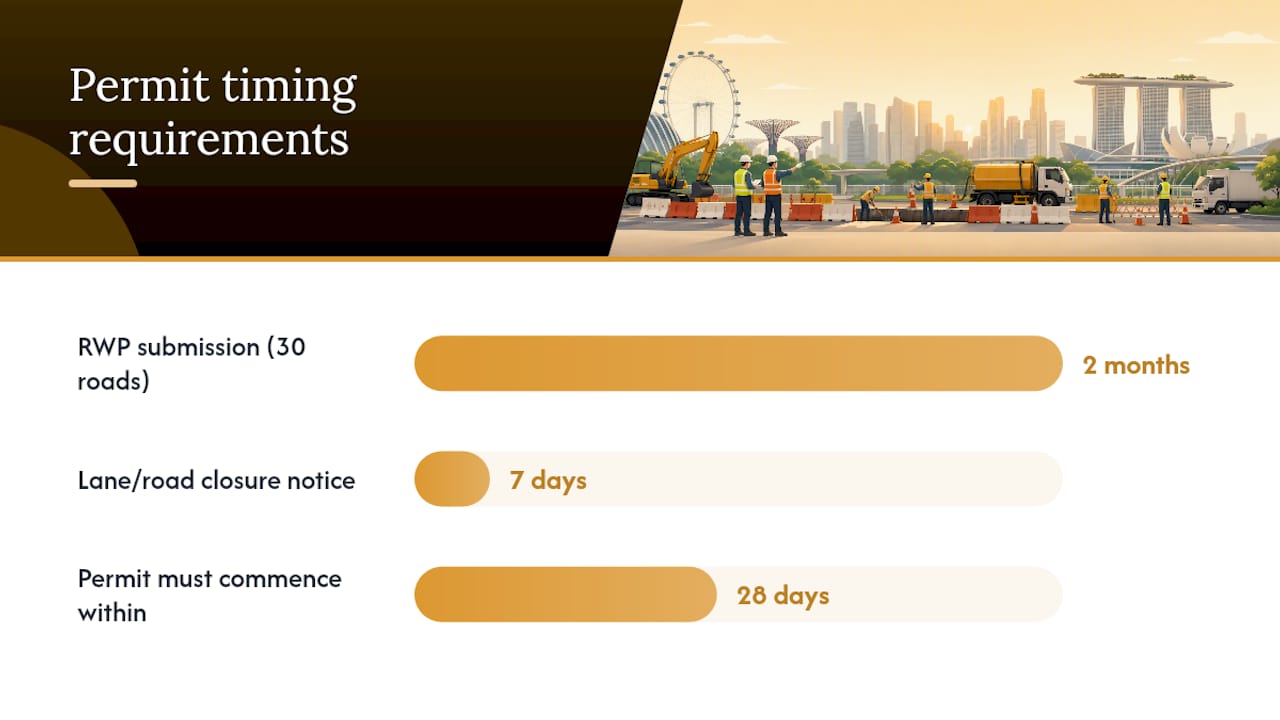
Timelines matter as much as documents. Road or lane closure notifications typically need a minimum of seven days’ advance notice, and permits generally must commence within 28 days of approval or risk revocation. A significant change arrives on October 1, 2026: for 30 identified roads, applicants must submit planned works schedules through the Road Works Planner at least two months in advance, on a quarterly cycle, before LTA.PROMPT will even accept a permit application for those roads. Miss that RWP window, and no amount of paperwork will get your permit through on time.
If your works touch more than one agency’s territory, LTA.PROMPT lets you file simultaneous applications rather than sequencing separate requests, which is the more efficient route for anything spanning a road reserve and an adjacent JTC-managed site.
Which Agencies Manage Which Locations?
Singapore splits land management responsibility across several statutory bodies, and street works crossing agency boundaries need each one’s sign-off. Getting this mapping wrong is one of the fastest ways to trigger a rejected or delayed application.
| Location Type | Managing Agencies |
|---|---|
| Road carriageway | LTA, JTC, HDB |
| Footpath | LTA, JTC, HDB |
| Drains and drain reserves | LTA, JTC, PUB |
| Vacant state land | JTC, SLA, NParks |
| Car parks | JTC, HDB |
Deep excavation, tunneling, or major utility diversions typically require pre-consultation with LTA or the relevant agency well before a formal application, sometimes months ahead given the scale of engineering review involved. The practical lesson: identify every agency with a stake in your site before you draft a single document, not after a rejection notice arrives citing a missing endorsement.
What Insurance and Financial Guarantees Does LTA Require?
Public liability insurance is non-negotiable for street works permits. The Code of Practice for Works on Public Streets requires a policy naming LTA as one of the principals, a minimum sum assured of S$1,000,000, and a cross-liability clause covering both the works period and the defects liability period that follows.
Workmen’s compensation applies whenever on-site labor is engaged, covering injury claims that arise from excavation, lifting, or road-side work activities.
- Public liability: minimum S$1,000,000, LTA named as principal
- Workmen’s compensation: required wherever labor is directly engaged on site
- Banker’s guarantees: sometimes required for major or higher-risk works, as security against incomplete reinstatement
- Fee categories: application/submission fees, inspection fees, and closure charges vary by works type and duration, so check the current LTA.PROMPT fee schedule before budgeting
Banker’s guarantees aren’t standard for every permit, but LTA can request one where the works carry elevated risk to the road structure, giving the authority financial recourse if reinstatement falls short of standard.
Duties, Completion Reporting, and the Defects Liability Period
Once a permit is issued, the obligations don’t stop at approval. A registered site supervisor must be present for the duration of works, holding either a CITI certificate or the diploma/degree-plus-experience combination LTA requires for registration. For structural or higher-risk works, a professional engineer takes on sign-off responsibility beyond what a site supervisor alone can certify.
- Notify completion through LTA.PROMPT within 7 days of finishing works
- Submit a post-condition photographic survey documenting the restored site
- Confirm the permit’s validity window before starting, and request extensions ahead of expiry rather than after
- Expect the defects liability period to vary in length depending on the depth and type of works carried out
Pro Tip: Take your completion photos from the same angles and distances as your pre-works survey. Reviewers comparing before-and-after conditions move faster when the two photo sets actually line up.
Practitioner Checklist: How Stellar Structures Avoids Permit Delays
Most permit delays trace back to sequencing, not paperwork quality. Before drafting an application, check whether planned utility works or other infrastructure projects on the same stretch of road could conflict with your proposed timeline. Clearing major engineering proposals with LTA first, then registering on the Road Works Planner where the road is listed, then filing on LTA.PROMPT, is the order that avoids abortive resubmissions.
Build in internal lead time beyond LTA’s stated minimums. A permit with a seven-day notification requirement still needs your traffic control plan, insurance endorsement, and photographic survey ready well before that clock starts.
The recurring mistakes worth checking for every time:
- Traffic control plans that don’t match actual lane widths or signage positions on site
- Insurance certificates missing the LTA-as-principal endorsement or the cross-liability clause
- Photographic evidence that’s too sparse or poorly angled to serve as a baseline record
- Incomplete cadastral plans on applications affecting state land boundaries
Pro Tip: Run a document dry-run against the Code of Practice checklist a full week before your target submission date, not the day before. It’s the single change that catches most rejectable gaps.
For anything involving deep excavation, new road structures, or multi-agency coordination, bringing in a professional engineer or an authority-submissions consultant early adds real value, since these proposals often trigger structural certification and independent safety review that a standard contractor submission won’t satisfy alone.
When Should Project Owners Bring in Specialist Help?
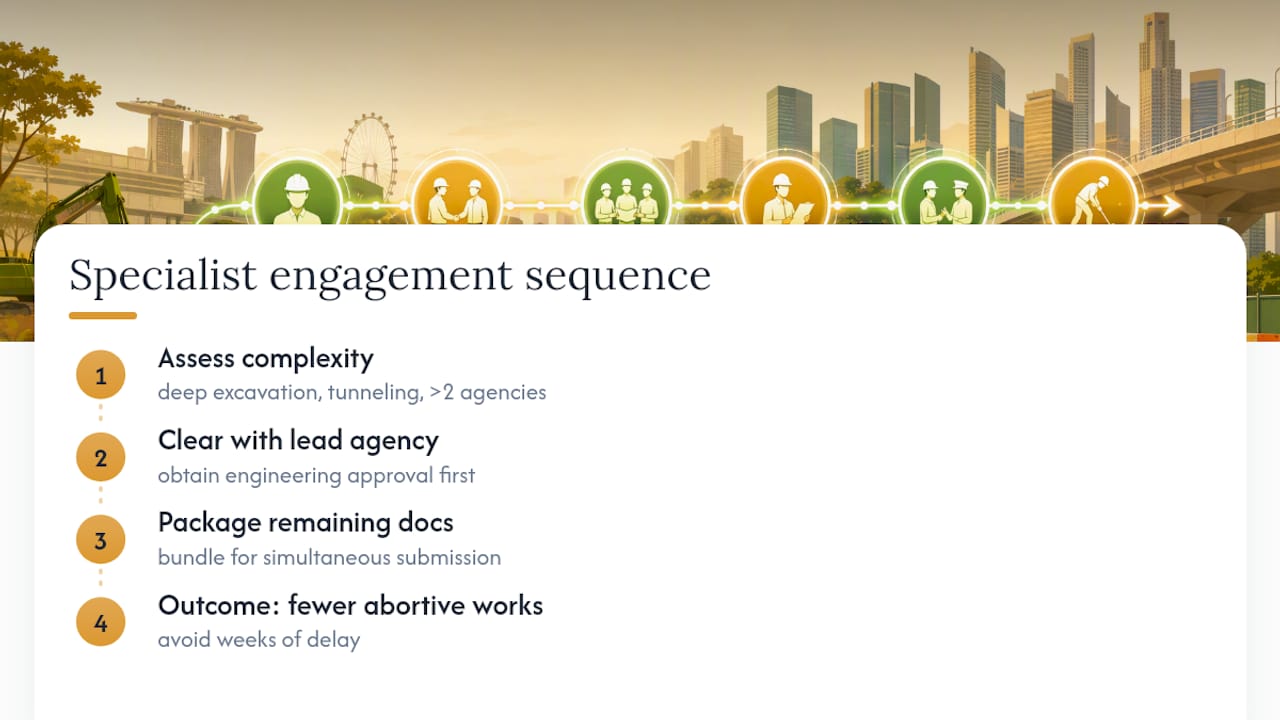
Projects involving deep excavation, tunneling, or works across more than two managing agencies rarely benefit from a solo contractor submission. These are the cases where a rejected traffic control plan or a missing structural endorsement costs weeks, not days.
Stellar Structures sequences these multi-agency approvals by clearing engineering proposals with the lead agency first, then packaging the remaining documentation for simultaneous submission elsewhere, an approach built specifically to reduce abortive works. For readers weighing whether a project needs that level of coordination, our guide on temporary works design is a useful starting point for assessing the technical scope involved.
— Aman
How Stellar Structures Supports Your Permit Application
Getting a street works permit approved on the first pass depends on documents that hold up under LTA scrutiny, not just documents that exist. Stellar Structures reviews your traffic control plan, method statement, and insurance endorsements before submission, catching the gaps that typically send applications back for revision.
Our team handles professional engineer sign-off for structural and excavation works, coordinates traffic diversion plans through our temporary traffic diversions guidance, and manages simultaneous submissions across LTA, PUB, JTC, HDB, SLA, and NParks so you’re not chasing five separate approvals on five separate timelines. If your project spans multiple agencies or involves works that need structural certification, get in touch through our authority submission services page for a permit readiness review before you file.
Sources
Check LTA.PROMPT directly for current fee schedules and the updated list of roads under the RWP requirement, since both are subject to periodic revision.
Recommended
- Temporary Traffic Diversions in Singapore: The Definitive LTA Compliance Guide
- NParks Approval Process: Checklist for Singapore Contractors