




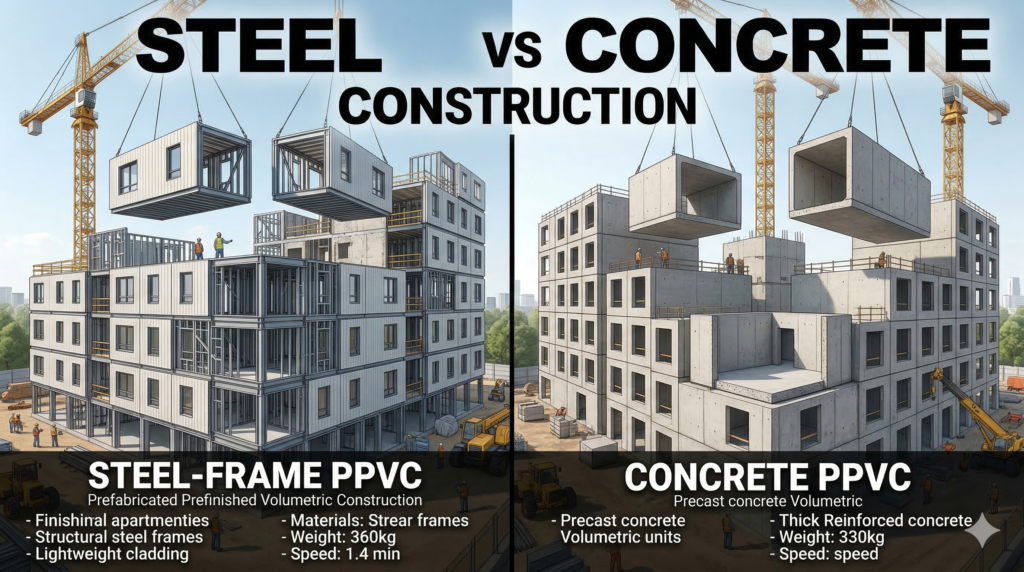
Steel PPVC vs Concrete PPVC Construction
The Paradigm Shift in Modern Industrialized Construction
The global construction industry is currently undergoing a systemic, irreversible paradigm shift, migrating aggressively away from traditional cast-in-place (CIP) methodologies toward highly industrialized prefabrication technologies.1
Historically, the built environment has relied heavily on CIP construction due to the perceived flexibility of pouring wet concrete on-site and the prior abundance of low-cost manual labor.1
However, the macroeconomic realities of 2026—characterized by severe skilled labor shortages, stringent environmental regulations, and unrelenting rapid urbanization—have rendered traditional methods dangerously inefficient and ecologically untenable.1
In response to these structural challenges, the architecture, engineering, and construction (AEC) sector has fully embraced the overarching principles of Design for Manufacturing and Assembly (DfMA).1
At the absolute pinnacle of the DfMA hierarchy is Prefabricated Prefinished Volumetric Construction (PPVC).1
Unlike standard two-dimensional precast concrete panels (Individual Panel Systems or IPS), PPVC involves the off-site manufacturing of free-standing, three-dimensional modules—complete with internal finishes, fixtures, mechanical routing, and structural integrity—which are then transported and hoisted into place on-site like interlocking blocks.3
The financial momentum behind this industrialized shift is staggering; the broader modular construction market generated billion globally in 2025 and is projected to expand exponentially to billion by 2034.1
Within this expanding matrix, the Singaporean prefabricated construction sector alone is forecast to grow at a Compound Annual Growth Rate (CAGR) of to , reaching approximately SGD million by the end of 2026, and scaling toward SGD billion by 2030.6
Within this rapidly expanding domain, a critical technological and economic debate has emerged: the comparative advantages of Steel PPVC vs Concrete PPVC Construction.
Each material matrix offers distinctly different mechanical properties, logistical penalties, acoustic profiles, and lifecycle environmental impacts.1
To fully optimize a capital asset’s lifecycle, developers must rigorously analyze how these differing material frameworks interact with modern regulatory environments and sophisticated supply chains.
This exhaustive report dissects the structural mechanics, economic trade-offs, sustainability profiles, and 2026 contractor marketing trends to determine which framework is ultimately more advantageous.
The 2026 Macroeconomic and Regulatory Landscape
To evaluate the efficacy of S-PPVC and C-PPVC, the macroeconomic context of high-density urban environments must be definitively established.
Singapore serves as the premier global laboratory for PPVC adoption, driven by aggressive government mandates, extreme land scarcity, and the urgent necessity to reduce reliance on foreign migrant labor.7
The Construction Supercycle and Projected Demand
The construction demand outlook in Singapore for 2026 reflects a multi-decade supercycle, with the Building and Construction Authority (BCA) projecting total construction demand to remain robust at between billion and billion in nominal terms.9
This volume is underpinned by massive public and private developments.10 Over the medium term (2027 to 2030), construction demand is projected to average between billion and billion annually.9
Institutional building construction is projected to remain the largest segment in 2026, accounting for of total building demand (valued at to billion), driven by megaprojects such as the Changi Airport Terminal 5 development, the new Tengah General and Community Hospital, and various bus depot developments.10
Civil engineering demand is simultaneously forecast to reach a record to billion, propelled by the Cross Island MRT Line (Phase 3), the Downtown Line 2 Extension, and infrastructure works at the Tuas Terminal.10
To sustain this unparalleled growth, the BCA stipulates strict minimum requirements for PPVC adoption. For building components on selected Government Land Sales (GLS) parcels sold on or after December 2015, the minimum mandated level of use for PPVC is of the total super-structural floor area.12
This sweeping mandate fundamentally altered the procurement strategies of every major developer in the region.
The Operational Struggles of Integrated Construction and Prefabrication Hubs (ICPHs)
Despite this guaranteed pipeline of demand, the local supply chain faces severe, localized friction.
The Singaporean government invested heavily in Integrated Construction and Prefabrication Hubs (ICPHs)—high-tech, automated, multi-story factories designed to manufacture PPVC modules and precast components domestically at speeds two to three times faster than traditional open yards.15
However, many of these highly capitalized facilities, which can cost over million to develop, have struggled significantly to turn a consistent profit.16
The primary friction points include severe storage bottlenecks and complex logistics.15 Because construction sites frequently experience delays due to weather, scheduling conflicts, or foundation issues, contractors routinely refuse to take delivery of completed PPVC modules.15
Consequently, ICPHs are forced to store massive concrete modules—some stretching up to 10 meters long—illegally on public roads, absorbing recurrent fines of approximately per trailer because paying the penalty is often cheaper than securing scarce, highly expensive Temporary Occupation Licence (TOL) land.15
Furthermore, intense cost competition from cross-border open precast yards in Malaysia, which benefit from vastly lower land and labor costs, has severely undercut domestic automated production.8
This dynamic illustrates a crucial vulnerability inherent to heavy C-PPVC systems: their sheer mass and physical footprint demand perfectly orchestrated, just-in-time (JIT) logistics.5
When site operations desynchronize from factory production, the storage of multi-ton concrete modules becomes a catastrophic logistical and financial liability.15
To alleviate this, entities like Jurong Port have begun stepping in to provide shared, pay-per-use storage options at upcoming ICPH facilities, yet the overarching logistical penalty of concrete remains a defining challenge.17
Consequently, the regulatory and operational environment in 2026 is shifting from basic “DfMA adoption” to rigorous “system governance and documented compliance”.6
Initiatives like the CORENET X platform act as a forcing function, pushing project teams toward highly repeatable, standardized designs with mathematically stable structural-envelope-MEP interfaces.6
Prefabrication is transitioning from an ad-hoc “project craft” to a standardized “submission-ready execution,” where digital models govern every millimeter of factory output.6
Structural Engineering and Architectural Mechanics
The fundamental physical disparity between Steel PPVC and Concrete PPVC dictates their respective architectural applications, hoisting requirements, and structural connection methodologies.
A rigorous engineering assessment is required to understand the long-term behavior of these modules under static and dynamic loading.
Volumetric Weight and Logistical Penalties
Concrete PPVC modules are extraordinarily dense and heavy. A standard six-sided C-PPVC module utilized in residential high-rises typically weighs between and tons.7
This extreme dead load requires highly specialized, heavy-duty crawler or tower cranes with capacities reaching to tons.7
The sheer mass of C-PPVC modules creates an exponential transport penalty; moving these volumetric units from the prefabrication yard to the urban site generates transportation carbon emissions up to higher than the transport of raw, unmixed materials for conventional site-built techniques.1
Conversely, S-PPVC modules utilize high-strength structural steel frames in tandem with lightweight architectural infill panels.1 A comparable steel module generally weighs between and tons.19
This renders the S-PPVC module to lighter than its concrete counterpart.1
This profound weight reduction fundamentally alters the logistical calculus of a project.
It downgrades the required capacity and daily rental cost of lifting equipment, broadens the pool of available logistics contractors, and vastly reduces the embodied energy expended during the transportation phase.1
Furthermore, the lighter, high-tensile structural framework of S-PPVC is exceptionally conducive to achieving large-span, uninterrupted interior spaces and highly adaptable, column-free floor layouts.1
For commercial pre-engineered metal buildings (PEMB), steel can theoretically span up to 300 feet without any interior load-bearing columns, an architectural feat impossible to achieve economically with precast concrete.20
Structural Connections, Integration, and Tolerances
The methodology for joining individual volumetric modules on-site represents a critical divergence in engineering philosophy between the two systems.
Connections must be robust enough to prevent disproportionate collapse and ensure the inter-connected volumetric system effectively redistributes internal forces to the nearest load-bearing elements.5
S-PPVC relies predominantly on dry, mechanical bolting systems.5 These connections are meticulously designed to resist tension forces during accidental scenarios, utilizing heavy-duty connection bolts at specific joints.19
The success of S-PPVC hinges entirely on manufacturing precision; the modules require immaculate 3D and 2D jig fabrication tolerances in the factory to ensure seamless alignment during rapid crane hoisting and installation.5
The completely dry nature of bolted connections allows for continuous, highly accelerated assembly regardless of adverse weather conditions.
Advanced structural innovations, such as patented grouted sleeve joining techniques for steel-concrete composite systems, have also been developed to ensure the rapid installation of high-strength steel modules without the need for complex on-site welding or extensive bolting, further accelerating the critical path.21
C-PPVC, by contrast, relies heavily on traditional wet trades for ultimate structural integration. The on-site grouting of vertical and horizontal joints using high-strength, non-shrink grout injected into corrugated ducts is the standard industry procedure.5
In landmark projects like The Clement Canopy, the small gaps existing between the walls of adjoining modules were systematically filled with grout so that the combined walls behaved monolithically as a composite shear wall system under extreme loading.22
Prototype testing with strain gauges confirmed that these sandwiched wall panels could withstand massive compression and bending loads without delamination at the critical wall-to-grout interface.22
While this creates a highly robust and rigid structure, it inevitably reintroduces messy, weather-dependent wet construction processes onto the site, demanding precise curing times, skilled grouting teams, and rigorous quality assurance protocols to prevent voids.22
High-Rise Wind Resistance and Hybrid Core Mechanics
Regardless of the material chosen, the application of purely modular systems in super high-rise buildings (structures exceeding 40 stories) presents a formidable and unique engineering challenge: the effective dissipation of lateral wind resistance and seismic shear forces.18
Both S-PPVC and C-PPVC modules inherently lack optimal, independent wind-resisting capabilities when stacked independently to extreme heights.18
Consequently, modern skyscrapers heavily utilize a hybrid structural methodology.3 In almost all high-rise PPVC projects in Singapore, this takes the form of a centrally located, cast-in-situ reinforced concrete core that houses the essential lift shafts, mechanical risers, and stairwells.3
The individual PPVC modules are subsequently tied securely to this rigid spine, which acts as the primary lateral load resisting system, absorbing and transferring the vast majority of wind-induced shear forces down into the deep foundation.3
While structurally imperative to ensure occupant safety, this hybrid approach inevitably reintroduces a significant amount of traditional, time-consuming “wet trade” construction on the critical path, slightly tempering the absolute speed advantage promised by pure prefabrication.3
Comparative Performance Metrics: Economics and Productivity
The selection of a PPVC material matrix is ultimately a calculation of intersecting performance metrics: initial economic capital, labor productivity, schedule compression, and long-term asset value.
Capital Cost Premiums and the Return on Investment
Both PPVC modalities command an initial financial premium over traditional Cast-in-Place (CIP) construction.
This premium functions as an upfront capital expenditure traded directly for accelerated time-to-market and drastic labor reduction.18
| Economic Metric | Steel PPVC (S-PPVC) | Concrete PPVC (C-PPVC) |
| Initial Cost Premium | Estimated premium over conventional methods.1 | Estimated premium over conventional methods.1 |
| Material Base Cost | Higher raw material volatility; requires skilled factory welders.18 | Lower raw material cost (cement, sand, aggregate are highly abundant).20 |
| Logistics Base Cost | Moderate (lighter weight requires fewer and smaller trucks).1 | Very High (massive weight requires specialized oversized trailers and cranes).5 |
| Manpower Savings | reduction in on-site manpower.1 | Up to improvement in installation productivity.22 |
Projects utilizing C-PPVC generally anticipate a cost increase ranging from to over conventional reinforced concrete.18
While the raw ingredients of concrete (cement, sand, gravel, water) are ubiquitous and inexpensive, this initial material saving is heavily counterbalanced by massive holding yard fees, extremely heavy logistics, and the necessity to hire -ton lifting machinery.1
S-PPVC carries a steeper initial material premium, typically estimated at to over traditional methods.1
The global volatility of steel prices and the absolute requirement for highly skilled welders and precision machinery in the fabrication phase drive this baseline cost upward.
However, some lifecycle cost analyses argue that steel is ultimately the more economical choice in the long run, costing approximately less than C-PPVC when factoring in the high end-of-life recovery, recycling, and reuse of steel materials.24
Schedule Compression and Labor Productivity
These upfront capital premiums are overwhelmingly offset by unprecedented schedule compression.
PPVC projects consistently reduce total construction durations by to months, representing an overall timeline reduction of to .1
This is achieved by running off-site factory fabrication concurrently with on-site foundation and deep excavation work.19
In the case of the record-breaking 56-story Avenue South Residence, the construction time for each massive tower was slashed by at least seven months compared to conventional methods.25
For commercial developers, this aggressive schedule compression translates directly into reduced interim construction loan financing costs and accelerated revenue realization through earlier property sales or rental yields.
Labor productivity gains are equally profound. Traditional construction is notoriously labor-intensive, exposing workers to high-risk environments and weather delays.
By shifting to of the physical work to a highly controlled, safe factory setting, on-site manpower requirements are drastically reduced.12
The Clement Canopy project achieved an installation rate of to modules per day, establishing a highly efficient -day floor cycle.7
The project recorded an astonishing manpower productivity rate of , marking a improvement over the Singapore industry average of .22
Similarly, S-PPVC requires remarkably lean installation crews; certain projects required only workers to seamlessly guide and install a steel module, representing a saving in total on-site manpower.18
To further mitigate costs and distribute financial risk, the industry is increasingly adopting collaborative contracting frameworks.
In 2025, the BCA awarded the first NEC4 Facilities Management Contract (FMC) in Asia, and JTC awarded an NEC4 target cost contract, allowing project parties to equitably share cost savings or overruns when they occur.9
This orchestration of shared risk is critical in an environment where the pool of highly capable PPVC contractors is narrowing, and early engagement is required to secure delivery partners.26
Environmental Performance and Lifecycle Assessment (LCA)
The global construction sector is heavily scrutinized for its outsized contribution to anthropogenic climate change, consuming vast amounts of raw materials and generating massive emissions.
The choice between S-PPVC and C-PPVC carries vast implications for a project’s Global Warming Potential (GWP).27
| Environmental Metric | Steel-Structure PPVC (S-PPVC) | Precast Concrete PPVC (C-PPVC) |
| Total CO2 Emission Profile | 1 | 1 |
| GHG Emission Variance | Lowest overall environmental impact; highly recyclable.1 | Significantly higher emissions due to massive transport weights and clinker.1 |
| Embodied Carbon Source | High initial energy required for smelting (24.9 MJ/kg).23 | High carbon footprint from clinker production (917 g CO2/kg).1 |
| End-of-Life Recyclability | Highly recyclable; maintains high end-of-life scrap value.1 | Mechanically challenging to recycle; typically downcycled to aggregate.1 |
An exhaustive comparative Life Cycle Assessment (LCA) clearly demonstrates that C-PPVC generates a significantly higher initial carbon footprint, registering compared to S-PPVC’s leaner (based on standardized comparative models).1
The primary driver of concrete’s severe environmental penalty is the calcination process inherent in cement production.29
Portland cement exhibits a massive emission factor of approximately .1
Because C-PPVC requires high-early-strength concrete mixes to survive the dynamic tensile stresses of repeated lifting and multi-modal transportation without cracking, the cementitious content in these modules is exceptionally high, further elevating the embodied carbon.1
Conversely, while the initial production of virgin steel from raw iron ore requires immense chemical energy (resulting in an embodied energy coefficient nearly times higher per kilogram than concrete and cement) 23, the absolute volume and mass of material used in an S-PPVC module is drastically lower.
Overall, comparative studies have shown that 1 square meter of structure impacts an average of for steel versus for concrete.29
Furthermore, S-PPVC operates seamlessly within a mature circular economy framework.
At the end of a building’s functional life, steel modules can be decoupled, recovered, and melted down with virtually zero degradation in metallurgical properties.1
Concrete, by contrast, is highly mechanically challenging to recycle and is typically crushed down into low-value aggregate base courses for road construction.1
Green Mark 2021 Certification and Future Sustainability
To systematically incentivize sustainable choices, regulatory bodies have deeply integrated PPVC into green certification frameworks.
Under the Singapore Green Mark 2021 standards, the adoption of sustainable building systems—such as S-PPVC, C-PPVC, or Mass Engineered Timber (MET)—that cover of the Constructed Floor Area (CFA) in residential buildings warrants crucial scoring points (CN 2.1).30
The scheme even awards additional points for the use of prefabricated water-retaining structures, such as stainless-steel or fiberglass-reinforced swimming pools, which integrate perfectly with volumetric architecture.31
The industry is aggressively pursuing material innovations to neutralize the carbon footprint of the built environment.
To mitigate C-PPVC’s environmental deficit, researchers are optimizing concrete mixes by incorporating industrial waste byproducts like ground-granulated blast-furnace slag (GGBS), silica fume, and fly ash.21
More revolutionary is the introduction of biochar into concrete. Biochar is a highly stable, charcoal-like substance produced through the pyrolysis of organic waste, which actively traps carbon that would otherwise decompose into atmospheric .32
Embedding biochar into cement and mortar reduces the module’s embodied carbon profile exponentially without compromising its structural yield strength; each kilogram of biochar sequesters up to three kilograms of .32
This transforms high-mass C-PPVC structures from massive carbon emitters into active carbon sinks.
Building Physics: Thermal, Acoustic, and Fire Performance
Beyond raw structural integrity, volumetric modules must perform as holistic, high-functioning environmental envelopes.
The differing physical densities and molecular structures of steel and concrete create profound operational variances that govern building physics.
Thermal Conductivity, Continuous Insulation, and R-Values
The thermal efficiency of a module dictates the operational HVAC energy loads over a building’s entire -to–year lifespan.
Thermal resistance is commonly measured by its R-value.33 Standard poured concrete has a very low intrinsic thermal resistance, offering only an R-value of per inch.34
However, concrete possesses massive thermal mass.1
This unique property allows C-PPVC structures to absorb excess heat during peak daytime hours and slowly release it at night, effectively dampening indoor temperature fluctuations and drastically reducing mechanical cooling loads in tropical or desert climates.1
Steel, conversely, is a highly conductive material. If an S-PPVC frame is not rigorously insulated, it acts as a massive thermal bridge, drawing heat directly from the exterior into the conditioned interior space.33
Energy code studies demonstrate that the “effective” R-value of cavity insulation, when installed between highly conductive steel studs, drops significantly—by or more—due to the intense thermal bridging of the metal.33
To counteract this critical flaw, S-PPVC absolutely demands the installation of Continuous Insulation (CI) systems.33
Advanced systems, utilizing composite metal hybrid designs and fiberglass-reinforced flanges, can achieve to thermal efficiency by entirely eliminating the thermal bridging that causes energy loss.36
Without through-metal fasteners, these advanced CI systems prevent cold spots and condensation, delivering the high effective R-values necessary for modern code-compliant assemblies.36
Acoustic Insulation and Vibration Transmission
In dense urban multi-family housing, acoustic privacy is a paramount concern that directly affects resident wellbeing.
Sound Transmission Class (STC) and Impact Insulation Class (IIC) ratings define a module’s acoustic efficacy.37
| Floor-Ceiling Assembly Type | Thickness | STC Rating | IIC Rating |
| Concrete Slab (Normal Weight) | 4 inches | 44 – 47 | 20 – 25 |
| Concrete Slab (Normal Weight) | 6 inches | 50 – 55 | 26 – 30 |
| Concrete Slab (Normal Weight) | 8 inches | 57 – 58 | 28 – 32 |
| Concrete Metal Deck | 4 inches Total | 45 – 49 | 18 – 21 |
| Concrete Metal Deck | 6 inches Total | 52 – 57 | 21 – 26 |
Data sourced from compiled acoustic information for concrete construction.37
Concrete modules, due to their massive density, provide exceptional low-frequency sound attenuation.
A standard -inch normal weight concrete slab typically achieves an impressive STC rating of and an IIC of , rendering it highly effective at blocking airborne noise.37
Steel frames, lacking this massive inherent density, are highly prone to severe vibration transmission and flanking noise.1
S-PPVC systems require extensive supplementary acoustic insulation—such as resilient channels, acoustic floor mats, and double-layered drywall assemblies—to meet minimum standards.1
The BCA requires all residential interior partitions to achieve a minimum STC of .38 While modern drywall systems outfitted with acoustic batts can easily match or exceed the STC of a solid concrete wall, achieving this in a dynamic S-PPVC module requires meticulous architectural detailing at all joints and junctions to prevent noise leakage.
Fire Resistance Profiles
Concrete possesses unparalleled, intrinsic fire resistance. A standard reinforced concrete module can withstand temperatures exceeding for up to hours without a catastrophic loss of structural capacity.1
Its non-combustible nature, extremely low thermal conductivity, and lack of toxic gas emission during combustion make C-PPVC exceptionally safe for high-density residential towers.1
Steel, however, rapidly loses its yield strength when exposed to extreme heat. At approximately , structural steel loses nearly of its load-bearing capacity.
Consequently, to prevent building collapse during a fire event, S-PPVC modules strictly mandate the rigorous application of supplementary fire-retardant intumescent coatings, heavy gypsum boardings, and strict fire compartmentation strategies.1
This necessary supplementary fireproofing adds weight, complexity, and significant cost to the S-PPVC factory fabrication process.
Facility Management: Pathology, Renovation, and Maintenance Constraints
The long-term economic viability of a structure is dictated not just by initial construction capital, but by continuous operational expenditures over its lifecycle.
The maintenance profiles of S-PPVC and C-PPVC diverge significantly in terms of material pathology and end-user renovation flexibility.
Pathological Degradation: Corrosion vs. Spalling
The primary enemy of S-PPVC is electrochemical oxidation and structural corrosion.39
In highly humid or harsh coastal environments, atmospheric moisture and airborne chlorides can aggressively attack structural steel joints if the protective intumescent coatings, paint, or galvanization layers are compromised during hoisting or over time.40
Regular, invasive inspections are required to ensure the sealed cavities within the module remain entirely dry.
C-PPVC suffers from an entirely different, slower pathology: concrete carbonation and chloride-induced reinforcement corrosion.39
Over decades, atmospheric carbon dioxide permeates the concrete matrix, reacting with calcium hydroxide to lower the concrete’s highly alkaline pH (from a protective down to ).39
This destruction of the alkaline passivating layer exposes the embedded steel rebars to oxidation.
As rust (Iron hydroxide, ) forms, its volume expands massively, causing immense internal tensile stresses that result in the cracking and explosive spalling of the concrete cover.39
However, utilizing modern high-performance concrete mixes with extremely low water-to-cement ratios generally ensures a -to–year service life before major spalling intervention is required.40
Joint Sealant Lifecycle
A critical vulnerability in all PPVC structures lies in the interstitial weatherproofing between the massive modules.
The exterior façade joints must be flawlessly sealed against extreme wind-driven rain. Polyurethane, acrylic, and silicone sealants are standard, but they possess finite lifespans.42
Over time, intense UV degradation and dynamic building sway lead to severe plasticizer migration, hardening, and cracking of the sealants.42
Under Singapore’s strict Periodic Façade Inspection (PFI) regime, these joints must be rigorously inspected—often utilizing advanced drone technology—and systematically cut out and replaced to prevent deep moisture ingress that could secretly compromise the hidden structural connections.1
Rigid Constraints on Interior Renovation
Perhaps the most notable and frustrating drawback of PPVC technology lies in its rigid inflexibility regarding future interior renovations, severely limiting end-user adaptability.1
To protect the tightly engineered structural tolerances and factory-applied waterproofing membranes, regulatory bodies impose draconian restrictions on modifications to PPVC apartments.44
In Singapore HDB and private PPVC properties, the hacking or demolition of any structural walls is strictly prohibited, as removing elements from a calculated module could trigger localized failure or alter the building’s vital load-path resistance against disproportionate collapse.5
Furthermore, homeowners are explicitly banned from hacking factory-provided bathroom wall and floor finishes for a minimum of three years post-completion.1
This strict mandate prevents accidental damage to the factory-installed waterproofing layer, which could result in catastrophic inter-module water leakage that damages neighbouring units below.44
Even minor non-structural modifications are severely constrained by strict weight limits.
If a homeowner wishes to lay new floor finishes (e.g., heavy ceramic tile or marble) over the existing slab, the total combined thickness of the new floor finish and the wet cement mortar screed must not exceed a maximum of .1
Exceeding this exact threshold risks breaching the module’s maximum designed dead load.43
Consequently, PPVC demands that developers select highly neutral, universally acceptable interior finishes during the initial factory fabrication phase, as the end-user cannot easily or legally alter the spatial layout or install heavy finishings post-occupancy.
2026 Construction Marketing, SEO, and Industry Sentiment
In 2026, the technological sophistication of the construction site must be mirrored by the digital sophistication of a contractor’s marketing strategy.
As the pool of available, highly qualified PPVC contractors narrows, securing lucrative developer contracts and consumer leads requires a high-converting digital presence engineered around rigorous Search Engine Optimization (SEO).26
SEO Strategy and Consumer Search Behavior
Studies indicate that an overwhelming of consumers and developers initiate their search for local construction and civil engineering services online.47
If a construction firm does not rank prominently for hyper-local, intent-driven queries, they are actively hemorrhaging revenue to competitors.47
The SEO landscape in 2026 has been fundamentally altered by Artificial Intelligence.
Search Generative Experience (SGE) and AI Overviews have shifted the paradigm from traditional keyword ranking to conversational, synthesized AI answers.46
It is estimated that AI summaries have caused standard click-through rates (CTR) to drop by approximately .48
To survive this shift, content must be optimized for “understanding.” Algorithms prioritize content that demonstrates profound E-E-A-T (Experience, Expertise, Authoritativeness, Trustworthiness).49
In the construction domain, this means abandoning generic keyword stuffing in favor of publishing highly detailed project portfolios, authentic author bios, structural engineering case studies, and transparent cost analyses that an AI engine will trust and subsequently quote.46
High-Impact Keywords and Strategic Power Words
To capture targeted traffic, firms must orchestrate a balanced portfolio of high-volume short-tail keywords and highly specific long-tail keywords.
| Search Term / Keyword | Search Volume | Keyword Strategy |
| “Construction” | Broad, high-competition; low conversion intent.50 | |
| “Contractor” | Broad, highly competitive (CPC ~).50 | |
| “Building a house” | High-intent, informational top-of-funnel query.50 | |
| “Cost to build a house” | Extremely high-intent; drives cost-conscious leads.50 | |
| “Ready mix concrete near me” | Hyper-local intent; vital for immediate supply chains.50 |
Successful content strategies do not merely list services; they leverage powerful linguistic framing.
The vocabulary of 2026 construction marketing relies heavily on high-impact power words that convey technological superiority and massive scale.52
Firms must highlight their Agentic capabilities, showcasing how they use autonomous software agents to manage supply chains.52
They emphasize the massive Compute power required to render their 3D BIM structural models.52
Most importantly, successful firms frame their project management as an Orchestration of complex variables, proving their capacity to seamlessly integrate off-site factory production with flawless on-site execution.52
Implementing long-tail keywords—such as “commercial hvac maintenance contract” or “kitchen remodeler near me”—captures clients who are past the research phase and are actively ready to deploy capital.53
The Future Frontier: 2026 to 2030 and Beyond
As the industrialized construction sector transitions from the experimental implementation of PPVC into a mature phase of system governance.
The technological horizon from 2026 to 2030 promises radical, transformative innovations that will entirely blur the boundaries between architecture, digital software, and advanced manufacturing.2
AI-Driven Generative Design and Robotic Assembly
The integration of Artificial Intelligence and Building Information Modeling (BIM) is moving rapidly from passive 3D collision detection to active, autonomous generative design.2
Modern AI models are now capable of receiving basic natural language prompts from architects and instantly generating mathematically optimized 3D structural meshes.56
More profoundly, Vision-Language Models (VLMs) can automatically separate these meshes into highly detailed, discrete prefabricated components, mapping out the precise geometry and joint tolerances required for robotic assembly.55
In highly automated factory settings, this software architecture enables true discrete robotic assembly, where autonomous robotic arms utilize real-time spatial reasoning and computer vision to weld S-PPVC steel frames or pour complex C-PPVC concrete molds with sub-millimeter precision.56
This eliminates the human error inherent in manual fabrication and facilitates unprecedented mass-customization, allowing developers to generate hundreds of unique module layouts without slowing down the manufacturing pipeline or increasing operational costs.55
Advanced Materials: 3D Printing and Modular-Building-as-a-Service
Simultaneously, industrial-grade 3D printing is graduating from small-scale prototyping to large-scale structural extrusion, fundamentally altering material physics.57
By 2030, the continuous 3D printing of complex, topology-optimized lightweight concrete nodes will allow C-PPVC modules to mimic the organic, load-bearing efficiency of human bone.57
This will strip away unnecessary mass while maintaining ultimate tensile strength, systematically neutralizing the severe logistical weight penalties that currently hinder heavy C-PPVC adoption.57
Furthermore, the business model of construction is evolving toward Modular Building-as-a-Service (MBaaS).58
Driven by the ethos of the circular economy and Design for Disassembly (DfD), S-PPVC modules are increasingly viewed not as static structures, but as flexible assets.58
Buildings can be unbolted, reconfigured, or entirely relocated to serve new demographics, turning real estate into a highly fluid, adaptable product capable of responding instantly to changing macroeconomic demands.58
Conclusion: Determining the Most Advantageous Matrix
The debate between Steel PPVC and Concrete PPVC cannot be resolved through a universally superior binary choice; rather, it is a highly complex calculation of precise project constraints, geographic locations, logistical realities, and capital architectures.
Steel PPVC (S-PPVC) is unequivocally advantageous when:
- Logistical Constraints are Severe: In dense urban infill projects where narrow road widths and tight site footprints physically cannot accommodate -ton crawler cranes or -ton transport trailers. The to reduction in weight is a logistical necessity.1
- Sustainability and Circularity are Paramount: When developers are targeting aggressive net-zero lifecycle carbon certifications, leveraging steel’s vastly superior end-of-life recyclability and its lower initial embodied carbon profile compared to high-cement concrete.1
- Foundation Limitations Exist: When poor soil conditions dictate low bearing capacities, the massive reduction in dead load offered by steel drastically reduces the requirement for deep, highly expensive foundation piling.
Concrete PPVC (C-PPVC) is undisputedly advantageous when:
- Acoustic Privacy and Fire Safety are Non-Negotiable: In ultra-high-density residential or hospitality developments where inherent, maintenance-free fire resistance and massive low-frequency sound attenuation (STC 50+) are critical to occupant safety and comfort.1
- Lifecycle HVAC Efficiency is Prioritized: In tropical or desert climates, where the immense thermal mass of concrete actively flattens diurnal temperature spikes, yielding decades of compounding reductions in mechanical cooling costs.1
- Maximum Structural Rigidity is Required: In super-high-rise projects demanding the highest thresholds of monolithic durability, trading initial transport costs and heavy crane rentals for a structure highly resilient to localized failure and progressive collapse.5
As the global construction industry navigates the transformative 2026 supercycle, the true catalyst for extreme profitability lies not merely in choosing between steel or concrete. Success is defined by a firm’s ability to master the digital software platforms, algorithmic supply chains, and collaborative procurement contracts required to wield these massive volumetric behemoths effectively.
The paradigm has permanently shifted; modern construction is no longer an exercise in chaotic site-based assembly, but a masterful orchestration of advanced, sustainable global manufacturing.
Works cited
- Guide to Precast Concrete vs. PPVC Construction in 2026 – Stellar Structures, accessed March 14, 2026, https://structures.com.sg/guide-to-precast-concrete-vs-ppvc-construction-in-2026/
- Global construction trends in 2026: The industry’s new phase – Kaizen Institute, accessed March 14, 2026, https://kaizen.com/insights/global-construction-trends-2026/
- The Concrete Lego: A Structural Engineering, accessed March 14, 2026, https://www.aectechnicalsg.com/the-concrete-lego-a-structural-engineering/
- The Ultimate Guide to PPVC in 2025: Smarter, Faster, Stronger – Geto Global Construction, accessed March 14, 2026, https://www.getoformwork.com/article/the-ultimate-guide-to-ppvc-in-2025.html
- Design for Manufacturing and Assembly (DfMA) – Building and Construction Authority (BCA), accessed March 14, 2026, https://www1.bca.gov.sg/docs/default-source/docs-corp-news-and-publications/publications/for-industry/ppvc_guidebook.pdf
- Singapore Prefabricated Construction Market Intelligence and Future Growth Dynamics Databook – 100+ KPIs, Market Size & Forecast by End Markets, Precast Products, and Precast Materials – Q1 2026 Update – Research and Markets, accessed March 14, 2026, https://www.researchandmarkets.com/reports/5740719/singapore-prefabricated-construction-market
- Prefabricated and Modular Construction for Affordable Housing in Singapore – Asian Development Bank, accessed March 14, 2026, https://www.adb.org/sites/default/files/publication/1015321/adbi-prefabricated-and-modular-construction-affordable-housing-singapore.pdf
- Critical to communicate, standardise, review if S’pore wants to raise construction productivity, accessed March 14, 2026, https://pfaps.com/once-touted-as-future-of-construction-in-singapore-high-tech-precast-factories-struggling-2/
- Steady Construction Demand In 2026 As Singapore Steps Up Support For Built Environment Firms Through Collaboration And Innovation, accessed March 14, 2026, https://www1.bca.gov.sg/about-us/news-and-publications/media-releases/2026/01/22/steady-construction-demand-in-2026-as-singapore-steps-up-support-for-built-environment-firms-through-collaboration-and-innovation
- Construction enters multi-decade supercycle as BCA sees $47b–$53b 2026 demand | Singapore Business Review, accessed March 14, 2026, https://sbr.com.sg/in-focus/construction-enters-multi-decade-supercycle-bca-sees-47b-53b-2026-demand
- SINGAPORE CONSTRUCTION PROSPECTS 20261 REVIEW OF CONSTRUCTION DEMAND2 IN 2025 1. In 2025, preliminary total construction demand, accessed March 14, 2026, https://www.bcaa.edu.sg/docs/librariesprovider2/events-seminars/berep2026/presentation-slides/2-spore-construction-prospects_2026_final_15-jan-26.pdf?sfvrsn=146aa72e_1
- ARCADIS INSIGHTS, accessed March 14, 2026, https://media.arcadis.com/-/media/project/arcadiscom/com/perspectives/asia/publications/insights/prefabricated-pre-finished-volumetric-construction.pdf?rev=3ca5adcf068e4cc6baad7f42c305bde0
- Prefabricated Prefinished Volumetric Construction (PPVC), accessed March 14, 2026, https://www1.bca.gov.sg/buildsg/productivity/design-for-manufacturing-and-assembly-dfma/prefabricated-prefinished-volumetric-construction-ppvc
- Prefabricated Prefinished Volumetric Construction (PPVC), accessed March 14, 2026, https://www1.bca.gov.sg/docs/default-source/docs-corp-buildsg/productivity/ppvc_info_kit.pdf?sfvrsn=e716e287_0
- Once touted as future of construction in Singapore, high-tech precast factories struggling, accessed March 14, 2026, https://pfaps.com/once-touted-as-future-of-construction-in-singapore-high-tech-precast-factories-struggling/
- Once touted as future of construction in Singapore, high-tech precast factories struggling, accessed March 14, 2026, https://www.straitstimes.com/singapore/operators-of-high-tech-factories-touted-as-the-future-of-construction-run-into-challenges
- Singapore’s construction boom strains large prefab component storage, putting project timelines at risk – CNA, accessed March 14, 2026, https://www.channelnewsasia.com/singapore/construction-prefabrication-components-storage-building-projects-delays-manufacture-5747391
- Comparative analysis of modular construction practices in mainland China, Hong Kong and Singapore – PolyU Institutional Research Archive, accessed March 14, 2026, https://ira.lib.polyu.edu.hk/bitstream/10397/103236/1/Zayed_Comparative_Analysis_Modular.pdf
- PPVC – A DfMA Game-Changing Technology for Singapore – CITF, accessed March 14, 2026, https://www.citf.cic.hk/Product_Photo/files/PPT%20Sharing/05_PPVC%20-%20A%20DfMA%20Game%20Changing%20Technology%20for%20Singapore.pdf
- Concrete Versus Steel Frame Structures: Pros and Cons – RHINO Steel Building Systems, accessed March 14, 2026, https://www.rhinobldg.com/blog/should-you-build-with-concrete-or-steel
- Lightweight High-Strength Steel-Concrete Composite Modular Buildings with Fast Track Connections – Civil and Environmental Engineering, accessed March 14, 2026, https://cde.nus.edu.sg/cee/research/research-clusters/built-environment/lightweight-high-strength-steel-concrete-composite-modular-buildings-with-fast-track-connections/
- Case Study: The Use of Concrete Prefabricated Prefinished Volumetric Construction for Two Blocks of 40-Storey Residential Flats (The Clement Canopy) in Singapore – Science Publishing Group, accessed March 14, 2026, https://www.sciencepublishinggroup.com/article/10.11648/j.eas.20210606.12
- Full article: Comparison of carbon footprints of steel versus concrete pipelines for water transmission – Taylor & Francis, accessed March 14, 2026, https://www.tandfonline.com/doi/full/10.1080/10962247.2016.1154487
- A comparative life cycle assessment (LCA) of concrete and steel-prefabricated prefinished volumetric construction structures in Malaysia – PubMed, accessed March 14, 2026, https://pubmed.ncbi.nlm.nih.gov/32734541/
- How United Tec built the world’s tallest modular building project | BuildSG Magazine, accessed March 14, 2026, https://www1.bca.gov.sg/buildsg-emag/articles/how-united-tec-built-the-world-s-tallest-modular-building-project
- Singapore’s construction sector gains momentum | Turner & Townsend, accessed March 14, 2026, https://www.turnerandtownsend.com/insights/singapores-construction-sector-gains-momentum-with-strategic-selectivity/
- Comparing Different Concrete Construction Techniques: Modular versus Individual Panel System Methods – IEOM, accessed March 14, 2026, http://www.ieomsociety.org/singapore2021/papers/261.pdf
- accessed March 14, 2026, https://www.tandfonline.com/doi/full/10.1080/10962247.2016.1154487#:~:text=Overall%2C%20steel%20had%20a%2032,life%2Dcycle%20phases%20for%20each.
- Detailed comparison of the two PPVC structures (i.e., steel (S-PPVC)… – ResearchGate, accessed March 14, 2026, https://www.researchgate.net/figure/Detailed-comparison-of-the-two-PPVC-structures-ie-steel-S-PPVC-and-concrete_fig6_343328572
- Green Mark 2021 TECHNICAL GUIDE – Building and Construction Authority (BCA), accessed March 14, 2026, https://www1.bca.gov.sg/docs/default-source/docs-corp-buildsg/sustainability/20210909_-carbon-technical-guide_r1.pdf
- Green Mark 2021 RESIDENTIAL BUILDINGS TECHNICAL GUIDE, accessed March 14, 2026, https://www1.bca.gov.sg/docs/default-source/docs-corp-buildsg/sustainability/20211026_mt-section-rb-technical-guide.pdf
- 5 construction innovations to watch in 2026 – Holcim, accessed March 14, 2026, https://www.holcim.com/who-we-are/our-stories/construction-innovations-in-2026
- Nominal vs. Effective R-Values | Dryvit Blog, accessed March 14, 2026, https://www.dryvit.com/blog/nominal-vs-effective-r-values
- R-Value of Building Materials, accessed March 14, 2026, https://www.ahfc.us/iceimages/manuals/building_manual_ap_1.pdf
- Thermal Metrics for High Performance Enclosure Walls: The Limitations of R-Value – Building Science, accessed March 14, 2026, https://buildingscience.com/sites/default/files/migrate/pdf/RR-0901_Thermal_Metrics.pdf
- Why Modular Construction Projects Need Continuous Insulation – GreenGirt.com, accessed March 14, 2026, https://greengirt.com/articles/why-modular-construction-projects-need-continuous-insulation/
- Compilation of Acoustics Information for Concrete Construction and Other Materials – NRMCA, accessed March 14, 2026, https://www.nrmca.org/wp-content/uploads/2022/07/Compilation_of_Acoustic_Information_for_Concrete_Construction.pdf
- Written Answer by Ministry of National Development on sound-proofing in HDB flats, accessed March 14, 2026, https://www.mnd.gov.sg/newsroom/speeches/view/written-answer-by-ministry-of-national-development-on-sound-proofing-in-hdb-flats
- The protection of reinforced concrete structures: Active and passive systems – Engineering, accessed March 14, 2026, https://www.engineegroup.us/articles/JCEES-8-154.php
- Degradation Models and Maintenance Strategies for Reinforced Concrete Structures in Coastal Environments under Climate Change: A Review – MDPI, accessed March 14, 2026, https://www.mdpi.com/2075-5309/14/3/562
- A Comparison of Service Life Models for Concrete Corrosion Durability – ROSA P, accessed March 14, 2026, https://rosap.ntl.bts.gov/view/dot/87986/dot_87986_DS1.pdf
- Inspection, maintenance and repair of joint sealant – Bostik, accessed March 14, 2026, https://www.bostik.com/files/live/sites/shared_bostik/files/images/documents-and-brochures/construction/bostik-academy/Bostik%20FactSheet%20FS002%20Inspection%20maintenance%20and%20repair%20of%20joint%20sealants.pdf
- Building Works – Singapore – Housing & Development Board (HDB), accessed March 14, 2026, https://www.hdb.gov.sg/residential/living-in-an-hdb-flat/renovation/guidelines/building-works
- What Are PPVC Flats? Plus Answers from HDB to Renovation Questions! – Qanvast, accessed March 14, 2026, https://qanvast.com/sg/articles/what-are-ppvc-flats-plus-answers-from-hdb-to-renovation-questions-2830
- How to Renovate Your HDB Flat | MyNiceHome, accessed March 14, 2026, https://www.mynicehome.gov.sg/get-settled-in/hdb-renovation-guide/
- What Content Will Rank (& Convert) in 2026? – Be Found Online, accessed March 14, 2026, https://befoundonline.com/blog/what-content-will-rank-and-convert-in-2026
- Construction Company Keywords That Attract Potential Clients – ITVibes, accessed March 14, 2026, https://www.itvibes.com/blog/search-engine-optimization/construction-company-keywords/
- Beyond Keywords: The Evolving Landscape of SEO in 2025 and 2026 – GRM Digital, accessed March 14, 2026, https://www.grm.digital/insights/sem/beyond-keywords-seo-in-2025-and-2026/
- Top SEO Tactics for Tech Blogs in 2025 and 2026 | by Nb Joshua | Medium, accessed March 14, 2026, https://medium.com/@nbjoshua8/top-seo-tactics-for-tech-blogs-in-2025-and-2026-f9ffb7262ced
- Top Construction Keywords | Free SEO Keyword List – KeySearch, accessed March 14, 2026, https://www.keysearch.co/top-keywords/construction-keywords
- Top 100 Best Contractor Keywords in 2026 – SERPWARS Agency, accessed March 14, 2026, https://serpwars.com/contractor-keywords/
- 10 Key Words for 2026 – ResearchWiseAI, accessed March 14, 2026, https://researchwiseai.com/blog/10-words-for-2026
- SEO for Contractors in 2026 (The Complete Guide), accessed March 14, 2026, https://fourarrowsmarketing.com/blog/seo-for-contractors/
- 10 Marketing Strategies for Construction in 2026, accessed March 14, 2026, https://core6.marketing/blog/marketing-strategies-for-construction/
- Making Physical Objects with Generative AI and Robotic Assembly: Considering Fabrication Constraints, Sustainability, Time, Functionality and Accessibility – arXiv, accessed March 14, 2026, https://arxiv.org/html/2504.19131v2
- AI-Driven Robotic Assembly System Builds Objects Based on Verbal Input, accessed March 14, 2026, https://www.assemblymag.com/articles/99731-ai-driven-robotic-assembly-system-builds-objects-based-on-verbal-input
- The Future of 3D Printing: The End of Additive Manufacturing, accessed March 14, 2026, https://3dprintingindustry.com/news/the-future-of-3d-printing-the-end-of-additive-manufacturing-249099/
- LIST OF TEN: Emerging Trends in The Modular Industry (2026–2030) | by Furio Barzon, accessed March 14, 2026, https://medium.com/@furiowrites/list-of-ten-emerging-trends-in-the-modular-industry-2026-2030-796e6084abf6
- Design for Manufacturing and Assembly (DfMA) and Design for Deconstruction (DfD) in the Construction Industry: Challenges, Trends and Developments – MDPI, accessed March 14, 2026, https://www.mdpi.com/2075-5309/13/5/1164