





Approval delays and extended construction timelines remain among the most persistent cost drivers for property developers and contractors in Singapore. The conventional linear model, where design, tendering, and construction proceed in isolated, sequential phases, generates coordination gaps that compound into costly rework, regulatory queries, and schedule overruns. Research confirms that BIM integration in modular construction can reduce on-site construction time by up to 50%, a figure that challenges the assumption that project speed is largely outside a developer’s control. This article breaks down how integrated design and construction works, what specific efficiency gains are achievable in Singapore’s regulatory environment, and what steps firms can take to implement these approaches effectively.
Table of Contents
- What is integrated design and construction?
- Why integrated approaches improve efficiency: Key mechanisms
- Regulatory compliance and smoother approvals in Singapore
- Real-world implementation: What it takes to succeed
- The uncomfortable truth about integration in Singapore construction
- Partner with experts for fully integrated project delivery
- Frequently asked questions
Key Takeaways
| Point | Details |
|---|---|
| Integration accelerates delivery | Unifying design, construction, and fabrication can cut on-site build time by up to 50%. |
| Efficient approvals | Digital BIM models and compliance tools like CORENET X simplify and speed up regulatory submissions in Singapore. |
| Collaboration is critical | Trust-based contracts and early team engagement align incentives for on-time, on-budget projects. |
| Success needs new skills | Teams must invest in compliance training, culture change, and digital tools for full benefits. |
What is integrated design and construction?
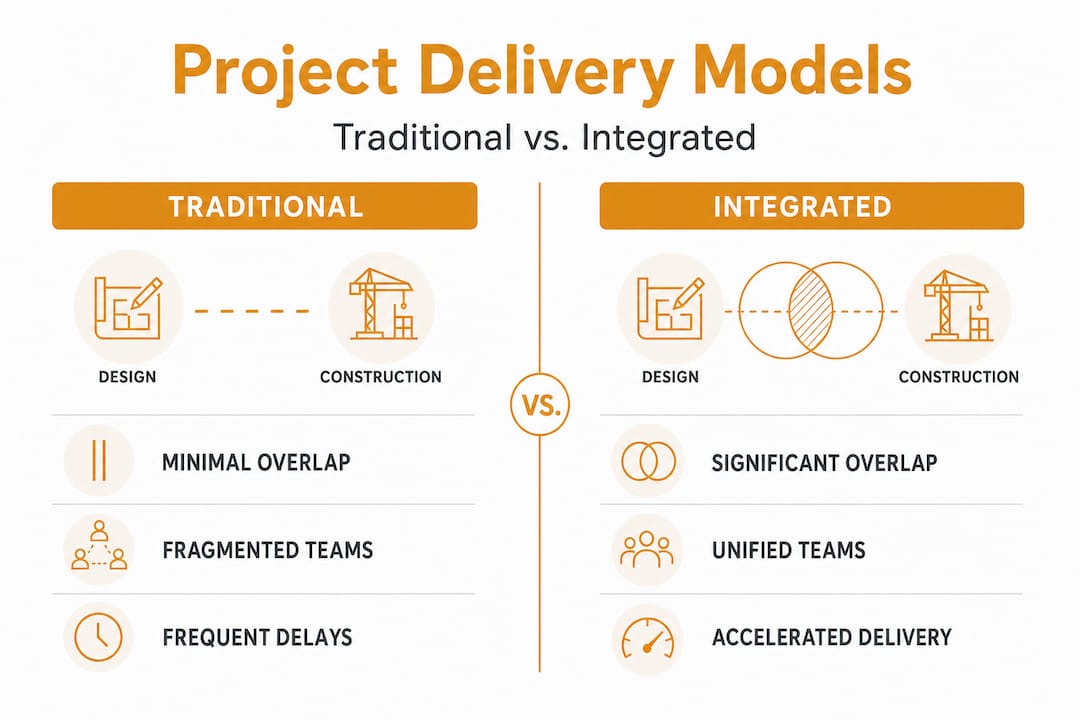
Integrated design and construction refers to a project delivery methodology that unifies design, engineering, fabrication, and construction activities into a single coordinated workflow, rather than treating each phase as a discrete handoff between separate parties. In a traditional linear model, the architect completes the design before the structural engineer reviews it, and the contractor only becomes involved after tendering. Each transition introduces the risk of misalignment, with design intent frequently lost or compromised by the time construction begins.
The integrated model eliminates these sequential handoffs by bringing key stakeholders, including architects, engineers, contractors, and specialist subcontractors, into the process from the earliest project stages. This early involvement allows constructability constraints, material lead times, and regulatory requirements to shape design decisions before they become expensive problems on site.
Three core components define most integrated approaches:
- Building Information Modeling (BIM): A digital, three-dimensional model that contains not only geometry but also data on materials, systems, and specifications. BIM integration with LOD 400 detailing enables fabrication-ready models and clash-free coordination across all disciplines.
- Modular and prefabricated construction: Structural and architectural components are manufactured off-site under controlled conditions and assembled on-site, reducing labor hours, material waste, and weather-related delays.
- Early contractor involvement (ECI): Contractors contribute cost, schedule, and buildability input during design development, preventing design decisions that are technically sound but practically difficult or expensive to execute.
In Singapore’s context, these components are especially relevant because the regulatory framework, spanning agencies such as BCA, URA, SCDF, PUB, and LTA, requires coordinated documentation across multiple disciplines. Fragmented design processes generate inconsistencies between submissions to different agencies, triggering clarification rounds that can add weeks or months to approval timelines.
“Integrated project delivery is not simply a technology upgrade. It is a fundamental restructuring of how project participants relate to one another, to the design, and to the construction process.”
This structural shift is what separates firms that merely adopt BIM software from those that genuinely accelerate project delivery.
Why integrated approaches improve efficiency: Key mechanisms
Understanding why integration delivers faster and more reliable outcomes requires examining the specific mechanisms through which it reduces waste, error, and delay. These mechanisms operate at the level of contracts, workflows, and digital tools simultaneously.
1. Shared risk and aligned incentives
Traditional design-bid-build contracts create adversarial dynamics. The designer’s interest is in protecting the design intent; the contractor’s interest is in managing cost exposure; the client’s interest is in minimizing variations. These interests frequently conflict, producing disputes that consume time and resources. Projects using shared risk/reward contracts under frameworks such as Integrated Project Delivery (IPD) or NEC4 align all parties’ incentives around a common outcome, resulting in on-time and under-budget delivery.
2. Clash detection and reduced rework
BIM-enabled clash detection identifies conflicts between structural, architectural, and MEP (mechanical, electrical, and plumbing) systems before construction begins. A clash between a structural beam and a ductwork run, if discovered on-site, can require redesign, procurement of replacement materials, and rescheduling of affected trades. Detected in the model, the same conflict is resolved in hours. Firms that apply value engineering examples alongside BIM coordination consistently report significant reductions in variation orders.

3. Parallel workflow execution
In a linear model, structural engineering cannot begin until architectural design is substantially complete. In an integrated model, disciplines work concurrently within a shared BIM environment, with agreed-upon design parameters established early. This parallel execution compresses the overall program without sacrificing coordination quality.
4. Faster procurement and fabrication
When contractors are involved early and BIM models reach LOD 400 (Level of Development 400, meaning the model contains sufficient detail for fabrication), procurement and off-site fabrication can begin before construction mobilization. This overlap between design completion and fabrication start reduces the total project duration materially.
Comparison: Traditional vs. integrated project delivery
| Factor | Traditional model | Integrated model |
|---|---|---|
| Design-construction overlap | Minimal | Significant |
| Clash detection | On-site | Pre-construction (BIM) |
| Contractor involvement | Post-tender | Early design stage |
| Variation order frequency | High | Low |
| Regulatory submission accuracy | Variable | High (coordinated model) |
| Approval cycle duration | Longer | Shorter |
| Risk allocation | Adversarial | Shared |
Pro Tip: When evaluating contract frameworks, consider NEC4’s Early Warning mechanism, which requires all parties to flag risks as soon as they are identified, rather than waiting until a problem materializes into a claim. This single process discipline alone can prevent a significant portion of schedule overruns on complex projects.
Regulatory compliance and smoother approvals in Singapore
Singapore’s building approval ecosystem is among the most structured in the Asia-Pacific region, with submissions required across multiple agencies and strict technical standards governing each discipline. Historically, the manual and document-centric nature of these submissions created bottlenecks: drawings submitted to BCA might not align precisely with those submitted to SCDF, generating queries that required resubmission cycles.
The introduction of CORENET X (Construction and Real Estate Network X), Singapore’s next-generation regulatory submission platform, fundamentally changes this dynamic. CORENET X operates on a model-based submission paradigm, where a single coordinated BIM model serves as the authoritative source for all agency submissions. The Automated Model Checker (AMC) in CORENET X validates BIM models before submission, catching compliance issues and reducing agency queries before they occur.
This pre-submission validation is a significant operational advantage. Rather than discovering a non-compliant element after a formal submission has been lodged, the AMC flags the issue during the preparation stage, allowing the project team to resolve it without triggering a formal rejection or request for information from the agency.
Key steps for BIM model submission under CORENET X:
- Prepare the BIM model in accordance with IFC-SG (Industry Foundation Classes, Singapore edition) standards, ensuring all elements carry the required data attributes.
- Run the model through the AMC to identify and resolve compliance gaps before formal submission.
- Coordinate discipline-specific models (architectural, structural, MEP) into a federated model to eliminate clashes.
- Submit the federated model through the CORENET X portal, with each agency’s requirements addressed within the single model environment.
- Assign a designated CX Champion within the project team to manage the submission process, liaise with agencies, and track approval milestones.
- Maintain version control throughout the approval process so that any agency-requested amendments are reflected consistently across all disciplines.
The practical impact of this approach is documented. Springleaf Residence’s coordinated BIM workflow resolved design clashes before construction and achieved a 20% acceleration in the approval timeline. For a mid-scale residential development, a 20% reduction in approval time can translate to several weeks of program savings and corresponding reductions in holding costs.
Compliance requirements also extend to specific building elements. For instance, facade design compliance under BCA’s standards requires coordinated structural and architectural input that is far more efficiently managed within an integrated BIM environment than through separate documentation streams. Similarly, mezzanine floor approvals involve structural, fire safety, and architectural submissions that benefit directly from a coordinated model.
Pro Tip: Invest in IFC-SG compliance training for your BIM team before project commencement. Errors in data attribution, such as missing element classifications or incorrect property sets, are among the most common causes of AMC rejection and can delay submissions by days or weeks if not addressed systematically.
Real-world implementation: What it takes to succeed
The efficiency gains described above do not materialize automatically from the adoption of BIM software or a change in contract form. Genuine integration requires organizational and behavioral change that many firms underestimate when they first commit to the approach.
The most critical prerequisite is leadership commitment. When senior project managers and directors treat integrated delivery as a genuine operating model rather than a compliance exercise, the cultural conditions for collaboration are established. When integration is treated as a software purchase or a contractual formality, the underlying siloed behaviors persist and the expected benefits do not follow.
IPD adoption research confirms that successful implementation requires a cultural shift, new contract structures, and deliberate trust-building among project participants, conditions that are particularly challenging for risk-averse firms accustomed to adversarial contract management. The research also confirms that the long-term gains, in cost, schedule, and quality, are substantial for firms that commit to the transition.
Key success factors for integrated project delivery:
- Executive sponsorship: Senior leadership must visibly champion integration, allocate resources for training, and hold teams accountable for collaborative behaviors.
- Contractual alignment: IPD or NEC4 contracts must be structured to genuinely share risk and reward, not merely to use integrated terminology while preserving traditional risk allocation.
- BIM competency: All project participants, including subcontractors, must be capable of working within the shared BIM environment at the required level of development.
- Process discipline: Clash detection meetings, model coordination sessions, and early warning reviews must be scheduled and enforced as non-negotiable project activities.
- Pilot project selection: Firms new to integration should select an initial project of moderate complexity to build competency before applying the model to high-value or high-risk developments.
Common resistance patterns include contractors who are reluctant to share cost data transparently, designers who resist early contractor input as an infringement on design authority, and clients who are unwilling to commit to shared risk structures because of perceived exposure. Addressing these resistances requires structured facilitation, not simply technical training.
Challenging ground conditions on Singapore sites add another dimension to implementation complexity. When geotechnical uncertainties are present, early contractor involvement in risk assessment is especially valuable, as the contractor’s site experience can inform design decisions that reduce the likelihood of costly ground-related variations during construction.
“The firms that extract the most value from integrated delivery are those that treat collaboration as a professional discipline, with the same rigor they apply to structural calculations or regulatory submissions.”
The uncomfortable truth about integration in Singapore construction
The construction industry in Singapore has made significant investments in BIM infrastructure, regulatory digitization, and training programs. Yet a candid assessment reveals that many firms are capturing only a fraction of the available efficiency gains. The reason is not technology. Singapore’s BIM tools, CORENET X platform, and IFC-SG standards are among the most capable regulatory frameworks in the region. The reason is adoption depth.
Firms that purchase BIM software but continue to manage projects through email chains and PDF drawings are not integrated. Firms that submit BIM models to CORENET X but maintain separate design documentation for internal coordination are not integrated. The technology is present; the workflow transformation is not.
Success in integrated delivery requires dedicated CX Champions with genuine BIM and project management competency, combined with regular milestone tracking against compliance and coordination benchmarks. Without this structural accountability, integration remains a stated aspiration rather than an operational reality.
Singapore’s regulatory environment is particularly unforgiving of poor coordination. When submissions to BCA and SCDF contain inconsistencies, the resulting queries do not merely delay one agency’s approval. They can trigger a cascade of resubmissions across multiple agencies, compounding the original delay. Firms that invest in genuine coordination discipline, not just tools, avoid this cascade entirely.
The practical wisdom for committed firms is to start with a defined pilot project, measure approval cycle time and variation order frequency rigorously, and use the data to build the internal business case for broader adoption. Firms that approach integration as a measurable operational improvement, rather than a compliance trend, consistently outperform those that do not. Applying a rigorous value engineering approach within an integrated framework further amplifies these gains by ensuring that efficiency is pursued at the design level, not just the delivery level.
Partner with experts for fully integrated project delivery
Achieving the full efficiency and compliance benefits of integrated design and construction requires more than internal commitment. It requires partners who understand both the technical requirements of BIM-based coordination and the regulatory expectations of Singapore’s multi-agency approval environment.

Stellar Structures provides integrated design solutions spanning civil, structural, geotechnical, and MEP engineering, architectural design, and interior design, all coordinated within a single professional framework. The firm’s established expertise in authority approvals across BCA, URA, HDB, JTC, SCDF, PUB, LTA, NEA, and NParks ensures that regulatory submissions are prepared with the coordination discipline that integrated delivery demands. For developers and contractors seeking to shorten approval timelines, reduce rework costs, and deliver projects with greater certainty, consulting with an experienced integrated delivery partner is the most direct path to measurable results.
Frequently asked questions
How does BIM integration impact the approval process in Singapore?
BIM integration enables coordinated, clash-free model submissions to Singapore’s regulatory agencies, reducing inconsistencies that generate approval queries. Springleaf Residence’s BIM workflow demonstrated a 20% faster approval outcome through this approach.
What is the Automated Model Checker (AMC) in CORENET X?
The AMC is a pre-submission validation tool embedded in the CORENET X platform that checks BIM models for compliance before formal lodgment. AMC validation in CORENET X reduces errors and minimizes agency queries during the approval process.
Are integrated delivery models more expensive to set up?
Initial investment in training, BIM systems, and contract restructuring is higher than in traditional models, but IPD and NEC4 frameworks consistently demonstrate time and cost savings over the full project lifecycle that outweigh setup costs.
Do I need unique expertise to adopt integrated design and construction?
Yes. Successful adoption requires upskilling project teams in BIM coordination, IFC-SG compliance, and collaborative contract management. Expert guidance on integrated delivery emphasizes that designated CX Champions and structured compliance training are essential prerequisites for effective implementation.
Recommended
- Value Engineering in Singapore’s Civil & Structural Projects
- Glass Curtain Wall Façade Design in Singapore
- Engineering Singapore’s MRT: Challenges Beneath The City – Stellar Structures
- Mezzanine Floor Approval Guide Singapore 2026