





Renovation projects in Singapore carry far greater regulatory complexity than most property owners anticipate. A seemingly straightforward wall removal or floor opening can trigger mandatory Building and Construction Authority (BCA) submissions, HDB permit requirements, and Professional Engineer (PE) endorsements that, if missed, result in stop-work orders, financial penalties, or structures that are fundamentally unsafe. This guide provides a structured, step-by-step framework for identifying when structural engineering oversight is required, how to hire the right qualified professional, and how to manage documentation and inspections so your renovation reaches successful completion without costly surprises.
Table of Contents
- Understanding when you need a structural engineer
- Step-by-step process: Mapping your renovation and engaging an engineer
- Setting clear scope and documentation expectations
- Inspection, supervision, and final verification: Ensuring safety and compliance
- Expert perspective: What most owners overlook when hiring a structural engineer
- Get expert guidance for your renovation project
- Frequently asked questions
Key Takeaways
| Point | Details |
|---|---|
| Engage engineers early | Start by involving a qualified structural engineer before making renovation commitments to align your project with Singapore’s regulations. |
| Map renovation to regulations | Always match your work scope to authority requirements and understand each permit or pathway needed. |
| Document everything clearly | Provide full records and clarify scope to your engineer to avoid costly delays or endorsement failures. |
| Insist on thorough inspections | Ensure the engineer provides detailed inspection reports and supervision for safe, compliant renovations. |
Understanding when you need a structural engineer
Now that you recognize the risks, it’s crucial to understand which renovation projects trigger legal requirements for structural engineering support.
In Singapore’s regulatory framework, two designations are central to any structural submission: the Qualified Person (QP) and the Professional Engineer (PE). A QP is the legally recognized individual responsible for submitting building plans and ensuring compliance with the Building Control Act. For structural plan submissions specifically, the QP must be a PE registered with the Professional Engineers Board (PEB) in the civil or structural discipline. For certain complex or high-risk projects, an Accredited Checker (AC) is also required as a second, independent structural review. These BCA structural design approvals requirements are non-negotiable and apply regardless of property type or project scale.
Understanding which renovation activities fall within structural territory is equally important. The following categories typically require structural engineering oversight:
- Removal or modification of load-bearing walls, including partial hacking or the creation of new openings
- Structural slab penetrations, such as cutting through floor slabs for new staircases or service openings
- Addition of heavy loads, including mezzanine floors, water features, or equipment with significant weight
- Column or beam modifications in commercial or industrial premises
- Foundation alterations in landed property renovations
- Roof structure changes that affect the building’s primary load path
The distinction between HDB, landed, and commercial properties matters significantly. For HDB flats, HDB wall hacking permit requirements involving structural elements can trigger PE endorsement and supervision obligations, with the specific approval pathway depending on the wall type, location, and extent of works. Landed property renovations involving structural changes require BCA building plan submissions with PE-endorsed drawings. Commercial and industrial premises often involve additional authorities such as URA, JTC, or SCDF depending on the nature of use and works.
Critical note: Even works that appear cosmetic can conceal structural implications. A contractor who proposes to “just remove a wall” without confirming its load-bearing status is presenting a significant risk. Always verify structural status before any hacking commences.
The table below summarizes common renovation scenarios and their typical structural engineering requirements:
| Renovation work | Property type | Structural PE required? | Authority submission |
|---|---|---|---|
| Non-load-bearing partition removal | HDB flat | Conditional (verify wall type) | HDB renovation permit |
| Load-bearing wall modification | HDB flat | Yes, PE endorsement | HDB + BCA |
| New internal staircase | Landed | Yes | BCA building plan |
| Mezzanine floor addition | Commercial | Yes | BCA + URA/JTC |
| Roof structure alteration | Landed | Yes | BCA building plan |
| Toilet relocation (no slab cut) | Any | Generally no | Renovation permit |
For a detailed overview of building plan submission requirements in Singapore, including documentation standards and submission pathways, property owners should review the relevant BCA guidelines before engaging any contractor.
Step-by-step process: Mapping your renovation and engaging an engineer
Once you determine that engineering input is essential for your renovation, follow these steps to ensure you hire the right professional and comply with authority requirements.
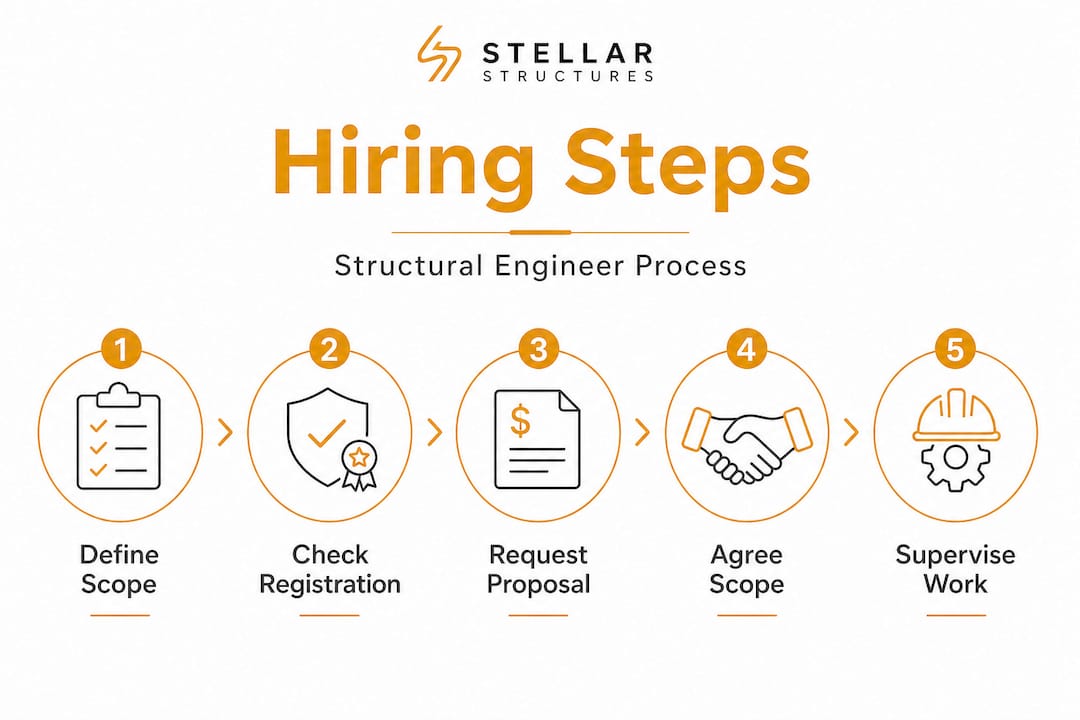
Step 1: Define and document your renovation scope in full detail. Before approaching any engineer, produce a written scope of works that identifies every structural element your renovation touches. Include floor plans, photographs of existing conditions, and any previously approved drawings if available. Vague scope descriptions lead to misaligned fee proposals and incomplete submissions.
Step 2: Map your scope to the correct regulatory pathway. A practical mapping methodology involves determining whether your works fall under BCA’s building plan approval process, the “insignificant works” category, or HDB-specific permit forms. This step determines which authorities must be notified, which submissions are mandatory, and whether a QP appointment is legally required.
Step 3: Verify the engineer’s registration and track record. All PEs practicing in Singapore must be registered with the PEB. You can verify registration status through the PEB’s public register. Beyond registration, review the engineer’s experience with your specific property type and renovation category. An engineer with extensive HDB structural experience may have limited familiarity with JTC industrial premises, and vice versa.
Step 4: Request a structured fee proposal with clearly defined deliverables. The scope of engineering services varies considerably across engagements. The table below outlines the two primary engagement models:
| Engagement model | What’s included | Best suited for |
|---|---|---|
| Endorsement only | PE reviews and stamps drawings prepared by others; limited site involvement | Simple structural checks, minor works |
| Full-service engagement | PE prepares structural drawings, handles authority submissions, responds to comments, conducts site inspections | Complex renovations, BCA plan submissions, high-risk works |
Understanding Qualified Person roles and liabilities is essential before signing any engagement letter, as the QP carries statutory liability for the accuracy and safety of all submitted documents.
Step 5: Conduct a pre-engagement interview. Before signing, ask the following questions:
- Who specifically will perform site inspections and sign off on structural drawings?
- What is the expected timeline for submission preparation and authority comment responses?
- Does the fee include responding to BCA or HDB queries, or are these billed separately?
- What happens if additional structural issues are discovered during works?
Pro Tip: Request a written engagement letter that specifies deliverables, submission responsibilities, and the process for scope changes. Verbal agreements on engineering scope create significant disputes when authority comments require additional work.
For a thorough understanding of how QP supervision in Singapore operates across different project types, reviewing the regulatory framework before your first engineer meeting will make the conversation substantially more productive.
Setting clear scope and documentation expectations
With your engineer selected, the next vital step is to agree on the scope and ensure your project is documented correctly to satisfy regulatory bodies and avoid delays.

One of the most common and costly mistakes in renovation projects is engaging an engineer for a “cheap sign-off” without providing the substantive information needed for a proper structural review. When scope boundaries and evidential requirements at the authority comment stage are not clearly established upfront, engineers are frequently unable to respond to BCA or HDB queries without additional site investigations or drawing revisions, generating delays and additional costs that far exceed any initial savings.
The documentation you should prepare and provide to your engineer includes:
- Existing approved building plans, including structural drawings if available from BCA’s records
- As-built drawings reflecting any previous renovations or modifications
- Photographs of all structural elements affected by the proposed works, including walls, columns, beams, and floor slabs
- Soil investigation reports for landed property projects involving foundation works
- Contractor’s method statements for any demolition or hacking works
- Authority correspondence from previous submissions, including any outstanding conditions
A particularly important nuance involves the classification of structural elements. The same “renovation” label can obscure significant structural ambiguity. For example, load-bearing status ambiguity in HDB walls is a common source of disputes, where an element assumed to be non-structural is later identified as load-bearing during works, requiring immediate stoppage and re-submission.
For commercial and industrial projects, the PE authority approvals process involves multiple regulatory bodies simultaneously. Ensuring your engineer is familiar with JTC, URA, BCA, and SCDF submission requirements, and that the engagement scope covers responses to all relevant authorities, is critical to avoiding gaps.
Pro Tip: Always clarify in writing who is responsible for preparing submission drawings, responding to authority comments, and coordinating with the main contractor. These responsibilities are frequently assumed rather than assigned, leading to project delays when queries arrive from BCA or HDB.
Common documentation gaps that cause submission failures:
- Missing load path diagrams for proposed structural modifications
- Insufficient details on connection design for new structural members
- No documentation of existing slab thickness or reinforcement layout
- Absent geotechnical data for foundation-adjacent works
- Incomplete fire compartmentalization details for SCDF submissions
Inspection, supervision, and final verification: Ensuring safety and compliance
After setting a clear scope, your attention shifts to supervision and final checks, which are crucial for both compliance and lasting peace of mind.
Structural engineering involvement does not end at the submission stage. Effective oversight requires physical site inspections at key construction milestones, and a professional engineer inspection report should document defect analysis, structural adequacy assessments, and specific remediation recommendations. These reports serve both regulatory and practical purposes: they satisfy authority requirements and provide a record that protects the property owner if disputes arise with contractors.
A well-structured PE inspection report for renovation works typically includes:
- Pre-commencement inspection: Confirmation of existing conditions, verification of element classifications, and baseline documentation before any works begin.
- Milestone inspections during construction: Verification that structural works conform to approved drawings, including reinforcement placement before concrete pours and connection details for new structural members.
- Defect identification and remediation tracking: Formal documentation of any non-conformances, with written instructions to the contractor and follow-up verification.
- Completion inspection: Final confirmation that all structural works comply with approved plans and that no unauthorized modifications have been made.
- Completion certificate or statutory declaration: Submission to BCA or HDB confirming that works are complete and compliant.
For higher-risk or structurally complex projects, Singapore’s regulatory system may require an Accredited Checker (AC) as an independent second review of structural calculations and drawings. The AC is appointed separately from the QP/PE and provides an additional layer of quality assurance. AC requirements typically apply to buildings above a certain height or complexity threshold, and your PE should advise you early if your project falls within this category.
The table below outlines typical inspection stages and their regulatory significance:
| Inspection stage | Trigger | Regulatory purpose |
|---|---|---|
| Pre-commencement | Before any structural works | Baseline condition record |
| Reinforcement check | Before concrete pour | Verify design compliance |
| Structural connection check | At key assembly points | Confirm load transfer paths |
| Completion inspection | After all structural works | Authority sign-off prerequisite |
| Post-occupancy check | If defects reported | Liability and safety documentation |
For properties with ongoing maintenance obligations, such as places of worship or shophouses, a periodic structural inspection program provides continuity of compliance and early identification of deterioration before it becomes a safety issue.
Regulatory reminder: BCA requires a Certificate of Statutory Completion (CSC) or Temporary Occupation Permit (TOP) for certain categories of building works. Your PE should confirm whether your renovation requires formal completion certification and manage that submission accordingly.
For landed property owners specifically, a PE inspection for structural integrity provides both compliance documentation and a detailed record that supports future sale, refinancing, or further renovation.
Expert perspective: What most owners overlook when hiring a structural engineer
The technical steps described above are necessary, but they do not capture the full picture of what separates a successful renovation from a problematic one. In practice, the most significant risks arise not from regulatory ignorance but from the gap between what an owner assumes is covered and what the engineer has actually been engaged to do.
Many property owners treat PE endorsement as a formality, a stamp that satisfies a regulatory requirement without expecting substantive technical review. This approach is genuinely dangerous. An engineer who signs drawings without conducting a thorough structural assessment provides no real protection to the owner. If a structural failure occurs, the owner bears the consequences: financial, legal, and in the worst cases, physical harm to occupants.
The value of a qualified structural engineer lies in the quality of their technical judgment, not the speed of their signature. When reviewing proposals, owners should look for engineers who ask detailed questions about existing conditions, request documentation proactively, and identify potential issues before submission rather than after authority queries arrive. An engineer who accepts a vague scope and returns drawings within 24 hours without a site visit has likely not performed a meaningful structural review.
Scope ambiguity is the second major risk. Owners frequently assume that an engineer engaged for “structural endorsement” will also handle authority submissions, respond to comments, and coordinate with the contractor. These assumptions, when unverified, create serious gaps at exactly the moments when professional support is most needed.
Fixed-fee arrangements can work well for clearly defined scopes, but owners should negotiate explicit provisions for authority comment responses and scope changes. An engagement that covers submission but excludes comment responses exposes the owner to additional costs at a stage when project pressure is highest and negotiating leverage is lowest.
For structural inspection and compliance obligations in commercial and industrial premises, the stakes are higher still, as BCA’s periodic inspection requirements impose ongoing obligations that cannot be deferred without regulatory consequence.
Get expert guidance for your renovation project
Navigating Singapore’s structural engineering and authority submission requirements demands professional support that goes beyond basic plan endorsement.

Stellar Structures provides integrated architectural design services, structural engineering, and authority submission management for residential, commercial, and industrial renovation projects across Singapore. Our team of registered PEs and QPs handles BCA, HDB, URA, JTC, and SCDF submissions, ensuring your project moves from concept to completion without regulatory interruption. Whether you need PE endorsement, a full structural design service, or guidance on QP supervision obligations, we provide clear, accountable professional support at every stage. Contact Stellar Structures today to discuss your renovation scope and receive a structured engagement proposal tailored to your project’s specific requirements.
Frequently asked questions
When is it mandatory to hire a structural engineer for renovation in Singapore?
You must hire a registered Professional Engineer for any renovation involving structural elements, load-bearing walls, or when required by BCA or HDB permit pathways, including structural plan submissions where the QP must hold civil or structural PE registration.
What documents should I prepare before meeting a structural engineer?
Prepare renovation plans, existing building records, any past authority approvals, and photographs of all structural elements affected by proposed works to enable the engineer to map your renovation scope to the correct regulatory pathway efficiently.
How much does a structural engineer inspection cost in Singapore?
Costs vary based on property type, scope complexity, and the level of authority submission required, but a thorough PE inspection report that identifies defects early typically delivers significant savings by preventing costly remediation after construction is complete.
Do all HDB wall hacking works require PE endorsement?
Not all HDB wall hacking requires PE endorsement, as routine removal of confirmed non-load-bearing RC partition walls may follow a simplified approval path, but structural element involvement triggers PE verification or supervision requirements regardless of the wall’s apparent size or location.
Recommended
- Periodic Structural Inspection of Singaporean Places of Worship: Regulatory Compliance, Pathology, and Heritage.
- BCA Periodic Structural Inspection for your business in Singapore – Stellar Structures
- Periodic Structural Inspection (PSI) for Industrial Buildings in Singapore: Regulations, Costs, and Smart Inspection Trends (2026 Edition)
- Mezzanine Floor Approval Guide Singapore 2026