





Property owners planning a landed home rebuild in Singapore frequently assume that an interior designer can manage the entire project from start to finish. This assumption, while understandable given an interior designer’s visible creative contributions, can set a project up for serious structural, compliance, and financial complications. Understanding precisely when and how to engage an interior designer, and equally important, which professionals must lead the earlier phases of a rebuild, is critical to achieving a project that is safe, code-compliant, and aesthetically successful.
Table of Contents
- Understanding rebuild-level work versus renovation
- The vital role of an interior designer in a rebuild
- Pitfalls of relying solely on interior designers for rebuilds
- Maximizing success: Integrating interior designers with the project team
- Why the conventional wisdom around interior designers is incomplete
- Ready to start your rebuild? Partner with proven experts
- Frequently asked questions
Key Takeaways
| Point | Details |
|---|---|
| Know the difference | A rebuild is far more complex than a renovation and may require authority approvals and structural work. |
| Multi-expert approach | Relying only on an interior designer risks non-compliance and costly mistakes—bring in architects and engineers early. |
| Designer’s unique value | Interior designers transform spaces functionally and visually after key compliance and buildability issues are settled. |
| Integrate for results | Collaborative teams where each expert plays their part are proven to deliver the best rebuild outcomes. |
| Avoid costly pitfalls | Engaging the right sequence of professionals saves time, money, and prevents regulatory headaches. |
Understanding rebuild-level work versus renovation
To understand why the right expertise matters, it is essential to grasp what separates a renovation from a true rebuild.
A renovation typically involves cosmetic or minor functional changes to a property that do not alter its structural system or require major regulatory approvals. Examples include repainting walls, replacing flooring, upgrading fixtures, installing built-in cabinetry, or reconfiguring non-structural partitions. Renovations are largely self-contained in scope, and an interior designer may legitimately serve as the primary coordinator for such work.
A rebuild, by contrast, involves the partial or full demolition of existing structural elements and the construction of new ones. This classification applies when a property’s floor slabs, columns, beams, or external envelope are being modified or replaced. Rebuilds trigger a range of authority submissions to bodies such as BCA (Building and Construction Authority), URA (Urban Redevelopment Authority), and SCDF (Singapore Civil Defence Force), and they require professional input from licensed architects and structural engineers at specific project stages.
Comparison of renovation vs. rebuild scope:
| Factor | Renovation | Rebuild |
|---|---|---|
| Structural changes | None or minor | Significant, often systemic |
| Authority approvals | Typically not required | BCA, URA, SCDF, and others |
| Primary professional lead | Interior designer or contractor | Architect or engineer |
| Compliance risk | Low | High |
| Buildability review | Not typically needed | Essential |
| Timeline complexity | Shorter, linear | Longer, phased |
Key distinctions to keep in mind when classifying your project:
- Any modification to load-bearing walls, structural beams, or columns qualifies as rebuild-level work
- Adding a new floor level, altering the building envelope, or changing the gross floor area triggers URA and BCA requirements
- Projects involving basement construction or deep excavation require geotechnical engineering input
- Unauthorized structural works can result in enforcement action, mandatory demolition, and significant financial penalties
As noted by construction industry professionals, rebuild-level work in projects such as landed house redevelopments should not be led by an interior designer alone, as structural sequencing, compliance, and buildability requirements demand builder, architect, or engineer leadership. When owners treat a rebuild as a renovation, they risk initiating work that cannot be legally signed off or structurally certified, which creates costly rework scenarios. Understanding the importance of architectural design expertise in shaping a compliant structural framework is the first step toward avoiding these outcomes.
The vital role of an interior designer in a rebuild
With the differences clarified, it is important to see how interior designers truly contribute to rebuild projects.

Interior designers bring specialized skills that no other professional on a construction project can fully replicate. Their value is maximized when they are engaged at the right phase of a rebuild. Once the structural shell has been built and the necessary authority approvals secured, the interior designer’s role becomes pivotal in shaping a home that is both livable and purposeful.
The core contributions of an interior designer in a rebuild project include:
-
Space planning and functional layout optimization. An interior designer analyzes how occupants will move through and use each room, ensuring that the finished configuration supports daily routines, accommodates furniture at scale, and maximizes natural light and ventilation within the approved structural envelope.
-
Material and finish specification. From flooring substrates and wall cladding to ceiling systems and millwork, the interior designer selects materials that achieve the desired aesthetic while meeting durability, maintenance, and budget requirements. In Singapore’s humid climate, moisture-resistant specifications are particularly critical.
-
Lighting design and electrical layout coordination. Interior designers work alongside M&E (mechanical and electrical) engineers to position light fixtures, power points, and data outlets in locations that serve both functional and atmospheric needs. Early coordination prevents costly re-routing of electrical conduits.
-
Custom joinery and built-in solutions. Kitchens, wardrobes, and storage systems that are custom-designed by an interior designer make more efficient use of the available volume than off-the-shelf alternatives, particularly in constrained floor plans.
-
Narrative and aesthetic cohesion. Interior designers ensure that design choices across all rooms create a coherent visual and sensory experience, which is particularly important in high-value landed properties where resale appeal and lifestyle quality are priorities.
However, as industry guidance confirms, when a project’s core risk is structural or compliance-heavy work such as a full rebuild scope, structural modifications, or permitting-intensive stages, interior design value is limited unless it is integrated with the builder, architect, or engineer who leads those foundational phases. Engaging an interior designer for functional interior planning at the correct phase, with full coordination across the technical team, produces far superior outcomes than placing the interior designer in a leadership role from day one.
Pro Tip: When briefing your interior designer, share the approved building plans and structural drawings immediately. This ensures every design decision is anchored to what has been constructed and approved, preventing revisions triggered by non-compliant specifications.
Proper sequencing with integrated design solutions that align interior, architectural, and engineering inputs delivers projects that are both buildable and beautiful, without the costly iteration that results from siloed workflows.
Pitfalls of relying solely on interior designers for rebuilds
Despite their value, failing to assemble the right team at the right stage can lead to expensive and time-consuming setbacks.
Property owners who appoint an interior designer as the sole project lead for a rebuild face several categories of risk. These risks are not hypothetical. They represent recurrent patterns in Singapore’s landed residential construction sector, and understanding them is essential before you commit to a project structure.
Common risks and their consequences:
| Risk category | Description | Potential consequence |
|---|---|---|
| Structural misdesign | Interior layout conflicts with load-bearing elements | Walls demolished or rebuilt; structural failure risk |
| Compliance oversight | Authority submissions not filed or incorrectly prepared | Stop-work orders, fines, mandatory demolition |
| Submission delays | Lack of qualified person for BCA or URA submissions | Project timeline extended by months |
| Buildability gaps | Design elements that cannot be physically constructed | Cost overruns due to redesign and re-fabrication |
| Coordination failures | Trades working off mismatched drawings | Rework costs and construction defects |
The following pitfalls are particularly common in Singapore landed home rebuilds:
- Missing a Qualified Person (QP) appointment. Under BCA regulations, any structural work requires a licensed QP, typically an architect or professional engineer, to submit plans and take responsibility for compliance. An interior designer is not a QP and cannot fulfill this role.
- URA planning permission not obtained. Changes to a property’s gross plot ratio, setback distances, or building height require URA approval before construction begins. Interior designers typically do not handle planning applications.
- SCDF fire safety requirements overlooked. Rebuild projects that alter a building’s layout may trigger fire safety compliance reviews. Missing these requirements can block the issuance of a Temporary Occupation Permit (TOP).
- Structural drawings not prepared or reviewed. Without a structural engineer’s input, slab openings, beam removals, and foundation modifications may proceed without adequate load path analysis.
As industry analysis on rebuild project risks explicitly states, relying solely on an interior designer for a full rebuild can result in structural misdesign, submission delays, and buildability review gaps that undermine the entire project. Interior design professionals themselves are often placed in an unfair position when asked to lead beyond their area of competence.
“A full rebuild is a construction project. It requires the leadership of a builder or architect who understands structural sequencing, legal submissions, and the regulatory framework governing the work.”
Understanding the authority submissions process and having a working knowledge of the building submission guide are baseline requirements for managing any rebuild project responsibly. Interior designers who recognize their boundaries and communicate them clearly to clients are a sign of professional integrity, not limitation. The interior design workflow challenges that arise in complex renovation and rebuild scenarios further illustrate how coordination breakdowns between trades and designers can generate measurable delays and cost increases.
Maximizing success: Integrating interior designers with the project team
To ensure your rebuild delivers both safety and style, collaboration strategies are key.
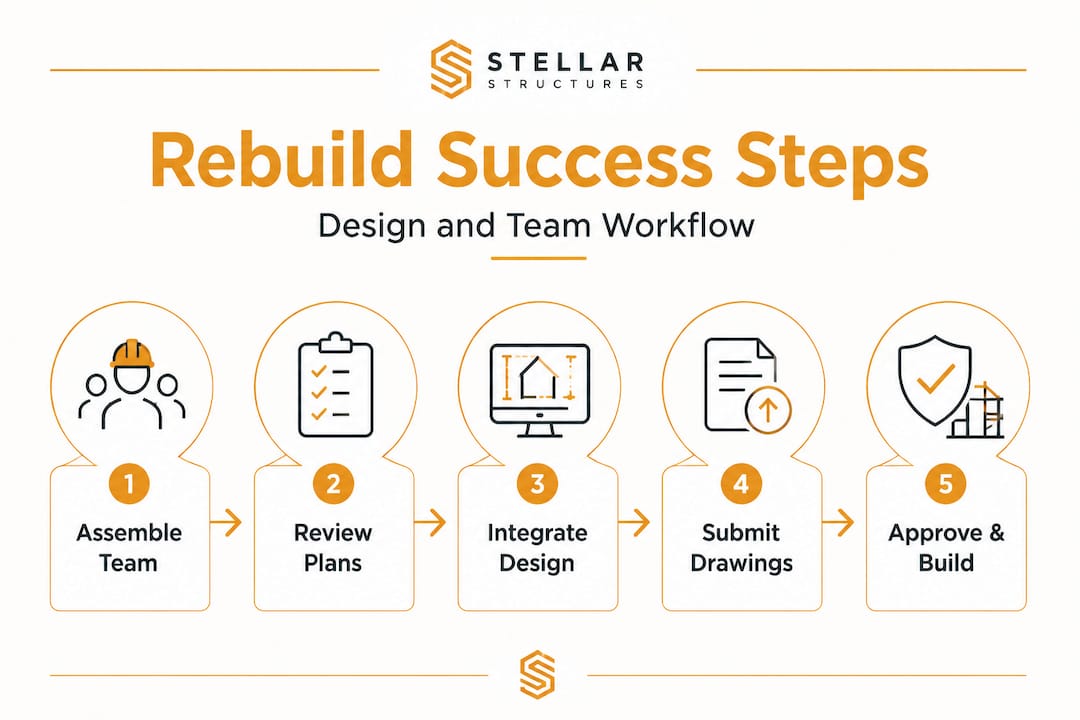
The most successful landed home rebuilds in Singapore operate on a phased leadership model. Builders, architects, and structural engineers take the lead during the technical foundation phases, and the interior designer steps in as a key collaborator once the structural shell is complete and plans are approved. This model preserves each professional’s contribution while protecting the project from the coordination failures described above.
A structured integration approach follows these steps:
-
Appoint your Qualified Person and main contractor first. Before any design decisions are finalized, engage a licensed architect or professional engineer to serve as the QP and handle BCA and URA submissions. Select a main contractor with demonstrated experience in the project type.
-
Complete structural and planning submissions before finalizing interior design. Interior layouts, floor finishes, and ceiling heights must be designed around approved structural drawings and planning permissions, not the other way around.
-
Introduce the interior designer at the design development stage. Once the structural shell and approved floor plans are established, bring in the interior designer to develop the spatial layout, finishes, lighting, and joinery within the approved envelope.
-
Establish a coordinated drawing set. Require that the interior designer’s drawings reference the structural and architectural drawings directly. Discrepancies between drawing sets are a leading cause of construction defects.
-
Schedule regular multi-disciplinary coordination meetings. Weekly or biweekly coordination sessions involving the architect, structural engineer, M&E engineer, contractor, and interior designer reduce the risk of conflicting instructions reaching the construction team.
-
Confirm compliance checkpoints before committing to long-lead items. Custom joinery, imported tiles, and bespoke fixtures should not be ordered until the relevant construction stages have been inspected and approved.
Pro Tip: Ask your interior designer to submit their drawings to the QP for review before finalizing specifications. This single step prevents the most common category of costly late-stage redesigns in Singapore rebuild projects.
Reviewing building plan requirements at the outset of your project, and engaging professionals who are familiar with authority approvals, ensures your team is aligned on both technical standards and regulatory timelines from day one. As confirmed by project leadership guidance for landed rebuilds, structural and compliance sequencing is properly led by builders, architects, and engineers, with the interior designer contributing maximum value during the interior stage once those foundations are secured.
Why the conventional wisdom around interior designers is incomplete
The property and renovation industry frequently positions interior designers as the natural starting point for any home improvement project. For minor renovations, this is reasonable. For rebuilds, it is an oversimplification that creates structural and regulatory exposure for property owners who follow it uncritically.
The more instructive framework is one of division of labor, where each professional is deployed at the phase where their expertise is most applicable and where their accountability is clearly defined. Architects and structural engineers own the compliance and buildability phase. Interior designers own the habitation and aesthetic phase. When these boundaries are respected, both the technical quality and the design quality of a project are higher than when a single professional is expected to manage all dimensions.
There is also a less-discussed dimension to this issue: the interior designer who accepts a project leadership role for a full rebuild without the appropriate technical team in place is taking on liability that their professional training and regulatory standing do not equip them to manage. Singapore’s construction regulatory framework is specific about who may submit plans, certify structural work, and take legal responsibility for compliance. Placing an interior designer in that position is not merely a risk management problem for the property owner. It creates professional risk for the designer as well.
The most successful rebuild projects we observe in Singapore’s residential and commercial sectors share a common characteristic: clear role delineation from project inception, combined with integrated architectural and interior design coordination that ensures each professional’s output supports the others. Property owners who invest time in assembling this structure before breaking ground consistently achieve better outcomes than those who assign project leadership based on familiarity or cost assumptions alone.
Ready to start your rebuild? Partner with proven experts
Knowing which professionals to engage, and when to engage them, is the foundation of a successful rebuild. Stellar Structures offers an integrated team of engineers, architects, and interior designers who coordinate across all project phases, from initial authority submissions to final interior finishes.

Whether your project requires BCA structural submissions, URA planning approvals, or detailed interior design for a completed shell, the team at Stellar Structures is equipped to support you through every compliance and design milestone. For property owners seeking purposeful, regulation-compliant spaces, explore our office interior design solutions and broader expert design and engineering capabilities. Reach out to schedule a consultation and ensure your rebuild project benefits from coordinated professional leadership from day one.
Frequently asked questions
What is the difference between renovation and a rebuild in Singapore?
A renovation involves improving existing structures without altering load-bearing elements, while a rebuild requires demolishing and constructing new structural components, which typically triggers authority approvals with BCA, URA, and other agencies. As industry guidance confirms, rebuild-level work requires builder, architect, or engineer leadership for structural and compliance sequencing.
Can an interior designer handle a full rebuild project alone?
No, full rebuilds require a team that includes licensed builders or architects for structural compliance, authority submissions, and Qualified Person responsibilities. Industry sources confirm that property owners should be careful about relying on an interior designer alone for rebuild-level work.
When is the best time to involve an interior designer in a rebuild?
Engage an interior designer after builders or architects have handled the structural, compliance, and authority stages, ensuring that interior design decisions align with the approved structural and planning drawings. This phased approach, where the interior designer is brought in for the interior stage, prevents costly late-stage conflicts.
What risks arise if you skip consulting structural professionals during a rebuild?
Skipping structural input can produce buildability failures, missed authority submissions, and compliance deficiencies that require expensive remediation. Specific pitfalls include structural misdesign, submission delays, and buildability review gaps that affect both project cost and timeline.
What professionals should be on your rebuild project team in Singapore?
Your rebuild team should include a licensed architect or professional engineer as Qualified Person, a main contractor with structural experience, an M&E engineer, and an interior designer who coordinates with the technical leads throughout the interior development phase.
Recommended
- Interior Design for Office Space That Works – Stellar Structures
- Architectural Design for Commercial Buildings – Stellar Structures
- Top Authority Approvals for Renovations – Stellar Structures
- Landed House Renovation Approval Explained – Stellar Structures