




BCA Periodic Structural Inspection PSI Cycle: Why does BCA require inspections every 5 or 10 years?
Introduction to the Periodic Structural Inspection Regime
The Building and Construction Authority enforces strict property maintenance laws across Singapore. The BCA Periodic Structural Inspection is a vital regulatory framework.1 This mandatory regime demands routine structural assessments for aging properties. Regular maintenance guarantees that buildings remain structurally safe for all occupants.2 Without periodic checks, older structures pose extreme safety risks to the public.2
The Periodic Structural Inspection cycle activates at a precise building age. Buildings become subject to this requirement from their thirteenth year onwards.1 Temporary buildings are explicitly exempt from this rigorous statutory obligation.2 Additionally, detached, semi-detached, and terraced houses used solely as residences are excluded.2 For all other structures, statutory compliance is a strict legal requirement.1
The inspection frequency varies greatly based on the primary building usage. Residential buildings require an inspection once every ten years.1 This applies if at least ninety percent of the floor area is residential.4 Non-residential buildings face a significantly stricter five-year inspection cycle.1 This broad category includes commercial, industrial, and major institutional properties.2
Understanding these specific intervals requires examining multiple highly critical factors. Historical structural disasters profoundly influenced this modern public policy. Furthermore, tropical climate mechanics and material degradation actively dictate these timelines.
The Historical Genesis of Stringent Building Controls
Singapore’s building regulations evolved rapidly following several major structural disasters. The Building Control Act of 1989 emerged from profound national tragedies.5 Before this critical legislation, structural design oversight was notably less stringent. Authorities recognized the urgent need to ensure long-term building safety.5
The Catastrophic Collapse of Hotel New World
On March 15, 1986, the Lian Yak Building collapsed completely.6 This six-story structure was widely known as Hotel New World.6 The devastating disaster trapped fifty people beneath massive concrete rubble.8 Ultimately, thirty-three individuals lost their lives in this catastrophic event.8 Seventeen people were miraculously rescued by emergency civil defense forces.8
Investigations revealed severe foundational errors in the original architectural plans. The original building designers completely omitted the building’s dead load.9 Structural support columns were stressed to their absolute maximum limits initially.9 Consequently, microscopic cracks developed silently within the concrete over fifteen years.10
Furthermore, additional heavy equipment was installed on the building roof over time.9 This equipment included a massive water tank and air conditioning compressors.6 This added substantial live loads to a severely compromised structural system.10 The lack of proper maintenance significantly accelerated the building’s ultimate demise.7
The Mechanics of Progressive Collapse
The Hotel New World failure mechanism is defined as a progressive collapse.10 A progressive collapse occurs when a local failure spreads throughout a structure.10 Column 26 was the first structural element to crack and fail.10 Its collapse rapidly redistributed massive weight to nearby adjacent support columns.10
Column 32 could not bear the sudden extra load and failed sequentially.10 This rapid chain reaction brought the entire building down in under sixty seconds.7 Following this disaster, all buildings constructed in the 1970s were thoroughly checked.8 Several structurally unsound buildings were evacuated and subsequently demolished for safety.8
The government immediately introduced tighter and highly stringent construction regulations.8 Since 1989, multiple Accredited Checkers must counter-check all new structural designs.8 This disaster highlighted the severe public dangers of inadequate structural maintenance.7
The Nicoll Highway Excavation Cave-In
Another highly pivotal event was the Nicoll Highway collapse on April 20, 2004.11 This tragedy occurred during deep excavation for the Circle Line MRT tunnel.12 The temporary supporting structure for the deep excavation failed catastrophically.12 A thirty-meter deep crater swallowed six lanes of the busy highway.12
Four construction workers died, and three others were seriously injured.11 The ground consisted of deep layers of extremely soft marine clay.11 This marine clay possessed a very low shear strength of 20 to 40 kPa.11 Contractors utilized thick reinforced concrete diaphragm walls as earth-retaining structures.11 These walls were supported by ten distinct levels of massive steel struts.11
Investigations exposed critical flaws in these temporary earth-retaining wall systems.11 The connection details between steel struts and waling beams were totally inadequate.13 Following this incident, the government drastically tightened civil engineering excavation regulations.11
Authorities strictly mandated independent checking of all temporary works designs.13 They required independent contractors for rigorous instrumentation and ground monitoring.13 The factors of safety for deep excavations were permanently upgraded.13 These historical tragedies underscore a vital, undeniable civil engineering reality. Structural failures are rarely sudden, unprovoked events without warning signs. They are the predictable culmination of hidden, compounding weaknesses over time.7
Climatic Catalysts for Accelerated Structural Degradation
Singapore features a highly aggressive and relentless tropical climate.14 This specific environment constantly attacks the integrity of reinforced concrete buildings. The climate is characterized by abundant sunshine and heavy, frequent rainfall.14 The average annual precipitation measures approximately 1600 millimeters.15
Furthermore, the mean daily temperature remains consistently high at around 27°C.16 Relative humidity in Singapore frequently exceeds a dangerous seventy percent.15 These specific environmental parameters drastically accelerate chemical degradation in concrete structures.15 Constant humidity allows external moisture to deeply penetrate concrete surfaces over time.17
Climate change further exacerbates these environmental stresses on aging civil infrastructure.18 Rising atmospheric carbon dioxide concentrations directly threaten long-term concrete durability globally.18 Global carbon dioxide levels have risen substantially since the year 2000.19
Consequently, traditional engineering models based solely on mechanical stress are insufficient. Modern engineers must also account for aggressive chemical weathering over a building’s lifespan.18 The tropical environment acts as a massive chemical catalyst for concrete degradation.20 This reality completely necessitates mandatory visual inspections to identify early-stage environmental damage.
The Mechanics of Concrete Carbonation
Concrete deterioration is the primary target of the BCA Periodic Structural Inspection. Carbonation is a severe, naturally occurring degradation mechanism in reinforced concrete.18 This chemical process destroys the protective alkaline environment surrounding internal steel reinforcement.16
The Chemistry of the Carbonation Process
Concrete is inherently highly alkaline when initially poured and properly cured. The initial pH value typically ranges between 12.5 and 13.0.16 This high alkalinity is largely due to hydroxide ions in the pore water.16 Calcium hydroxide readily dissolves from the solid cement gel.16
This highly alkaline environment forms a non-porous, passivating oxide layer on steel rebars.16 This microscopic chemical layer perfectly protects the steel reinforcement from rapid corrosion.16 However, atmospheric carbon dioxide constantly penetrates the porous concrete surface.18
The intruding carbon dioxide reacts directly with the dissolved calcium hydroxide.16 This chemical reaction produces calcium carbonate and microscopic amounts of water.16 The rapid formation of calcium carbonate drastically lowers the internal pH value.16 When the internal pH drops below 9.0, the protective oxide layer is destroyed.16 Consequently, the internal steel reinforcement becomes entirely vulnerable to rapid corrosion.16
Carbonation Rates in Tropical Environments
The overall rate of carbonation depends heavily on ambient temperature and relative humidity.15 The penetration depth is generally modeled using a standard mathematical diffusion equation. This formula states that carbonation depth equals the coefficient multiplied by the square root of time.21
Research shows that carbonation is maximized when relative humidity is roughly seventy percent.22 Abundant pores in concrete are partially filled by water vapor at this humidity.22 In very dry conditions, there is insufficient internal water to dissolve carbon dioxide.23 In fully saturated conditions, liquid water completely blocks carbon dioxide gas diffusion.23
Singapore’s climate consistently provides the optimal optimal humidity for maximum carbonation speed.22 Studies firmly indicate Singapore’s carbonation rates are much higher than in temperate zones.24 The carbonation coefficient in Singapore ranges from 5.5 to 8.6 mm per square root year.24
In colder, temperate climates, this coefficient only ranges from 1.0 to 3.0.24 The higher temperatures and humidity vastly accelerate diffusion and chemical reactions.20
| Climate Zone | Mean Daily Temperature | Carbonation Coefficient Range | Overall Corrosion Risk |
| Temperate (Europe/North America) | 8°C – 9°C | 1.0 – 3.0 | Low to Moderate |
| Tropical (Singapore) | 27°C | 5.5 – 8.6 | Extremely High |
This massively accelerated degradation rate is a crucial reason for frequent statutory inspections. By the thirteenth year, the carbonation front often reaches the internal steel reinforcement. This perfectly aligns with the BCA’s thirteen-year mandatory inspection trigger threshold.1
Phenolphthalein and Advanced Testing Methods
Engineers historically test concrete carbonation depth using a simple phenolphthalein reagent.22 A one percent phenolphthalein solution is prepared using ethyl alcohol.22 Engineers spray this sensitive solution onto freshly split concrete core samples.21 Highly alkaline, uncarbonated concrete instantly turns a bright pink or purple color.22 Carbonated concrete with a lowered pH remains completely colorless after spraying.22
However, recent studies indicate the traditional phenolphthalein method possesses significant analytical limitations. This visual method frequently underestimates the advancement of the carbonation front’s leading edge.21 Coarse aggregates often cause a very irregular carbonation front during physical measurements.25
Consequently, modern structural engineers increasingly utilize advanced infrared spectroscopy for accurate testing.26 This advanced method detects calcium carbonate via highly specific infrared chemical spectra.26 It successfully detects specific carbon-oxygen bonds within the degraded concrete matrix.26 This offers superior precision compared to traditional, visually subjective phenolphthalein staining methods.26
The Destructive Threat of Spalling Concrete
When the carbonation front finally reaches the steel, active corrosion begins immediately. Corroding steel reinforcement rapidly expands up to several times its original volume.18 This immense internal expansion generates severe outward pressure within the concrete matrix.27
This unrelenting pressure forces the outer concrete cover to crack, bulge, and detach.28 This specific structural phenomenon is universally known as spalling concrete.27 Spalling concrete is a highly prevalent structural defect in aging Singaporean properties.17 It frequently occurs in damp residential areas like kitchens, toilets, and external balconies.28
Secondary Causes of Spalling
While carbonation is primary, other factors heavily contribute to spalling concrete severity. Inadequate concrete cover over steel reinforcement allows moisture to reach rebars quickly.27 Poor drainage near slab edges ensures constant destructive water pooling and penetration.17
Alkali-Silica Reaction is another severe chemical process causing internal concrete expansion.29 Extreme fire exposure causes internal steam pressure, blowing off concrete cover violently.29 Additionally, aging waterproofing systems constantly fail, allowing severe hidden moisture intrusion.17 Older developments near coastal areas deteriorate even faster due to higher salt exposure.17
The Dangers of Ignored Spalling
If ignored, dislodged massive concrete chunks can fall and cause severe fatal injuries.29 Furthermore, deep spalling continually exposes more reinforcement steel to moisture and oxygen.27 This drastically accelerates ongoing corrosion and significantly reduces the building’s structural load capacity.27
Repeated patching alone rarely provides a viable, safe long-term structural solution.17 Many spalling concrete repairs fail because deeper structural moisture issues continue developing internally.17 Therefore, early detection through rigorous periodic inspections is absolutely critical to prevent failures.
Proper Rectification Techniques
Repairing spalling concrete requires meticulous adherence to established civil engineering methodologies. The affected area must not be ignored, as it will rapidly enlarge.28 First, all loose concrete must be hacked away to expose the corroding steel.
The rusted steel bars are aggressively cleaned to remove all loose oxidation.28 Next, contractors apply two complete coats of specialized anti-rust paint to the bars.28 A high-quality bonding agent is then applied to the surrounding affected concrete surface.28 This ensures proper, lasting adhesion for the newly applied repair mortar.28 Finally, workers patch the hacked area using dense, polymer-modified cement mortar.28
| Repair Phase | Specific Action Required | Primary Engineering Purpose |
| Surface Preparation | Hack away all loose, flaking concrete. | Exposes clean substrate and rusted reinforcement. |
| Steel Treatment | Clean rebar; apply two coats anti-rust paint. | Halts ongoing corrosion; protects exposed steel. |
| Bonding | Apply chemical bonding agent to concrete. | Ensures old and new materials adhere perfectly. |
| Patching | Apply polymer-modified cement mortar. | Restores structural cover and structural integrity. |
Rationale Behind the Differentiated Inspection Frequencies
The Building and Construction Authority mandates different inspection intervals based on specific usage. Residential buildings enjoy a relatively relaxed ten-year structural inspection cycle.1 Conversely, non-residential buildings must endure a much stricter five-year inspection cycle.1 Several crucial engineering and sociological risk factors dictate this targeted regulatory differentiation.
The Five-Year Cycle: Non-Residential Buildings
Non-residential buildings include commercial malls, industrial factories, and public institutional facilities.2 These massive structures face significantly higher and highly dynamic operational live loads. Industrial buildings often house heavy, continuously vibrating machinery that severely stresses structural joints.4 Commercial retail spaces experience massive daily footfall, causing continual dynamic floor loading and deflection.
Furthermore, non-residential buildings undergo incredibly frequent tenancy changes and major interior renovations. Tenants frequently perform extensive, heavy additions and alterations to original commercial layouts.2 These constant architectural modifications can inadvertently alter critical original structural load distribution pathways.30
Unauthorized structural works are far more common in fast-paced, high-turnover commercial environments.1 Retailers often overload floor slabs with extremely heavy inventory or large display fixtures. Therefore, a five-year cycle ensures highly prompt detection of unsafe, unauthorized structural modifications. It limits the time a compromised structural element remains dangerously undetected.
The Five-Year Cycle: Civil Engineering Structures
The five-year inspection cycle also heavily encompasses major civil engineering structures. The authorities recently expanded the PSI regime to include highly critical marine and transit infrastructure. This includes aging jetties, docks, and bustling commercial wharves.2 These specific structures provide vital access for marine vessels, ships, and smaller boats.2
Bridges that are generally accessible to the public also require periodic inspections.2 This category strictly includes pedestrian footbridges and various vital crossings over public drains.2 However, utility bridges carrying mechanical and electrical services are officially exempt from PSI.2
Floating structures also strictly fall under this rigorous five-year inspection mandate.2 A floating structure is constructed on a permanent flotation system supported by water.2 These are permanently moored to the seabed and are not intended for general navigation.2 Large commercial fish farms requiring plan approval must strictly undergo this periodic inspection.2
Annex E of the structural guidelines specifies rigorous inspection requirements for submerged structures.2 These marine environments represent the absolute highest risk for aggressive concrete degradation and corrosion.
The Ten-Year Cycle: Residential Buildings
Residential buildings generally experience highly static, predictable, and relatively light daily live loads. Once a high-rise condominium or apartment block is fully occupied, structural stresses remain remarkably consistent. Most residential additions and alterations are minor, completely non-structural aesthetic interior renovations.2
Additionally, massive residential buildings are heavily partitioned with thick, internal reinforced shear walls. These dense walls provide tremendous inherent structural redundancy, virtually eliminating progressive collapse risks. The primary threat to residential buildings is gradual environmental weathering, primarily spalling concrete.29
A ten-year interval provides adequate time to carefully monitor this slower degradation curve safely.2 The carbonation process in painted residential interiors is slower than fully exposed external environments. Therefore, a decade is an appropriate, safe interval for residential structural health monitoring.
The Multi-Stage Inspection and Compliance Process
The BCA Periodic Structural Inspection is a rigorous, legally binding statutory process. It demands strict, unfailing adherence from both building owners and appointed structural engineers. The process guarantees absolute accountability in maintaining structural safety standards across the entire nation.
Notice Issuance and Structural Engineer Appointment
The inspection process begins when the authorities issue a formal PSI Notice.2 Upon receiving this official notice, the building owner must promptly appoint a Structural Engineer.2 This engineer must be a registered Professional Engineer strictly in the civil engineering discipline.3 They must possess a valid, currently active practicing certificate from the Professional Engineers Board.1
Crucially, the appointed engineer must maintain absolute, unquestionable professional independence. They cannot possess any professional or financial interest whatsoever in the specific building.2 They cannot have been involved in its original architectural design or physical construction phases.2
In highly complex strata-titled developments, the Management Corporation Strata Title assumes the owner’s responsibilities.2 The MCST acts collectively on behalf of all individual subsidiary proprietors within the estate.
Managing Joint Appointments
For buildings with multiple owners but lacking a management corporation, strict joint appointments apply.4 Individual unit owners in these un-subdivided buildings cannot independently appoint their own engineer.2 Instead, all owners must jointly appoint a single, unified structural engineer for the inspection.4
This appointed engineer must meticulously inspect all units within the entire building.2 The engineer is strictly forbidden from inspecting only selected, easily accessible units.2 The official appointment is formalized using the highly specific Form D2.2
Form D2 must be meticulously completed using black ink and submitted digitally.2 The engineer digitally submits this form via the centralized CORENET government system.2 Every joint owner must individually submit their own Notice of Appointment to the authorities.2
Stage 1: The Comprehensive Visual Inspection
The actual inspection usually commences with a highly comprehensive Stage 1 visual assessment.4 The engineer must physically visit the site in person to conduct this critical inspection.2 Delegating this highly vital task entirely to an unregistered assistant is strictly unacceptable.2 If this illegal delegation occurs, owners are strongly encouraged to immediately notify BCA.2
During Stage 1, the engineer meticulously surveys all accessible load-bearing structural elements. They carefully assess current building loading and actual usage against original approved design parameters.2 They actively search for early signs of structural defects, dangerous deformation, or material deterioration.31
The engineer thoroughly surveys potential exposure to highly aggressive chemical or marine environments.31 They closely examine retaining walls, steep slopes, and vital structural slope protection systems.31 They also thoroughly verify the integrity of all structural safety barriers across the property.31
Building Owner Facilitation Duties
Building owners must actively facilitate this complex process by providing completely unhindered site access.2 They must provide original as-built structural plans and comprehensive historical building maintenance records.30 Owners must meticulously provide previous periodic inspection reports for baseline comparison purposes.30
Owners may need to physically remove architectural claddings or heavy false ceilings.2 This exposes hidden structures, such as completely concealed timber roof trusses, for visual inspection.2 Providing heavy access equipment, like aerial lifts or tall mechanical ladders, is also entirely mandatory.2 Tenant coordination is solely the building owner’s responsibility during this intensive phase.30
Stage 2: The Full Structural Investigation
If the engineer discovers severe, alarming structural deficiencies, they may strongly recommend Stage 2.2 Stage 2 constitutes a full, deeply invasive structural investigation of the compromised building.4 This stage is highly detailed and requires explicit prior written approval from the BCA.4
Stage 2 involves extracting highly detailed data regarding construction materials and historical maintenance.2 Engineers will mathematically reconstruct structural calculations to verify original design adequacy rigorously.2 They frequently extract solid concrete core samples to conduct destructive laboratory material strength tests.2
In highly uncertain scenarios, they may perform actual physical load tests on structural floor slabs.2 Stage 2 heavily relies on deeply scientific, empirical material testing rather than simple visual observation. Building owners possess the legal right to engage a completely different engineer for Stage 2.2 However, they must formally notify the authorities in writing before changing appointed engineers.4
Reporting, Review, and Rectification
Following the exhaustive inspection, the engineer compiles a highly detailed, formalized structural report.1 This document meticulously classifies all identified defects and clearly recommends appropriate, safe remedial actions.1 The engineer officially certifies the overall structural integrity and safety of the entire building.1
The engineer directly submits this comprehensive, legally binding report to the BCA.1 The engineer assumes massive personal civil and criminal liability regarding the findings’ absolute accuracy.1 Authorities meticulously vet the submitted report and frequently seek deep technical clarifications from the engineer.2
The BCA may conduct a joint site inspection alongside the appointed structural engineer.2 They may also formally require the engineer to conduct a detailed presentation of their findings.2
Once the official report is fully accepted, the owner must urgently execute all recommended rectifications.2 Prompt rectification successfully prevents further rapid structural deterioration and substantially reduces long-term repair costs.30 The structural engineer actively supervises these complex repairs to ensure strict compliance with engineering standards.30
| Inspection Phase | Primary Actor | Key Responsibilities and Actions |
| Notice & Appointment | Building Owner | Receives BCA notice; engages qualified independent PE; submits Form D2. |
| Stage 1 Visual | Professional Engineer | Surveys structure; assesses loads; identifies spalling/cracks; reviews as-built plans. |
| Stage 2 Investigation | Professional Engineer | Conducts concrete coring; reconstructs math calculations; performs load tests. |
| Report Submission | Professional Engineer | Drafts detailed findings; recommends repairs; certifies integrity; answers BCA queries. |
| Rectification Works | Owner & Contractor | Hires contractor; executes PE-recommended repairs; PE supervises actual construction work. |
Handling Special Scenarios and Exemptions
Periodic structural inspections cannot be postponed simply because a building was recently heavily renovated.2 The scope of Addition and Alteration works does not satisfy the independent PSI requirements.2 However, if an owner intends to execute massive structural alterations shortly, postponements are possible.2 The BCA considers these specific deferment requests on a strict case-by-case basis.2
If a building is scheduled for imminent demolition, owners must officially inform the BCA.2 Once properly demolished, future inspection notices are permanently halted for that specific land parcel.2 If an inspected building is actively being sold, the inspection obligations firmly remain.2 An owner cannot avoid urgent recommended repairs merely because they intend to sell the property.2
Financial Obligations and Severe Legal Penalties
The BCA Periodic Structural Inspection regime generates specific financial obligations for property owners. Professional Engineer fees vary widely based on the building’s size, age, and extreme complexity.1 Typical professional fees range from S8,000 per comprehensive inspection.1
Owners must additionally bear the substantial costs of any highly necessary access equipment.2 If severe structural defects are discovered, the subsequent repair costs can be exceptionally high.
Strict Penalties for Non-Compliance
The Building and Construction Authority treats regulatory non-compliance with extreme, uncompromising statutory severity. Failing to comply with a periodic inspection notice is a very serious criminal offense.32 Building owners who deliberately ignore the official notice face severe financial penalties upon legal conviction. The courts can impose a massive fine of up to $20,000 per single offense.32
Furthermore, authorities possess the tremendous power to order immediate stoppage of any dangerous works.34 Severe structural negligence causing public danger can result in catastrophic fines reaching up to $500,000.34 Custodial sentences of up to two full years of imprisonment are also legally possible.34
If the criminal failure continues post-conviction, the owner faces a brutal daily compounding fine.34 This daily fine can reach up to $10,000 for every single day the non-compliance continues.34 For less severe orders, the daily fine is capped at $2,500 per day.34
| Legal Violation | Maximum Fine Potential | Imprisonment Potential | Additional Daily Fine |
| Ignoring PSI Notice | Up to $20,000 | Not explicitly specified | None specified for this tier |
| Ignoring Stop Work Order | Up to $500,000 | Up to 2 years | Up to $10,000 per day |
| Ignoring Remedial Order | Up to $100,000 | Up to 12 months | Up to $2,500 per day |
These highly punitive measures successfully enforce a nationwide culture of strict proactive structural maintenance. The government heavily prioritizes public safety over the financial convenience of private property owners.
Technological Integration in Modern Structural Diagnostics
Historically, periodic structural and facade inspections relied heavily on intense manual labor and direct visual observation. Inspectors used simple binoculars, extremely heavy scaffolding, and highly dangerous suspended gondola systems to view facades.35
This highly traditional approach was exceedingly time-consuming, inherently risky, and highly economically costly.35 Workers faced constant severe risks of fatal falls while working at extreme urban heights. Recently, the Periodic Structural Inspection process has undergone a massive, unprecedented technological revolution. The deep integration of smart sensors and advanced robotics has completely transformed building diagnostics.36
Unmanned Aerial Vehicles (Drones)
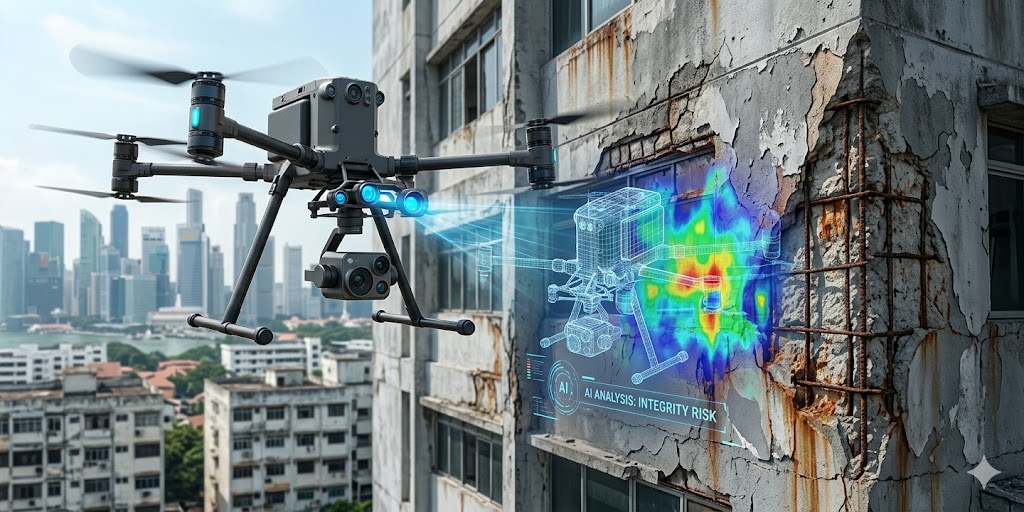
Drones offer an incredibly safe and highly efficient alternative to traditional manual facade inspections.35 Unmanned Aerial Vehicles can easily access towering modern skyscrapers and extremely hazardous confined spaces.37 They completely eliminate the deadly risks associated with rope access or highly unstable scaffolding systems.38
Drones capture ultra-high-resolution digital imagery of external structural features with absolute pinpoint accuracy.39 They effortlessly inspect highly inaccessible roofs, fragile exhaust vents, and sprawling complex exterior facades.39 This cutting-edge technology enables engineers to achieve one hundred percent visual inspection coverage incredibly rapidly.35
Traditional methods rarely achieved more than ten percent coverage due to severe access limitations.38 Furthermore, advanced drone operations cause absolutely minimal disruption to surrounding urban traffic and pedestrians.39
Government Innovation and Large-Scale Deployment
The Singaporean government actively strongly encourages the rapid adoption of this advanced drone technology. The Housing Development Board and BCA jointly launched a massive open innovation call in 2017.35 Supported by Enterprise Singapore, this initiative urged tech companies to develop highly advanced drone inspection systems.35
The challenge successfully attracted over twenty highly innovative proposals from local and overseas technology players.35 Five massive consortiums were eventually awarded lucrative contracts to rapidly develop Internet of Things and robotics solutions.35
Recently, NovaPeak secured a massive S$1 million contract for AI-powered drone inspections.40 This massive contract covers the rigorous inspection of 1,500 distinct HDB residential buildings.40 This marks a major, unprecedented step forward in executing large-scale, AI-enabled public building inspections.40
Infrared Thermography Scanning
Modern inspection drones are frequently equipped with highly advanced Forward Looking Infrared (FLIR) cameras.38 Infrared thermography easily detects deeply hidden structural issues completely invisible to the naked human eye.38
Thermal scanning identifies microscopic temperature anomalies across massive building envelopes in mere hours.38 These specific thermal signatures instantly indicate highly dangerous hidden moisture intrusion or critical insulation failures.38 Detecting trapped subsurface moisture is absolutely vital for preventing concealed concrete carbonation and internal rebar corrosion.17
By utilizing thermal imaging, engineers pinpoint exactly where water is actively destroying the internal structure. This entirely prevents unnecessary destructive testing on perfectly healthy sections of the massive building facade.
Artificial Intelligence and 3D Photogrammetry
Furthermore, Artificial Intelligence immensely enhances the diagnostic speed and accuracy of modern structural engineers.35 AI models rapidly process hundreds of thousands of high-resolution drone images automatically. They quickly categorize facade cracks, concrete spalling, and dangerous loose tiles with incredible mathematical precision.37
Companies like Operva AI and TUV SUD heavily utilize advanced AI models for compliance reporting.35 TUV SUD’s engineers deliver highly compliant inspection reports assisted by this advanced artificial intelligence.35 Operva AI combines drone pilots, certified thermographers, and AI specialists to provide completely end-to-end solutions.41
Additionally, highly sophisticated photogrammetry software seamlessly stitches thousands of overlapping 2D images into exact 3D digital replicas.37 Engineers effectively utilize these digital twins to conduct highly accurate off-site structural analyses.42 They can execute precise digital measurements directly on their computer screens without re-visiting the dangerous site.37
| Technology Deployed | Primary Inspection Function | Key Advantage in PSI Regime |
| UAV Drones | High-altitude visual data capture | Eliminates dangerous scaffolding risks; ensures 100% facade coverage.35 |
| Infrared Thermography | Thermal anomaly and leak detection | Visually reveals deeply hidden moisture and dangerous subsurface defects.38 |
| Artificial Intelligence | Automated defect pattern classification | Radically accelerates reporting; ensures extremely high analytical precision.43 |
| 3D Photogrammetry | High-fidelity digital twin creation | Enables precise, repeatable structural measurements safely off-site.37 |
This highly collaborative synergy of Drones, AI, and Thermography represents the absolute future of building inspections. It ensures that the BCA’s strict regulatory mandates are met with maximum efficiency and unmatched safety.
Concluding Remarks on Structural Integrity
The BCA Periodic Structural Inspection regime is a highly effective, deeply necessary regulatory safeguard. Singapore’s exceptionally harsh tropical climate relentlessly degrades reinforced concrete infrastructure through rapid, unavoidable carbonation.18 The thirteen-year initial threshold perfectly intercepts the highly critical onset of dangerous steel reinforcement corrosion.44
The carefully differentiated inspection frequencies perfectly balance necessary public safety with practical economic realities. The intense five-year cycle strictly monitors highly dynamic, heavily utilized commercial, industrial, and marine environments.1 The slightly longer ten-year cycle adequately monitors the slower, highly predictable degradation of static residential structures.2
Historical catastrophes like the tragic Hotel New World collapse conclusively prove that complacency breeds disaster.7 The Nicoll Highway collapse further reinforces the extreme dangers of inadequate structural oversight.13 The Building and Construction Authority’s incredibly strict enforcement ensures accountability remains paramount across the entire industry.32
By combining highly strict legislation with cutting-edge drone and AI diagnostics, Singapore ensures unparalleled urban structural safety.35 Proactive, technology-driven structural maintenance remains the ultimate, most effective defense against the inevitable forces of physical decay. Ignoring these vital statutory requirements is not merely illegal; it is a direct, unforgivable threat to human life.
Works cited
- BCA Periodic Structural Inspection (PSI) Singapore Guide – CVC Engineers, accessed May 17, 2026, https://www.cvcengineers.com/post/bca-periodic-structural-inspection-singapore
- Periodic Structural Inspection (PSI) | Building and Construction …, accessed May 17, 2026, https://www1.bca.gov.sg/safety-and-standards/periodic-building-inspections/periodic-structural-inspection/
- BCA Guidelines for Periodic Structural Inspections | PDF – Scribd, accessed May 17, 2026, https://www.scribd.com/doc/207958067/Periodic-Structural-Inspection-of-Existing-Building
- GUIDELINES FOR STRUCTURAL ENGINEERS, accessed May 17, 2026, https://isomer-user-content.by.gov.sg/338/7fefc1c0-6299-41fa-bf17-17c3a9896f1a/psi-guidelines-for-structural-engineers-(sep-2024).pdf
- 37/MAR 14-2/89/03/20 SPEECH BY MR PETER SUNG, MINISTER OF STATE FOR NATIONAL DEVELOPMENT & FOREIGN AFFAIRS AT TH, accessed May 17, 2026, https://www.nas.gov.sg/archivesonline/data/pdfdoc/sp19890320s.pdf
- HOTEL NEW WORLD – Singapore – National Heritage Board, accessed May 17, 2026, https://www.nhb.gov.sg/~/media/nhb/files/resources/publications/ebooks/nhb_ebook_hotel_new_world.pdf
- Failures – Hotel New World Collapse – Penn State Engineering, accessed May 17, 2026, https://www.engr.psu.edu/ae/thesis/failures/MKP/failures/failures.wikispaces.com/Hotel_New_World_Collapse.html
- Collapse of Hotel New World – Wikipedia, accessed May 17, 2026, https://en.wikipedia.org/wiki/Collapse_of_Hotel_New_World
- The Hotel New World Collapse | PPTX – Slideshare, accessed May 17, 2026, https://www.slideshare.net/slideshow/the-hotel-new-world-collapse/66586061
- (DOC) Archstruc – Academia.edu, accessed May 17, 2026, https://www.academia.edu/30432716/Archstruc
- Revisiting Lessons Learned from the Nicoll Highway Collapse – Structure Magazine, accessed May 17, 2026, https://www.structuremag.org/article/revisiting-lessons-learned-from-the-nicoll-highway-collapse/
- Nicoll Highway collapse – Index of /, accessed May 17, 2026, https://www.scatnow.com/TunnelCollapses/NicollHWayCollapse2004.pdf
- Case Histories of Failure of Deep Excavation. Examination of Where Things Went Wrong: Nicoll Highway Collapse, Singapore – Scholars’ Mine, accessed May 17, 2026, https://scholarsmine.mst.edu/cgi/viewcontent.cgi?article=3091&context=icchge
- The carbonation of concrete structures in the tropical environment of Singapore and a comparison with published data for temperate climates, accessed May 17, 2026, https://www.emerald.com/jmacr/article-pdf/48/177/293/2568585/macr_1996_48_177_293.pdf
- A Study on the Carbonation Rate of Concrete Exposed in Different Climatic Conditions – UniversePG, accessed May 17, 2026, https://www.universepg.com/ajeit/a-study-on-the-carbonation-rate-of-concrete-exposed-in-different-climatic-conditions
- The-carbonation-of-concrete-structures-in-the-tropical-environment-of-Singapore-and-a-comparison-with-published-data-for-temperate-climates.pdf – ResearchGate, accessed May 17, 2026, https://www.researchgate.net/profile/Derek-Northwood/publication/250072299_The_carbonation_of_concrete_structures_in_the_tropical_environment_of_Singapore_and_a_comparison_with_published_data_for_temperate_climates/links/5be0738a92851c6b27aa08c6/The-carbonation-of-concrete-structures-in-the-tropical-environment-of-Singapore-and-a-comparison-with-published-data-for-temperate-climates.pdf?origin=scientificContributions
- Why Spalling Concrete Repairs Keep Failing in Singapore Buildings – AmpleBuild, accessed May 17, 2026, https://amplebuild.sg/why-spalling-concrete-repairs-keep-failing-in-singapore-buildings/
- Degradation of Concrete Structures from the Climate Change Perspective 1 Introduction – Semantic Scholar, accessed May 17, 2026, https://pdfs.semanticscholar.org/4feb/1693507d64feb197f79dfac9885739ffeec7.pdf
- A Review of Concrete Carbonation and Approaches to Its Research under Irradiation – MDPI, accessed May 17, 2026, https://www.mdpi.com/2075-5309/13/8/1998
- Carbonation of Concrete in Singapore | PDF – Scribd, accessed May 17, 2026, https://www.scribd.com/document/985172208/Carbonation-Singapore
- A COMPARISON OF METHODS FOR DETERMINING CARBONATION DEPTH IN FLY-ASH BLENDED CEMENT MORTARS – American Concrete Institute, accessed May 17, 2026, https://www.concrete.org/publications/internationalconcreteabstractsportal.aspx?m=details&id=51687452
- Effects of Environmental Factors on Concrete Carbonation Depth and Compressive Strength, accessed May 17, 2026, https://www.mdpi.com/1996-1944/11/11/2167
- Sources of Variations When Comparing Concrete Carbonation Results | Journal of Materials in Civil Engineering | Vol 21, No 7 – ASCE Library, accessed May 17, 2026, https://ascelibrary.org/doi/10.1061/%28ASCE%290899-1561%282009%2921%3A7%28333%29
- The carbonation of concrete structures in the tropical environment of Singapore and a comparison with published data for temperate climates – ResearchGate, accessed May 17, 2026, https://www.researchgate.net/publication/250072299_The_carbonation_of_concrete_structures_in_the_tropical_environment_of_Singapore_and_a_comparison_with_published_data_for_temperate_climates
- CARBONATION IN CONCRETE AND EFFECT ON STEEL CORROSION – College of Engineering, accessed May 17, 2026, http://www.eng.usf.edu/~sagues/Documents/FDOT%20Arch/0510785-Carbonation-Comp-OCR.pdf
- Application of Infrared Spectroscopy in the Measurement of Carbonation Depth of Concrete, accessed May 17, 2026, http://jase.tku.edu.tw/articles/jase-202112-24-6-0019
- Spalling Concrete Repair Singapore: The Complete Guide – CWP Waterproofing, accessed May 17, 2026, https://www.cwp.com.sg/blog/spalling-concrete/
- Preventing and Fixing Spalling Concrete in HDB Flats, accessed May 17, 2026, https://www.hdb.gov.sg/managing-my-home/renovation-and-maintenance/home-maintenance/home-care-guide/spalling-concrete
- Spalling Concrete in Singapore: What It Is and How to Fix It – Hydro-Seal Engineering Pte Ltd, accessed May 17, 2026, https://www.hydroseal.com.sg/post/what-is-spalling-concrete
- BCA Periodic Structural Inspection (PSI) Process Singapore, accessed May 17, 2026, https://bca-psi.sg/psi-process
- BCA Periodic Structural Inspection (PSI), accessed May 17, 2026, https://structures.com.sg/bca-periodic-structural-inspection-psi/
- Building Control Act 1989 – Singapore Statutes Online, accessed May 17, 2026, https://sso.agc.gov.sg/Act/BCA1989?ProvIds=pr26-,pr27-,pr28-,pr29-
- Building Control (Inspection of Buildings) (Amendment) Regulations 2017 – Singapore Statutes Online, accessed May 17, 2026, https://sso.agc.gov.sg/SL-Supp/S508-2017/Published/20170912170000?DocDate=20170912170000
- Building Control (Amendment) Bill, accessed May 17, 2026, https://www.bca.gov.sg/publications/others/amendment_bill.pdf
- Smart Drones, A Game Changer For Building Façade Inspection – Open Innovation Network, accessed May 17, 2026, https://www.openinnovationnetwork.gov.sg/success-stories/success-stories/smart-drones-a-game-changer-for-building-facade-inspection
- How GovTech and SLA use drones and AI for building inspections – GovTech Singapore, accessed May 17, 2026, https://www.tech.gov.sg/technews/how-govtech-and-sla-use-drones-and-ai-for-building-inspections/
- Drone Inspection Services in Singapore: Advanced UAV Solutions for Industrial Inspection – Standard Non Destructive Testing Pte Ltd, accessed May 17, 2026, https://www.sndt.com.sg/drone-inspection-services-singapore/
- Thermal Envelope Inspection | AI-Powered Drone Inspection | AERIALLY.AI, accessed May 17, 2026, https://aerially.ai/services/thermal-inspection/
- Smart Drone Building Facade Inspection Services in SG – Environ Construction, accessed May 17, 2026, https://environ-construction.com/services/
- NovaPeak LiveInspect – NovaPeak, accessed May 17, 2026, https://nova-peak.com/
- Inspection Services – OPERVA AI, accessed May 17, 2026, https://operva.ai/building-inspection/
- A Review of the Potential of Drone-Based Approaches for Integrated Building Envelope Assessment – MDPI, accessed May 17, 2026, https://www.mdpi.com/2075-5309/15/13/2230
- Inspekt AI: Revolutionizing Façade Inspections with AI, accessed May 17, 2026, https://inspektai.com/
PE Endorsement & BCA Submissions – CVC Engineers, accessed May 17, 2026, https://www.cvcengineers.com/blog/categories/pe-endorsement-bca-submissions