




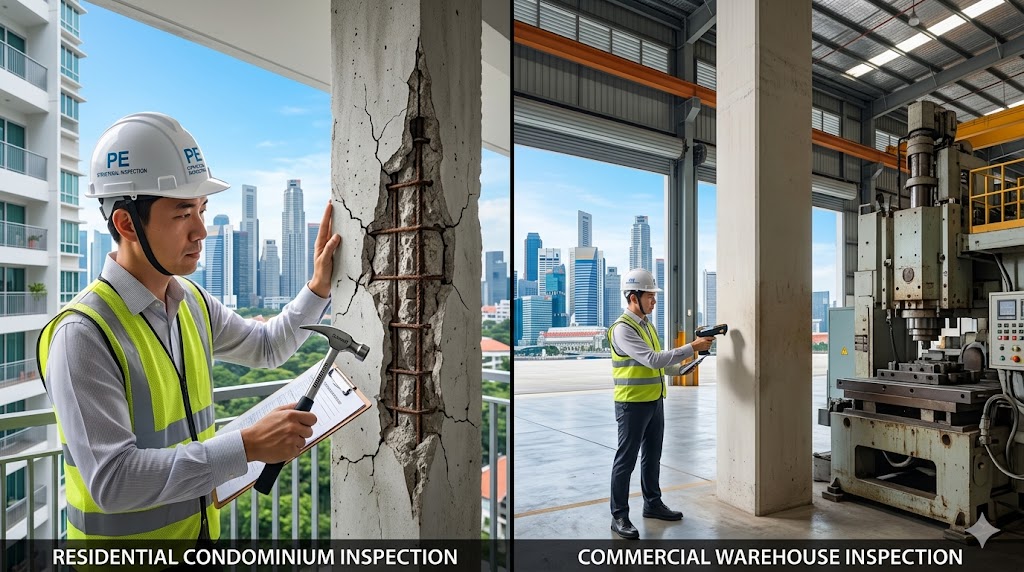
Residential vs. Commercial PSI: Singapore Building Inspection Differences
Introduction to Singapore Building Safety
Singapore features a highly dense and modern urban skyline. Maintaining this built environment requires strict regulatory oversight. Consequently, structural integrity remains a paramount national priority. The Building and Construction Authority regulates this sector strictly. They enforce the Periodic Structural Inspection regime.1
This regime is commonly known as the PSI. It ensures buildings remain completely safe for occupation. Regular inspections prevent catastrophic structural failures over time. Furthermore, these checks identify early signs of dangerous deterioration. Building owners bear the primary responsibility for compliance.
They must engage a registered professional structural engineer. The engineer conducts these mandatory statutory assessments. Minor defects can easily escalate into severe hazards. Therefore, early detection is absolutely critical for public safety. The rules differ significantly across various building types. Specifically, residential vs. commercial PSI rules vary greatly. This exhaustive report details these essential regulatory differences.
Historical Context: The 1986 Catalyst
Singapore’s building regulations were not always this rigorous. A specific historical tragedy catalyzed the current safety framework. On March 15, 1986, the Hotel New World collapsed.2 This catastrophic event left thirty-three people dead.2 It remains a profound disaster in modern Singaporean history.
A Commission of Inquiry quickly investigated the horrific collapse.3 They discovered severe structural defects and poor quality construction.2 Furthermore, structural designs lacked proper independent engineering oversight. A massive rescue operation involved over five hundred personnel.2
The Singapore Civil Defence Force led these intensive efforts.2 Seventeen survivors were miraculously pulled from the deep rubble.2 Consequently, the government recognized an immediate need for reform. They completely overhauled all building safety laws and regulations.4 Accountability became the foundational pillar of the new framework.
The Legislative Overhaul of 1989
The government introduced tighter, far more stringent regulations. They officially passed the Building Control Act in 1989.5 This pivotal legislation fundamentally shifted the industry paradigm forever. It introduced mandatory counter-checks by independent Accredited Checkers.4 All structural designs required verification before construction could begin.5
Furthermore, the Act established the framework for periodic inspections.6 The law demanded proactive, recurring checks on older buildings. It forced owners to adopt highly stringent maintenance standards.3 The government also upgraded the Singapore Civil Defence Force.4 They improved rescue training for future complex collapse scenarios.4 Additionally, site material testing became a strict legal requirement.7 This legislation successfully curbed historical corruption within the industry.7 It established the structural safety baseline utilized today.
Understanding the Building Control Act
The primary legal bedrock is the Building Control Act. This legislation empowers the Building and Construction Authority.6 Specifically, Section 28 governs the periodic inspection of buildings.6 This critical section outlines the statutory mechanisms for enforcement. It grants immense authority to the Commissioner of Building Control.8
The Commissioner formally issues mandatory inspection notices to owners.8 Non-compliance with these official notices attracts very severe penalties.9 The legislative framework undergoes continuous refinement and necessary updates.
For example, the Building Control Regulations commenced in 2022.10 These updates refined the inspection and reporting methodologies significantly.6 Furthermore, 2025 amendments extended rules to civil engineering structures.10 These include jetties, bridges, underpasses, and floating structures.10 The overarching legislative goal remains early defect detection.6
Section 28: The Core Regulatory Mechanism
Section 28 details exact procedures for building owners.8 It outlines precise statutory intervals for mandatory structural inspections.8 The intervals depend strictly on the specific building classification.8 A formal notice specifies the exact building requiring assessment.8 It also dictates the strict timeline for inspection completion.8
Upon receiving this notice, owners face immediate legal obligations.8 They must appoint a qualified structural engineer without delay.8 Subsequently, the engineer prepares a highly detailed condition assessment.8 The engineer must use a legally approved reporting format.8 Finally, the owner submits this report to the Commissioner.8 The Commissioner retains the power to demand further actions.8 They can order mandatory repairs based on the findings.8 This mechanism guarantees continuous monitoring of aging infrastructure.
Defining Building Ownership Legally
The Building Control Act defines an owner quite broadly.11 This ensures accountability always falls on a responsible party. For undivided premises, it means the registered property proprietor.11 This includes individuals holding fee simple or leasehold estates.11 In strata-titled developments, ownership definitions become slightly more complex.
Here, the Management Corporation Strata Title assumes primary responsibility.12 They handle the mandatory inspections for all common property areas.12 For public housing estates, different administrative rules apply legally. A reference to the owner often means the Town Council.8 Town Councils manage the common property within HDB estates.8 Alternatively, the Housing and Development Board assumes this role.8 Identifying the legal owner is the first compliance step. The designated owner faces all financial and legal liabilities.
Defining Residential vs. Commercial PSI
The PSI regime categorizes buildings strictly based on usage. This core categorization dictates the required statutory inspection frequency. Residential buildings possess specific defining criteria under the law. Conversely, commercial buildings fall under the non-residential statutory category.1 This non-residential category encompasses a vast array of structures. It includes offices, retail malls, and hospitality hotels.10
Industrial factories, logistics warehouses, and institutional buildings are non-residential.10 Furthermore, mixed-use developments generally follow the strict non-residential timelines.10 The distinction hinges primarily on functional structural usage patterns. Residential buildings experience relatively predictable and stable structural loading. Commercial and industrial buildings endure heavier, dynamically fluctuating loads. Factories may install heavy machinery without considering slab capacities. Therefore, regulatory scrutiny adapts directly to these varying risks.
The Ninety Percent Residential Rule
The Act precisely defines what constitutes a special building.11 A special building is functionally synonymous with a residential building. To qualify, ninety percent of the floor area is assessed.11 This area must be used solely for residential purposes.11 The calculation method for this floor area is strictly defined. It is the total space measured between external party walls.11 It explicitly includes the thickness of these external walls.11
Such qualifying buildings include private condominiums and HDB blocks.10 They also include standalone multi-story residential apartment complexes.10 If commercial shops occupy more than ten percent, categorization changes. The building loses its special residential status immediately. Consequently, it defaults to the stricter non-residential inspection timeline. This mathematical threshold ensures commercial risks are monitored frequently.
Exemptions from Periodic Structural Inspection
Some building types are entirely exempt from these rules. The regime focuses exclusively on higher-risk, high-density structures. Therefore, single-family landed homes generally avoid these strict mandates. Detached houses and semi-detached homes are legally exempt.6 Terraced or linked houses used exclusively for residence qualify too.1 These properties pose a significantly lower mass public risk. Their failure would not typically cause mass urban casualties.
Furthermore, temporary buildings receive exemptions from structural inspection requirements.13 The Act defines temporary buildings with high statutory precision.14 They include structures permitted for a maximum of 36 months.14 Workers’ quarters and site offices are considered temporary structures.14 Show-flats and builder sheds also fall into this category.14 These structures are dismantled before long-term deterioration occurs.
Analyzing Inspection Frequencies
Statutory frequency is the most obvious difference in regulations. It clearly separates residential vs. commercial PSI compliance obligations. Residential buildings face inspections exactly once every ten years.1 This longer interval reflects their inherently lower structural load variance. However, commercial and non-residential buildings face much stricter timelines. They must undergo a PSI once every five years.1
This halved interval addresses the elevated risks of commercial usage. Industrial overloading can degrade concrete slabs extremely rapidly over time. Frequent tenant changes in retail spaces cause extensive structural modifications. Therefore, a five-year cycle catches unauthorized, dangerous alterations much earlier. This bifurcated timeline optimizes national engineering resources highly effectively. It focuses regulatory scrutiny precisely where risks are statistically highest.
The Thirteenth-Year Trigger Point
Buildings do not require inspections immediately upon their construction. Newly constructed buildings benefit from modern codes and robust materials. Consequently, a grace period exists before the first inspection. All applicable buildings become subject to rules eventually. Specifically, this obligation begins exactly from their thirteenth year.15
The clock starts ticking from the issuance of occupancy permits. This applies equally to both residential and commercial property types. Once the thirteenth year arrives, the periodic cycle officially begins. The BCA issues the first official inspection notice to owners. Following this initial assessment, the respective five or ten-year cycles apply. This system acknowledges that concrete structures degrade very slowly initially. However, degradation accelerates exponentially as the building ages further. Therefore, the thirteenth year serves as the ideal baseline assessment.
Comparative PSI Frequency Overview
| Building Category | Primary Usage Examples | Inspection Cycle | Trigger Year |
| Residential | Condos, HDBs, Apartments | Every 10 Years | 13th Year |
| Commercial | Offices, Retail, Hotels | Every 5 Years | 13th Year |
| Industrial | Factories, Warehouses | Every 5 Years | 13th Year |
| Institutional | Schools, Hospitals, Temples | Every 5 Years | 13th Year |
| Exempted | Detached, Terraced Houses | Not Applicable | Not Applicable |
Qualifications of the Structural Engineer
Building owners cannot perform these mandatory inspections by themselves. They must legally appoint a registered professional structural engineer.1 The law defines the engineer’s required qualifications very stringently.11 This engineer must possess a currently valid practicing certificate.11
The certificate must be issued under the Professional Engineers Act 1991.11 Furthermore, the engineer must be registered in the civil discipline.11 Alternatively, registration in the structural engineering discipline is legally acceptable.11 This ensures only highly trained experts assess complex urban infrastructure. The engineer bears immense personal civil and criminal liability.15 They must guarantee the absolute accuracy of their inspection findings.15 Selecting an unqualified inspector renders the entire submission legally invalid.
The Prohibition of Delegated Inspections
The Building and Construction Authority enforces strict professional conduct rules. The engineer must personally conduct the physical visual survey.16 Delegating this critical inspection entirely to junior staff is unacceptable.16 The authority has observed and penalized such terrible practices recently.17
Absenteeism during inspections undermines the entire building safety framework.17 The engineer’s seasoned professional judgment is fundamental to safety.17 Their direct visual observation identifies subtle, critical signs of distress.17 They cannot rely solely on photographs taken by third parties.17 BCA expects engineers to allocate adequate personal time and resources.17 They must physically walk the site and evaluate structural capacity.17 Disobeying this personal involvement mandate results in strict disciplinary actions.17
Joint Appointments in Subdivided Properties
Property ownership structures in Singapore can be incredibly complex. Sometimes, a single building comprises multiple privately owned flats. If these flats are not officially subdivided legally, complications arise. The owners might hold subsisting leases under older land acts.16 They might be registered under the Registration of Deeds Act.16
Alternatively, they might fall under the Land Titles Act.16 In these complex scenarios, fragmented inspections are strictly forbidden. The law mandates that all owners must cooperate completely. They must jointly appoint the exact same structural engineer.16 The engineer can only commence work after this joint appointment.16 This ensures a unified, cohesive assessment of the entire structure. Assessing a building piecemeal compromises the holistic engineering evaluation fatally.
Stage One: The Visual Inspection Phase
The PSI framework utilizes a highly effective tiered assessment methodology. This approach optimizes engineering resources while ensuring maximum public safety. The mandatory process consists of two distinct investigative stages.16 Stage 1 involves a highly detailed, comprehensive visual inspection.16
The vast majority of buildings in Singapore only require this stage. Stage 2 involves a full and highly invasive structural investigation.16 Stage 1 serves as the crucial primary diagnostic screening tool. The engineer surveys the building for any visible structural defects.16 They look for concrete distress, beam deformation, or severe deterioration.16 A professional report documents all these visual findings meticulously.16 If no dangerous defects exist, the visual inspection alone suffices.16
Pre-Inspection Document and Plan Reviews
Engineers do not walk into a building completely blind. Proper preparation is essential for a legally compliant Stage 1 inspection. The engineer must first obtain the latest approved structural plans.16 They source these crucial technical documents directly from the BCA.16 These structural layout plans reveal the building’s hidden internal skeleton.16
They help the engineer understand the intended load-bearing structural system.16 Furthermore, the plans identify special and critical structural components.16 Engineers pinpoint transfer girders, slender columns, and long-span structures.16 They also identify structures utterly lacking in necessary engineering redundancies.16 These include cantilever balconies fully exposed to harsh weather elements.16 Studying these plans dictates the physical inspection routing strategy.
Identifying Structural Alterations and Misuse
During Stage 1, engineers perform critical audits of building usage. They actively assess whether current loading matches intended structural usage.16 This is particularly vital when conducting a commercial PSI. They scan for unauthorized structural modification works continuously.16
HTenants often remove load-bearing walls without obtaining necessary approvals.18 If a structure risks immediate collapse, the engineer acts swiftly. They must warn the building owner as soon as possible.16 If visual defects appear, the engineer must recommend remedial actions.16 They might restrict the usage of specific overloaded building areas.16 They could mandate the immediate removal of heavy industrial machineries.16 They may also require specialized anti-termite treatments for timber structures.16
Residential Coverage Requirements
Engineers cannot practically inspect every single square inch of property. Therefore, BCA mandates specific minimum visual sampling coverage percentages.16 The sampling strategy differs vastly between residential vs. commercial PSI. In residential buildings, engineers must access individual private dwelling units. This often requires complex logistical coordination with individual homeowners.
For residential buildings under thirty years old, 20% coverage applies.16 At least twenty percent of all units must be inspected.16 Selected units must be distributed widely across different building wings.16 Furthermore, all rooftop residential units must absolutely be inspected.16 Rooftops suffer the highest thermal stress and water ingress risks. At least one unit per individual storey must be accessed.16 This guarantees a vertical cross-section of the building’s health.
Coverage Scaling by Building Age
Older buildings inherently possess a significantly higher rate of defects. Consequently, BCA implements an age-scaled sampling requirement for residential structures. As the building ages, the mandatory inspection coverage increases proportionally. For buildings over thirty years old, 30% coverage applies.16
Engineers must access and inspect nearly a third of units. Buildings over forty years old face even stricter regulatory requirements. At least forty percent of these older units demand inspection.16 The strictest rule applies to buildings over sixty years old. An exhaustive sixty percent of units must be physically inspected.16 This scaling ensures that deteriorating assets receive maximum professional scrutiny. The older the concrete, the higher the probability of carbonation failure. This proactive approach prevents sudden collapses in aging residential estates.
Residential Unit Inspection Coverage Table
| Building Age Bracket | Minimum Unit Coverage | Key Mandatory Checks |
| Under 30 Years | 20% of total units | All rooftop units |
| 31 to 40 Years | 30% of total units | Minimum 1 unit per storey |
| 41 to 60 Years | 40% of total units | Distributed across all wings |
| Over 60 Years | 60% of total units | Distributed across all wings |
(Source: BCA PSI Guidelines for Structural Engineers) 16
Commercial and Industrial Coverage Rules
Conversely, commercial buildings emphasize broad, expansive floor plate inspections. Non-residential developments often feature massive, continuous suspended ceiling areas. These ceilings conceal the critical floor slabs and supporting beams. Therefore, access panels must be opened and inspected at specific intervals. The regulations mandate access at intervals under 500 square meters.16 This rule applies strictly to all indoor commercial and industrial areas.16
Commercial PSI focuses heavily on identifying usage load deviations constantly.16 Engineers check if industrial machinery exceeds approved floor slab limits.16 Warehouses often stack inventory far beyond the safe structural capacity. Factories may install heavy vibrating equipment that causes metal fatigue. Consequently, commercial inspections demand a deep understanding of tenant operations. The engineer essentially audits both the structure and the business process.
Cladded Columns and Hidden Defect Risks
Certain architectural choices create massive blind spots for structural engineers. Columns hidden behind decorative claddings pose a severe, hidden risk. Moisture can easily become trapped in the air gaps behind claddings. This trapped moisture accelerates unseen corrosion of the hidden column. To mitigate this, BCA introduced specific rules for cladded columns.
The engineer must actively expose at least thirty percent of them.16 They physically remove sections of the cladding to view the concrete.16 This specific rule prevents hidden corrosion from progressing completely unnoticed. Furthermore, structural elements in all common areas demand 100% inspection.16 This includes essential egress routes like stairways, corridors, and lobbies.16 Special and critical structures must be visually inspected fully without exception.16 Unconcealed structural elements require complete, exhaustive visual assessment.16
Critical Elements: Pre-1989 Void Decks
Certain historical building elements demand heightened professional scrutiny during inspections. Small, slender reinforced concrete columns in void decks are highly critical.16 Many residential blocks built before 1989 utilized grade 20 concrete.16 This specific concrete grade is relatively weak by modern engineering standards. These columns suffer greatly from natural deterioration and support settlement.16 Furthermore, they are highly vulnerable to accidental vehicle impacts.16
Cars crashing in void deck carparks significantly reduce column load capacity.16 Rebar placement accuracy in these older columns is sometimes questionable.16 Therefore, engineers must thoroughly search for early distress signs here.16 A failing void deck column threatens the entire tower block above. Documenting their exact condition is a paramount duty during PSI.
Assessing Complex Building Structures
Modern architecture frequently challenges traditional structural engineering limits and boundaries. Complex buildings require even more sophisticated and meticulous inspection methodologies. Buildings with multiple level transfer structures are legally deemed complex.16 This includes transfer floors carrying the massive weight of upper levels.16 Cantilevered transfer structures carrying five or more floors are highly complex.16
Large span structures exceeding forty meters trigger complex building status.16 Cantilever spans exceeding eight meters also fall into this strict category.16 Unconventional geometry, such as large domes or arches, requires special attention.16 Non-vertical or inclined structural elements pose unique gravitational load challenges.16 Engineers must evaluate if these complex load paths remain entirely intact. Any cracking near a major transfer girder is a catastrophic warning.
Prefabricated Volumetric Construction (PPVC)
Singapore heavily promotes Prefabricated Prefinished Volumetric Construction to boost productivity. This modern PPVC technology involves assembling entire room modules onsite. However, it introduces completely new paradigms for periodic structural inspections. PPVC structures rely heavily on concealed, inter-modular connection systems. The structural integrity depends entirely on how well these modules connect.
Engineers must specifically inspect the concealed structural elements of PPVC buildings.16 They must verify that connection grouting remains completely solid and intact. Water ingress into these specific connection joints can cause severe corrosion. As PPVC buildings age, assessing these hidden joints becomes increasingly vital. The PSI guidelines specifically incorporate checks for these emerging construction technologies.19 Engineers must adapt their traditional skill sets to inspect modular architectures.
Stage Two: Full Structural Investigation
Stage 2 represents a deep, invasive, forensic engineering audit.20 The engineer officially recommends this stage if serious defects appear.16 Widespread or completely unexplainable cracks easily trigger Stage 2 investigations.20 First, BCA must formally approve the specific Stage 2 scope.16 If structural deficiencies are highly localized, the investigation targets that area.16
YThis localized investigation may eventually escalate to the entire building.16 Interestingly, building owners may hire a different engineer for Stage 2.16 They must simply inform BCA in writing before investigations commence.16 Stage 2 abandons simple visual checks for hard, empirical material science. It is an expensive, time-consuming, but absolutely necessary safety mechanism. It definitively proves whether a building can remain safely occupied.
Triggers for Invasive Stage Two Testing
What exactly prompts an engineer to demand a Stage 2 audit? The triggers are always tied to inexplicable or severe physical distress. Massive diagonal shear cracks in primary load-bearing columns are immediate triggers. Extensive spalling concrete exposing deeply rusted primary reinforcement bars is another. Excessive floor slab deflections indicating potential yielding require deep forensic investigation. If the engineer discovers severe unauthorized works, Stage 2 determines safety capacity.
Stage 2 involves gathering every historical document regarding the building’s construction.16 The engineer assesses structural capacity by recalculating the original design loads.16 If original structural plans are entirely missing, the engineer reconstructs them.16 This involves mapping the entire building’s skeleton from scratch physically. It requires immense technical skill and advanced surveying technologies to execute.
Concrete Coring and Carbonation Analysis
The physical scope of Stage 2 is highly invasive and destructive.16 It involves concrete core extraction for detailed laboratory testing procedures.21 Technicians drill cylindrical samples directly out of the building’s columns. Laboratories crush these cores to determine the actual compressive concrete strength. Furthermore, engineers conduct carbonation tests on these specific core samples.21
They spray phenolphthalein indicator solution onto the freshly cut concrete surfaces. This chemical test checks the remaining internal concrete alkalinity levels.21 High alkalinity protects the embedded steel rebar from dangerous corrosion. If carbonation has penetrated deeply, the steel is highly vulnerable. This empirical data dictates the exact scope of necessary structural repairs. It moves the assessment from professional opinion to undeniable scientific fact.
Non-Destructive Testing Methodologies
In addition to destructive coring, Stage 2 utilizes advanced Non-Destructive Testing. NDT allows engineers to see inside the concrete without destroying it. Ultrasonic pulse velocity (UPV) tests check for hidden internal concrete voids.21 UPV measures the speed of sound waves traveling through the column. Slower wave speeds indicate problematic honeycombing or hidden internal cracking. Surface hardness is tested using tools like the Schmidt Rebound Hammer.21
Windsor probes test penetration resistance to estimate the concrete’s compressive strength.21 Furthermore, engineers may perform massive physical load tests onsite directly.16 They stack immense weights onto slabs to measure actual physical deflection. Ultimately, they use all this data to propose comprehensive strengthening works.16 These works restore the structural stability and integrity of the building.16
The Pathology of Spalling Concrete
Spalling concrete is arguably the most prevalent structural defect in Singapore.6 It frequently plagues older residential condominiums and aging HDB flats.22 This phenomenon is largely caused by a natural concrete carbonation process.22 Over time, atmospheric carbon dioxide permeates the porous concrete surface structure.
This carbon dioxide reacts with the calcium hydroxide inside the concrete. This specific chemical reaction lowers the alkalinity of the concrete matrix.22 The protective passivation layer around the steel reinforcement is eventually destroyed. This process allows the embedded steel reinforcement bars to corrode rapidly.22 Spalling is an insidious defect because it develops silently over decades. By the time it is visible, internal damage is already severe.
Rebar Corrosion and Structural Failure
As the embedded steel rusts, an unstoppable mechanical process begins. Rust occupies a significantly larger volume than the original uncorroded steel. This expanding rust exerts immense internal tensile pressure on the concrete.12 Concrete possesses tremendous compressive strength but relatively poor tensile strength.
Consequently, the expanding rust cracks the surrounding concrete cover from inside.12 The concrete surface eventually bulges outward and flakes off entirely.22 Falling concrete debris poses a massive, potentially lethal safety hazard.12 Moisture ingress drastically accelerates this entire spalling concrete corrosion cycle.12 Kitchens, toilets, and bathrooms are highly susceptible due to damp conditions.22 Water leakage from the unit above is a very common trigger.12 The combination of water, oxygen, and carbonated concrete is highly destructive.
Maintenance Solutions for Spalling Concrete
Preventing spalling requires proactive, routine maintenance by the individual property owner. Sufficient ventilation is critical to prevent moisture buildup and carbonation.22 Keeping windows open reduces humidity in moisture-prone areas like kitchens.22 Painting ceilings regularly protects concrete from carbon dioxide and moisture ingress.22 Any cracks or drilled holes should be sealed immediately to prevent ingress.22
Repairing spalling concrete requires complete removal of the damaged material. Contractors must scrape away the concrete to expose the rusted bars.22 The exposed steel bars must be wire-brushed completely clean of rust.22 Anti-rust coatings are then applied to protect the bare steel bars. Finally, specialized patching mortars restore the concrete surface perfectly.23 However, surface patching fails completely if underlying moisture seepage persists.23
Unauthorized Additions and Alterations
Unauthorized structural modifications represent a massive, ongoing urban compliance challenge.24 Many ambitious building owners alter structures without necessary BCA plan approval.25 These actions directly contravene the strict rules of the Building Control Act.14 Residential owners sometimes illegally hack away critical load-bearing walls or columns.18 Commercial owners frequently erect illegal, unapproved mezzanine floors in high-volume warehouses.18
These unauthorized works introduce entirely unintended, highly dangerous loads onto structures. The original foundation and columns were never designed for this weight. During a PSI, the structural engineer must identify these illegal modifications.16 They meticulously cross-reference the actual physical building against approved BCA structural plans.16 Discovering unauthorized works triggers immediate, highly stressful regulatory regularization procedures.18
The Regularization Submission Process
When illegal works are discovered, the owner faces a difficult path. The engineer must assess if the illegal structure is actually safe.18 They perform a Regularization Submission to seek retroactive BCA approval.18 The engineer prepares as-built drawings and performs complex structural load calculations.18 If the structure is fundamentally unsafe, they mandate immediate physical removal.18
Alternatively, they may prescribe expensive structural strengthening works to ensure safety.18 The penalties for conducting unauthorized construction are extremely severe in Singapore. Offenders face crippling statutory fines of up to two hundred thousand dollars.24 They may also face a maximum two-year criminal jail term.24 Therefore, the PSI serves as a powerful, recurring deterrent against illegal works. It ensures structural modifications are always engineered by qualified professionals.
The Financial Costs of PSI Compliance
The cost of a PSI varies significantly based on several variables. Building size, architectural complexity, and age directly influence structural engineering fees.15 For a small single-unit landed property, fees generally start from $1,500.15 These typically cover standard building spaces under two hundred square meters.15 Medium-sized residential strata blocks usually cost between $3,000 and $5,000.15
Large commercial or massive industrial buildings demand much higher engineering fees.15 Commercial PSI costs often exceed $8,000 due to their inherent complexity.15 These base fees only cover the standard Stage 1 engineering inspection process. If Stage 2 is triggered, forensic testing costs escalate incredibly rapidly. Furthermore, owners must pay for any required high-access lifting equipment rentals.13
Differentiating Residential and Commercial Fees
The cost disparity between residential vs. commercial PSI is quite logical. Commercial buildings require complex analysis of dynamic loads and machinery usage. The engineer spends significantly more time analyzing heavy industrial operational impacts. Conversely, residential inspections are labor-intensive due to private unit access requirements.
Coordinating with hundreds of private condo owners requires immense administrative effort. If an owner refuses access, the engineer faces massive logistical scheduling nightmares. Ultimately, building owners bear the total cost of all remedial repairs.13 Rectifying massive structural defects in a high-rise can cost millions. Therefore, proactive maintenance is always the most economical strategy for owners. Ignoring minor leaks inevitably leads to catastrophic, highly expensive concrete repairs.
PSI Estimated Fee Structure Matrix
| Property Category | Typical Scope / Scale | Estimated PE Fee Range |
| Small Property | < 200 sqm GFA (Single Unit) | $1,500 – $3,000 |
| Medium Strata | Standard Residential Tower Block | $3,000 – $5,000 |
| Large Commercial | High-Rise Office / Industrial Hub | $5,000 – $8,000+ |
(Note: Estimates strictly exclude high-access equipment rental and Stage 2 forensic testing). 15
Statutory Duties of Building Owners
Building owners possess exceptionally strict statutory duties during the PSI cycle. First, they receive a formal Notice of Inspection from the BCA.13 Upon receipt, they must appoint a structural engineer very promptly.13 They absolutely cannot delay this critical initial professional appointment process. Second, they must provide complete, unimpeded site access to the engineer.1 This includes arranging mandatory access to private residential units for sampling.16
Owners must remove architectural claddings or false ceilings if requested.13 They must provide the necessary equipment, such as ladders or aerial cranes.13 Furthermore, owners must provide complete sets of as-built structural layout plans.13 They must supply all previous periodic inspection reports for baseline referencing.13 Complete transparency regarding maintenance history and alteration records is legally required.13
Enforcement and Severe Legal Penalties
The Building and Construction Authority enforces the regime with absolute severity. Building owners who ignore the official inspection notice face immediate prosecution. Failing to comply without reasonable excuse attracts a twenty thousand dollar fine.26 Offenders may also face criminal imprisonment for up to twelve months.26
A punishing continuing daily fine of five hundred dollars also applies.26 For continuing offences, further fines of two thousand dollars per day apply.26 Therefore, ignoring the law guarantees immense, escalating financial pain for owners. Furthermore, owners must implement all recommended rectification works within the timeframe.1 They cannot simply file the inspection report and ignore the dangerous findings. The BCA actively monitors the progress of all mandated structural rectification works.
Criminal Liability for Structural Engineers
Structural engineers also face intense regulatory scrutiny and extremely heavy penalties. The integrity of the entire system relies upon their unyielding professional honesty. If an engineer delegates the inspection illegally, BCA takes swift enforcement action.17 Submitting fraudulent documentation is considered a severe, unforgivable professional engineering offence.17 For instance, reusing old inspection photographs is strictly and explicitly prohibited.17
Inadequate inspection coverage triggers immediate regulatory censure and disciplinary board hearings.17 Engineers failing their statutory duties face fines up to twenty thousand dollars.24 They also risk losing their professional practicing license permanently and disgracefully. This strict enforcement stance ensures engineers price their fees appropriately for rigor.17 It successfully upholds paramount public confidence in national building safety.17
The Differentiated PSI Approach
Aging buildings pose a significantly higher structural risk profile to society. To address this escalating risk, BCA introduced the Differentiated PSI Approach.19 This highly targeted regulatory framework officially commenced in February 2023.19 It applies far greater regulatory scrutiny to older, statistically riskier buildings.19 This collaborative approach relies heavily on proactive stakeholder dialogue and engagement sessions.19
BCA actively reviews building maintenance records and recent A&A works closely.19 This targeted methodology ensures absolute compliance with the latest inspection guidelines.19 It forces owners to address deterioration aggressively before it becomes highly critical.19 BCA has facilitated over 120 meetings under this specific differentiated approach.19 These productive meetings address industry challenges in inspecting complex concealed structures.19 Consequently, the Differentiated Approach drastically elevates the entire national maintenance culture.
Standardizing the Reporting Framework
In the past, inspection reports varied wildly in quality and detail. Some lacked conclusive engineering views or detailed empirical structural analysis. To combat this inconsistency, BCA introduced a Standard PSI Report Template.19 This rigid template enforces a unified, rigorous documentation standard nationwide completely.19 Engineers must meticulously complete highly specific checklists within this standardized template.16
They must clearly detail the primary structural system and construction materials.16 The report must describe deep foundation systems and local soil conditions.16 Engineers must document critical floor systems like complex pre-stressed concrete slabs.16 They must log every single sign of distress, steel corrosion, or settlement.16 The standardized template eliminates vague, unhelpful reporting language completely and forever. It forces engineers to provide highly concrete, actionable structural remedial recommendations.16
Integrating Periodic Facade Inspections
The structural inspection regime does not exist in an isolated vacuum. It aligns perfectly with the newer Periodic Facade Inspection (PFI) framework.6 While PSI checks the internal skeleton, PFI rigorously checks the external skin. Building facades experience intense, relentless weathering in Singapore’s harsh tropical climate.27
Deteriorating facades can result in deadly, unpredictable falling exterior architectural features.27 Consequently, BCA introduced the mandatory PFI regime to protect the public.6 The PFI applies specifically to buildings taller than exactly thirteen meters.6 These buildings must also be older than twenty years to qualify.6 PFI inspections must be conducted strictly every seven years by professionals.6 PFI costs vary widely, from ten thousand to over nineteen thousand dollars.28 Together, the PSI and PFI create a truly comprehensive urban safety net.
Digitalization in Building Inspections
The construction inspection industry is currently undergoing a rapid digital transformation. Traditional physical inspections are highly labor-intensive and incredibly time-consuming for engineers.29 Consequently, BCA strongly encourages the adoption of ops-tech enabled inspections today.29 Digitalization of site documents enhances collaboration and engineering accuracy very greatly.29 Engineers use advanced digital platforms to cross-reference approved structural layout plans.29
Furthermore, virtual site inspections are becoming increasingly prevalent nationwide across sites.29 Drone technology assists engineers in safely viewing highly inaccessible exterior building structures.29 Drones capture high-resolution imagery of concrete elements that are too dangerous to climb. Artificial intelligence algorithms then scan these images to detect microscopic concrete cracks.30 Ultimately, these digital tools drastically reduce human error and improve overall safety.
The Future of CORENET-X Submissions
Regulatory submissions are also transitioning to fully integrated digital building platforms. BCA utilizes the CORENET-X platform for efficient building plan submissions currently.18 Starting in October 2026, all projects must submit entirely through CORENET-X.18 This is a massive paradigm shift for the entire built environment sector.
This BIM-based platform centralizes data for architectural, MEP, and structural engineering.18 It forces consultants to resolve spatial clashes virtually before actual physical construction. When a building undergoes a PSI in the future, records will be perfect. The engineer will instantly access a flawless 3D digital twin of the structure. This eliminates the historical problem of missing or inaccurate paper structural plans. It ensures the future of building inspections is highly efficient and data-driven.
Search Volume and Industry Awareness
The industry demand for building inspection services generates significant online traffic. Search volume metrics clearly indicate high market awareness among Singaporean building owners.31 High-volume keywords like “Singapore building inspections” drive intense local SEO competition.31
Commercial building managers actively search for “BCA structural engineer” to fulfill mandates.18 Professional engineering firms optimize their digital presence to capture this mandatory demand.32 The keyword “Periodic Structural Inspection cost Singapore” shows strong commercial search intent.15 Owners want to estimate their financial liabilities before the BCA notice arrives. This digital behavior underscores how deeply ingrained the PSI regime has become. It is not just a law; it is a major recurrent economic activity. Engineering consultancies thrive by ranking highly for these specific regulatory compliance searches.33
Concluding Analytical Remarks
The Periodic Structural Inspection regime is a monumental triumph of urban governance. It successfully transformed the horrific legacy of the Hotel New World collapse.2 Today, Singapore boasts one of the safest, most resilient built environments globally.6 The strict regulations ensure towering concrete structures age safely and gracefully.1 The precise differentiation between residential vs. commercial PSI ensures proportional, logical oversight.
Ten-year cycles perfectly suit stable residential blocks with predictable loading patterns.1 Five-year cycles rigorously protect commercial assets from dynamic industrial abuse and alterations.1 Building owners must view the PSI not as an expensive bureaucratic burden. Instead, it is an absolutely vital asset management and wealth preservation tool. Early defect detection saves millions in potential catastrophic concrete repair costs eventually.
The rigorous methodologies employed by independent structural engineers guarantee absolute precision.16 With the introduction of the Differentiated PSI Approach, national standards improve constantly.19 Furthermore, rapid digitalization promises faster, more accurate structural inspections in the future.29
Artificial intelligence and drones will further revolutionize how defects are identified early. The integration with the Periodic Facade Inspection regime closes all remaining loopholes.6 Ultimately, this incredibly comprehensive legal framework protects lives, property, and economic confidence. It ensures Singapore’s iconic, dense skyline remains a permanent symbol of enduring stability. Continuous vigilance, enforced by stringent laws and expert engineers, guarantees this safety.
Works cited
- Periodic Structural Inspection (PSI) – Building and Construction Authority, accessed May 17, 2026, https://www1.bca.gov.sg/safety-and-standards/periodic-building-inspections/periodic-structural-inspection/
- Hotel New World Collapse – Singapore – NLB, accessed May 17, 2026, https://www.nlb.gov.sg/main/article-detail?cmsuuid=ea8bc1f2-ae27-4208-beb6-7ff88715f3ea
- HOTEL NEW WORLD – Singapore – National Heritage Board, accessed May 17, 2026, https://www.nhb.gov.sg/~/media/nhb/files/resources/publications/ebooks/nhb_ebook_hotel_new_world.pdf
- Collapse of Hotel New World – Wikipedia, accessed May 17, 2026, https://en.wikipedia.org/wiki/Collapse_of_Hotel_New_World
- 37/MAR 14-2/89/03/20 SPEECH BY MR PETER SUNG, MINISTER OF STATE FOR NATIONAL DEVELOPMENT & FOREIGN AFFAIRS AT TH, accessed May 17, 2026, https://www.nas.gov.sg/archivesonline/data/pdfdoc/sp19890320s.pdf
- The Ultimate Guide to Structural & Façade Inspections in Singapore: BCA Compliance, Certification, and Rectification for 2025, accessed May 17, 2026, https://structures.com.sg/structural-facade-inspections-singapore/
- Failures – Hotel New World Collapse – Penn State Engineering, accessed May 17, 2026, https://www.engr.psu.edu/ae/thesis/failures/MKP/failures/failures.wikispaces.com/Hotel_New_World_Collapse.html
- Building Control Act 1989 – Singapore Statutes Online, accessed May 17, 2026, https://sso.agc.gov.sg/Act/BCA1989?ProvIds=pr26-,pr27-,pr28-,pr29-
- accessed May 17, 2026, https://bca-psi.sg/about-psi#:~:text=Legal%20Framework%20%26%20Regulations-,Building%20Control%20Act%20(Cap%2029),compliance%20may%20result%20in%20penalties.
- About BCA Periodic Structural Inspection (PSI) | Requirements …, accessed May 17, 2026, https://bca-psi.sg/about-psi
- Building Control Act 1989 – Singapore Statutes Online, accessed May 17, 2026, https://sso.agc.gov.sg/Act/BCA1989?ProvIds=pr26-&ViewType=Advance&Phrase=building+maintenance+and&WiAl=1
- MCST vs. Owner: Who Pays for Concrete Spalling Repairs in Your Singapore Condo?, accessed May 17, 2026, https://www.b4waterleakage.com.sg/mcst-vs-owner-who-pays-for-concrete-spalling-repairs-in-your-singapore-condo/
- BUILDING OWNER’S GUIDE, accessed May 17, 2026, https://isomer-user-content.by.gov.sg/338/4afd5888-86c9-4c29-863a-598f42888be5/frequently-asked-questions-for-building-owner-(sep-2024).pdf
- Building Control Act 1989 – Singapore Statutes Online, accessed May 17, 2026, https://sso.agc.gov.sg/Act/BCA1989?ViewType=Pdf&_=20251219123436
- BCA Periodic Structural Inspection (PSI) Singapore Guide – CVC Engineers, accessed May 17, 2026, https://www.cvcengineers.com/post/bca-periodic-structural-inspection-singapore
- GUIDELINES FOR STRUCTURAL ENGINEERS, accessed May 17, 2026, https://isomer-user-content.by.gov.sg/338/7fefc1c0-6299-41fa-bf17-17c3a9896f1a/psi-guidelines-for-structural-engineers-(sep-2024).pdf
- Our ref : APPBCA-2026-02 02 Mar 2026 To: All Professional Engineers (Civil & Structural) and Industry Stakeholders REMINDER, accessed May 17, 2026, https://info.corenet.gov.sg/docs/default-source/bca-circulars/circular-on-reminder-on-proper-conduct-of-psi-and-expectations-of-structural-engineers_2march2026.pdf?sfvrsn=ad4bdb5e_1
- BCA Submission Service Singapore: 2026 Complete Guide – CVC Engineers, accessed May 17, 2026, https://www.cvcengineers.com/post/bca-submission-service-singapore-complete-guide
- Our Ref : APPBCA-2024-19 02 Dec 2024 For enquiries, please contact: Building Resilience Group (#10-01) Tel: 1800 3425222 (1800-, accessed May 17, 2026, https://isomer-user-content.by.gov.sg/338/20350145-f27a-488c-b171-be81166651e9/circular-on-bca-findings-following-the-implementation-of-enhanced-psi-guidelines-and-introduction-of-standard-report-template.pdf
- Periodic Structural Inspection (PSI) for Industrial Buildings in Singapore: Regulations, Costs, and Smart Inspection Trends (2026 Edition), accessed May 17, 2026, https://structures.com.sg/periodic-structural-inspection-psi-for-industrial-buildings-in-singapore-regulations-costs-and-smart-inspection-trends-2026-edition/
- Building Assessment – GBAD Service, accessed May 17, 2026, https://gbadservices.com/building-assessment/
- Preventing and Fixing Spalling Concrete in HDB Flats, accessed May 17, 2026, https://www.hdb.gov.sg/managing-my-home/renovation-and-maintenance/home-maintenance/home-care-guide/spalling-concrete
- Why Spalling Concrete Repairs Keep Failing in Singapore Buildings – AmpleBuild, accessed May 17, 2026, https://amplebuild.sg/why-spalling-concrete-repairs-keep-failing-in-singapore-buildings/
- Oral Answer by Ministry of National Development on unauthorised works in buildings, accessed May 17, 2026, https://www.mnd.gov.sg/newsroom/speeches/view/oral-answer-by-ministry-of-national-development-on-unauthorised-works-in-buildings
- Making Observations on Unauthorized Buildings in Singapore | GoBuid, accessed May 17, 2026, https://gobuid.com/en/blog/all-articles/building-illegally-unauthorized-buildings-in-singapore
- Building Control (Amendment) Bill – Parliament of Singapore, accessed May 17, 2026, https://www.parliament.gov.sg/docs/default-source/default-document-library/building-control-(amendment)-bill-10-2020.pdf
- Periodic Building Inspections | Building and Construction Authority, accessed May 17, 2026, https://www1.bca.gov.sg/safety-and-standards/periodic-building-inspections/
- Facade Inspection Cost Calculator – GREENER AIR FACADE PTE LTD, accessed May 17, 2026, https://greenerair.sg/facade-inspection-cost-calculator/
- Ops-tech enabled inspections | Building and Construction Authority, accessed May 17, 2026, https://www1.bca.gov.sg/growth-and-transformation/productivity/ops-tech-enabled-inspections/
- Use AI-powered and modular inspection product to improve Singapore’s Urban Drainage Systems – Bwell, accessed May 17, 2026, https://www.bwell-int.com/solutions/use-ai-powered-and-modular-inspection-product-to-improve-singapor/
- Free Keyword Search Volume Checker – SE Ranking, accessed May 17, 2026, https://seranking.com/keyword-search-volume-checker.html
- Local SEO Singapore & Malaysia – Hashmeta, accessed May 17, 2026, https://hashmeta.com/local-seo-singapore/
Best Consultants for BCA Approval, accessed May 17, 2026, https://www.amanengineering.com.sg/best-consultants-for-bca-approval/