





Facade engineering is defined as the trans-disciplinary practice of designing, analyzing, and verifying building envelopes to meet structural, environmental, and regulatory performance requirements. Understanding how facade engineering works is critical for architects, developers, and construction professionals who need to translate design intent into buildable, code-compliant enclosures. The discipline integrates structural analysis, materials science, thermal physics, fire safety, and fabrication logistics into a single coordinated process. As UWE Bristol’s MSc program confirms, facade engineering extends well beyond aesthetics to address the full technical performance of a building’s skin.
How facade engineering works: core principles and scope
Facade engineering is a distinct technical discipline that sits at the intersection of architecture and structural engineering, governing every layer of a building’s exterior enclosure from the primary structure to the outermost cladding surface. Its scope covers structural load resistance, weather exclusion, energy performance, acoustic control, fire containment, and constructability. Each of these domains influences the others, which is why facade engineering cannot be treated as a downstream task assigned after architectural design is complete.
The facade engineering process begins with establishing performance targets derived from building codes, client requirements, and site conditions. These targets define the minimum acceptable thresholds for air infiltration, water penetration resistance, thermal transmittance, and structural deflection under wind and seismic loading. From those targets, engineers select system types, materials, and connection details that satisfy all criteria simultaneously.

A key principle in understanding facade systems is that the building envelope functions as an assembly, not a collection of independent components. Aluminum mullions, insulating glass units (IGUs), sealant joints, thermal breaks, and anchor systems must be designed to work together under the full range of environmental conditions the building will experience across its service life. Failure in any one component propagates through the assembly, which is why facade engineering applies a systems-level methodology from the earliest design stages.
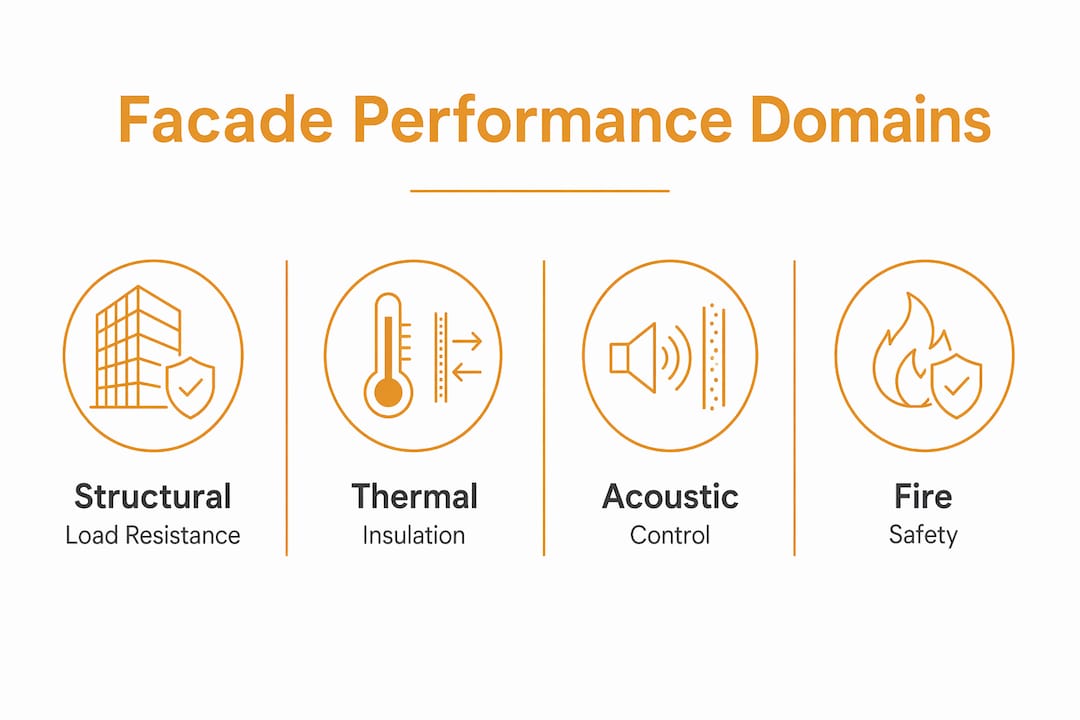
What performance domains does facade engineering address?
Curtain wall facade engineering evaluates five primary performance domains, each of which directly governs material selection, module sizing, and construction detailing:
-
Structural safety. Wind load is the dominant environmental force acting on facades. Design codes such as ASCE 7 define pressure coefficients and gust factors for distinct zones across a building face, including field, edge, corner, and roof regions. Corner and edge zones experience significantly higher suction pressures than field zones, requiring heavier mullion profiles or closer anchor spacing in those areas.
-
Air and water tightness. Uncontrolled air infiltration degrades thermal performance and creates condensation risk within the assembly. Water penetration at joints and interfaces causes long-term material degradation and occupant disruption. Facade engineers specify sealant types, drainage paths, and pressure-equalized chambers to manage both risks.
-
Thermal and acoustic performance. Thermal bridging through aluminum framing members is a primary source of energy loss in glazed facades. Facade engineers specify thermally broken profiles and low-emissivity IGU coatings to reduce heat transfer. Acoustic performance is governed by the mass and isolation characteristics of the glazing and panel assemblies, which must be tuned to the ambient noise environment of the site.
-
Fire performance. At floor edges and within rainscreen cavities, fire stopping must interrupt the path of flame and hot gases between compartments. This requirement directly constrains cavity depth, insulation material selection, and the detailing of spandrel zones.
-
Constructability and tolerance management. Facade modules must be designed with sufficient anchor adjustability to accommodate structural frame tolerances, which in concrete construction can reach plus or minus 25 millimeters in any direction. Ignoring this in early design leads to costly field modifications.
These five domains do not operate independently. A decision to increase glazing area for daylighting simultaneously affects structural load, thermal performance, and acoustic isolation, requiring the facade engineer to rebalance the entire system.
How is facade performance tested and verified?
Facade verification follows a structured evidence chain that moves from component-level laboratory testing through full-scale mock-up evaluation to on-site acceptance testing. This sequence is contractually defined and assigns clear remediation responsibilities at each stage. The process works as follows:
-
Component testing. Individual materials and sub-assemblies, including sealant joints, IGU units, and thermal break profiles, are tested to relevant ASTM or EN standards to confirm their baseline performance characteristics before integration into the full system.
-
Laboratory system testing. A representative facade assembly is tested in a certified laboratory for air infiltration per ASTM E283, water penetration resistance per ASTM E331, and structural wind resistance per ASTM E330. These tests apply prescribed static and cyclic pressures to confirm that the system meets specified acceptance criteria.
-
Full-scale mock-up testing. A full-scale mock-up replicating a typical bay of the facade, including all interfaces, joints, and penetrations, is constructed and subjected to the same test sequence. This step identifies installation-related deficiencies that component testing cannot detect, such as inadequate sealant application at corners or insufficient drainage clearance.
-
Cyclic and dynamic simulation. Some projects require additional testing for inter-story drift, seismic racking, or thermal cycling to simulate the building’s movement over its service life. These tests verify that the facade system accommodates structural movement without losing weather tightness.
-
On-site acceptance testing. After installation, field tests confirm that the constructed facade matches the performance of the tested mock-up. Deviations trigger contractually defined remediation, which may include re-sealing, panel replacement, or anchor adjustment.
Pro Tip: Specify the full test sequence, including mock-up scope and on-site re-testing requirements, in the facade subcontract before tender. Leaving these requirements undefined at tender stage routinely results in cost disputes and schedule delays during construction.
This evidence-based verification approach reduces disputes between clients, contractors, and facade specialists by establishing objective, measurable acceptance criteria at each project milestone.
How do digital tools and BIM improve the facade engineering process?
Modern facade engineering relies on integrated digital platforms to manage the complexity of large-scale facade projects. The shift from 2D drawing sets to parametric 3D models has changed how facades are designed, coordinated, and fabricated.
-
Parametric modeling with CATIA and 3DEXPERIENCE. Platforms like CATIA and ENOVIA automate repetitive design tasks such as mullion layout generation, anchor positioning, and panel scheduling across hundreds of facade modules. This reduces manual drafting errors and accelerates design iteration when performance targets change.
-
Centralized data environments. BIM platforms create a single source of truth for geometry, material specifications, and performance data accessible to architects, facade engineers, fabricators, and installers simultaneously. This eliminates version conflicts between disciplines and reduces the risk of fabricating components to superseded drawings.
-
Clash detection and coordination. Facade models are overlaid with structural, mechanical, and interior fit-out models to identify physical conflicts before construction. Typical conflicts include facade anchors clashing with structural reinforcement or mechanical ductwork penetrating the thermal line of the facade.
-
Client communication and design validation. Rendered 3D models and performance simulations allow clients and design teams to evaluate facade options visually and quantitatively before committing to fabrication. This is particularly valuable for complex geometries where 2D drawings do not adequately communicate the design intent.
Pro Tip: Require the facade contractor to deliver a fabrication-level BIM model as a contract deliverable. This model becomes the basis for on-site installation guidance and post-construction facade inspection records, both of which have long-term asset management value.
What practical factors shape facade design and construction?
Understanding facade systems at the construction level requires attention to material interactions, moisture management, thermal performance, and site installation control. The table below compares key design considerations across two common facade system types.
| Design factor | Unitized curtain wall | Stick-built curtain wall |
|---|---|---|
| Installation speed | Fast; factory-assembled panels crane-lifted into position | Slower; components assembled piece by piece on site |
| Quality control | Higher; factory conditions reduce installation variability | Lower; dependent on site labor skill and conditions |
| Tolerance accommodation | Fixed and slotted anchor systems absorb frame tolerances | Adjusted at each mullion connection during installation |
| Thermal performance | Consistent; thermal breaks integrated in factory | Variable; dependent on site installation quality |
| Suitability | High-rise commercial and mixed-use projects | Low-rise or retrofit projects with irregular geometry |
The rain-screen principle governs moisture management in most modern facade assemblies. Rather than relying on a single outer seal to exclude all water, the rain-screen design creates a pressure-equalized cavity behind the outer cladding layer. Any water that penetrates the outer face drains through the cavity and exits at the base of each floor zone, preventing accumulation against the air barrier.
An envelope-first design approach prioritizes thermal and fire performance decisions at the earliest design stage, before architectural finishes and cladding materials are selected. This prevents the common conflict where a preferred cladding material is incompatible with the fire-stopping strategy or creates an unacceptable thermal bridge through the wall assembly. Engaging facade specialists early in the design process is the single most effective way to avoid late-stage redesign costs.
Thermal bridging through aluminum framing is quantified using linear thermal transmittance values (psi values), which facade engineers calculate using finite element thermal modeling software. These values feed directly into the building’s overall energy model and must meet the thresholds set by the applicable energy code, such as Singapore’s BCA Green Mark requirements or ASHRAE 90.1 in the United States.
Key takeaways
Facade engineering works by integrating structural analysis, environmental performance testing, digital coordination, and construction-level detailing into a single disciplined process that transforms architectural design into a verified, buildable building envelope.
| Point | Details |
|---|---|
| Performance-based design | Structural, thermal, acoustic, and fire criteria govern every material and detail decision in facade engineering. |
| Structured verification | Testing follows an evidence chain from component tests through full-scale mock-ups to on-site acceptance, with defined remediation at each stage. |
| Digital coordination | BIM platforms and parametric tools like CATIA reduce errors, accelerate iteration, and align fabrication with design intent. |
| Early engagement | Involving facade engineers at concept stage prevents costly conflicts between cladding, fire stopping, and thermal performance strategies. |
| System-level thinking | Facade assemblies must be designed as integrated systems; failure in one component, such as a sealant joint or anchor, affects the entire enclosure. |
Why facade engineering deserves a seat at the design table from day one
The most persistent mistake I observe in construction projects is treating facade engineering as a specialist trade to be appointed after the architectural design is substantially complete. By that point, the decisions that most affect facade performance, including floor-to-floor heights, structural grid spacing, slab edge details, and building geometry, are already fixed. The facade engineer then spends the project managing the consequences of those decisions rather than shaping them.
The early envelope-first approach is not a theoretical preference. It is a documented cost-reduction strategy. Projects that engage facade specialists during concept design consistently avoid the late-stage redesigns that occur when a preferred cladding system cannot meet fire-stopping requirements or when the structural frame tolerances exceed what the specified anchor system can accommodate.
I have also seen the consequences of treating facade testing as a formality rather than a genuine verification exercise. When mock-up testing is compressed or the scope is reduced to save time, deficiencies surface during on-site acceptance testing or, worse, after practical completion. Remediation at that stage costs multiples of what early testing would have cost.
The future of facade engineering lies in greater integration between performance simulation, parametric design, and fabrication data. Projects that use a single connected digital environment from design through installation will consistently outperform those that rely on fragmented drawing sets and manual coordination. For developers and architects, the practical implication is clear: select facade engineers who operate within BIM-integrated workflows and require that capability as a contract deliverable, not an optional extra.
— Aman
How Stellar Structures supports your facade engineering projects

Stellar Structures provides facade design services and civil and structural design checks that support the full facade engineering process, from performance specification and system selection through authority submission and construction verification. The firm’s engineers work within BIM-integrated workflows and hold direct experience with BCA, URA, and SCDF compliance requirements governing facade systems in Singapore. For developers and architects seeking to integrate facade engineering expertise from concept stage, Stellar Structures offers structured consultation services that align performance targets, regulatory requirements, and construction budgets before design commitments are made. Contact Stellar Structures to discuss your project’s facade engineering requirements and avoid the late-stage conflicts that drive cost and schedule overruns.
FAQ
What is facade engineering?
Facade engineering is the trans-disciplinary practice of designing and verifying building envelopes to meet structural, thermal, acoustic, fire, and weather-tightness performance requirements. It bridges architectural design and construction by translating intent into technically verified, buildable enclosures.
What tests verify facade performance before installation?
Facade systems are tested for air infiltration per ASTM E283, water penetration per ASTM E331, and structural wind resistance per ASTM E330, followed by full-scale mock-up testing and on-site acceptance testing after installation.
Why does wind load matter so much in facade design?
Wind load is the dominant structural force on building facades, with pressure zones defined by ASCE 7 varying significantly across field, edge, and corner regions of the building face. These pressure differences directly determine mullion sizing, glazing thickness, and anchor capacity requirements.
How does BIM improve facade engineering?
BIM platforms and tools like CATIA enable centralized design coordination across architecture, engineering, fabrication, and installation teams, reducing version conflicts, detecting clashes before construction, and accelerating design iteration when performance targets change.
When should facade engineers be engaged in a project?
Facade engineers should be engaged at concept design stage, before floor-to-floor heights, structural grids, and slab edge details are fixed. An envelope-first engagement strategy prevents late-stage conflicts between cladding systems, fire-stopping requirements, and thermal performance targets.
Recommended
- Façade Engineering in SG: Mastering Wind Loads, Materials
- When to Use Facade Inspection Services – Stellar Structures
- Best Façade Design Services in Singapore – Stellar Structures
- Facade Failure Analysis: Learning from the Past to Build a Safer Future