





When structural and architectural teams operate in separate workflows, the consequences compound quickly: late-stage clashes, redundant drawing revisions, and authority submissions that bounce back for incomplete coordination. The integrated structural architectural design process, formally structured as the Integrated Digital Design Process (IDDP), addresses this by establishing a project-wide coordination layer with defined roles, digital exchange standards, and iterative feedback loops. This guide walks property developers, architects, and construction professionals through the preparation, execution, and verification steps that make the process work in practice.
Key Takeaways
| Point | Details |
|---|---|
| Establish a BIM Execution Plan early | A pre-agreed BEP locks in LOD milestones, roles, and naming conventions before design begins, preventing costly late-stage coordination failures. |
| Assign an IDDPM role | The Integrated Digital Design and Process Manager governs information exchange, interoperability, and phase-based coordination across disciplines. |
| Use LOD 350 for coordination | LOD 350 models include connection details and support elements needed for accurate clash detection and construction documentation. |
| Embed compliance in the model | IFC-based automated structural compliance checks reduce manual transcription errors and produce traceable pass, fail, warn, or blocked statuses. |
| Verify at defined milestones | Coordination sign-off requires milestone-based federated model reviews, not just standalone clash detection runs. |
Prerequisites for the integrated structural architectural design process
Most coordination failures do not originate in the design itself. They originate in the absence of a shared process framework before design begins. Getting these foundations right is what separates projects that close out cleanly from those that spiral into rework.
Stakeholder alignment and shared objectives

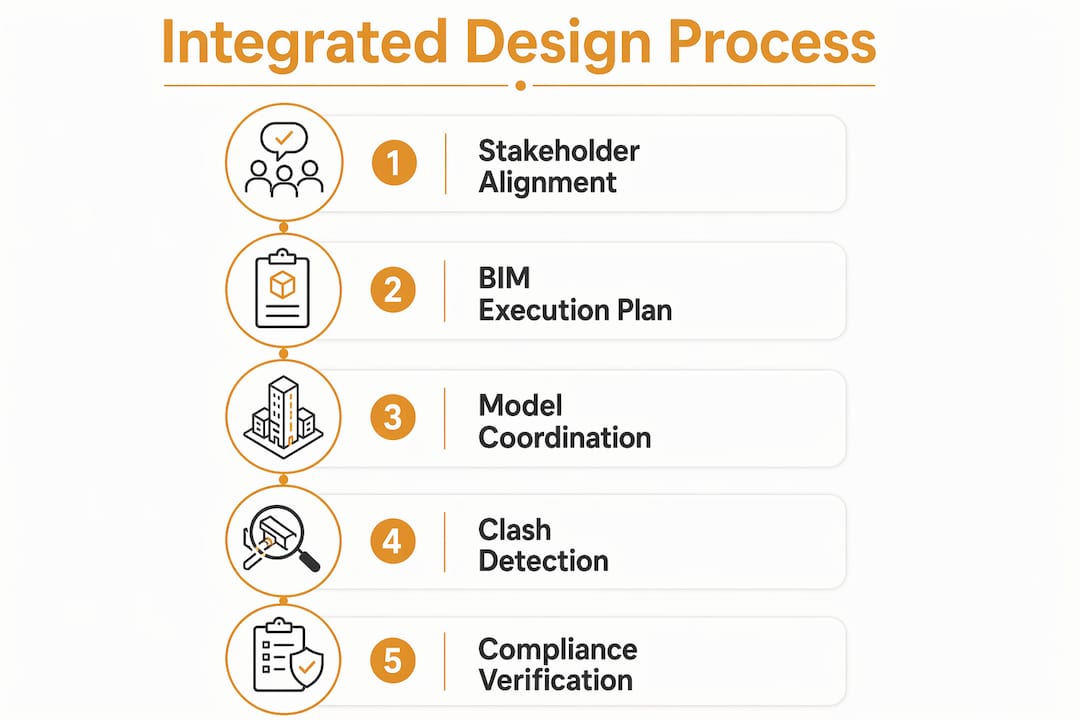
Before any model is opened, the project’s key stakeholders, including the developer, lead architect, structural engineer, and M&E consultants, must agree on project goals, design constraints, and decision-making authority. This is not a formality. Misaligned assumptions about structural systems or spatial priorities surface as expensive conflicts later when they go unaddressed at the outset.
BIM Execution Plan development
A BIM Execution Plan (BEP) is the single most consequential document in the collaborative design process. Without one, projects experience mismatched Levels of Development, inconsistent file naming, and fragmented coordination that leads to rework and expensive clashes. The BEP must specify:
- Roles and responsibilities for each discipline’s model authorship
- LOD and Level of Information Need (LOIN) thresholds at each project milestone
- Shared coordinate systems and file naming conventions
- Software platforms and IFC export settings for interoperability
- Clash detection frequency, ownership, and resolution protocols
- Common Data Environment (CDE) platform selection and access rights
Software compatibility and digital exchange interfaces
Selecting compatible platforms is necessary but not sufficient. The team must also define the formats, frequencies, and ownership of each digital exchange point between disciplines. Early definition of exchange interfaces significantly reduces information fragmentation across software tools and prevents the scenario where structural updates remain invisible to the architectural model for weeks.
The IDDPM role
Assigning an Integrated Digital Design and Process Manager is the organizational step most projects skip. This role supervises digital coordination, manages phase-based information exchanges, and resolves interface conflicts before they become design conflicts.
Pro Tip: Treat the BEP as a live contract. Schedule a review of it at the end of each design phase and update it to reflect any changes in scope, software, or team structure. A BEP written at project kickoff and never revised rarely reflects how the project actually runs.
Executing the integrated workflow step by step
Once prerequisites are in place, the integrated structural and architectural design process follows a phase-based structure with embedded feedback loops rather than a linear handoff sequence. Here is how to execute it effectively.
-
Schematic design coordination: Both structural and architectural teams develop initial concepts within the agreed CDE. Structural engineers provide preliminary system options, including frame, shear wall, or transfer slab configurations, so architects can test spatial layouts against realistic structural constraints rather than idealized assumptions.
-
Coordinated digital modeling at LOD 300: At design development, all disciplines model to LOD 300, which represents geometry with defined dimensions, location, and material properties. LOD 350 distinctions matter here: LOD 350 adds supports, hangers, and connection details that are necessary for accurate clash detection and construction documentation. Jumping straight to coordination without reaching LOD 350 in critical interface zones is a common source of late-stage surprises.
-
Federated model review and clash detection: The IDDPM consolidates discipline models into a federated model and runs clash detection at agreed intervals, not just at the end of design. Clashes are categorized by severity and assigned to responsible parties with resolution deadlines tracked inside the CDE.
-
Automated structural compliance checking: IFC-based compliance workflows reintegrate structural analysis results directly into IFC models, enabling systematic automated design code compliance checks. This eliminates the manual transcription step where analysis outputs are typically copied from analysis software into documentation, a process prone to errors that affect BCA submissions.
-
Interpreting compliance check outputs: Automated checkers produce four result types: pass, fail, warn, and blocked. A BLOCKED status signals that required model properties, such as section dimensions or load combination data, are missing. Blocked results are not compliance failures. They are data maturity flags that require model refinement before the check can execute meaningfully.
-
Data reintegration and CDE update: After each coordination cycle, updated models are published back to the CDE with version control. All clash resolutions and compliance check results are documented as part of the project record, which becomes critical evidence during authority submissions.
Pro Tip: Run clash detection in discipline pairs first, such as structural against architectural, then structural against M&E, before running a full federated model clash. This isolates where conflicts originate and assigns accountability clearly rather than generating a single undifferentiated clash report.
| Workflow Stage | Primary Output | LOD Requirement |
|---|---|---|
| Schematic design | Structural system options, spatial validation | LOD 100 to 200 |
| Design development | Coordinated discipline models, initial clash report | LOD 300 |
| Coordination and documentation | Federated model, clash register, compliance check results | LOD 350 |
| Authority submission | Compliant IFC model, design documentation, compliance records | LOD 350 to 400 |
Common pitfalls in integrated design workflows
Even well-structured projects encounter coordination breakdowns. The following issues account for the majority of integration failures in architectural-structural workflows.
-
Mismatched LOD between disciplines: When the architectural model is at LOD 350 and the structural model remains at LOD 200, clash detection results are unreliable. Coordination sign-off is meaningless at mismatched development levels because it does not represent an accurate spatial picture of the building.
-
Late or absent digital interface definitions: Projects that skip the interface definition step in the BEP phase routinely encounter situations where structural analysis outputs exist in a format that cannot be directly ingested by the architectural or compliance checking workflow. Proper linkage of structural analysis outputs to IFC elements is necessary for reliable automated code compliance checks.
-
BLOCKED results misread as compliance failures: Teams unfamiliar with automated compliance checking often treat blocked statuses as failed checks and escalate them as structural design problems. In reality, missing required properties generate blocked outcomes that call for model authoring corrections, not redesign.
-
BEP enforcement gaps: A BEP that is written but not enforced produces the same coordination failures as no BEP at all. Without the IDDPM actively auditing model submissions against BEP standards, teams revert to siloed work habits and ad hoc problem solving.
-
Communication breakdowns during complex phases: Transfer structures, façade systems, and hybrid construction methods generate the highest coordination complexity. At these points, informal communication channels often replace the documented CDE processes, creating decisions that are untracked and unreproducible for authority review.
“Effective integrated architectural-structural workflows depend on governance as a process rather than just shared models; missing overarching responsibility and documentation structures cause repeated coordination failures.” — IDDP research findings
The solution in each case is the same: restore process governance. This means returning to the BEP, reassigning responsibilities explicitly, and reestablishing CDE discipline before proceeding. Projects that absorb this cost early recover faster than those that attempt to resolve coordination problems through individual judgment calls.
Measuring outcomes and verifying compliance
Verifying that the collaborative design process has delivered what was intended requires structured review at defined milestones, not continuous informal assessment.
Milestone-based LOD and LOIN acceptance
Coordination is not complete simply because a clash detection run returns zero hard clashes. Coordination close-out requires milestone-based LOD and LOIN agreements and federated model review cycles, confirming that the model contains the information needed for the next phase of work. Each milestone gate should require a signed-off federated model, a closed clash register, and documented compliance check results.
Automated compliance check interpretation
| Status | Meaning | Required Action |
|---|---|---|
| Pass | Element meets code requirements | No action needed |
| Fail | Element does not meet code requirements | Redesign or recalculate element |
| Warn | Element is near limit state, review recommended | Engineer to confirm acceptability |
| Blocked | Required model data is missing | Update model properties and rerun check |
Interpreting these outputs correctly requires both digital literacy and structural engineering judgment. Automated tools accelerate review and improve consistency, but they do not replace the engineer’s responsibility for design adequacy.
Preparing for authority submissions
Singapore’s BCA, URA, and other regulatory authorities increasingly expect coordinated digital deliverables. An integrated model that has been validated through milestone reviews and documented compliance checks substantially reduces the risk of submission rejection. The model record, including clash registers and compliance outputs, also supports facility management handover by providing a reliable as-designed data source.
Pro Tip: Do not treat the authority submission model as a separate deliverable from the coordination model. If the models diverge, any changes required during the submission review process must be applied twice, which doubles the rework risk. Keep one federated model as the single source of truth throughout the project.
My perspective on process governance in integrated design
I’ve worked across enough integrated design projects to recognize the pattern that most practitioners eventually learn the hard way: technology is almost never the limiting factor. The projects that struggle with integration are not using the wrong software. They are operating without genuine process ownership.
The IDDPM role is the single intervention with the highest return in an integrated structural-architectural workflow. Most firms treat coordination as a shared responsibility, which functionally means no one owns it. When a clash is found at LOD 350 because the structural transfer beam conflicts with a ceiling plenum that was modeled three months earlier, the question of who should have caught it earlier becomes unanswerable. An IDDPM makes that question answerable from day one.
I’ve also seen teams invest heavily in automated compliance tools and then misread blocked results as failures, triggering unnecessary redesign cycles. Blocked means the model is not ready for the check, not that the structure is wrong. That distinction matters, and it only becomes clear when the team has sufficient BIM literacy to interpret tool outputs correctly.
The cultural shift required here is not about embracing digital tools. It is about treating process documentation with the same rigor applied to structural calculations. A submission delay caused by poor coordination is never purely a technical failure. It is a governance failure. And governance failures are preventable.
— Aman
How Stellar Structures supports your integrated design projects

Stellar Structures provides structural and civil design checks that are designed for projects using coordinated BIM workflows, making automated compliance verification a practical step rather than a project-end scramble. Their team of engineers and architects operates across residential, commercial, industrial, and infrastructural projects in Singapore, applying the same phase-based coordination discipline described in this guide.
For projects where authority submissions are the critical path constraint, Stellar Structures’ authority submission services cover BCA, URA, HDB, JTC, SCDF, PUB, LTA, NEA, and NParks approvals, with coordination built into the submission process from the outset. Their civil engineering consultancy also supports teams managing complex structural-architectural interfaces where independent technical review adds a necessary layer of quality assurance.
FAQ
What is the integrated digital design process in construction?
The Integrated Digital Design Process (IDDP) is a project-wide coordination framework that assigns explicit roles, digital exchange standards, and iterative feedback loops to govern interdisciplinary collaboration between structural, architectural, and other design teams.
Why does a BIM Execution Plan matter for integrated design?
Without a BIM Execution Plan, projects experience mismatched Levels of Development, inconsistent file naming, and fragmented coordination that produces costly late-stage clashes and rework. The BEP establishes shared standards before design begins.
What does a BLOCKED result mean in structural compliance checking?
A BLOCKED result indicates that required model properties, such as section dimensions or load combination data, are missing from the BIM. It signals a data maturity issue in the model authoring workflow, not a structural design failure.
What is LOD 350 and why is it required for coordination?
LOD 350 represents a modeling level that includes supports, hangers, and connection details necessary for accurate clash detection and construction documentation. Standard LOD 300 models lack the geometric specificity needed to confirm true multi-discipline coordination.
How does integrated design reduce authority submission delays in Singapore?
An integrated workflow produces a coordinated, compliance-checked model with documented clash resolution records. This gives BCA, URA, and other authorities a complete digital deliverable that reduces the probability of rejection due to incomplete or inconsistent coordination documentation.
Recommended
- Steel Structure Analysis and Design Using STAAD Pro – Stellar Structures
- What Happens During a Structural Engineer Inspection? Expert Guide
- Types of collaborative engineering services architects provide
- What Is an As-Built Drawing? A Professional Guide