




Public officials who underestimate the role of structural engineer public projects is not uncommon, and the consequences range from budget overruns to catastrophic failures. Structural engineers, formally known as licensed engineers of record, do far more than run load calculations. They are technical authorities responsible for designing safe infrastructure, managing compliance documentation, and shaping the safety attitudes of every party on a project site. This article examines their core responsibilities, their influence on regulatory compliance, and how their coordination decisions affect project delivery outcomes.
Table of Contents
- Key takeaways
- Role of structural engineers in public projects
- Safety culture and risk management on public sites
- Regulatory compliance and special inspections
- Structural design and project delivery models
- My perspective on structural engineering’s underestimated influence
- How Stellar Structures supports public infrastructure
- FAQ
Key takeaways
| Point | Details |
|---|---|
| Engineers of record lead compliance | Structural engineers prepare mandatory inspection documents that govern how public projects meet code requirements. |
| Safety culture is an engineering responsibility | Structural engineers influence worksite safety attitudes, not just the physical design of structures. |
| Special inspections protect public safety | Owner-funded special inspections verify construction quality during high-risk operations and must follow the engineer’s inspection plan. |
| Design coordination affects project costs | Incomplete structural design coordination during procurement can cause significant cost overruns and schedule delays. |
| Early engagement reduces risk | Involving structural engineers from project inception prevents compliance gaps and costly redesign during construction. |
Role of structural engineers in public projects
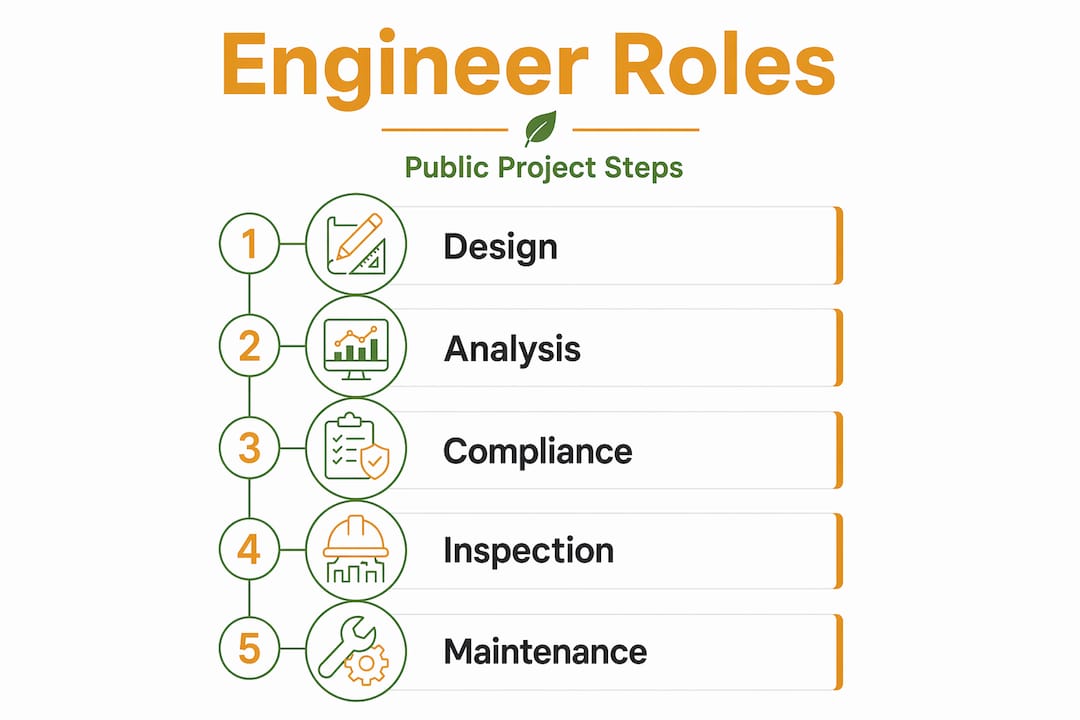
The recognized industry term for the structural engineer’s official position on a project is engineer of record, and this designation carries both legal authority and accountability throughout the project lifecycle. On public infrastructure projects, that accountability extends across three distinct phases: design, construction, and post-construction assessment.
During the design phase, the engineer of record produces structural drawings, specifies materials, and performs structural analysis to verify that the proposed structure can withstand all anticipated loads, including dead loads, live loads, wind, seismic forces, and soil pressure. For public bridges, for instance, lifecycle management responsibilities extend from initial condition assessments through rehabilitation design and final construction documentation.
The construction phase introduces a separate but equally significant set of public project engineering tasks. Key responsibilities include:
- Reviewing contractor submittals and shop drawings to confirm they match design intent
- Issuing responses to requests for information from contractors
- Conducting periodic site visits to verify construction matches approved documents
- Preparing and administering the Statement of Special Inspections
- Coordinating with the authority having jurisdiction (AHJ) to satisfy code requirements
Post-construction, structural engineering roles shift toward periodic inspections, facade inspections, and structural condition assessments that keep public assets safe over their operational life.
Pro Tip: When procuring engineering services for a public project, require the engineer of record to demonstrate prior experience with the specific IBC chapter categories applicable to your project type. Generic structural experience is not a substitute for familiarity with the inspection and compliance mechanisms your project demands.
The Morandi Bridge collapse in Italy remains the most cited example of what happens when structural analysis is inadequate and compliance is treated as a formality. Forty-three people died. Rigorous engineering and code compliance are not bureaucratic exercises. They are the primary line of defense between the public and structural failure.
Safety culture and risk management on public sites
Many public officials assume that once a design is signed and sealed, the structural engineer’s active involvement concludes. This assumption is both common and incorrect. The importance of structural engineers in this context extends well into the construction phase, particularly in shaping the safety culture of the project site.
Safety on construction sites is not purely a contractual matter between the owner and the contractor. Structural engineers occupy a unique position as technical intermediaries who understand both what the drawings require and what the construction sequence demands. That knowledge positions them to identify safety risks that neither the owner nor the contractor may recognize.
Consider how this plays out in practice. A contractor may propose a temporary shoring scheme that meets the minimum load criteria but fails to account for dynamic loads during concrete placement. The structural engineer reviewing that scheme is often the only party with the technical grounding to flag the risk before work begins.
“Safety in construction is not just a matter of calculation but a systems-thinking approach integrating physical and social tolerance mechanisms. Engineers have the expertise to lead in both dimensions.” — ASCE, 2026
Strategies that structural engineers use to embed safety culture into public projects include:
- Participating in pre-construction safety planning meetings alongside the contractor’s superintendent
- Issuing detailed means-and-methods guidelines for high-risk construction operations
- Flagging design assumptions about construction sequence in the construction documents
- Communicating directly with the AHJ when site conditions deviate from approved plans
When engineers treat construction site safety as a leadership function rather than a checkbox, outcomes improve measurably. Projects that integrate engineer-led safety planning consistently report fewer change orders related to structural corrections and fewer incidents during high-risk operations such as formwork loading, pile installation, and steel erection.
Regulatory compliance and special inspections
Few mechanisms in public construction are more misunderstood than the special inspection process, and that misunderstanding often creates compliance gaps that expose public agencies to legal liability. Understanding how structural engineers manage this process is central to grasping how structural engineering roles translate into legally defensible project delivery.
Under IBC Section 1705, the engineer of record is required to prepare a Statement of Special Inspections (SSI) before construction begins. The SSI functions as a construction inspection roadmap, identifying every inspection category required for the project, whether each inspection is continuous or periodic, and the qualifications required of the inspectors who will perform them.
The table below clarifies the distinction between special inspections and standard municipal building inspections.
| Feature | Special inspections | Municipal building inspections |
|---|---|---|
| Who performs them | Qualified special inspectors engaged by the owner | Building department inspectors employed by the AHJ |
| Who pays | The building owner, not the jurisdiction | Covered under permit fees paid to the jurisdiction |
| What they cover | Specific high-risk materials and processes per the SSI | General code compliance at defined construction milestones |
| Oversight authority | Approved by the AHJ; inspectors certified per IBC Table 1705 | AHJ directly |
| Legal mechanism | Mandatory under IBC Chapter 17 for regulated project types | Mandatory under local building codes for all permitted work |
Special inspection costs are borne by the building owner and can represent a meaningful portion of the project budget when multiple IBC Chapter 17 categories apply. For public infrastructure, where concrete, masonry, steel, and soil work may all be involved simultaneously, these costs are a non-negotiable investment in life safety verification.
Special inspectors must hold certifications specific to each inspection category as defined in IBC Table 1705. The engineer of record selects the special inspection agency, but final approval rests with the AHJ, creating a two-layer accountability structure.
Pro Tip: Public project managers should request that the engineer of record present the draft SSI at the project kickoff meeting. Reviewing it early allows all parties to budget for inspection costs, assign inspection agency responsibilities, and identify any inspection categories that require long-lead procurement of certified inspectors.
Early submission of the SSI also serves as a regulatory safety net, providing transparency and accountability that protects the public agency from compliance disputes during or after construction.
Structural design and project delivery models
The relationship between structural design decisions and public project procurement is poorly understood outside the engineering profession, and that knowledge gap has produced costly surprises on high-profile public infrastructure programs.

Public agencies increasingly use design-build and progressive design-build delivery models, in which a contractor is selected before the structural design is complete. This arrangement creates a complex interdependency: procurement risks intensify when the cost estimate is based on an incomplete structural design package, because gaps in the design translate directly into gaps in the contractor’s pricing assumptions.
The Baltimore Key Bridge rebuild offers a current example of this risk. Maryland’s decision to replace its primary contractor, Kiewit, was driven in part by cost validation failures tied to the progressive design-build process. The table below summarizes the delivery model attributes and their structural design implications.
| Delivery model | Design completion at contractor selection | Structural engineer coordination burden | Cost certainty risk |
|---|---|---|---|
| Design-bid-build | 100% complete | Low | Low |
| Design-build | 30 to 60% complete | High | Moderate |
| Progressive design-build | 10 to 30% complete | Very high | High |
In the Key Bridge case, schedule delays past 2030 illustrate the downstream consequences of structural design coordination failures on public procurement. Even a well-qualified contractor cannot reliably price work that the engineer of record has not fully resolved.
For public officials, the lesson is direct. The how structural engineers contribute to a project cannot be separated from when they contribute. Compressing engineering scope to accelerate procurement creates a false efficiency. The costs surface later, magnified by contractor claims, scope changes, and delayed project certification.
My perspective on structural engineering’s underestimated influence
In my experience working across public and private infrastructure projects, the most consistent gap I observe is not technical. It is relational. Public officials and procurement officers consistently engage structural engineers too late in the project lifecycle, treating them as service providers to be contracted after the project’s scope and budget have already been locked.
What I have found is that engineers brought into the project at the concept stage make materially different decisions than those who inherit a fixed design brief. They ask questions about constructability, material availability, and inspection feasibility that change the cost profile of a project before a single dollar is committed. When that input is deferred, those questions get answered by change orders.
The other pattern I have observed is the tendency to measure structural engineering value solely by deliverable count: drawings issued, calculations submitted, inspections conducted. What this misses is the leadership dimension that ASCE describes when it notes that physical and social tolerance mechanisms must both be navigated by engineers. A structural engineer who can walk a job site, identify a deviating practice, and redirect a contractor’s superintendent without escalating to a formal dispute is delivering value that never appears in a fee proposal.
My advice to any public official overseeing infrastructure procurement: define the structural engineer of record’s role in your project charter, not just your contract. Clarify their authority to pause work when structural concerns are unresolved, and require their participation in cost validation reviews before contractor selection.
— Aman
How Stellar Structures supports public infrastructure
Public officials seeking a trusted engineering partner for complex compliance and delivery challenges will find Stellar Structures’ depth of experience directly relevant. Stellar Structures provides civil and structural design checks that verify code conformance before and during construction, reducing the risk of compliance disputes at project closeout. The firm’s authority submission capabilities cover the full spectrum of regulatory approvals required across Singapore’s public project framework.

Their team manages authority submission processes for public and private projects, including submissions to BCA, URA, LTA, and other agencies. Whether you are overseeing a new public facility or managing periodic compliance for existing infrastructure, Stellar Structures brings the technical depth and regulatory familiarity that public project delivery demands. Contact them to discuss how their structural engineering expertise can be integrated into your project from the earliest planning stage.
FAQ
What is the role of a structural engineer in a public project?
The structural engineer of record designs safe structures, performs analysis, prepares the Statement of Special Inspections, and coordinates compliance with the AHJ throughout design and construction. Their responsibilities extend from initial design through post-construction condition assessments.
How do special inspections differ from regular building inspections?
Special inspections are performed by owner-engaged, AHJ-approved inspectors who focus on specific high-risk materials and construction processes per the SSI. Municipal building inspections are conducted by jurisdiction staff at standard construction milestones and are covered under permit fees.
Why does structural design affect project delivery timelines?
Incomplete structural design at the time of contractor selection, common in design-build and progressive design-build delivery, introduces cost and schedule uncertainty. The Baltimore Key Bridge rebuild illustrates how unresolved structural scope can lead to contractor replacement and delays extending beyond projected completion dates.
When should a structural engineer be engaged in a public project?
Structural engineers should be engaged at the concept phase, not after scope and budget are fixed. Early engagement allows engineers to resolve constructability, material, and inspection questions before they become change orders.
What qualifications should a public agency require from a special inspection agency?
The agency must employ inspectors certified per IBC Table 1705 for each applicable inspection category, and the selected agency must receive written approval from the AHJ before inspections begin.
Recommended
- Civil and Structural Design Checks for Building Engineering – Stellar Structures
- What Is Structural Engineering: A Beginner’s Guide – Stellar Structures
- Structural vs Geotechnical Engineering – Stellar Structures
- Key Principles Of Civil Engineering In Urban Singapore – Stellar Structures