





A building contract is defined as a legally binding agreement between a property owner and a contractor that specifies the scope of work, price, completion timeline, and rights of both parties for construction or renovation projects. In Singapore, understanding building contracts is not optional for homeowners. Whether you are renovating an HDB flat, upgrading a condominium unit, or commissioning a landed property rebuild, the contract governs every aspect of the project. Standard forms like the SIA Conditions of Building Contract and the REDAS Design and Build Conditions are widely used, while residential renovations often rely on bespoke agreements tailored to the specific project. Getting the contract right before work begins is the single most effective way to protect your investment.
What is a building contract and what must it include?
A legally enforceable building contract must contain at minimum the price, scope of work, and completion timeline. Singapore courts will not uphold a contract that is ambiguous or missing these core terms. The absence of any one of these elements can render the agreement unenforceable, leaving both parties without legal recourse.
The following elements are required in any residential building contract in Singapore:
- Scope of work: A room-by-room breakdown specifying materials by brand or grade, not just total costs. Vague descriptions like “paint walls” or “install flooring” create disputes. Detailed material specifications by brand or grade are the standard for enforceable agreements.
- Price and payment schedule: The total contract sum and a payment schedule tied to verifiable project milestones, not calendar dates.
- Completion timeline: A defined start date, end date, and provisions for extensions due to unforeseen circumstances such as supply delays or authority approval delays.
- Defects Liability Period (DLP): A minimum 12-month DLP is standard. The DLP start date in Singapore has been adjusted to the 35th day after the Temporary Occupation Permit notice or vacant possession, whichever comes first, providing stronger homeowner protection in 2026.
- Dispute resolution clause: Specify whether disputes go to mediation, arbitration, or litigation. Mediation through the Singapore Mediation Centre is a common first step.
- Retention sum: A percentage of the contract sum held back until the DLP ends, protecting the owner against defects.
Singapore courts apply the contra proferentem rule, meaning ambiguous contract terms are interpreted against the party who drafted them. If your contractor wrote the contract, any unclear clause will be read in your favor. If you signed a contractor-drafted agreement without reviewing it, that protection may not be enough.
Pro Tip: Request a full itemized scope of work before signing. If a contractor cannot provide room-by-room material specifications, treat that as a red flag before any money changes hands.
What are the common building contract types in Singapore?
Building contract types in Singapore range from standardized industry forms to fully bespoke agreements. The right choice depends on project size, complexity, and the level of design involvement required.

Standard contract forms
The three most commonly referenced forms in Singapore are:
- SIA Conditions of Building Contract: Published by the Singapore Institute of Architects, this form is used primarily for private residential and commercial projects where an architect administers the contract. It is detailed and well-tested in Singapore courts.
- REDAS Design and Build Conditions: Used for design-and-build projects where the contractor takes on both design and construction responsibilities. Common in private residential developments.
- PSSCOC (Public Sector Standard Conditions of Contract): Mandatory for public sector projects in Singapore. Not typically used for private residential renovations.
For a deeper comparison of how these forms apply to developer-led projects, the design and build contracts guide from Stellar Structures covers the key distinctions in detail.
Comparison of common building contract types
| Contract Type | Best For | Design Responsibility | Risk Allocation |
|---|---|---|---|
| SIA Conditions | Private residential, architect-led | Owner/Architect | Balanced between owner and contractor |
| REDAS Design and Build | Private residential, developer-led | Contractor | Higher contractor responsibility |
| PSSCOC | Public sector projects | Owner/Consultant | Government-standard allocation |
| Bespoke Agreement | Small renovations, HDB works | Owner/Contractor | Varies; often less protective |
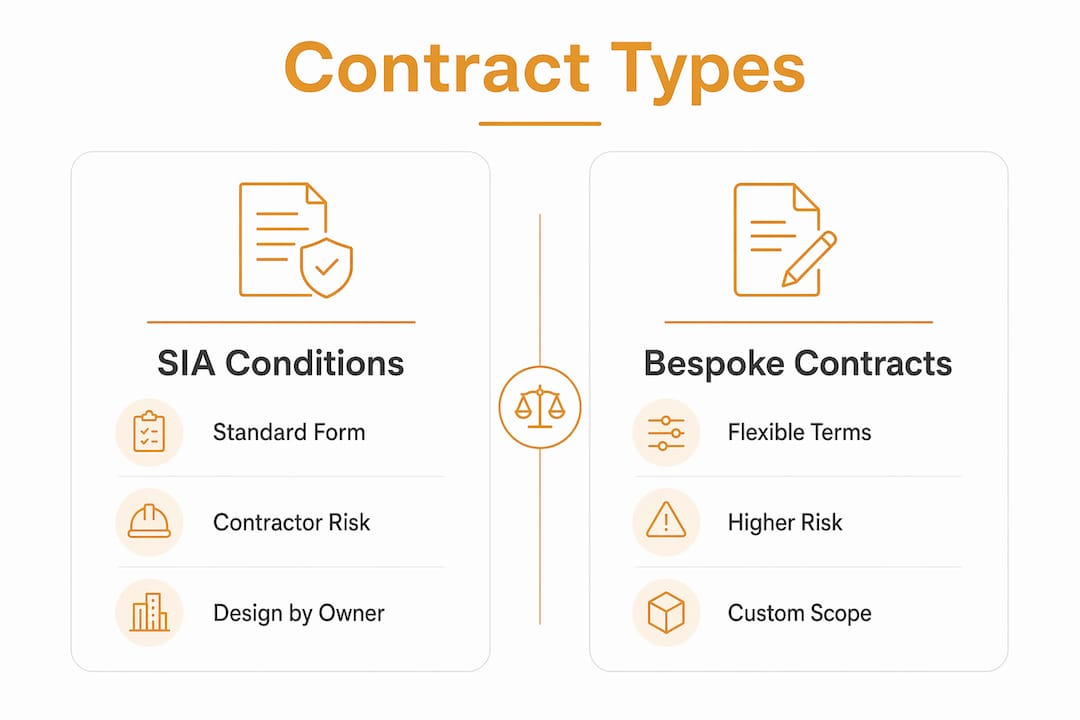
Bespoke contracts are common for HDB renovations and smaller condo works. They are flexible but carry higher risk because they lack the tested provisions of standard forms. For HDB projects, the contractor must be listed in the HDB Directory of Renovation Contractors regardless of which contract form is used.
Pro Tip: For any renovation exceeding S$30,000, consider using the SIA Minor Works Contract rather than a bespoke agreement. It provides structured dispute resolution and DLP provisions without the complexity of the full SIA Conditions.
How do regulatory approvals affect your building contract?
Regulatory compliance is not separate from your building contract. It is embedded in it. Homeowners are legally responsible for ensuring all approvals are obtained before work begins, even when contractors handle the application submissions.
The key regulatory bodies and their roles are:
- HDB: For HDB flat renovations, the contractor must be registered in the HDB Directory of Renovation Contractors. Certain works such as hacking of walls, installation of grilles, and toilet modifications require prior HDB approval.
- MCST (Management Corporation Strata Title): For condominium renovations, MCST approval is required for structural modifications, wet area changes, and works affecting common property.
- BCA (Building and Construction Authority): BCA approval is mandatory for major structural, electrical, or plumbing alterations under the Building Control Act. Fines for non-compliance reach up to S$50,000 under the Building Control Act, and HDB violations carry fines up to S$5,000.
Work that starts before the required approvals are in place can trigger stop-work orders. A signed contract does not protect either party from a stop-work order. The contract must include a clause requiring the contractor to obtain all necessary permits before commencing each phase of work.
For projects involving structural changes, understanding the building plan submission requirements in Singapore is a prerequisite to drafting an enforceable contract. If your renovation involves unauthorized works from a previous owner, the regularization process must be addressed before new works begin.
Pro Tip: Before signing any contract, verify your contractor’s license status directly on the HDB or BCA website. Licensing status can change, and a contractor who was registered six months ago may no longer be compliant today.
What should homeowners know about payment terms and dispute resolution?
Payment structure is where most residential building contract disputes originate. The contract’s payment terms determine how much leverage you retain throughout the project.
- Link every payment to a verifiable milestone. Paying on calendar dates removes your ability to withhold payment if work is incomplete or defective. Milestone-based payments align cash flow with actual construction progress.
- Limit upfront payments to 10–20% of the contract sum. Large upfront payments beyond this range increase your financial exposure if the contractor defaults or abandons the project.
- Include a retention sum of 5–10%. The retention sum is held back until the end of the Defects Liability Period. It gives the contractor a financial incentive to return and rectify defects promptly.
- Understand SOPA before you sign. The Building and Construction Industry Security of Payment Act (SOPA) governs payment disputes in Singapore construction projects. It provides a fast adjudication process for resolving payment claims, typically within 35 business days. Both homeowners and contractors are subject to its provisions.
- Include a dispute resolution ladder. The contract should specify mediation first, then arbitration, and litigation as a last resort. This sequence reduces legal costs and preserves the working relationship during the project.
Red flags in payment terms include requests for more than 30% upfront, payment schedules tied to weeks rather than milestones, and contracts that do not mention a retention sum. Any of these patterns increases your financial risk significantly.
For projects involving structural elements, engaging a qualified structural engineer for renovation early in the process helps define the scope accurately, which directly strengthens the payment milestone structure.
Key takeaways
A building contract in Singapore is only as strong as the specificity of its terms. Vague scope, calendar-based payments, and missing DLP clauses are the three most common sources of costly disputes for property owners.
| Point | Details |
|---|---|
| Core contract elements | Every contract must include scope, price, timeline, DLP, and dispute resolution to be enforceable. |
| Contract type selection | Use SIA Conditions or REDAS forms for larger projects; bespoke agreements carry higher risk for owners. |
| Regulatory compliance | Homeowners bear legal responsibility for obtaining HDB, MCST, and BCA approvals before work starts. |
| Payment structure | Cap upfront payments at 10–20% and retain 5–10% until the DLP ends to protect your interests. |
| SOPA protection | The Security of Payment Act provides a fast adjudication process for payment disputes in Singapore. |
Why most homeowners sign contracts they do not fully understand
I have reviewed dozens of residential building contracts in Singapore, and the pattern is consistent. Homeowners focus on the total price and the completion date. They skim the DLP clause, ignore the dispute resolution section, and sign without questioning the payment schedule. That sequence creates the conditions for nearly every dispute I have seen.
The most common misconception is that the contractor is responsible for all compliance. Legal responsibility for approvals sits with the property owner, not the contractor. A contractor who proceeds without MCST approval is violating the rules, but the owner faces the fine and the stop-work order. That asymmetry is not widely understood, and it is not in most contractors’ interest to explain it clearly before signing.
The second issue is scope vagueness. A contract that says “renovate master bathroom” without specifying tile brand, grout color, fixture grade, and waterproofing method is not a scope of work. It is a blank check. When the contractor installs budget tiles and you expected mid-range, the contract does not protect you because you never specified.
My practical advice is this: treat the contract drafting phase as the most important part of the project. Spend more time on the scope document than on the mood board. Verify every contractor license before signing, not after. And if the contract does not include a retention sum, add one before you agree to anything.
— Aman
How Stellar Structures supports your building project in Singapore
Stellar Structures is a Singapore-based design and engineering firm with direct experience across residential, commercial, and industrial projects. The firm manages authority submissions to BCA, HDB, URA, MCST, and other regulatory bodies, supporting property owners through every compliance requirement before and during construction.
For property owners planning renovations or new construction, Stellar Structures provides structural assessments, design checks, and guidance on contract scope to reduce compliance risk. Their integrated design and engineering services cover the full project lifecycle, from initial design through authority approval and construction oversight. Working with a firm that understands both the technical and regulatory dimensions of Singapore construction projects means your contract terms are grounded in what is actually achievable and compliant.
FAQ
What is the definition of a building contract in Singapore?
A building contract is a legally binding agreement between a property owner and a contractor that defines the scope of work, price, timeline, and rights of both parties. Standard forms include the SIA Conditions of Building Contract and the REDAS Design and Build Conditions.
What are the main types of building contracts used in Singapore?
The main types are the SIA Conditions, REDAS Design and Build Conditions, PSSCOC for public sector projects, and bespoke agreements for smaller residential renovations. The choice depends on project size, design responsibility, and whether an architect is administering the contract.
Who is responsible for obtaining renovation approvals in Singapore?
The property owner is legally responsible for ensuring all approvals from HDB, MCST, and BCA are obtained before work begins. Contractors typically submit applications, but the legal obligation and liability for non-compliance rest with the owner.
What is the Defects Liability Period in a building contract?
The Defects Liability Period is a contractual clause requiring the contractor to rectify defects identified after project completion. The standard period is 12 months, and in Singapore the DLP now starts from the 35th day after the Temporary Occupation Permit notice or vacant possession, whichever is earlier.
How does SOPA protect homeowners in Singapore building contracts?
The Building and Construction Industry Security of Payment Act provides a fast adjudication process for resolving payment disputes, typically within 35 business days. It applies to both contractors and homeowners, regulating progress payment claims and written response obligations throughout the project.
Recommended
- Design and build contracts: Singapore developer guide
- Singapore A&A Works (2025): Essential Guide to Hiring a BCA-Certified Builder
- Mezzanine Floor Approval Guide Singapore 2026
- Section 28 Building Control Act: Your Legal Obligations Summary