





A structural checker is a qualified, independent professional who reviews and verifies building designs to catch errors before construction begins, protecting your investment, your timeline, and the safety of every person who will occupy the structure. For property owners and developers in Singapore, the decision to engage a structural checker is not optional on regulated projects. It is the single most effective step you can take to prevent costly rework, secure regulatory approvals from authorities such as BCA and URA, and maintain long-term building integrity. This article explains why engage a structural checker matters, what the role involves, and how to get the most from the engagement.
Why engage a structural checker before construction starts
A structural checker, formally known in Singapore as an Accredited Checker (AC), performs an independent review of structural calculations and drawings produced by the project’s design engineer. The checker does not design the structure. The checker verifies that the design is sound, code-compliant, and free of calculation errors that the original engineer may have overlooked.
The distinction matters because design engineers and checkers serve different functions in the project lifecycle. A design engineer produces the structural solution. The checker audits it with fresh eyes and no prior attachment to the design decisions. This independence is what makes the process reliable.

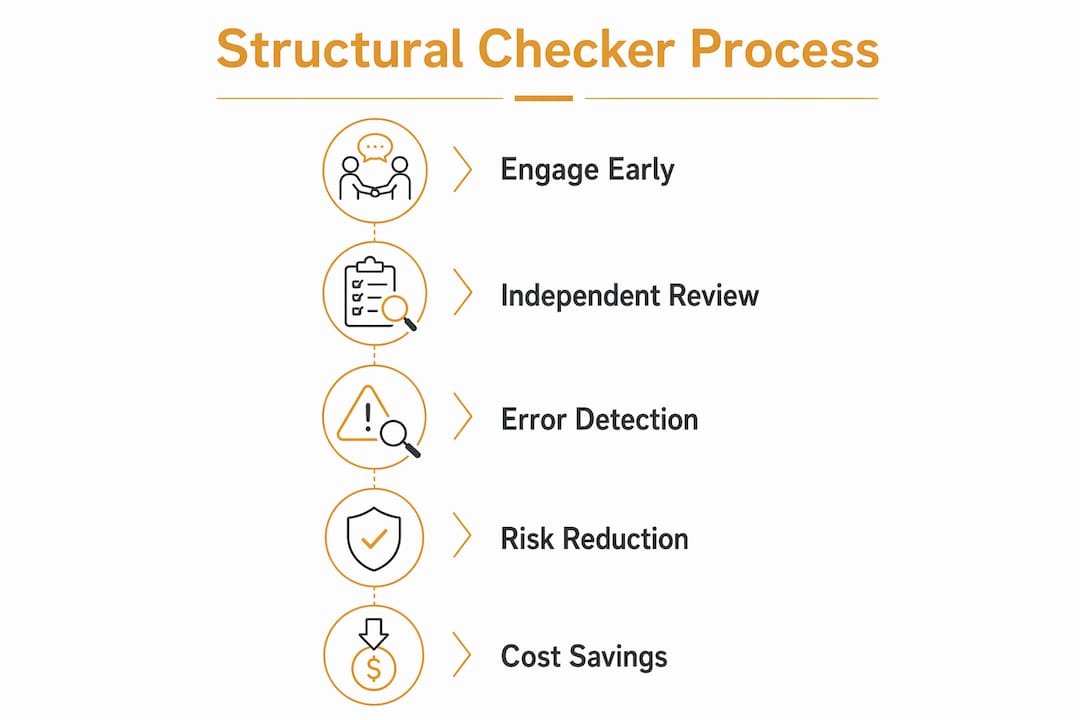
Structural peer reviews improve safety, prevent costly rework, and build trust with regulatory authorities. That outcome is not incidental. It is the core purpose of the role. When a checker identifies a miscalculated beam connection or an under-specified foundation before the contractor pours concrete, the correction costs hours of drafting time rather than weeks of demolition and reconstruction.
Modern checkers also use structural design software that automates code compliance checks, reducing human error and accelerating reviews. Software libraries embedding standards such as Eurocode and AISC allow checkers to run load combinations and code clause verifications within a single workflow. This means the review is both faster and more thorough than a purely manual process.
How structural checkers reduce construction risks and long-term costs
The financial case for engaging a structural checker is direct. Proactive audits prevent structural fatigue and costly major reconstruction, which can reach several times the initial engineering cost. Catching a design error at the drawing stage costs a fraction of what it costs to fix the same error after the structure is built.
Consider the types of errors that checkers routinely identify:
- Under-designed connections: Beam-to-column connections specified with insufficient bolt capacity or weld size
- Incorrect load path assumptions: Loads routed through elements not designed to carry them
- Missing load combinations: Wind and seismic loads not combined with dead and live loads as required by code
- Foundation sizing errors: Pile capacities or footing dimensions that do not match the actual soil bearing data
- Inadequate reinforcement detailing: Rebar lap lengths, cover depths, or anchorage zones specified below code minimums
Each of these errors, if undetected, creates a defect that either triggers a structural failure or requires expensive remediation during or after construction. Contractors who underbid often do so because design ambiguities inflate their risk pricing. A verified, checked set of drawings reduces that ambiguity and can lower tender prices.
A less obvious benefit is the prevention of structural fatigue over the building’s service life. A structure built to a slightly under-designed specification may perform adequately for years before cumulative loading degrades connections or causes cracking. Audit reports provide prioritized repair lists that allow owners to plan maintenance budgets before problems become emergencies.
Pro Tip: Request that the structural checker’s scope explicitly covers secondary connections, not just primary members. Most structural failures occur in secondary connections rather than main structural members, and these are the areas most likely to be omitted from an ambiguously scoped engagement.
Value engineering is another direct financial benefit. Experienced checkers identify cost savings by proposing alternative foundations or simpler structural systems during the review process. This is not a compromise on safety. It is the application of technical expertise to eliminate over-engineering and unnecessary material costs.
What independent verification delivers beyond safety
Safety is the primary driver for engaging a structural checker, but the commercial benefits extend well beyond it.
-
Regulatory approval support. In Singapore, BCA requires an Accredited Checker to certify structural plans before a building permit is issued. A thorough, well-documented checking report accelerates the approval process and reduces the likelihood of queries or resubmissions from the authority.
-
Insurance premium advantages. Buildings undergoing regular structural health assessments show better resilience and higher market valuation. Insurers recognize documented structural integrity as a risk reduction factor, which can translate into more favorable premium terms for property owners.
-
Market valuation and transactional confidence. A property with a complete set of structural audit records is easier to value, finance, and sell. Buyers and financiers treat verified structural documentation as evidence of responsible asset management.
-
Early warning capability. Structural audits replace risky assumptions with verified data, managing long-term integrity reliably. For existing buildings, periodic structural inspections detect cracks, corrosion, and settlement before they escalate into failures requiring emergency intervention.
“A structural safety audit is not a one-time compliance exercise. It is a systematic process that converts unknown structural risk into quantified, manageable maintenance obligations.”
The documentation produced by a structural checker also serves as a legal record. If a dispute arises between a developer and a contractor over structural defects, a signed and dated checking report establishes what was verified, when, and by whom. That record has direct evidentiary value.
Structural checkers vs. structural engineers: what is the difference?
Property owners frequently conflate the roles of structural engineer and structural checker. The two are distinct, and both are necessary on most regulated projects in Singapore.
| Attribute | Structural engineer | Structural checker (AC) |
|---|---|---|
| Primary function | Design and calculate the structure | Independently verify the design |
| Regulatory role | Qualified Person (QP) responsible for design | Accredited Checker (AC) certifying compliance |
| Project involvement | From concept through construction | At design completion and key submission stages |
| Independence | Employed by or engaged by the developer | Must be independent of the design team |
| Output | Structural drawings and calculations | Checking certificate and review report |
The structural engineer and the checker must not be the same individual or from the same firm on BCA-regulated projects. This separation is deliberate. It creates a second set of qualified eyes with no incentive to defend the original design decisions.
Engaging both professionals early in the project lifecycle produces the best outcome. When the checker is brought in at the detailed design stage rather than at the point of submission, there is still time to incorporate the checker’s observations into the design without delaying the program. Late engagement compresses the review timeline and increases the risk that comments cannot be fully resolved before the submission deadline.
The structural design check stages followed by experienced firms show that checkers contribute most effectively when they review designs progressively, not just at the final submission package.
When and how to engage a structural checker effectively
Timing and scope definition are the two variables that most directly determine whether a structural checker engagement delivers full value.
On timing: Engage the structural checker alongside the design engineer, not after the design is complete. Early involvement allows the checker to flag systemic issues in the design approach before they are embedded across dozens of drawings. Late engagement means comments arrive when the design team has limited flexibility to respond without rework.
On scope: Defining scope early is the biggest factor enabling cost-effective structural checks. The scope document should specify:
- Whether the check covers superstructure only or includes foundations and geotechnical elements
- Whether M&E coordination interfaces are within scope
- Which code editions apply (for example, SS EN 1992 for concrete or SS EN 1993 for steel in Singapore)
- The number of review cycles included in the fee
- The format and distribution of the checking report
Ambiguity in any of these areas creates disputes over what was checked and what was not. A well-drafted scope protects both the property owner and the checker.
Pro Tip: Ask the checker to confirm in writing which elements are excluded from scope. Exclusions are as important as inclusions. An accredited checker engagement that does not specify exclusions leaves the owner uncertain about coverage.
Proactive communication between the checker, the design engineer, and the architect reduces the number of review cycles. When all three parties share a common understanding of the design intent, the checker’s queries are resolved faster and with less friction. Treat the checker as a collaborator in the quality process, not as an external auditor working in isolation.
Key takeaways
Engaging a structural checker is the most direct way to protect a building project from design errors, regulatory delays, and long-term structural risk.
| Point | Details |
|---|---|
| Independent verification catches errors early | Checkers identify design and calculation errors before construction, when corrections are inexpensive. |
| Scope definition drives value | Clearly specifying what is checked, including secondary connections, prevents gaps that create risk. |
| Commercial benefits extend beyond safety | Verified structural records support insurance terms, regulatory approvals, and property market value. |
| Checkers and engineers serve distinct roles | Structural engineers design; accredited checkers independently verify. Both are required on regulated projects. |
| Early engagement reduces rework | Involving the checker during detailed design, not at submission, preserves time to act on findings. |
The real cost of skipping the check
Having reviewed structural checking engagements across residential, commercial, and industrial projects in Singapore, the pattern is consistent. The projects that encounter the most expensive problems are not the ones with the most complex designs. They are the ones where the checking scope was vague, the checker was engaged too late, or the review was treated as a formality rather than a technical process.
Secondary connections are where I see the most overlooked issues. A primary beam may be correctly sized, but the connection plate, the weld, or the anchor bolt group is under-specified. These details are easy to miss in a fast-moving design program, and they are exactly what a focused checker should be looking for.
The value engineering dimension is also underutilized. Developers who engage checkers only for compliance purposes miss the opportunity to have an experienced engineer review the design for material efficiency. On a mid-sized commercial project, that review can identify savings that more than cover the checker’s fee.
My recommendation is straightforward. Treat the structural checker as a core member of the project team from the detailed design stage onward. Define the scope precisely, include secondary connections explicitly, and build in enough program time for at least two review cycles. The cost of doing this correctly is small relative to the cost of a single undetected error reaching the construction phase.
— Aman
How Stellar Structures supports your structural check requirements

Stellar Structures provides civil and structural design checks for residential, commercial, industrial, and infrastructural projects across Singapore. The firm’s checking services cover superstructure, foundation, and geotechnical elements, with direct coordination between the checking team and the architectural and engineering design teams to keep projects on program. Stellar Structures’ engineers are experienced in BCA, URA, HDB, JTC, and SCDF submission requirements, so the checking process is aligned with regulatory expectations from the outset. If you are planning a new development or a major addition and alteration project, contact Stellar Structures to discuss the scope and timing of your structural check engagement.
FAQ
What is a structural checker and what do they do?
A structural checker, formally an Accredited Checker (AC) in Singapore, independently reviews structural calculations and drawings to verify code compliance and design accuracy. The checker does not design the structure but certifies that the design engineer’s work meets regulatory and safety standards.
When should a structural checker be engaged on a project?
The structural checker should be engaged during the detailed design stage, alongside the structural engineer, not at the point of BCA submission. Early engagement allows findings to be incorporated into the design without delaying the project program.
How does a structural checker differ from a structural engineer?
A structural engineer designs and calculates the structure as the Qualified Person responsible for the design. A structural checker independently audits that design and must be from a separate firm to maintain independence, as required by BCA regulations.
What should be included in a structural checker’s scope?
The scope should specify whether the check covers superstructure, foundations, and geotechnical elements, which code editions apply, the number of review cycles, and which elements are explicitly excluded. Clear scope definition is the single biggest factor in ensuring a cost-effective and thorough check.
Can a structural check reduce project costs?
Yes. Checkers identify design errors before construction, preventing expensive rework, and can propose value engineering alternatives that reduce material costs without compromising structural performance.
Recommended
- Why Engage a Structural Engineer for Your Landed Home
- Structural Design Check Stages for Construction Professionals
- What Happens During a Structural Engineer Inspection? Expert Guide
- Hiring a Structural Engineer for Renovation in Singapore