





M&E coordination is defined as the process of aligning mechanical and electrical engineering designs with architectural and structural drawings to eliminate physical conflicts before construction begins. In Singapore, coordinating M&E architectural drawings requires integrating multidisciplinary Building Information Modeling (BIM) workflows across architects, M&E engineers, civil and structural consultants, and fire safety specialists. Without this coordination, clashes between ductwork, piping, cable trays, and structural beams go undetected until workers are already on site. That is when fixing errors becomes genuinely expensive. This guide gives property owners and developers a structured, practical path through the entire coordination process.
What does coordinating M&E architectural drawings in Singapore involve?
M&E coordination with architectural drawings is the technical discipline of merging discipline-specific BIM models into a single federated model and resolving all conflicts before issuing drawings for construction. The industry term for this process is multidisciplinary BIM coordination, though many developers and contractors refer to it informally as M&E drawing coordination. Both terms describe the same workflow.
A typical Singapore project involves 3 to 5 engineering consultants, including M&E, civil and structural (C&S), Fire Safety and Shelter Department (FSSD), and sometimes geotechnical and specialist trade consultants. Each consultant produces a separate BIM model. The federated model combines all of them into one shared digital environment. Conflicts visible in that combined model are resolved before any physical work starts.

The construction industry in Singapore is rapidly shifting from 2D drafting to federated digital BIM models for integrated design workflows. This shift is not optional for most commercial and institutional projects. The Building and Construction Authority (BCA) mandates BIM submissions for projects above a defined gross floor area threshold, making structured coordination a regulatory requirement, not just a best practice.
What prerequisites and tools are needed before coordination begins?
Effective M&E design integration in Singapore depends on having the right inputs assembled before the first coordination session. Missing any of these inputs delays the entire process.
Required inputs:
- Architectural drawings and a fully developed architectural BIM model
- Initial M&E designs covering mechanical, electrical, plumbing, and fire protection systems
- Civil and structural BIM model including beams, columns, slabs, and openings
- A common coordinate system agreed upon by all consultants
- Employer’s Information Requirements (EIR) document specifying BIM deliverable standards
Key software and file formats:
| Tool | Purpose | Format |
|---|---|---|
| Autodesk Revit | Discipline-specific BIM modeling | .rvt |
| Autodesk Navisworks | Clash detection and federated model review | .nwc / .nwd |
| IFC (ISO 16739) | Open format for cross-platform model exchange | .ifc |
| Common Data Environment (CDE) | Centralized file sharing and version control | Platform-based |
MEP BIM models contain rich data including system properties, specifications, and performance parameters that go far beyond geometrical layouts. This data enables virtual testing and performance simulation that traditional 2D drawings cannot provide. That capability makes BIM models significantly more useful than flat drawings for coordination decisions.
Roles involved in coordination:
- Architect: Owns the base architectural model and approves spatial changes
- M&E engineer: Produces and updates the mechanical, electrical, and plumbing model
- BIM coordinator: Manages the federated model, runs clash detection, and tracks issue resolution
- Main contractor: Responsible for construction-stage coordination and shop drawing production
- Specialist subcontractors: Contribute detailed fabrication models for specific systems
Pro Tip: Failing to include Employer’s Information Requirements (EIR) in the contract means you have no contractual leverage to demand construction-ready BIM models from consultants. Draft the EIR before appointing any consultant.
How do you coordinate M&E drawings step by step using BIM?
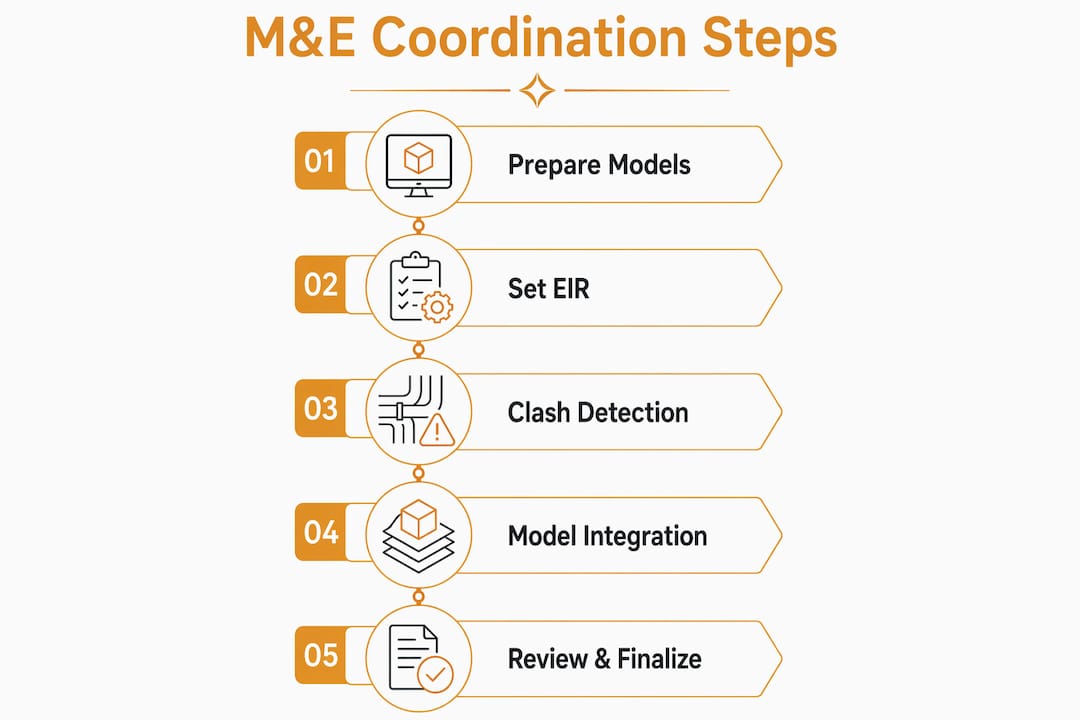
The coordination process follows a defined sequence. Skipping steps creates gaps that surface as construction errors.
-
Federate discipline models. Import the architectural, structural, and M&E BIM models into Autodesk Navisworks or an equivalent platform. Confirm all models share a common coordinate origin and agreed floor levels.
-
Run initial clash detection. Execute automated clash detection to identify all conflicts. Clashes fall into three categories: hard clashes (physical overlap between two elements), soft clashes (insufficient clearance for maintenance or installation), and workflow clashes (sequencing conflicts). Each type requires a different resolution approach.
-
Categorize and assign clashes. Export the clash report and categorize each issue by discipline, severity, and responsible party. Assign each clash to the consultant or contractor who must resolve it.
-
Hold coordination meetings. Bring architects, M&E engineers, and the BIM coordinator together to review assigned clashes. Regular BIM coordination meetings between architects, M&E engineers, and contractors minimize errors and align stakeholder models before changes are made.
-
Update models based on agreed resolutions. Each discipline updates their model to reflect agreed changes. Rerouted ducts, relocated pipes, and adjusted structural openings are all modeled before any physical work begins.
-
Re-run clash detection. After model updates, run clash detection again. Repeat this cycle until the clash count reaches zero or only accepted minor clashes remain.
-
Sign off the coordinated model. All discipline leads formally sign off the federated model. This sign-off is the trigger for producing installation drawings.
-
Produce installation drawings and submit to authorities. Installation drawings produced from coordinated Revit BIM models serve as reliable references for site teams. These drawings reflect all coordination decisions and are tailored for site execution. For Singapore projects, the coordinated model also supports BCA, URA, and SCDF authority submissions.
Clash type comparison:
| Clash type | Definition | Resolution approach |
|---|---|---|
| Hard clash | Physical overlap between two building elements | Reroute or resize one element |
| Soft clash | Insufficient clearance around an element | Adjust routing to meet clearance standards |
| Workflow clash | Sequencing or timing conflict during installation | Revise construction sequence or phasing |
Pro Tip: Early clash detection during design is far cheaper than fixing conflicts on site. Resolving a duct routing conflict in Navisworks takes hours. Cutting and rerouting installed ductwork on site takes days and costs multiples more.
What are the common challenges in M&E and architectural drawing coordination?
The most frequent failure point in M&E drawing coordination in Singapore is starting coordination too late. When M&E engineers begin modeling after the architectural design is already frozen, the number of clashes multiplies and the options for resolution shrink. Early parallel design development is the only reliable way to avoid this.
Common challenges and how to avoid them:
- No EIR in the contract. Without a formal EIR, consultants deliver design-intent BIM models at LOD 300, which indicate intent but are not construction-ready. Specify LOD requirements and deliverable milestones in the EIR before contracts are signed.
- Incompatible model formats. Consultants using different software versions or non-standard coordinate systems produce models that cannot be federated cleanly. Mandate IFC export standards and a shared coordinate origin in the project BIM Execution Plan (BEP).
- Unclear responsibility for clash resolution. When no one owns a clash, it stays unresolved. Assign every clash to a named party in the clash register and track it to closure.
- Communication gaps between consultants and contractors. Design consultants and main contractors often work in separate silos. Regular coordination meetings close this gap.
- Confusing design-intent models with construction-ready models. Design-stage BIM models at LOD 200–300 are not the same as shop fabrication models. Developers who assume otherwise receive drawings that cannot be built from directly.
“Embedding BIM requirements in tender documents and EIR helps ensure main contractors are contractually obliged to provide coordinated, clash-free BIM models.” — What Is Design Coordination in BIM
Governance gaps are the root cause of most coordination failures. A clear BIM Execution Plan, a named BIM coordinator, and a structured clash register eliminate the ambiguity that allows problems to persist.
Best practices for M&E and architectural drawing coordination in Singapore
Property owners and developers who engage BIM consultants at the tender stage consistently achieve better coordination outcomes than those who appoint them after design is underway. Early appointment gives the BIM coordinator time to set up the federated model environment, define clash tolerances, and embed coordination requirements in consultant briefs.
Practical best practices:
- Use a Common Data Environment (CDE). A CDE facilitates secure sharing and version control of BIM models for all coordination parties. Platforms like Autodesk Construction Cloud or BIM 360 provide audit trails, access controls, and change tracking that email-based file sharing cannot match.
- Embed BIM requirements in the EIR. Specify LOD requirements, clash tolerance thresholds, file naming conventions, and coordination meeting frequency in the EIR. This creates contractual accountability for every consultant.
- Phase coordination for large projects. Phased coordination allows installation drawings to be issued for completed project zones while coordination continues in others. This approach reduces overall project delays without compromising drawing quality.
- Set clash priority levels. Not all clashes carry equal risk. Categorize clashes as critical, major, or minor at the start of the project. Critical clashes block construction and must be resolved first.
- Maintain a clash register with version control. Document every clash, its assigned owner, the agreed resolution, and the model version in which it was resolved. This register becomes the audit trail for disputes and authority queries.
- Schedule coordination meetings at fixed intervals. Weekly or fortnightly meetings keep resolution momentum going. Ad-hoc meetings allow clashes to accumulate and create last-minute pressure before construction milestones.
Pro Tip: For integrated design engineering projects in Singapore, appoint your BIM coordinator before the design team is finalized. The coordinator should help define the BIM Execution Plan, not inherit someone else’s incompatible setup.
The role of M&E engineers in residential and commercial projects extends well beyond producing system layouts. Their active participation in coordination meetings and model updates is what converts a design-intent model into a construction-ready set of drawings.
Key Takeaways
Effective M&E drawing coordination in Singapore requires federated BIM workflows, a formal EIR, and structured clash detection cycles starting at the design stage, not after construction begins.
| Point | Details |
|---|---|
| Start coordination early | Engage BIM coordinators and M&E engineers before architectural design is frozen. |
| Use a federated BIM model | Combine all discipline models in Navisworks or equivalent to detect clashes across the full project. |
| Specify LOD in the EIR | Require LOD 350–400 for construction-ready models; LOD 300 indicates design intent only. |
| Categorize clashes by type | Hard, soft, and workflow clashes each require a different resolution method and responsible party. |
| Phase coordination on large projects | Issue installation drawings for completed zones while continuing coordination in remaining areas. |
The shift I’ve seen in how Singapore developers approach BIM coordination
The most significant change I’ve observed over recent years is not the software. It’s the mindset. Developers who once treated BIM as a submission requirement now treat it as a project management tool. That shift produces measurably better outcomes.
The projects that run smoothly are the ones where the developer insists on a BIM Execution Plan before the first consultant is appointed. The projects that run into trouble are the ones where coordination is treated as the contractor’s problem to solve after design is complete. By that point, the architectural drawings are fixed, the M&E systems are sized, and every clash requires a negotiation rather than a design decision.
The move from 2D drawings to 3D federated models has also changed how disputes get resolved. When a conflict is visible in a shared model, the responsible party is obvious. That clarity reduces the finger-pointing that used to consume weeks of project time. Clear BIM governance is the single most effective tool for reducing disputes on complex Singapore projects.
My advice to any property owner or developer reading this: select your coordination team based on their BIM governance experience, not just their technical modeling skills. A team that can run clash detection is common. A team that can manage a multi-consultant coordination process from EIR to sign-off is far less common and far more valuable.
— Aman
How Stellar Structures supports M&E and architectural coordination in Singapore
Stellar Structures provides integrated architectural and M&E coordination services for residential, commercial, and industrial projects across Singapore.

The firm’s team of engineers and architects manages the full coordination workflow, from setting up federated BIM models and running clash detection to preparing coordinated drawings for BCA, URA, HDB, JTC, SCDF, and PUB authority submissions. Stellar Structures embeds BIM requirements into project documentation from the start, giving developers contractual clarity over deliverables at every stage. Property owners and developers can consult Stellar Structures for architectural and M&E design services tailored to their project scale and compliance requirements.
FAQ
What is M&E coordination in architectural drawings?
M&E coordination is the process of aligning mechanical and electrical engineering models with architectural and structural drawings using BIM to detect and resolve conflicts before construction. The goal is a clash-free, construction-ready set of drawings signed off by all discipline leads.
Why is BIM used for M&E drawing coordination in Singapore?
BIM allows all discipline models to be federated into a single digital environment where clashes are detected automatically. Singapore’s BCA mandates BIM submissions for qualifying projects, making BIM-based coordination both a technical and regulatory requirement.
What is the difference between LOD 300 and LOD 400 in BIM coordination?
LOD 300 models represent design intent and are not construction-ready. LOD 400 models include precise geometry, fabrication details, and installation data needed for site execution. Developers should specify the required LOD in the EIR before appointing consultants.
How long does M&E coordination typically take on a Singapore project?
Coordination duration depends on project complexity and the number of discipline models involved. A straightforward residential project may require 4–8 weeks of coordination cycles. A large commercial or industrial project can require several months of iterative clash detection and resolution.
What happens if M&E coordination is skipped or done late?
Late or absent coordination means clashes are discovered on site, where fixing them requires cutting installed elements, reordering materials, and rescheduling trades. These corrections cost significantly more than resolving the same conflicts during the design stage in a BIM environment.
Recommended
- Choosing an Architect for Your New Build in Singapore
- What Are The Requirements For Building Plan Submission In Singapore – Stellar Structures
- Mezzanine Floor Approval Guide Singapore 2026
- Integrated Design Engineering Projects in Singapore: A Developer’s Guide