




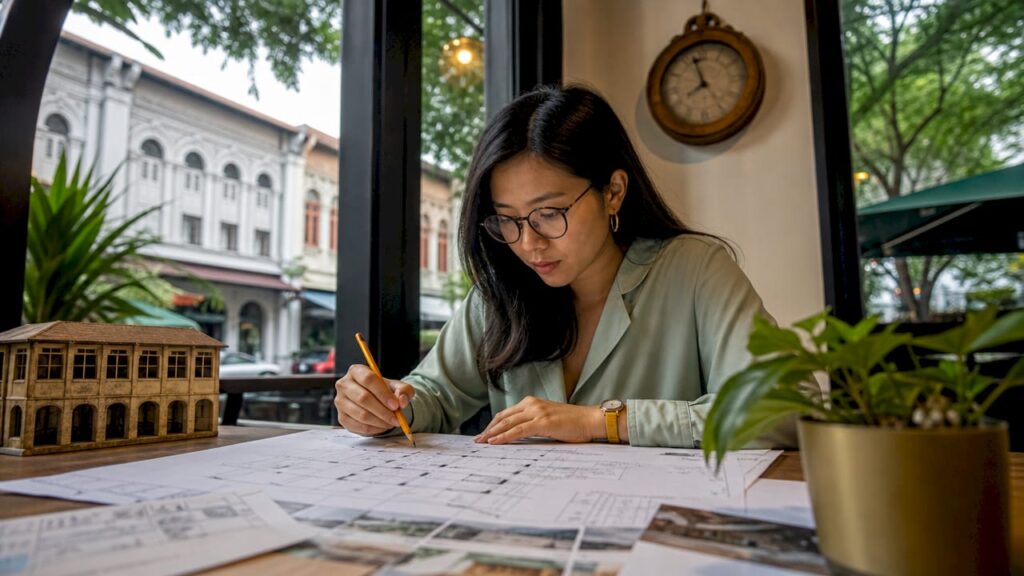
A conservation building in Singapore is a structure officially protected by the Urban Redevelopment Authority (URA) due to its architectural, historical, or cultural significance. The URA requires owners to preserve key external features while permitting internal modifications and functional upgrades. Singapore has conserved over 7,200 buildings under its program since 1989, covering shophouses, black-and-white bungalows, and civic structures. Understanding what is a conservation building in Singapore matters for property owners, developers, and investors because the designation carries specific legal obligations, renovation restrictions, and financial implications that differ substantially from standard building ownership.
What is a conservation building in Singapore and how does designation work?
The URA is the primary authority responsible for identifying and gazettin conservation buildings in Singapore. Gazetted means formally listed under the Planning Act, which gives the designation legal force. The URA evaluates buildings against three criteria: architectural merit, historical significance, and cultural or social value. A building does not need to satisfy all three criteria, but it must demonstrate clear relevance to Singapore’s built heritage.
The designation process is distinct from the classification of National Monuments. Singapore has 77 National Monuments, governed separately under the Preservation of Monuments Act and administered by the National Heritage Board (NHB). National Monuments carry stricter controls than URA-conserved buildings. Owners of National Monuments must obtain NHB consent for any works, while URA-conserved building owners apply through the URA’s development control process.
The legal basis for conservation building regulation sits within the Planning Act. Any external alteration, addition, or demolition requires formal URA approval before work begins. Internal modifications are generally more flexible, provided they do not compromise structural integrity or primary heritage features.
- Identify the building’s conservation status by checking the URA’s Integrated Land Use Plan or written permission records.
- Submit a development application to URA for any proposed external works, including repainting in non-original colors.
- Engage a qualified architect familiar with URA conservation guidelines to prepare drawings and specifications.
- Obtain written permission from URA before commencing any approved works on site.
- Retain records of all approved works for future compliance audits and ownership transfers.
Pro Tip: Check the URA SPACE portal before purchasing a conservation property. The portal shows the building’s conservation status, approved use, and any outstanding conditions that could affect your renovation plans.
What types of buildings are conserved in Singapore?
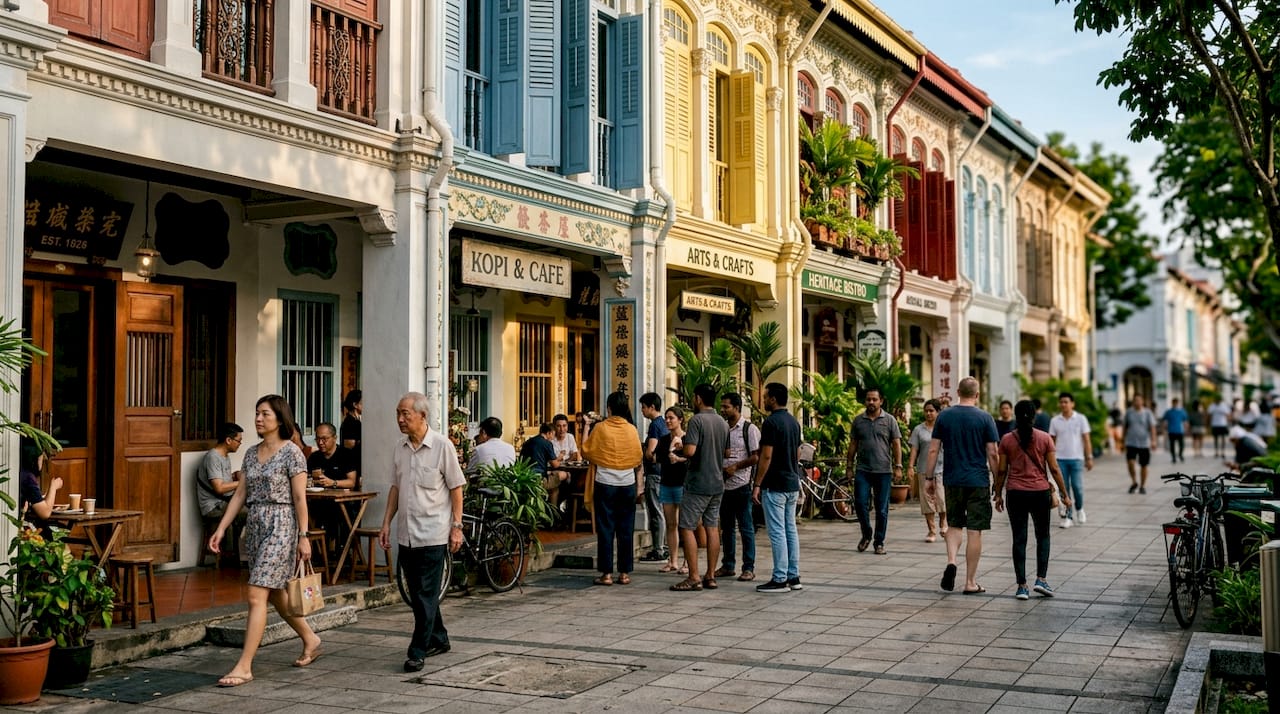
Shophouses form the largest category of conserved buildings in Singapore. Over 6,500 conserved shophouses date mainly from the early 1800s to the mid-1900s, concentrated in areas including Chinatown, Joo Chiat, Little India, and Orchard Road. Shophouses are defined by their narrow frontage, covered pedestrian walkway at ground level (known as the five-foot way), and decorative plasterwork on the facade. They typically combine a ground-floor commercial unit with upper-floor residential or office space.
Black-and-white bungalows represent a second major typology. These colonial-era detached houses, built primarily between the 1900s and 1940s, feature white-painted walls, black timber framing, and large verandas. They are found in areas such as Nassim Road, Ridout Road, and Goodwood Hill.
Civic and religious buildings form a third category. The Orchard Road Presbyterian Church’s main building, a neo-classical 19th-century structure, is conserved to maintain its architectural and heritage value, with modern restoration ongoing. Villa Haji Kahar in Bedok is another example: a culturally significant 20th-century bungalow conserved while surrounding land was released for new housing development.
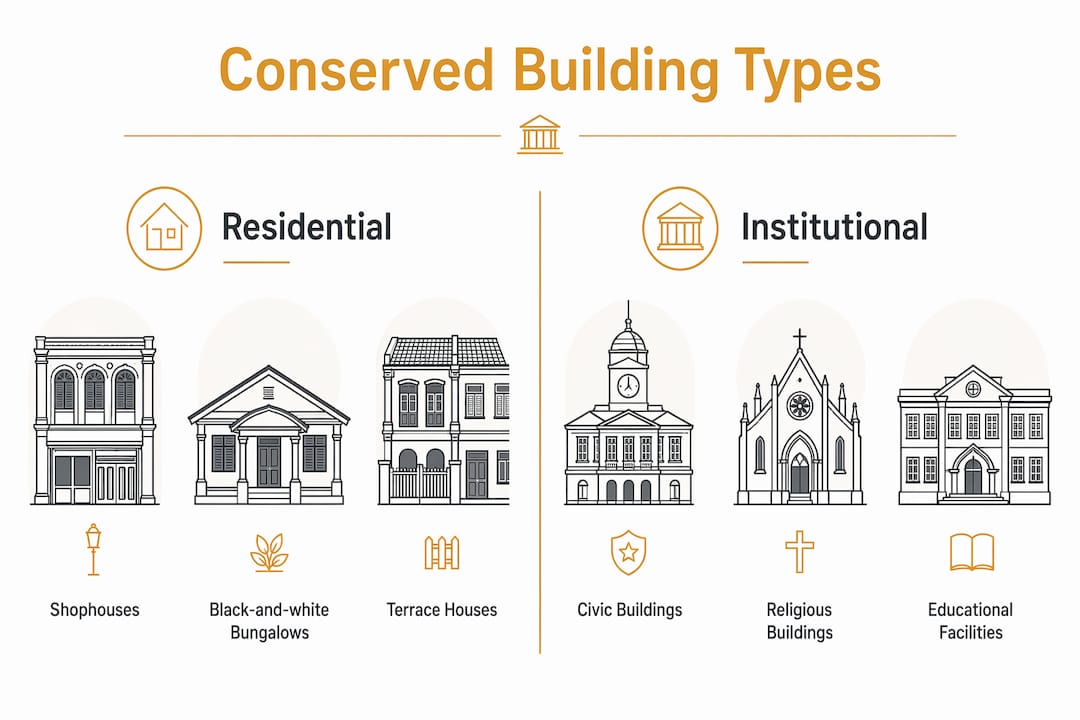
The table below compares the three primary conservation building typologies:
| Feature | Shophouses | Black-and-white bungalows | Civic and religious buildings |
|---|---|---|---|
| Era | Early 1800s to mid-1900s | 1900s to 1940s | 19th to early 20th century |
| Typical location | Chinatown, Joo Chiat, Little India | Nassim Road, Ridout Road | City center and established districts |
| Defining feature | Five-foot way, plasterwork facade | White walls, black timber framing | Neo-classical or colonial architecture |
| Common use | Commercial and residential mixed | Residential or institutional | Religious, civic, or cultural |
Key architectural features that URA requires owners to retain include:
- Facade composition, including window openings, arches, and decorative moldings
- Original rooflines and roof pitch
- Party walls shared with adjacent conserved units
- Five-foot ways in shophouse rows
- Structural bays and floor-to-ceiling proportions
How does conservation status affect property owners?
URA approval is required before any external changes on a conservation building. This includes repainting in a color not consistent with the approved palette, replacing windows with non-original profiles, or adding external air-conditioning units in visible locations. Demolition of any part of the conserved structure is prohibited without specific written permission, which is rarely granted.
Internal modifications are treated more flexibly. Owners may upgrade mechanical and electrical systems, install modern kitchens and bathrooms, and reconfigure internal partitions, provided the works do not affect primary structural elements or the external appearance of the building. This flexibility supports adaptive reuse, which is the practice of updating a heritage building’s function while preserving its historic character.
Modern energy upgrades are permitted but tightly controlled. Solar panel installation on conservation buildings is typically limited to the rear pitched roof slope, with coverage capped to minimize visual impact on the heritage facade. This reflects URA’s position that sustainability upgrades must not compromise the building’s architectural integrity.
Facade maintenance is a legal obligation, not an optional practice. Building owners must conduct periodic facade inspections to comply with regulatory requirements and preserve heritage exteriors effectively. Neglecting facade maintenance can result in enforcement action and costly remediation.
Key restrictions for conservation building owners include:
- No unauthorized external alterations, including signage changes
- No demolition of conserved structural elements without URA written permission
- No deviation from approved facade colors or materials
- Mandatory periodic facade inspections for buildings in the Central Business District and other designated areas
- Compliance with regularization requirements if previous owners carried out unauthorized works
Pro Tip: Before committing to a conservation property purchase, commission a pre-acquisition structural assessment. Unauthorized works by previous owners are the buyer’s liability after transfer, and remediation costs can be substantial.
What are the investment considerations for conservation buildings?
Conservation properties are scarce by definition. The total stock is fixed because no new buildings receive conservation status under normal circumstances. Scarcity combined with prime district locations drives strong capital appreciation over time. Rental yields on conservation shophouses are typically in the range of 2–3%, which is moderate by Singapore standards. Capital appreciation, not rental income, is the primary investment driver for most buyers.
Commercial shophouses carry a significant tax advantage. They are exempt from the Additional Buyer’s Stamp Duty (ABSD), which is a tax applied to most residential property purchases in Singapore. The ABSD rate for foreign buyers of residential property stands at 60%. This exemption makes commercial conservation shophouses one of the few property categories where foreign investors can acquire Singapore real estate without the ABSD burden.
“The intersection of URA conservation regulations, the Residential Property Act, and stamp duty laws creates complex ownership and usage implications for conservation properties, notably influencing foreign investment decisions.” — Conservation Shophouses Singapore 2026
Zoning determines whether a shophouse qualifies for the ABSD exemption. A shophouse zoned for commercial use is exempt. A mixed-use or residential-zoned shophouse is not. Buyers must verify zoning before purchase because the financial implications are material.
- Confirm the zoning classification with URA before signing any option to purchase.
- Assess stamp duty exposure based on zoning, buyer profile, and intended use.
- Evaluate the conservation status to understand renovation restrictions that affect rental potential.
- Review outstanding URA conditions on the property, including any approved or pending development applications.
- Engage a qualified engineer to assess structural condition, particularly for buildings over 80 years old.
Key takeaways
A conservation building in Singapore is a URA-gazetted structure requiring owners to preserve primary external features while permitting internal upgrades and adaptive reuse under the Planning Act.
| Point | Details |
|---|---|
| URA designation | Over 7,200 buildings are protected under Singapore’s conservation program since 1989. |
| External works require approval | Any external alteration or demolition needs formal URA written permission before work starts. |
| Shophouses dominate the stock | Over 6,500 conserved shophouses are concentrated in Chinatown, Joo Chiat, and Little India. |
| Commercial shophouses are ABSD-exempt | Foreign buyers can acquire commercial shophouses without paying the 60% Additional Buyer’s Stamp Duty. |
| Facade inspections are mandatory | Building owners must conduct periodic facade inspections to meet regulatory obligations and preserve heritage exteriors. |
Why conservation and development are not opposites
Working on conservation building projects for years has reinforced one clear lesson: most owners approach these properties with the wrong mental model. They treat the conservation status as a constraint to work around rather than a framework to work within. That shift in perspective changes everything about how a project proceeds.
The URA’s adaptive reuse approach is genuinely well-designed. It allows owners to modernize interiors completely while holding the line on external heritage features. The buildings that succeed commercially are the ones where the owner invested in high-quality interior work precisely because the exterior was fixed. The heritage facade becomes a differentiator, not a limitation.
The harder challenge is technical. Ageing structures require structural retrofitting to meet current load and safety standards, and that work must be done without compromising the conserved elements. Getting that balance right requires engineers and architects who understand both the regulatory framework and the physical constraints of century-old construction. Generic consultants who lack conservation experience routinely underestimate the complexity and cost.
Singapore’s conservation policies will likely tighten over the next decade as the remaining stock ages and urban pressure increases. Owners who invest in proper maintenance and compliant upgrades now will be in a far stronger position than those who defer. The buildings that are well-maintained and properly documented will also be the easiest to sell, lease, and finance.
— Aman
How Stellar Structures supports conservation building projects
Conservation building projects require consultants who understand both heritage regulations and structural realities. Stellar Structures provides architectural design for commercial buildings that meets URA conservation guidelines while delivering functional, compliant outcomes for property owners and developers.
The firm’s engineers and architects handle URA authority submissions, civil and structural design checks, facade assessments, and adaptive reuse planning for conservation properties across Singapore. Whether you are acquiring a conserved shophouse, planning an internal fit-out, or addressing unauthorized works left by a previous owner, Stellar Structures provides the technical expertise and regulatory knowledge to keep your project on track. Contact the team to discuss your conservation building requirements.
FAQ
What is a conservation building in Singapore?
A conservation building in Singapore is a structure gazetted by the Urban Redevelopment Authority (URA) under the Planning Act due to its architectural, historical, or cultural significance. Owners must preserve primary external features but may modify interiors with URA approval.
How many conservation buildings are there in Singapore?
Singapore has conserved over 7,200 buildings and structures under the URA’s program since 1989, including shophouses, black-and-white bungalows, and civic buildings.
What is the difference between a conservation building and a National Monument?
Conservation buildings are regulated by the URA under the Planning Act, while Singapore’s 77 National Monuments are governed separately under the Preservation of Monuments Act and administered by the National Heritage Board. National Monuments carry stricter controls and require NHB consent for any works.
Can foreigners buy conservation shophouses in Singapore?
Foreigners can purchase commercial conservation shophouses in Singapore. Commercial shophouses are exempt from the 60% Additional Buyer’s Stamp Duty that applies to residential property purchases, making them one of the few accessible property categories for foreign buyers.
What happens if unauthorized works were done on a conservation building?
The new owner assumes liability for any unauthorized works carried out by previous owners. Regularization through URA is required, which involves submitting retrospective applications and potentially reversing non-compliant alterations at the current owner’s expense.
Recommended
- Glass Curtain Wall Façade Design in Singapore
- What Is a Building Contract? Singapore Guide 2026
- Building With Nature: How Eco-Engineering Is Transforming Singapore’s Coastlines – Stellar Structures
- Periodic Facade Inspection for CBD buildings in Singapore – Stellar Structures