





A design and build contract structure in Singapore assigns both design and construction responsibilities to a single contractor, consolidating accountability under one agreement. This model differs from the traditional approach, where an owner engages a separate architect and builder. For property owners, real estate developers, and project managers, understanding how to structure these contracts correctly is the foundation of any successful construction or renovation project. Standard forms such as PSSCOC, SIA Building Contract, and REDAS Design and Build Conditions govern how these agreements are drafted and enforced across Singapore.
What are the key components of a design and build contract structure in Singapore?
A well-structured design and build contract must cover project milestones, pricing, variation rules, defects liability, and insurance. The Building Control Act and SOPA mandate these components for compliance on all Singapore construction projects. Missing any one element creates legal exposure and operational risk for developers and owners alike.
The core contract components include:
- Project milestones and timelines. The Building Control Act requires clear construction phase milestones tied to regulatory submissions and inspections.
- Transparent pricing and variation order mechanisms. The contract must define how cost changes are initiated, approved, and documented. Variation orders must follow SOPA’s framework to prevent payment disputes.
- Defects liability period. This clause specifies the duration during which the contractor must rectify defects at no additional cost, typically 12 months after practical completion.
- Insurance requirements. Contracts must specify Contractor’s All Risks (CAR) coverage, professional indemnity insurance, and Work Injury Compensation Act (WICA) coverage. Insurers must be MAS-licensed for policies to be valid under Singapore law.
- Payment terms under SOPA. Section 11 of SOPA requires employers to respond to payment claims within 21 days. Monthly progress payment claims are the standard mechanism for cash flow management on Singapore projects.
Pro Tip: Always include a payment response timeline in the contract that mirrors SOPA’s 21-day rule. Omitting this clause does not exempt you from the statutory obligation, but it removes your contractual clarity when disputes arise.
The table below compares the key contract clauses and their purposes:
| Contract clause | Purpose |
|---|---|
| Milestone schedule | Defines phased completion dates tied to regulatory inspections |
| Variation order procedure | Controls scope changes and prevents cost disputes |
| Defects liability period | Allocates post-completion repair responsibility to the contractor |
| Insurance schedule | Specifies required coverage types and minimum policy limits |
| Payment terms | Establishes claim cycles and response deadlines per SOPA |
| Performance bond | Provides financial security if the contractor defaults |
How to select the right design and build contractor in Singapore
Selecting the right contractor is as critical as drafting the contract itself. Choosing prequalified contractors with proven regulatory approval track records minimizes delays and cost overruns on Singapore projects. The lowest bid rarely reflects the full cost of a project when delays, rework, and compliance failures are factored in.
Use the following criteria when evaluating contractors:
- BCA licensing and grading. Verify the contractor holds the appropriate Building and Construction Authority (BCA) license grade for your project’s contract value and scope.
- Regulatory approval experience. Assess the contractor’s track record with URA, LTA, SCDF, and other authorities. Experienced contractors’ relationships with regulatory bodies like URA and SCDF help expedite approvals and reduce project risk.
- Insurance and professional indemnity coverage. Confirm that the contractor carries valid CAR and professional indemnity policies from MAS-licensed insurers.
- Pricing transparency. Request an itemized breakdown of costs, not a lump sum. This protects you during variation order negotiations.
- Technology capabilities. Contractors using BIM, DfMA, and parametric design technologies reduce timelines and align with Singapore’s Green Mark sustainability goals.
For guidance on hiring qualified builders, the BCA-certified builder guide covers best practices for contractor selection across project types.
Pro Tip: Request a prequalification questionnaire before inviting tenders. Ask for documented examples of past authority submissions, including BCA and URA approvals, to verify the contractor’s compliance track record before contract award.

What standard contract forms are used for design and build in Singapore?
Three standard forms govern design and build contracts in Singapore: PSSCOC for public sector projects, the SIA Building Contract for private sector works, and the REDAS Design and Build Conditions for developer-led projects. Each form allocates risk and responsibility differently. Choosing the wrong form, or modifying it without legal advice, creates gaps in liability coverage.
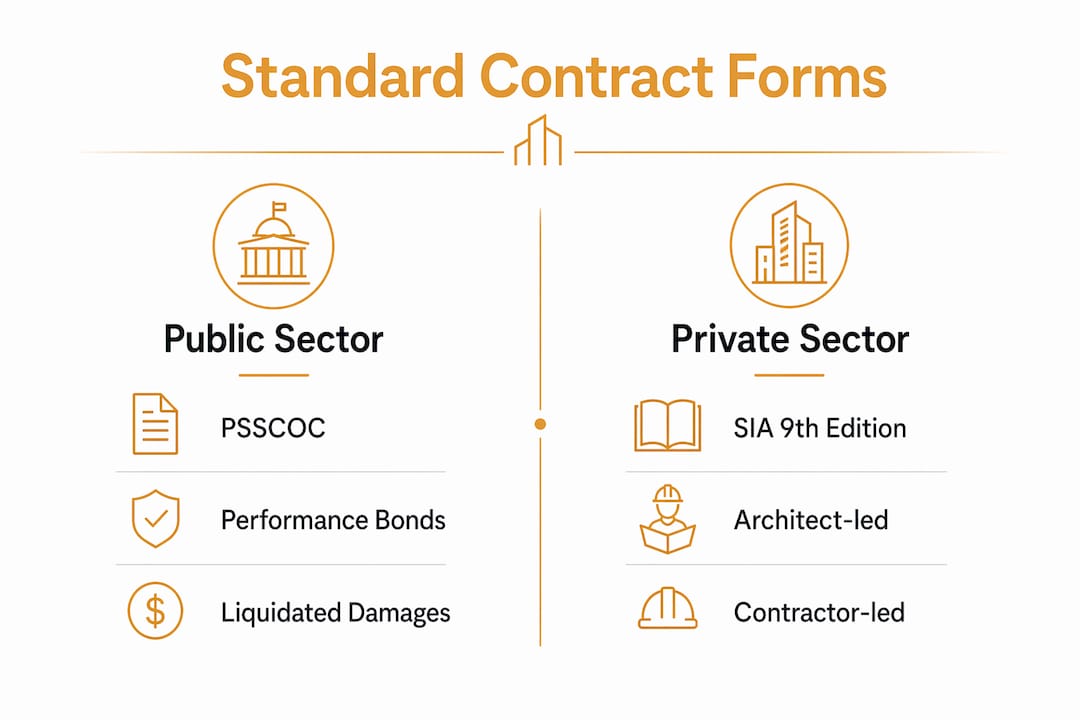
PSSCOC (Public Sector Standard Conditions of Contract)
PSSCOC applies to government and public agency projects. It contains detailed clauses on performance bonds, liquidated damages, and dispute resolution through adjudication. The form is administered by the Building and Construction Authority and is updated periodically to reflect regulatory changes.
SIA Building Contract (9th Edition)
The Singapore Institute of Architects (SIA) Building Contract governs most private sector construction projects. It distinguishes clearly between the contractor’s construction obligations and the architect’s design responsibilities. The Building Control Act distinguishes construction and design responsibilities, and the SIA form reflects this by maintaining separate indemnity obligations for each party.
REDAS Design and Build Conditions
The Real Estate Developers’ Association of Singapore (REDAS) form is tailored for developer-led design and build projects. Its performance bond clauses are frequently modified by parties during negotiation. Recent High Court rulings show risks of ambiguous bond terms when REDAS clauses are altered without precise legal drafting. The distinction between an indemnity bond and an on-demand bond carries significant financial consequences if a contractor defaults.
The table below compares the three standard forms:
| Feature | PSSCOC | SIA (9th Ed.) | REDAS D&B |
|---|---|---|---|
| Sector | Public | Private | Developer-led |
| Performance bond type | On-demand | Indemnity or on-demand | Often modified |
| Design liability | Contractor | Architect retains design liability | Contractor |
| Dispute resolution | Adjudication, arbitration | Arbitration | Arbitration |
| Insurance requirements | Specified by authority | Defined in contract schedule | Negotiated |
For a broader overview of building contract frameworks in Singapore, including how these forms interact with regulatory requirements, the Stellar Structures resource library provides detailed guidance.
Effective contract management during design and build projects in Singapore
Strong contract management prevents disputes and keeps projects on schedule. The following steps define a reliable contract administration process for design and build projects in Singapore.
- Submit monthly progress payment claims on time. SOPA Section 11 sets a 21-day response window for employers. Missing this deadline exposes the employer to adjudication proceedings and potential payment orders.
- Document all variation orders formally. Every scope change must be recorded in writing before work begins. Verbal instructions are not enforceable under SOPA’s variation framework.
- Manage the defects liability period actively. Maintain a defects register from the date of practical completion. Issue formal notices to the contractor within the contractual timeframe to preserve your rights.
- Administer insurance claims promptly. Notify insurers within the timeframes specified in the CAR and professional indemnity policies. Late notification is a common reason for claim rejection.
- Use digital contract management tools. Platforms that automate payment claim tracking, variation order workflows, and compliance checklists reduce administrative errors. A construction software glossary covering ERP, scheduling, and takeoff tools helps teams select the right systems for their project scale.
- Schedule compliance checkpoints with BCA and other authorities. Align internal project milestones with BCA inspection stages, URA approval conditions, and any SCDF fire safety requirements.
Pro Tip: Appoint a dedicated contract administrator at project inception. This person should own the variation order log, payment claim schedule, and defects register. Projects without a named contract administrator consistently generate more disputes at practical completion.
A common mistake developers make is treating contract management as a back-office function. Contract administration is a front-line risk management activity. Gaps in documentation during construction become expensive legal disputes after handover.
Key takeaways
A properly structured design and build contract in Singapore must address pricing, milestones, insurance, variation procedures, and SOPA payment terms to protect all parties and ensure regulatory compliance.
| Point | Details |
|---|---|
| Single-contractor accountability | Design and build contracts consolidate design and construction under one party, reducing coordination gaps. |
| SOPA payment compliance | Employers must respond to payment claims within 21 days under SOPA Section 11 to avoid adjudication. |
| Standard form selection | Choose PSSCOC, SIA, or REDAS based on project sector and risk allocation requirements. |
| Contractor prequalification | Verify BCA licensing, regulatory approval history, and MAS-licensed insurance before awarding contracts. |
| Contract administration | Maintain formal variation order logs, defects registers, and insurance records throughout the project lifecycle. |
Why the cheapest contract is often the most expensive decision
Most disputes I see in Singapore design and build projects do not start with a bad contractor. They start with a poorly drafted contract that nobody questioned at the time of signing. A developer accepts a lump sum price, skips the itemized breakdown, and assumes the standard form covers everything. It rarely does.
The performance bond issue is the clearest example. The difference between an indemnity bond and an on-demand bond is not a technicality. It determines whether you can call on the bond immediately when a contractor defaults or whether you must first prove your loss in court. Recent High Court decisions have confirmed that ambiguous bond language defaults to the more restrictive interpretation. That ambiguity costs developers months of litigation and significant legal fees.
The other pattern I consistently observe is developers undervaluing contractor relationships with regulatory bodies. A contractor who has submitted 50 URA applications knows which details trigger a request for information and which layouts sail through. That institutional knowledge is not reflected in a tender price. It shows up in your project timeline. Selecting a contractor purely on price ignores this entirely.
Technology adoption is the next differentiator that developers overlook. Contractors using BIM and DfMA do not just produce better drawings. They identify clashes between structural and M&E systems before construction begins. That saves real money. The Green Mark framework increasingly rewards this approach, and contracts that reference sustainability performance benchmarks are becoming standard on larger Singapore projects.
My advice: treat the contract drafting phase as a risk allocation exercise, not a paperwork formality. Engage a construction lawyer to review any modifications to standard form clauses. The cost of that review is a fraction of the cost of a single disputed variation order.
— Aman
How Stellar Structures supports your design and build contract needs
Stellar Structures provides civil, structural, and architectural design services that integrate directly with the design and build process in Singapore. The firm’s engineers and architects work alongside developers and contractors from concept through to authority submission, covering BCA, URA, HDB, JTC, SCDF, PUB, LTA, NEA, and NParks approvals.
For developers who need confidence that their structural design meets compliance requirements before construction begins, Stellar Structures’ civil and structural design checks service provides independent verification at every critical stage. The firm also handles authority submission services across all major regulatory bodies, reducing the approval risk that commonly delays design and build projects in Singapore.
FAQ
What is a design and build contract in Singapore?
A design and build contract assigns both design and construction responsibilities to a single contractor under one agreement. This structure simplifies accountability and is governed by standard forms including PSSCOC, SIA, and REDAS.
Which standard contract form should I use for a private project?
The SIA Building Contract (9th Edition) is the standard form for private sector construction projects in Singapore. It clearly separates design liability from construction liability, which is critical for professional indemnity coverage.
What does SOPA require for payment terms in a design and build contract?
SOPA Section 11 requires employers to respond to payment claims within 21 days. Monthly progress payment claims are the standard mechanism, and non-compliance can trigger adjudication proceedings.
What is the difference between an indemnity bond and an on-demand performance bond?
An on-demand bond allows the employer to call on the bond immediately upon contractor default, without proving loss first. An indemnity bond requires the employer to establish the loss before the bond can be called, which typically involves litigation.
How do I verify a design and build contractor’s qualifications in Singapore?
Verify the contractor’s BCA license grade, review their history of regulatory approvals with URA, SCDF, and other authorities, and confirm that their CAR and professional indemnity insurance is held with MAS-licensed insurers.
Recommended
- Design and build contracts: Singapore developer guide
- What Is a Building Contract? Singapore Guide 2026
- Why hire an architect for your new build in Singapore
- Choosing an Architect for Your New Build in Singapore