





Managing subcontractors in a design-build project is defined as the coordinated oversight of all trade partners operating under a single integrated contract to deliver cohesive construction outcomes. Unlike traditional design-bid-build delivery, the design-build model compresses the schedule by running design and construction concurrently. That compression makes subcontractor management strategies more demanding, not less. Project managers who treat subcontractor oversight as an afterthought face compounding risks: scope gaps, cost overruns, and schedule failures that are difficult to unwind once construction is underway. The sections below address every critical phase, from prequalification through performance evaluation.
How to manage subcontractors in a design-build project
Effective subcontractor management in a design-build project begins before a single contract is signed. The design-build delivery model places the general contractor or design-build entity in direct control of both design and construction trade partners. That single-point responsibility means subcontractor failures reflect directly on the prime contractor’s obligations to the owner.

The stakes are measurable. 91% of general contractors report higher productivity when using software to manage subcontractors. That figure signals that digital management is no longer optional. It is the baseline standard for competitive project execution.
Three foundational principles govern effective subcontractor oversight in design-build settings:
- Single-source accountability. The prime contractor owns all design and construction outcomes. Subcontractor failures become prime contractor failures.
- Concurrent phase management. Design development and construction procurement often overlap. Subcontractors must be engaged earlier than in traditional delivery.
- Flow-down compliance. Subcontract terms must mirror the prime design-build agreement on risk allocation, dispute resolution, and schedule obligations.
How do you prequalify subcontractors for design-build work?
Prequalification is the most underinvested step in subcontractor management. Assuming prior relationships are adequate vetting is a documented risk. Each design-build project requires current financial, safety, and scope-specific due diligence regardless of past performance.
A 30-minute prequalification process per subcontractor can prevent weeks of costly project delays and potential legal disputes. That time investment is among the highest-return activities a project manager can perform before mobilization.
Prequalification criteria for design-build projects should cover:
- Safety record. Review the Experience Modification Rate (EMR) and OSHA incident logs for the past three years.
- Financial stability. Request current financial statements and confirm bonding capacity relative to the subcontract value.
- Licensing and insurance. Verify active licenses and confirm insurance certificates meet project-specific minimums.
- Design-phase capability. For specialty trades, confirm the subcontractor can contribute constructability input during design development, not just execute drawings.
- References from comparable projects. Prioritize references from design-build or fast-track projects where schedule compression was a factor.
Compliance tracking software with automated alerts keeps prequalification current throughout the project lifecycle. Alerts sent at 90, 60, and 30 days before insurance and licensing documents expire prevent work stoppages caused by lapsed credentials.
Pro Tip: Run prequalification as a formal process with a scored checklist, not a conversation. A documented score creates a defensible record if a subcontractor selection is later challenged.
What should subcontractor contracts include in design-build delivery?
Subcontract scope definition is where most design-build disputes originate. Ambiguous inclusions and exclusions create gaps that surface mid-construction, when resolving them is most expensive.
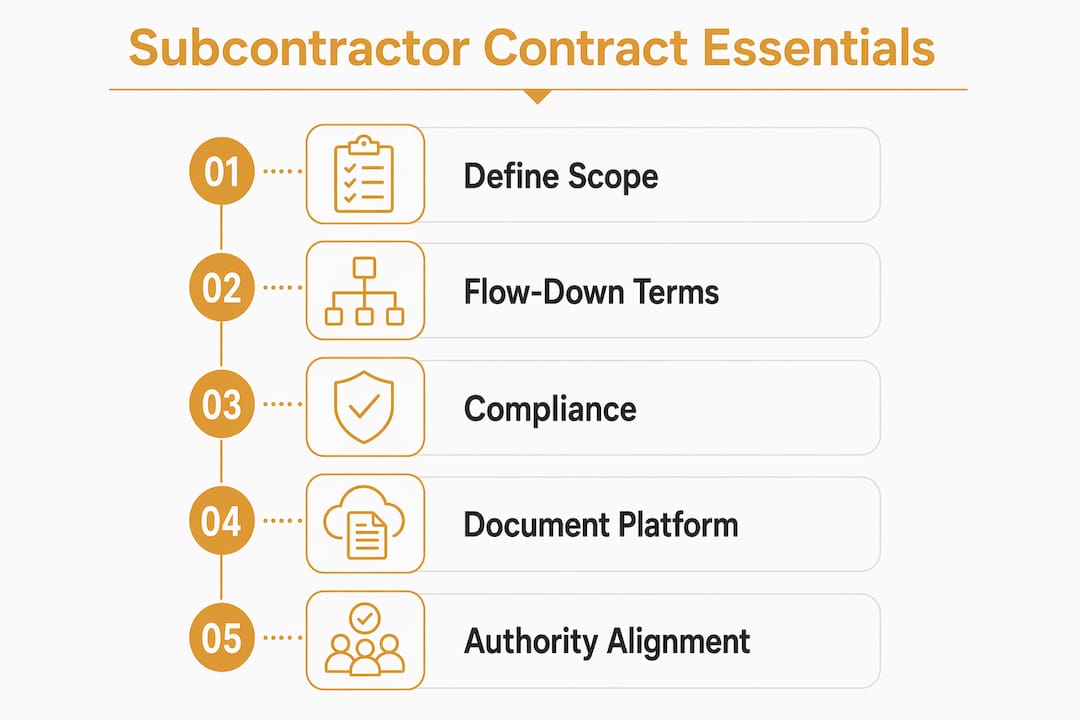
Subcontractor contracts in design-build projects flow down from the prime design-build agreement. That flow-down structure means dispute resolution procedures, timeline obligations, and risk allocation in the subcontract must align with the owner-contractor agreement. A subcontractor who signs without reviewing the prime contract terms accepts obligations they may not have priced.
Every subcontract in a design-build setting should address the following elements:
| Contract Element | Purpose |
|---|---|
| Scope inclusions and exclusions | Tied directly to current drawings and specifications by revision number |
| Flow-down provisions | Mirrors prime contract risk, schedule, and dispute terms |
| Schedule and milestones | Defines design submission dates, procurement windows, and construction start |
| Change order process | Establishes written authorization requirements before work proceeds |
| Payment terms | Specifies schedule of values, retainage, and pay-when-paid conditions |
| Dispute resolution | Aligns with prime contract mediation or arbitration procedures |
| Warranty obligations | Defines duration, scope, and response time for defect correction |
Centralized document platforms are the standard method for managing RFIs, change orders, and drawing revisions across multiple subcontractors. Email-based document control creates retrieval problems when scope disputes arise. A centralized platform gives every party access to the current version of every document, with a time-stamped audit trail.
The design-and-build contract structure in Singapore, for example, requires subcontractors to align with authority submission timelines set by bodies such as BCA and URA. Subcontracts that do not account for these regulatory milestones create schedule risk at the permitting stage.
How do you coordinate subcontractors during design and construction phases?
Early subcontractor involvement is the single highest-value coordination practice in design-build delivery. Involving specialty subcontractors during the design phase produces real-time constructability input that reduces costly change orders and keeps the project on budget. A mechanical subcontractor who reviews coordination drawings before they are issued for construction will identify conflicts that would otherwise become field change orders.

Pull-planning is the scheduling method best suited to design-build subcontractor coordination. Pull-planning requires trades to identify dependencies before the schedule is set, exposing risks early and increasing accountability. The technique shifts scheduling from a top-down directive to a collaborative commitment, which improves follow-through.
Effective coordination practices during both phases include:
- Three-week rolling schedules. Updated weekly, these schedules give each subcontractor a short-horizon view of their commitments and dependencies.
- Weekly coordination meetings. Structured agendas covering RFI status, submittals, procurement, and upcoming milestones keep all trades aligned.
- Early design-phase workshops. Bring mechanical, electrical, and structural subcontractors into design coordination meetings before drawings are finalized.
- Centralized communication logs. Replace fragmented email threads with project-specific logs that record all scope clarifications and decisions.
Centralized platforms reduce retrieval time compared to email threads, particularly when scope disputes require documentation of prior decisions. The time saved compounds across a project with multiple active subcontracts.
Pro Tip: Assign one person on your team as the single point of contact for each subcontractor. Fragmented communication between multiple project staff and a single subcontractor is a leading cause of scope confusion.
How do you monitor subcontractor performance and manage risk?
Performance monitoring requires defined metrics, not periodic site walks. Key performance indicators for subcontractors in design-build projects should cover schedule adherence, quality inspection results, safety incident rates, and submittal turnaround times. Each metric needs a baseline and a threshold that triggers a formal response.
- Establish a submittal log. Track every required submittal, its due date, submission date, and review cycle. Late submittals compress the construction schedule downstream.
- Conduct regular quality inspections. Document inspection results with photographs and written records tied to the subcontract scope. Verbal corrections without documentation create disputes at closeout.
- Track lien waivers and payment records. Conditional and unconditional lien waivers must be collected at each payment milestone to protect the owner and prime contractor from downstream claims.
- Monitor compliance document expiration. Use automated alerts at 90, 60, and 30-day intervals before insurance and licensing documents expire. A lapsed certificate can halt work on a critical-path activity.
- Document warranty obligations at substantial completion. Record warranty start dates, scope, and contact information for each subcontractor before the project closes out.
Risk in design-build subcontractor management concentrates at three points: scope definition at contract execution, design coordination during development, and schedule compression during construction. Proactive mitigation at each point requires written records, not assumptions. Subcontractors must align their processes with prime agreements because their contracts are directly tied to owner-designer contracts, impacting claims and resolution procedures.
Bid leveling is a risk mitigation tool that project managers often skip under schedule pressure. Bid leveling normalizes subcontractor bids by adding estimated costs for missing scope items, enabling a fair comparison across proposals. A bid that appears lower may exclude scope that another bidder included. Selecting the lower bid without leveling transfers that scope gap into the subcontract.
Key Takeaways
Effective subcontractor management in a design-build project requires early integration, documented scope, flow-down contracts, and performance tracking with defined metrics at every project phase.
| Point | Details |
|---|---|
| Prequalify every subcontractor formally | Review EMR, financial statements, and bonding capacity regardless of prior relationships. |
| Use flow-down contracts | Subcontracts must mirror prime design-build agreement terms on risk, schedule, and disputes. |
| Involve specialty trades early | Early design-phase input from subcontractors reduces change orders and cost overruns. |
| Apply pull-planning for scheduling | Pull-planning exposes dependencies early and increases subcontractor accountability. |
| Automate compliance tracking | Set alerts at 90, 60, and 30 days before document expirations to prevent work stoppages. |
Why bid leveling is the most overlooked step in subcontractor management
Most project managers focus their energy on contract execution and site coordination. The bid evaluation phase gets compressed under schedule pressure, and that is where the most preventable problems originate.
Bid leveling requires manually adding estimated costs for missing scope line items to achieve a true comparison across bids. It is not a software feature. It requires a project manager who understands the full scope well enough to identify what each bidder left out. I have seen projects where the apparent low bidder was actually the highest-cost option once missing scope was priced in. The team that skipped leveling spent months resolving the resulting disputes.
The second lesson I would emphasize is document control. Email threads are not a document management system. When a scope dispute surfaces six months into construction, the ability to retrieve a specific RFI response or scope clarification in under two minutes is the difference between a quick resolution and a protracted claim. Centralized platforms make that retrieval possible. Email threads do not.
The third point is one that formal guides rarely state directly: the quality of your subcontractor relationships is a function of the clarity of your contracts, not the warmth of your communication. Subcontractors perform best when they know exactly what they are responsible for, when they will be paid, and how disputes will be resolved. Clear contracts produce clear performance. Ambiguous contracts produce claims.
— Aman
Integrated engineering support for your design-build projects
Design-build project execution depends on coordinated engineering and architectural input from the earliest stages of design development. Stellar Structures provides integrated design engineering services across civil, structural, geotechnical, M&E, and architectural disciplines, giving project managers a single point of technical accountability for design coordination and authority submissions.
Stellar Structures supports contractors and developers through BCA, URA, HDB, JTC, SCDF, and other authority approval processes, reducing the compliance risk that affects subcontractor schedules. Their architectural design for commercial buildings service integrates directly with construction procurement, enabling early subcontractor engagement during design development. For project managers who need technical depth behind their subcontractor coordination, Stellar Structures provides the engineering foundation that keeps design-build projects on schedule and within scope.
FAQ
What is the design-build delivery model?
The design-build model is a project delivery method where a single entity holds contracts for both design and construction. This structure gives the prime contractor direct responsibility for coordinating all subcontractors across both phases.
How does flow-down affect subcontractor contracts in design-build projects?
Flow-down provisions require subcontract terms to mirror the prime design-build agreement on risk allocation, dispute resolution, and schedule obligations. Subcontractors who sign without reviewing the prime contract accept obligations they may not have priced.
Why is early subcontractor involvement important in design-build?
Involving specialty subcontractors during design development produces constructability input that reduces change orders and cost overruns before construction begins. The highest value comes from engaging trade partners before drawings are finalized.
What metrics should project managers track for subcontractor performance?
Project managers should track schedule adherence, quality inspection results, safety incident rates, submittal turnaround times, and compliance document expiration dates. Each metric requires a defined threshold that triggers a formal corrective response.
How does bid leveling reduce risk in subcontractor selection?
Bid leveling adds estimated costs for missing scope items to each bid, enabling a fair comparison across proposals. Skipping this step transfers scope gaps into the subcontract, creating disputes during construction.
Recommended
- What Is a Design Build Contractor Role: A Clear Guide
- Design and Build Contract Structure in Singapore: 2026 Guide
- What Is a Design Build Program: A Developer’s Guide
- Design and build contracts: Singapore developer guide