




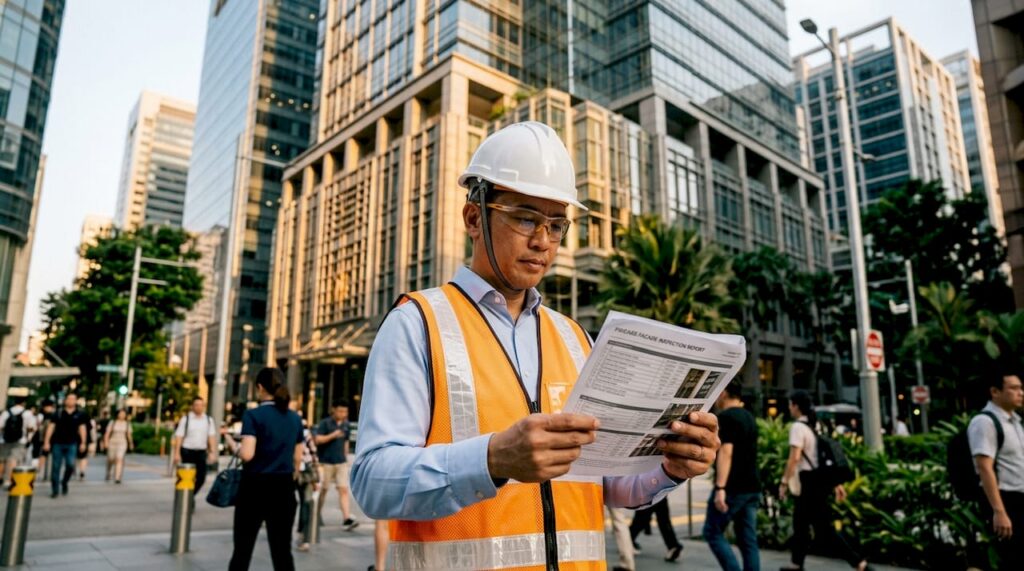
Facade inspection standards for Singapore buildings are defined under the Building Control (Periodic Inspection of Buildings and Building Facades) Regulations 2021, which mandate that qualified professionals assess building exteriors on a fixed schedule to protect public safety. Known formally as Periodic Facade Inspection (PFI), this requirement applies to buildings over 20 years old and taller than 13 meters, covering condominiums, offices, shopping centers, and commercial properties across Singapore. The Building and Construction Authority (BCA) enforces these requirements, and non-compliance carries serious legal consequences. Property developers, architects, and contractors who understand the full scope of these obligations avoid costly penalties and protect their projects.
1. What are the key Singapore facade inspection standards and regulations?
The primary legal framework governing facade inspection standards for Singapore buildings is the Building Control (Periodic Inspection of Buildings and Building Facades) Regulations 2021. This regulation requires facade inspections every 7 years for qualifying buildings. That seven-year cycle is not optional. It is a statutory obligation enforced by BCA.
The scope of these inspections is broad. Facade elements covered include:
- Plastering and paint finishes
- Tiled facades and stone cladding
- Glass curtain walls and aluminum cladding
- Windows, fixtures, and sealant joints
- Visible defects such as cracked tiles, loose cladding, spalling concrete, corroded anchors, and sealant failure
Beyond the main regulation, TR 78 sets the technical reference for using Unmanned Aircraft Systems (drones) in facade inspections. This standard governs how drone operators must conduct aerial surveys to meet BCA reporting requirements. Operators must hold Civil Aviation Authority of Singapore (CAAS) licenses and activity permits to legally fly drones for this purpose.
Non-compliance with PFI requirements carries severe consequences. Fines reach up to $20,000, and imprisonment is possible in serious cases. That level of penalty reflects how seriously Singapore treats facade safety as a public risk issue.
2. Who qualifies as a competent person and facade inspector?
BCA requires that a Competent Person (CP) oversees every PFI exercise. The CP must hold relevant qualifications and experience in building inspection or structural engineering. This is not a role that any licensed contractor can fill.
Key qualification requirements include:
- The CP must be a registered Professional Engineer (PE) or an architect with relevant experience
- The CP may appoint registered facade inspectors to assist with physical inspection work
- PE endorsement is mandatory for all facade inspection reports submitted to BCA
- Facade inspectors should hold certifications recognized by bodies such as the Institution of Engineers Singapore (IES) or the Association of Consulting Engineers Singapore (ACES)
- Work-at-height certifications are required for personnel conducting physical access inspections
Using an unqualified inspector creates compounding problems. BCA will reject the report, triggering a full re-inspection at the building owner’s cost. Legal liability also shifts to the building owner when unqualified parties conduct statutory inspections.
Pro Tip: Always verify that your appointed CP is listed on the BCA register before signing any inspection contract. A quick check prevents expensive report rejections.
The role of the Professional Engineer in this process extends beyond signing a document. The PE takes on legal responsibility for the accuracy and completeness of the inspection report. That accountability is why PE endorsement is non-negotiable for BCA submission.
3. What methods and technologies are used in facade inspections?
Facade inspection methods in Singapore range from traditional physical access techniques to modern drone-based surveys. Each method has specific applications, cost profiles, and compliance requirements.
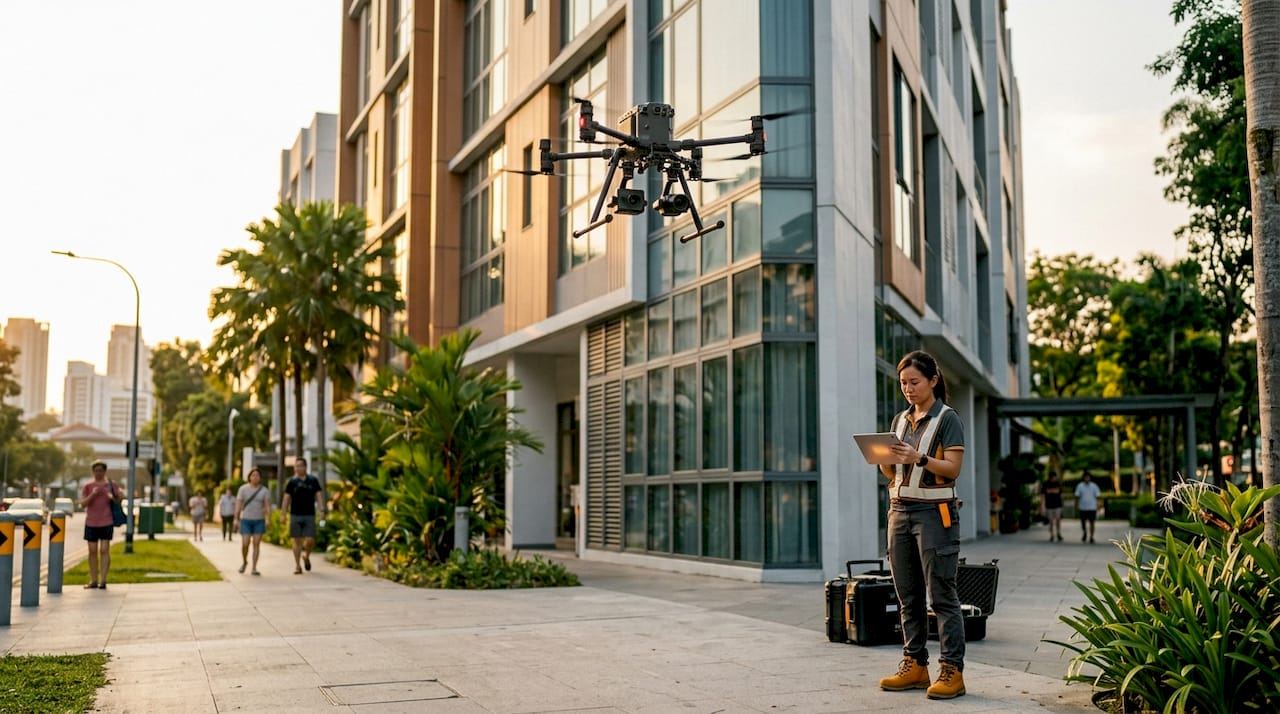
Traditional methods include rope access, scaffolding, and boom lifts. These allow inspectors to physically touch and probe facade elements. They are effective for detecting subsurface defects and conducting tap tests on tiled surfaces. The limitation is time and cost. Rope access and scaffolding setups for a mid-rise building can take one to two weeks to complete.
Drone inspections under TR 78 have changed the efficiency equation. Drone inspections complete in one to two days versus one to two weeks for rope access. Reports are delivered within three to five working days with full BCA-compliant documentation. That speed advantage is significant for developers managing tight project timelines.
Thermal imaging adds another layer of detection capability. Thermal imaging detects hidden moisture, insulation defects, and early-stage spalling that visual inspection alone misses. Borescopes serve a similar purpose for inspecting concealed cavities and joints.
| Method | Typical Duration | Key Advantage | Key Limitation |
|---|---|---|---|
| Rope access | 1–2 weeks | Physical contact testing | High cost, safety risk |
| Scaffolding | 1–2 weeks | Full facade access | Expensive, disruptive |
| Boom lift | 2–5 days | Flexible positioning | Limited to accessible areas |
| Drone (TR 78) | 1–2 days | Fast, safe, cost-effective | Requires CAAS licensing |
| Thermal imaging | Add-on to above | Detects hidden defects | Requires specialist analysis |
Pro Tip: Combine drone visual surveys with targeted rope access for tap testing on suspect areas. This hybrid approach satisfies BCA requirements while keeping costs lower than full rope access coverage.
For drone facade inspection to count toward BCA compliance, the service provider must hold CAAS licensing and operate under TR 78 protocols. Using an unlicensed hobbyist drone operator produces an invalid report.
4. How much does facade inspection cost in Singapore?
Facade inspection pricing in Singapore varies significantly based on building height, facade complexity, inspection method, and report scope. Understanding the cost structure helps developers and contractors budget accurately and avoid surprise expenses.
PFI projects for mid-to-high rise buildings typically cost $10,000 to $20,000. Drone-only inspections cost $1,500 to $4,000, excluding PE fees. PE endorsement fees add $5,000 to $10,000 on top of inspection costs.
| Cost Component | Typical Range | Notes |
|---|---|---|
| Full PFI (mid-to-high rise) | $10,000–$20,000 | Includes inspection and report |
| Drone-only inspection | $1,500–$4,000 | Excludes PE endorsement |
| PE endorsement fee | $5,000–$10,000 | Mandatory for BCA submission |
| Re-inspection (non-compliant) | Variable | Avoidable with qualified providers |
The drone-only figure looks attractive, but it is incomplete without PE endorsement. A report without PE sign-off cannot be submitted to BCA. Developers who select the cheapest drone provider without confirming PE arrangement end up paying twice.
Factors that push costs toward the higher end include complex facade geometries, mixed cladding materials, buildings with restricted access zones, and reports requiring detailed remediation schedules. For a detailed breakdown of BCA inspection pricing, the variables are consistent with structural inspection cost drivers.
5. What are best practices for compliance and safety in Singapore facade inspections?
Compliance with Singapore facade safety regulations requires more than scheduling an inspection. The following practices define the difference between a clean BCA submission and a costly rejection.
- Verify CAAS licensing for drone providers. Using accredited drone providers with CAAS licensing ensures TR 78 compliance. Request the provider’s license number before signing any contract.
- Engage a registered PE for report endorsement. PE endorsement is legally required. Confirm the PE’s registration status with the Professional Engineers Board (PEB) Singapore before engagement.
- Schedule inspections well ahead of BCA deadlines. BCA inspection notices specify submission deadlines. Late submissions attract penalties. Build in at least three months of lead time for larger buildings.
- Prepare the building for inspection access. Clear mechanical room access, confirm lift availability for inspectors, and notify tenants of inspection dates. Restricted access delays inspections and increases costs.
- Document and remediate defects promptly. BCA requires that identified defects be rectified within specified timeframes. Maintain a defect register and track remediation progress against the inspection report.
- Integrate facade inspection into facility management cycles. Buildings that conduct interim visual checks between PFI cycles catch deterioration early. This reduces the scope of defects found during statutory inspections.
- Use experienced facade inspectors with verifiable track records. Request references from previous PFI projects. Inspectors who have worked on similar building types deliver more accurate defect assessments.
Selecting a service provider based on price alone is the most common compliance mistake property developers make. The cost of a rejected BCA report, including re-inspection fees and potential penalties, consistently exceeds the savings from choosing the cheapest option.
Pro Tip: Ask your inspection provider for a sample BCA-compliant report before engaging them. A provider who cannot produce a sample report has likely never submitted one successfully.
Reading your BCA inspection notice correctly is the first step toward meeting every deadline and requirement it contains.
Key Takeaways
Facade inspection compliance in Singapore requires qualified professionals, BCA-aligned methods, and timely documentation to avoid fines of up to $20,000 and report rejections.
| Point | Details |
|---|---|
| Mandatory inspection cycle | BCA requires PFI every 7 years for buildings over 20 years old and taller than 13 meters. |
| PE endorsement is non-negotiable | All facade inspection reports submitted to BCA must carry a registered Professional Engineer’s endorsement. |
| Drone inspections require CAAS licensing | TR 78-compliant drone surveys must be conducted by CAAS-licensed operators to produce valid BCA reports. |
| Cost ranges vary widely | Full PFI costs $10,000–$20,000; drone-only inspections start at $1,500 but require separate PE fees of $5,000–$10,000. |
| Non-compliance penalties are severe | Fines reach up to $20,000, and using unqualified inspectors invalidates reports and triggers costly re-inspections. |
Facade inspection in Singapore: what the industry gets wrong
The conversation around facade inspection in Singapore has shifted dramatically toward drone technology, and for good reason. Speed, safety, and cost efficiency are real advantages. But I have seen developers treat drone adoption as a compliance shortcut rather than a compliance tool, and that distinction matters enormously.
The most persistent problem is the separation between inspection execution and PE endorsement. Developers engage a drone operator, receive a visually impressive report, and assume the job is done. Then BCA rejects the submission because no registered PE has endorsed it. The re-inspection cost and the penalty exposure are entirely avoidable.
Qualified Professional Engineers are not just signatories. They carry legal liability for the accuracy of what they endorse. That accountability is what gives the report its legal standing. Developers who understand this stop treating PE endorsement as an add-on and start treating it as the core of the compliance process.
The other trend worth watching is thermal imaging integration. Buildings with older tile facades and aging sealant systems benefit significantly from thermal surveys that catch moisture ingress before it becomes structural spalling. The upfront cost of thermal imaging is modest compared to the remediation bill for undetected water damage.
My advice to property developers and contractors: select your inspection team based on their BCA submission track record, not their drone footage quality. The report is what BCA evaluates.
— Aman
Stellar Structures’ facade inspection services for Singapore compliance
Stellar Structures provides facade and structural inspection services aligned with BCA regulations, TR 78 requirements, and the Building Control (Periodic Inspection of Buildings and Building Facades) Regulations 2021. The firm’s team includes registered Professional Engineers who endorse inspection reports for BCA submission, covering the full compliance chain from physical inspection through authority filing.
Stellar Structures handles PFI projects across residential, commercial, and industrial building types, including drone-based surveys conducted by CAAS-licensed operators. For developers and contractors who need PE inspection services that meet every BCA requirement without report rejections, Stellar Structures offers a direct path from inspection to compliant submission. Contact the team to discuss your building’s PFI timeline and scope.
FAQ
What triggers a mandatory facade inspection in Singapore?
BCA mandates a Periodic Facade Inspection for buildings over 20 years old and taller than 13 meters, required every 7 years under the Building Control (Periodic Inspection of Buildings and Building Facades) Regulations 2021.
Can a drone inspection alone satisfy BCA facade inspection requirements?
A drone inspection satisfies the survey component only if conducted by a CAAS-licensed operator under TR 78. The report still requires Professional Engineer endorsement before BCA will accept it.
What happens if a building owner misses the PFI deadline?
Non-compliance with facade inspection requirements can result in fines of up to $20,000 or imprisonment. BCA enforces these penalties under the Building Control Act.
How long does a facade inspection take in Singapore?
Drone-based inspections complete in one to two days, with reports delivered within three to five working days. Traditional rope access or scaffolding methods take one to two weeks for a comparable building.
Who is legally responsible for the facade inspection report?
The appointed Competent Person, typically a registered Professional Engineer, carries legal responsibility for the accuracy and completeness of the inspection report submitted to BCA.
Recommended
- Structural & Façade Inspections in Singapore
- Periodic Facade Inspection for CBD buildings in Singapore – Stellar Structures
- Building Owners in Singapore Must Conduct Periodic Facade Inspections Regularly Now – Stellar Structures
- Section 28 Building Control Act: Your Legal Obligations Summary