




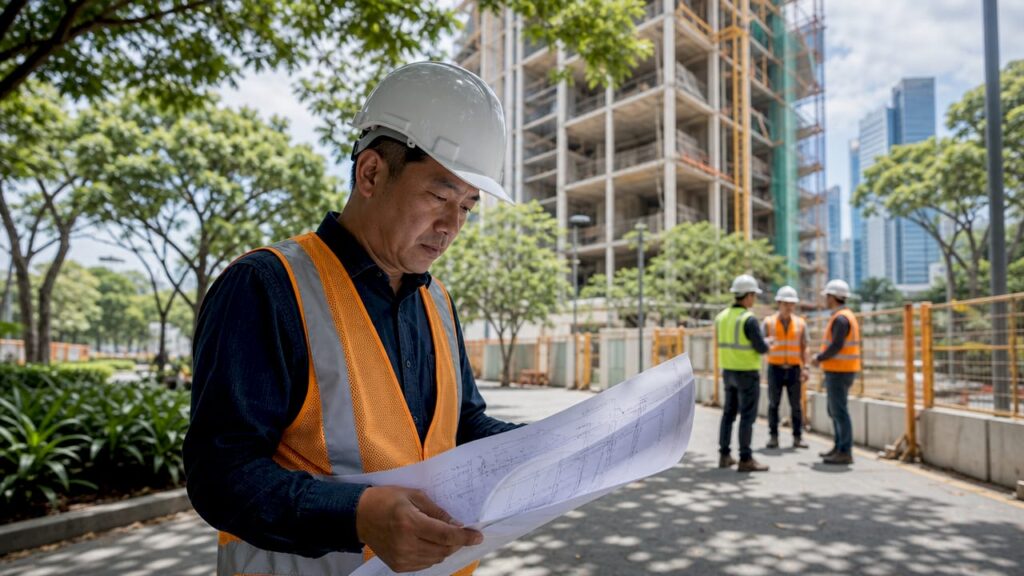
The principal contractor in Singapore is defined as the legally appointed party responsible for planning, managing, coordinating, and ensuring safety compliance across all phases of a construction project involving multiple contractors. This role carries direct accountability under the Workplace Safety and Health (WSH) Act and the Building Control Act, making it the central operational authority on any qualifying site. The role of principal contractor in Singapore extends beyond physical construction management. It covers subcontractor integration, regulatory liaison with agencies such as the Building and Construction Authority (BCA) and the Ministry of Manpower (MOM), and the creation of documented compliance trails that satisfy government inspections. Non-compliance risks penalties up to S$200,000 or two years imprisonment, which underscores why understanding this role matters for every developer and property owner.
What are the primary duties of a principal contractor in Singapore?
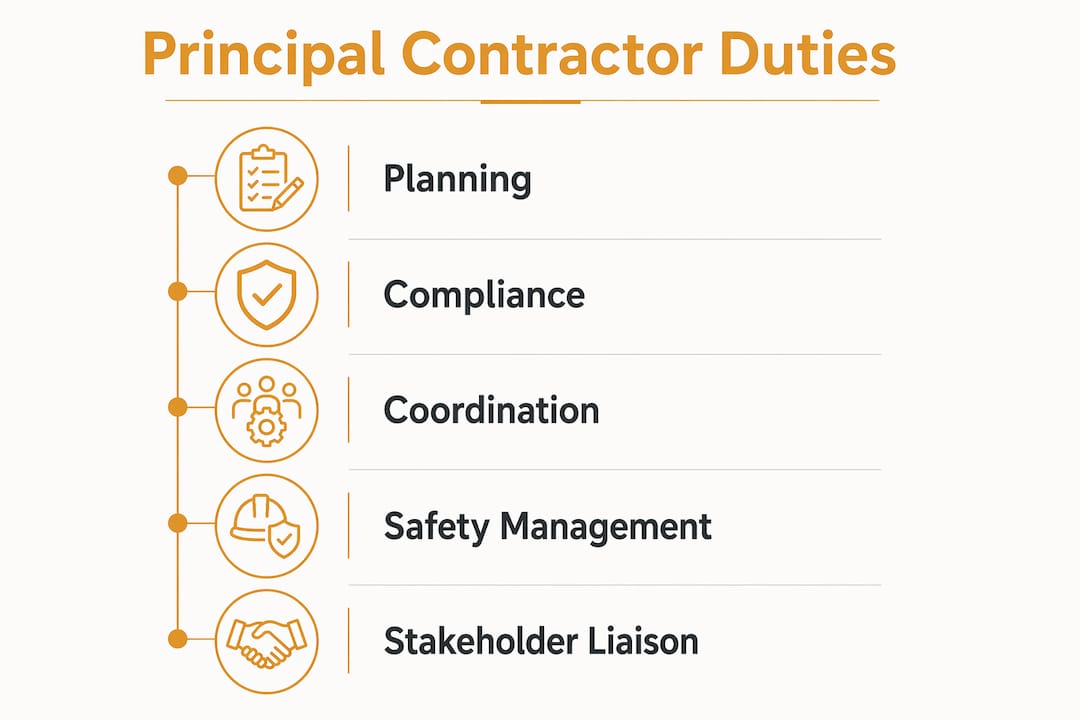
The principal contractor serves as the central authority overseeing all construction phases, with statutory duties defined by the WSH Act and the Building Control Act. These two pieces of legislation set the minimum standard for site safety, documentation, and subcontractor management. Failing to meet either framework exposes the principal contractor and the project owner to serious legal consequences.
The core statutory duties include:
- Safety Management System (SMS) implementation. The principal contractor must establish and maintain a documented SMS covering hazard identification, risk assessment, and incident reporting for the entire site.
- bizSAFE certification compliance. bizSAFE certification is mandatory for the principal contractor and, on most projects, subcontractors must hold at least bizSAFE Level 3 before gaining site access. bizSAFE Star is the highest tier and signals a mature safety culture.
- Documentation for authority approvals. The principal contractor must maintain a complete compliance trail to pass inspections and secure approvals such as the Temporary Occupation Permit (TOP). Failing regulatory inspections can halt work and generate significant cost overruns.
- Subcontractor compliance oversight. Every subcontractor on site must be integrated into the principal contractor’s SMS. The principal contractor is responsible for verifying their credentials and safety status before work begins.
- WSH Officer or WSH Coordinator appointment. The correct appointment depends on project risk level and scale. Incorrect appointments trigger enforcement actions under the WSH Act.
Understanding builder responsibility in Singapore requires recognizing that the principal contractor cannot delegate ultimate accountability. Even when subcontractors carry out the physical work, the principal contractor remains the legally responsible party for site safety outcomes.
Pro Tip: Keep a live compliance register that tracks each subcontractor’s bizSAFE status, insurance certificates, and method statements. Auditors from MOM can request this documentation with little notice, and a gap in the register is treated the same as a gap in compliance.

How does the principal contractor coordinate stakeholders and subcontractors?
The coordination function of the principal contractor often determines project success more than technical skill alone. A project with excellent engineering but poor coordination will still experience delays, cost overruns, and regulatory friction. The principal contractor sits at the center of a web connecting property owners, architects, structural and M&E engineers, and multiple specialist subcontractors.
Effective coordination follows a structured sequence:
- Pre-construction planning. The principal contractor reviews architectural and engineering drawings to identify trade dependencies. Floors cannot be finished before plumbing is roughed in. Electrical conduits must be set before concrete is poured. Proper sequencing prevents the costly delays that come from sequence errors.
- Procurement alignment. The principal contractor tracks material lead times and adjusts the construction program when supply chain disruptions occur. A delayed steel delivery, for example, must trigger a revised sequence for dependent trades.
- Authority liaison. The principal contractor coordinates with BCA, LTA, SCDF, and PUB for permits, utility connections, and inspections. Established relationships with authorities like PUB and SCDF measurably improve project flow by reducing inspection wait times.
- Daily site meetings. Daily communication frameworks such as site toolbox meetings and weekly written status reports allow the principal contractor to identify problems before they become stoppages.
- Subcontractor integration. Each new trade entering the site receives a site-specific induction covering emergency procedures, restricted zones, and the SMS requirements they must follow.
The principal contractor also manages authority submissions for regulatory clearances, coordinating the timing of inspections to minimize disruption to ongoing work. This requires advance scheduling with multiple agencies whose inspection calendars do not always align.
Pro Tip: Build a master inspection calendar at project start that maps every anticipated authority inspection against the construction program. Share it with all subcontractors so they can plan their work sequences around inspection windows rather than reacting to them.

What qualifications and licenses must a principal contractor hold?
Mandatory credentials for a principal contractor in Singapore are defined by BCA and MOM. Holding the correct licenses is not optional. A contractor operating without the required credentials cannot legally serve as the principal contractor on a qualifying project.
| Credential | Issuing Body | Requirement |
|---|---|---|
| BCA Builder’s Licence (e.g., CR09 for general building) | Building and Construction Authority | Required before undertaking any building works as principal contractor |
| bizSAFE Level 3 (minimum) | Workplace Safety and Health Council | Mandatory for site access and project appointment |
| bizSAFE Star | Workplace Safety and Health Council | Highest tier; required or preferred on larger public and commercial projects |
| WSH Officer registration | Ministry of Manpower | Required on higher-risk or larger-scale projects |
| WSH Coordinator registration | Ministry of Manpower | Required on lower-risk projects where a full WSH Officer is not mandated |
The BCA Builder’s Licence grade determines the scope and value of projects a contractor can undertake. CR09 covers general building works, but specialist works such as piling or structural steelwork require separate specialist trade licenses. A contractor holding only a general building license cannot legally self-perform specialist trades as principal contractor.
Common pitfalls include allowing licenses to lapse during a project, appointing a WSH Coordinator on a project that legally requires a WSH Officer, and failing to verify that subcontractors hold current bizSAFE status. Non-compliance with bizSAFE requirements among subcontractors is a frequent cause of immediate work stoppages. Understanding building plan submission requirements helps principal contractors anticipate the documentation BCA expects at each project stage.
What practical challenges do principal contractors face in Singapore?
The daily complexity of the principal contractor role is consistently underestimated by developers and property owners. Managing a single subcontractor is straightforward. Managing ten or more specialist trades simultaneously, each with different bizSAFE statuses, work schedules, and regulatory obligations, requires a level of operational discipline that goes beyond construction knowledge.
The most common practical challenges include:
- Safety integration across multiple subcontractors. Each subcontractor brings its own safety culture and practices. The principal contractor must align all of them to a single SMS. A subcontractor with bizSAFE Level 1 cannot simply be waved onto a site where Level 3 is required.
- Regulatory authority conflicts. Regulatory bodies cause more timeline volatility than physical construction in some projects. SCDF fire safety checks, PUB utility inspections, and BCA structural reviews do not always coordinate with each other, and the principal contractor must manage all of them simultaneously.
- Supply chain disruptions. Material delays shift the critical path. The principal contractor must resequence trades quickly to keep other work progressing while waiting for delayed materials.
- Documentation volume. The compliance trail required for a TOP application includes method statements, risk assessments, inspection records, and test certificates from every trade. Assembling this documentation retroactively is far more costly than maintaining it in real time.
- Subcontractor vetting gaps. Developers sometimes pressure principal contractors to accept the lowest-cost subcontractors. A subcontractor without current credentials creates a compliance liability for the entire project.
Reviewing engineering safety best practices specific to Singapore helps principal contractors build site protocols that address these challenges before they become enforcement issues. Effective subcontractor onboarding processes also reduce the risk of credential gaps appearing mid-project.
Key Takeaways
The principal contractor in Singapore holds legally defined accountability for site safety, regulatory compliance, and subcontractor coordination that cannot be delegated to any other party on the project.
| Point | Details |
|---|---|
| Legal accountability is non-delegable | The principal contractor remains liable under the WSH Act and Building Control Act regardless of subcontractor actions. |
| Compliance documentation is the primary deliverable | A complete compliance trail is required to pass inspections and secure the Temporary Occupation Permit. |
| Credentials must be current throughout the project | BCA Builder’s Licence, bizSAFE status, and WSH appointments must remain valid from appointment to project completion. |
| Coordination determines project outcomes | Daily site meetings, sequencing plans, and authority liaison prevent delays more reliably than construction speed alone. |
| Subcontractor vetting is a principal contractor duty | Every subcontractor must meet bizSAFE requirements before site access, and the principal contractor is responsible for verifying this. |
Why developers consistently underestimate the principal contractor’s role
The most persistent misconception I encounter is the belief that appointing a principal contractor transfers all project risk away from the developer. Owners retain accountability for appointing a competent principal contractor, and that accountability does not disappear once the contract is signed. I have seen projects stall not because of construction problems but because the principal contractor lacked the authority relationships needed to move inspections forward.
The coordination aspect of this role is what separates average projects from well-executed ones. Technical competence is a baseline requirement. What actually drives project success is the principal contractor’s ability to communicate clearly, document consistently, and manage competing demands from multiple agencies without losing the construction program. Developers who engage a qualified principal contractor early, before design is finalized, gain a significant advantage. Early involvement allows the principal contractor to flag constructability issues, sequence dependencies, and authority submission timelines before they become costly problems on site.
My strongest advice to property owners is this: verify credentials before appointment, not after. Check the BCA Builder’s Licence grade, confirm bizSAFE status, and ask specifically about the contractor’s experience with the relevant regulatory agencies for your project type.
— Aman
How Stellar Structures supports your construction project in Singapore
Stellar Structures works alongside principal contractors and project owners to deliver architectural design for commercial buildings that is fully aligned with Singapore’s regulatory requirements, including BCA, URA, SCDF, and PUB. The firm’s engineers and architects understand the compliance demands that principal contractors face and design with those constraints built in from the start.

When design and engineering are coordinated with the principal contractor’s compliance program from the outset, authority submissions move faster and inspection outcomes improve. Stellar Structures handles authority approvals across BCA, URA, HDB, JTC, SCDF, PUB, LTA, NEA, and NParks, giving principal contractors and developers a single point of contact for design and regulatory coordination. Contact Stellar Structures to discuss how integrated design and engineering support can reduce compliance risk on your next project.
FAQ
What is the role of a principal contractor in Singapore?
The principal contractor is the legally appointed party responsible for planning, managing, and coordinating all construction phases on a project involving multiple contractors. This role carries direct accountability under the WSH Act and the Building Control Act for site safety, subcontractor compliance, and regulatory approvals.
What licenses does a principal contractor need in Singapore?
A principal contractor must hold a valid BCA Builder’s Licence at the appropriate grade for the project scope, a minimum bizSAFE Level 3 certification, and either a WSH Officer or WSH Coordinator registration depending on project risk and scale.
Can a developer delegate safety responsibility to the principal contractor?
Developers cannot fully transfer safety accountability by appointing a principal contractor. Owners retain responsibility for appointing a competent contractor, and the principal contractor holds statutory liability for site safety outcomes under the WSH Act.
What happens if a principal contractor fails a regulatory inspection?
Failed inspections can result in immediate work stoppages, enforcement actions under the WSH Act or Building Control Act, and delays to the Temporary Occupation Permit. Penalties can reach S$200,000 or two years imprisonment for serious non-compliance.
Why does subcontractor bizSAFE status matter to the principal contractor?
The principal contractor is responsible for verifying that every subcontractor meets the required bizSAFE level before site access is granted. Non-compliance among subcontractors is a direct cause of work stoppages and regulatory enforcement actions against the principal contractor.
Recommended
- Design and Build Contract Structure in Singapore: 2026 Guide
- Builder Responsibility in Singapore: 2026 Legal Guide
- Design and build contracts: Singapore developer guide
- What Is a Building Contract? Singapore Guide 2026