





Design-build risk allocation is the formal process of assigning each project risk to the party best positioned to control and manage it, consolidating design and construction liability under a single design-builder rather than splitting responsibility across multiple contracts. For construction professionals and property developers in Singapore, understanding what is a design build risk allocation means recognizing that this structure fundamentally changes who bears financial exposure when things go wrong on site. The design-build contract structure shifts primary risk away from the owner, but only when the allocation is done correctly. Poorly structured risk transfer inflates bids, damages collaboration, and ultimately costs the owner more than a balanced approach would.
What is design-build risk allocation and how does it work?
Design-build risk allocation is defined as the contractual distribution of project risks between the owner and the design-builder, where the design-builder assumes responsibility for both design errors and construction defects under a single point of accountability. This contrasts sharply with traditional delivery models, where the owner retains design risk and the contractor carries only construction risk. The consolidation of design and construction under one contract reduces the number of change orders and improves constructability management compared to traditional design-bid-build approaches. That reduction matters in Singapore’s dense urban construction environment, where project delays carry significant regulatory and financial consequences.
The standard industry term for this practice is “risk allocation,” and it operates through contract clauses that define which party bears liability for specific categories of risk. Each clause should identify the risk, assign it to one party, and state the rationale for that assignment. Generic risk matrices that lack project-specific detail often fail to capture the nuances of a given project, causing negotiation delays and raising concerns during lender due diligence. Specificity in contract language is not optional. It is the foundation of effective design build risk management.

How does design-build risk allocation differ from traditional models?
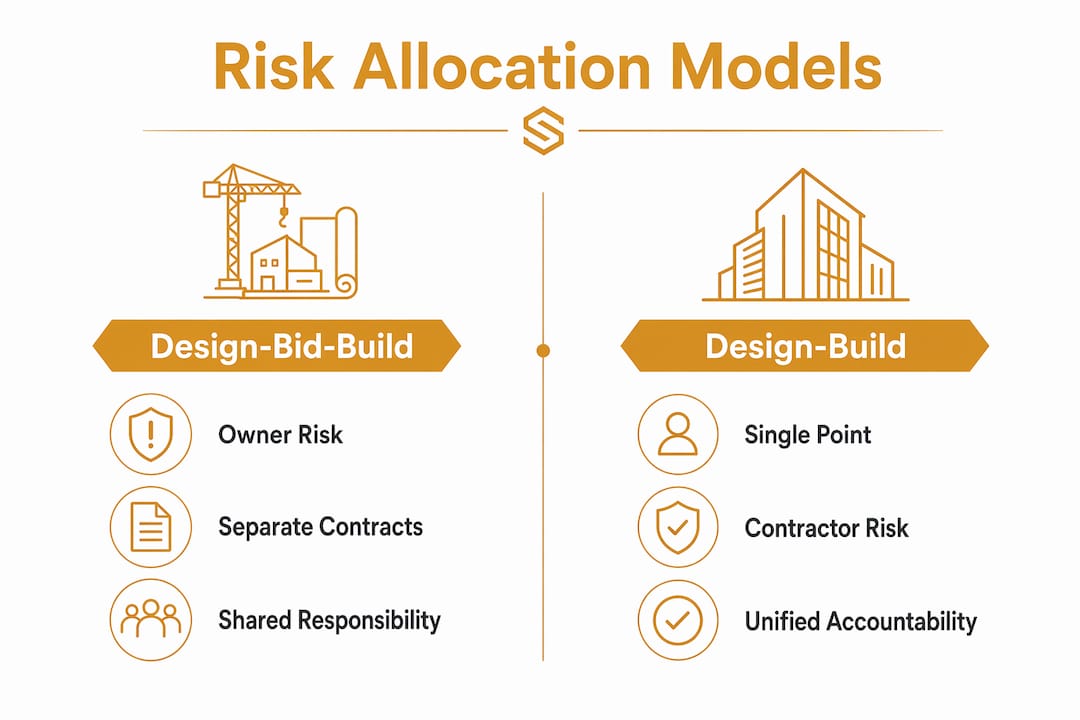
The core difference between design-build and design-bid-build risk allocation lies in accountability. In a traditional design-bid-build model, the owner contracts separately with a designer and a contractor, retaining the interface risk between those two parties. When a design error causes a construction problem, disputes over liability are common and expensive.
In a design-build model, the design-builder owns both the design and the construction outcome. The owner’s exposure to design-related change orders drops significantly. The table below summarizes how risk responsibility shifts between the two delivery models.
| Risk category | Design-bid-build (owner exposure) | Design-build (design-builder exposure) |
|---|---|---|
| Design errors and omissions | Owner retains risk | Design-builder absorbs risk |
| Constructability conflicts | Owner mediates disputes | Design-builder resolves internally |
| Schedule overruns from design changes | High owner exposure | Reduced; single contract accountability |
| Unforeseen site conditions | Typically owner-managed | Negotiated; often shared or owner-retained |
| Cost escalation from scope gaps | Owner bears cost | Design-builder manages within contract |
Understanding these design build contract differences helps developers set realistic expectations before procurement begins. The design-build model does not eliminate risk. It relocates it. Owners who assume the model removes all their exposure will be surprised when subsurface conditions or regulatory changes create claims.
What risks are commonly allocated in design-build projects?
Design-build projects carry several distinct risk categories, and the party best placed to control each risk should carry it. The following breakdown reflects standard practice in Singapore construction projects.
- Design risk: The design-builder carries full responsibility for design errors, omissions, and compliance with BCA and URA requirements. This is the defining feature of the design-build model.
- Construction execution risk: Labor productivity, material procurement, and workmanship quality rest with the design-builder. The owner has no direct role in managing these variables.
- Geotechnical and subsurface risk: This is the most contested category. Owners who commission thorough site investigations before tendering enable fair risk pricing. Without baseline data, design-builders price in large contingencies.
- Regulatory and authority approval risk: In Singapore, approvals from BCA, URA, HDB, JTC, SCDF, PUB, LTA, NEA, and NParks each carry their own timeline and compliance risks. These are typically shared, with the design-builder managing submissions and the owner bearing risk for policy changes outside the design-builder’s control.
- Unforeseen conditions risk: Fixed-price contracts often push this risk to the design-builder, but fixed-price structures lead to inflated bids as contractors price in worst-case scenarios. Cost-plus or shared-cost models produce more accurate pricing.
- Third-party and interface risk: Risks from adjacent properties, utility diversions, and public access are typically owner-retained unless the design-builder has direct control over those interfaces.
Pro Tip: Require the design-builder to submit a project-specific risk register at tender stage, not a generic matrix. Each risk entry should name the responsible party, the trigger condition, and the cost-sharing mechanism. This one requirement eliminates most post-contract disputes.
Why does equitable risk allocation matter for project costs?
Equitable risk allocation directly controls project cost. When owners transfer risks that the design-builder cannot reasonably control, the design-builder prices those risks into the bid at a premium. Government guidance on risk pricing approaches explicitly cautions against placing all risks on the design-builder, noting that excessive transfer inflates contract margins without delivering value. The owner pays more and gains no additional protection.
“Risk transfer is often confused with value for money. True value comes from allocating risks where they can be controlled efficiently. Owners who seek to shift all risk undermine collaboration and risk project difficulties.”
This principle applies directly to Singapore’s construction market, where a limited pool of qualified design-build contractors means that aggressive risk transfer reduces the number of competitive bids. Fewer bids produce higher prices. The role of architect design-build contracts in Singapore reinforces this point: equitable risk sharing from the outset sets the tone for the entire project relationship.
Collaboration initiated early in procurement is the single most effective tool for balanced risk allocation. Early procurement collaboration allows owners and design-builders to identify risks jointly, agree on allocation before contract execution, and avoid the adversarial dynamic that inflates costs and delays projects. Owners who treat risk allocation as a negotiation tactic rather than a project management tool consistently experience cost overruns.
Pro Tip: Run a pre-tender risk workshop with shortlisted design-builders before issuing the final contract. The risks they flag will reveal gaps in your project brief and give you accurate pricing data before you commit.
How do geotechnical baseline reports support fair risk allocation?
Geotechnical risk is the category most likely to generate disputes in Singapore design-build projects. The city-state’s varied subsurface geology, including soft marine clay in reclaimed areas and hard granite in the central region, means that ground conditions can change significantly across a single site. Owners who provide comprehensive geotechnical data before bidding enable design-builders to price accurately and reduce contingency allowances.
A Geotechnical Baseline Report (GBR) is the standard tool for managing this risk. A GBR defines the expected ground conditions against which the design-builder prices the work. When actual conditions exceed the baseline, the contract triggers a cost-sharing or owner-liability mechanism. When conditions fall within the baseline, the design-builder absorbs the cost. This structure removes the guesswork from subsurface pricing and gives both parties a clear, objective reference point for any claim.
| GBR element | Function | Risk allocation impact |
|---|---|---|
| Baseline ground conditions | Defines expected soil and rock parameters | Design-builder prices within baseline; owner covers deviations |
| Site investigation data | Provides factual subsurface records | Reduces design-builder contingency; improves bid accuracy |
| Deviation trigger clauses | Specifies conditions that activate cost-sharing | Prevents disputes by pre-agreeing liability thresholds |
| Owner-retained risk schedule | Lists conditions outside design-builder control | Clarifies owner exposure before contract execution |
A geotechnical engineering consultant should prepare the GBR before tender documents are issued. Commissioning the GBR after contract award removes its primary benefit: giving design-builders the data they need to price fairly. The Singapore Foundation Engineering Guide provides detailed guidance on baseline reporting standards applicable to local foundation projects.
Contractual risk-sharing clauses that reference the GBR baseline prevent costly disputes by establishing an objective standard before work begins. Without a GBR, every unexpected ground condition becomes a negotiation, and negotiations mid-construction are expensive for both parties.
Key Takeaways
Effective design-build risk allocation assigns each risk to the party best positioned to control it, reducing total project cost and preventing the adversarial disputes that fixed-price, all-risk-transfer contracts routinely produce.
| Point | Details |
|---|---|
| Single-point accountability | Design-build consolidates design and construction risk under one entity, reducing owner exposure to interface disputes. |
| Equitable allocation reduces cost | Transferring uncontrollable risks to the design-builder inflates bids; balanced allocation produces accurate, competitive pricing. |
| GBRs define subsurface risk | Geotechnical Baseline Reports set objective ground condition standards, preventing costly mid-construction disputes. |
| Early collaboration is critical | Risk workshops before contract execution allow joint risk identification and prevent adversarial pricing. |
| Project-specific risk registers | Generic risk matrices miss project-specific exposures; each risk entry must name the responsible party and trigger condition. |
Risk allocation lessons from Singapore project experience
The most persistent mistake I see in Singapore design-build projects is owners treating risk allocation as a legal formality rather than a project management decision. The contract gets drafted, risks get assigned in bulk to the design-builder, and everyone assumes the problem is solved. It is not. The design-builder simply prices the uncontrollable risks into the contract sum, and the owner pays a premium for risks they thought they had transferred.
The second mistake is commissioning geotechnical investigations too late. I have seen projects in reclaimed land areas where the GBR was prepared after the design-builder was appointed. By that point, the design-builder had already priced in worst-case ground conditions. The GBR confirmed better conditions, but the contract price did not change. The owner paid for risk that never materialized.
Singapore’s regulatory environment adds a layer of complexity that generic risk allocation frameworks do not address. Authority approvals from BCA, URA, and JTC each carry their own timelines and policy risk. A design-builder can manage the submission process, but they cannot control a policy change or a regulatory interpretation that shifts mid-project. Owners who assign this risk entirely to the design-builder will find that no qualified contractor accepts it without a significant price premium.
The projects that run well are the ones where the owner and design-builder sit down before tender and agree on which risks each party can genuinely control. That conversation, done honestly, produces a contract that both parties can execute without constant disputes. Risk allocation is a project management tool. Use it as one.
— Aman
Professional support for design-build risk management in Singapore

Effective risk allocation in design-build projects requires technical input before contract documents are finalized. Stellar Structures provides architectural design for commercial buildings and specialized geotechnical consulting services that give developers the site-specific data and design clarity needed to allocate risks accurately at tender stage. The firm’s experience with BCA, URA, HDB, JTC, SCDF, PUB, LTA, NEA, and NParks authority submissions means that regulatory risk is identified and documented before it becomes a contract dispute. For developers and contractors working on Singapore design-build projects, early engagement with a qualified engineering and architectural team is the most cost-effective risk management decision available.
FAQ
What is design-build risk allocation in construction?
Design-build risk allocation is the contractual process of assigning each project risk to the owner or design-builder based on which party can best control and manage it. It consolidates design and construction liability under a single entity, reducing the owner’s exposure to interface disputes.
How does risk allocation differ in design-build versus design-bid-build?
In design-bid-build, the owner retains the risk between the designer and contractor. In design-build, the single-contract structure transfers design and construction risk to the design-builder, reducing owner exposure to design-related change orders.
Why does transferring all risk to the design-builder increase project costs?
Risks that the design-builder cannot control get priced into the bid as contingencies. Government guidance confirms that excessive risk transfer inflates contract margins without delivering value, meaning the owner pays more for no additional protection.
What is a Geotechnical Baseline Report and why does it matter?
A Geotechnical Baseline Report defines expected ground conditions before tendering, giving design-builders an objective standard for pricing subsurface work. Conditions that exceed the baseline trigger cost-sharing mechanisms, preventing mid-construction disputes over unforeseen ground conditions.
When should risk allocation be agreed in a design-build project?
Risk allocation should be agreed before contract execution, ideally during the pre-tender phase. Early procurement collaboration allows both parties to identify and assign risks jointly, producing accurate pricing and a collaborative project relationship from the start.
Recommended
- Design and build contracts: Singapore developer guide
- Design and Build Contract Structure in Singapore: 2026 Guide
- Singapore Marine Clay & Property Settlement: Guide for Homeowners (2025)
- Singapore A&A Works (2025): Essential Guide to Hiring a BCA-Certified Builder