





Engaging a specialist subcontractor means hiring a skilled expert who takes direct responsibility for a defined scope of work within a construction project. General contractors coordinate the overall build, but specialist subcontractors deliver the technical depth that complex projects demand. In sectors like life sciences laboratory construction, M&E packages handled by specialist subcontractors can represent up to 60% of total project value. That figure alone explains why property owners, developers, and project managers need to understand exactly why engage specialist subcontractor decisions matter from day one.
Why engage a specialist subcontractor on your project?
A specialist subcontractor is a trade contractor appointed to execute a specific technical scope, such as mechanical and electrical systems, structural steelwork, geotechnical works, or facade installation. The industry term for this engagement model is “specialist subcontracting,” and it sits at the core of how modern construction projects allocate technical risk and accountability. General contractors manage program, cost, and coordination. Specialist subcontractors own the technical outcome for their defined package.
The benefits of specialist subcontractors extend well beyond simple task delegation. Engaging specialists reallocates technical mastery and risk from the general contractor to experts, improving delivery on critical-path elements. That shift matters because a general contractor who attempts to self-perform highly technical work without the required depth of expertise introduces quality and compliance risk across the entire project.

Regulatory frameworks reinforce this logic. In Singapore, authority submissions to bodies such as BCA, URA, SCDF, and LTA require demonstrated technical competence for specific scopes. Engaging a specialist subcontractor with the right credentials and track record directly supports those submission requirements and reduces the likelihood of rejection or rework.
What roles and expertise do specialist subcontractors provide?
Specialist subcontractors cover a wide range of technical disciplines, each requiring years of focused practice and certification. The most common categories in commercial and industrial construction include the following.
- Mechanical and electrical (M&E) engineers: Design and install HVAC, plumbing, fire protection, and electrical distribution systems.
- Structural specialists: Execute complex steel fabrication, post-tensioned concrete, or deep foundation systems.
- Geotechnical contractors: Handle ground improvement, piling, and earth retention works.
- Facade specialists: Install curtain wall systems, cladding, and glazing to precise weatherproofing and thermal performance standards.
- Fire protection contractors: Design and install suppression and detection systems to SCDF code requirements.
The difference between a general contractor and a specialist subcontractor is not just scope. It is depth of knowledge. A general contractor understands enough about M&E systems to coordinate them. A specialist M&E subcontractor understands the detailed engineering behind every circuit, duct size, and pressure rating. That depth is what improves project quality and ensures compliance with technical standards.
Pro Tip: When evaluating specialist subcontractors, ask for a list of completed projects in the same technical category and request references from the supervising engineer on each. Past performance on comparable scope is the most reliable predictor of delivery quality.
Technical mastery also transfers to the project team. Specialist subcontractors often identify design conflicts, constructability issues, and code gaps during their pre-construction review. That input, when captured early, prevents costly variations during construction.
How does engaging specialists reduce project risk and improve compliance?
Risk reduction is one of the clearest advantages of engaging specialists. Treating subcontractor engagement as proactive risk management, rather than a procurement cost, changes how project managers structure their pre-construction phase.
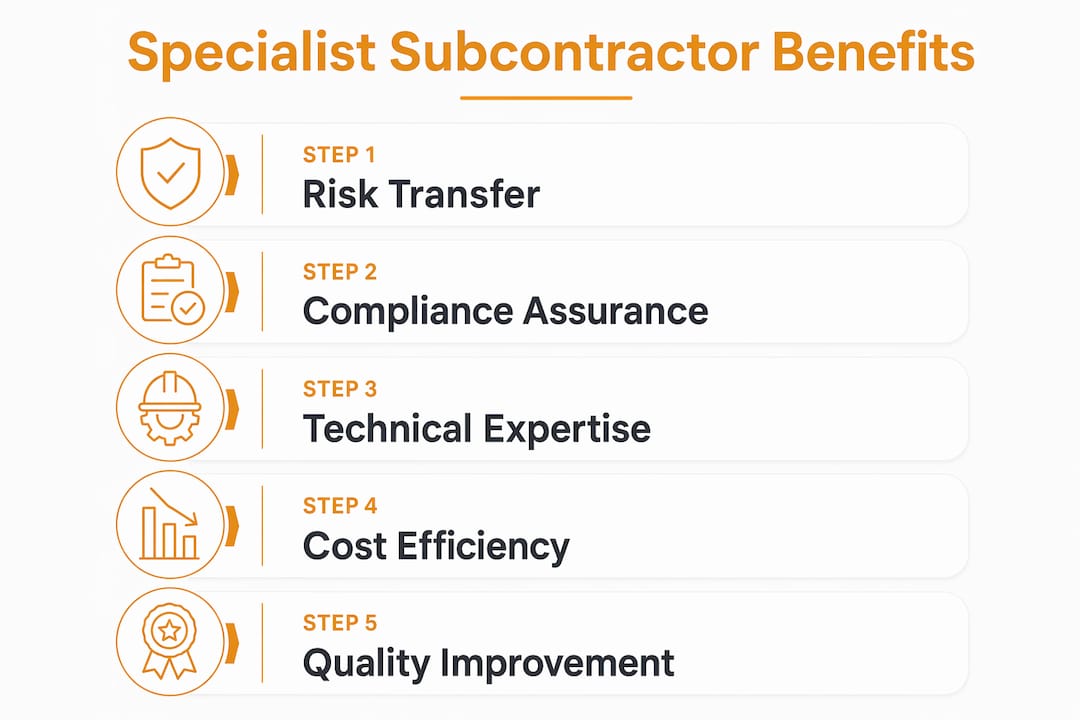
The key risk management benefits of specialist subcontractors include the following.
- Technical risk transfer: The specialist assumes accountability for the performance of their scope, reducing the general contractor’s exposure on complex packages.
- Compliance assurance: Specialists maintain current knowledge of relevant codes, standards, and authority requirements, reducing the risk of non-compliant installations.
- Capacity security: In volatile markets, early engagement locks in skilled labor and materials before shortages develop.
- Quality control: Specialists apply their own internal quality systems, adding a layer of inspection beyond the general contractor’s oversight.
Market conditions in 2026 make early engagement especially critical. M&E inflation is running at 4.2% year over year. That rate means a project that delays specialist appointment by six months faces measurably higher costs and reduced availability of skilled trades.
Failing to secure early commitments from specialist subcontractors in niche sectors causes project fragility. In life sciences and other technically demanding sectors, Pre-Construction Services Agreements (PCSAs) with key specialists are not optional. They are the mechanism that holds the program together before a main contract is signed.
For projects requiring compliance with LTA frameworks or SCDF submissions, the specialist subcontractor’s documented competence forms part of the authority submission package. Appointing an unqualified subcontractor to a regulated scope creates a compliance gap that can halt a project entirely.
What are the cost, budget, and timeline implications of hiring specialist subcontractors?
Budget allocation for specialist subcontractors follows a consistent pattern across construction project types. Project budgets typically allocate 25–40% of subcontracted revenue to specialist subcontractor costs. That proportion reflects the technical complexity and material intensity of specialist scopes.
The table below summarizes the key financial and scheduling parameters project managers should plan for.
| Parameter | Typical Range | Implication |
|---|---|---|
| Budget allocation for specialist subcontractors | 25–40% of subcontracted revenue | Plan this as a fixed cost category, not a contingency item |
| Management time for subcontractor oversight | 10–20% of project timeline | Assign a dedicated coordinator, not a shared resource |
| M&E cost inflation (2026) | 4.2% year over year | Early appointment locks in pricing before escalation |
| Pre-qualification administrative cost | Variable by scope count | Consolidating related scopes under fewer subcontractors reduces this burden |
Management overhead is the cost that project managers most consistently underestimate. Successful delivery requires dedicating 10–20% of the project timeline to onboarding, quality control, and troubleshooting. Specialist subcontractors do not operate autonomously. They require briefing, feedback loops, and documented quality sign-offs at each stage.
Consolidating specialist subcontractors for related tasks reduces administrative and pre-qualification costs. Appointing a single M&E specialist group to cover mechanical, electrical, and fire protection, rather than three separate subcontractors, cuts the verification workload significantly.
Pro Tip: Build subcontractor management time into your project schedule as a named activity, not an assumed overhead. If you cannot point to a specific line in your program for subcontractor coordination, you have not budgeted for it.
The financial case for specialist subcontractors also includes a structural benefit. Engaging specialists converts fixed in-house labor costs into variable costs, giving developers and project managers the ability to scale technical resources up or down without long-term overhead commitments. That flexibility is particularly valuable on projects with phased delivery or uncertain scope.
How to effectively manage and collaborate with specialist subcontractors
Effective management of specialist subcontractors determines whether their technical expertise translates into project value. Clear contracts and documented communication prevent disputes and schedule delays. The following practices define the standard for high-performing subcontractor relationships.
-
Define scope precisely in the contract. Ambiguous scope boundaries are the primary cause of subcontractor disputes. Every interface between the specialist’s scope and adjacent packages must be documented before work begins.
-
Establish a single point of contact on each side. Communication routed through multiple people on either side creates version control problems and delays decisions. Assign one coordinator per package.
-
Conduct structured pre-start meetings. A formal pre-start meeting covering program, quality requirements, site access, and authority submission obligations aligns expectations before mobilization.
-
Implement a documented inspection and sign-off regime. Each stage of the specialist’s work should have a defined inspection point with a written record. This protects both parties and supports authority submission documentation.
-
Vet subcontractors through pre-qualification before appointment. Pre-qualification confirms financial standing, technical competence, safety record, and relevant certifications. Skipping this step to save time creates downstream risk.
-
Use project management tools to centralize documentation. Digital platforms that track RFIs, submittals, and inspection records reduce the administrative burden and create a clear audit trail. Monitoring project management signals early helps teams identify coordination gaps before they affect the program.
-
Build the relationship, not just the contract. Specialist subcontractors who trust the project team communicate problems earlier. Early problem disclosure is the single most effective schedule protection mechanism available to a project manager.
The importance of hiring subcontractors with a proven track record in your specific project type cannot be overstated. A specialist who has completed ten similar projects brings process knowledge that no contract can replicate. Ask the right questions to ask subcontractors during vetting: What were the three biggest technical challenges on your last comparable project, and how did you resolve them?
Key Takeaways
Engaging specialist subcontractors is the most direct way to transfer technical risk, secure compliance, and control cost on complex construction projects.
| Point | Details |
|---|---|
| Specialist subcontractors own technical risk | They take accountability for complex scopes, reducing the general contractor’s exposure on critical packages. |
| Early engagement controls cost | With M&E inflation at 4.2% year over year, early appointment locks in pricing and secures skilled labor capacity. |
| Budget 25–40% for specialist costs | Plan this allocation as a fixed line item, not a contingency, to avoid mid-project budget pressure. |
| Management time is a real cost | Reserve 10–20% of the project timeline for onboarding, quality control, and coordination oversight. |
| Clear contracts prevent disputes | Precise scope definition and documented communication are the foundation of dispute-free subcontractor relationships. |
The case for specialists is stronger than most project managers admit
From my experience working across residential, commercial, and infrastructure projects in Singapore, the decision to engage specialist subcontractors is rarely the problem. The problem is when that decision comes too late or is treated as a procurement formality rather than a technical strategy.
I have seen projects where the general contractor delayed appointing an M&E specialist to protect margin, then spent three times the savings resolving installation defects and failed authority inspections. The math never works in favor of deferral. Specialist subcontractors bring not just labor but institutional knowledge of how regulators think, what inspectors look for, and where the technical risk actually sits in a given scope.
The other pattern worth naming is the tendency to underinvest in subcontractor management. Developers sometimes assume that appointing a qualified specialist means the technical problem is solved. It is not. The specialist’s expertise only delivers value when the project team maintains active oversight, clear communication, and documented quality control throughout the engagement.
The construction industry in Singapore is moving toward more technically complex projects, tighter authority submission requirements, and greater accountability for building safety. That trajectory makes the advantages of engaging specialists not just useful but necessary for any project that carries real technical or regulatory risk.
— Aman
How Stellar Structures supports projects requiring specialist expertise
Projects that involve structural, civil, or geotechnical complexity require more than coordination. They require a design and engineering partner who understands how specialist subcontractor scopes interact with authority submission requirements and overall structural integrity.

Stellar Structures provides civil and structural design checks that verify specialist subcontractor outputs against BCA, URA, and LTA requirements, reducing the risk of non-compliant submissions. The firm’s engineers work across residential, commercial, industrial, and infrastructure projects, supporting developers and project managers who need technical assurance at every stage. For projects where specialist coordination and authority compliance intersect, Stellar Structures offers the engineering depth and regulatory experience to keep your project on track.
FAQ
What is a specialist subcontractor?
A specialist subcontractor is a trade contractor appointed to execute a specific technical scope within a construction project, such as M&E systems, structural steelwork, or geotechnical works. They hold direct technical accountability for their package and operate under the overall coordination of a general contractor.
Why engage a specialist subcontractor early in a project?
Early engagement secures skilled labor capacity and locks in pricing before market escalation. With M&E inflation running at 4.2% year over year, delayed appointment directly increases cost and reduces the pool of available qualified specialists.
How much of a project budget goes to specialist subcontractors?
Project budgets typically allocate 25–40% of subcontracted revenue to specialist subcontractor costs. Management and quality control oversight requires an additional 10–20% of the project timeline.
What questions should I ask when vetting a specialist subcontractor?
Ask for a list of comparable completed projects, references from supervising engineers, current certifications relevant to your scope, and a description of how they handled the three most significant technical challenges on their last project.
How do specialist subcontractors support authority submissions in Singapore?
Specialist subcontractors with the correct credentials and documented track records provide the technical evidence required for BCA, SCDF, URA, and LTA submissions. Their competence documentation forms part of the submission package and directly affects approval outcomes.
Recommended
- Managing Subcontractors in a Design-Build Project
- Best Consultants for SCDF Submissions – Stellar Structures
- Why Engage a Structural Checker for Your Project
- Top Contractors for Your Next Home Renovation Project in Singapore