




Value engineering (VE) is defined as a systematic method for optimizing a project’s function-to-cost ratio while maintaining all essential performance, safety, and compliance requirements. The core formula is straightforward: Value = Function / Cost. Raising value means either improving function at the same cost, or delivering the same function at lower cost. For property owners, developers, and project managers, understanding what is value engineering explained in practical terms is the difference between a project that performs well over its lifetime and one that simply came in under budget. This article covers the principles, process, and real-world applications of VE in construction.
What is value engineering explained: core principles
Value engineering focuses on function first, not form or initial price. The discipline asks one question about every design decision: does this element deliver the required performance at the lowest possible lifecycle cost? That lifecycle lens is what separates VE from ordinary cost management.
Four dimensions drive every VE evaluation:
- Capital cost (capex): The upfront construction and procurement spend.
- Operational cost (opex): Energy, maintenance, and replacement costs over the building’s life. Lifecycle cost analysis typically spans 20–30 years.
- Project timeline: Schedule impacts that affect financing costs and revenue start dates.
- Risk: Probability and consequence of technical, regulatory, or supply chain failures.
A VE proposal that reduces capex but increases opex by a larger amount destroys value. The evaluation must account for all four dimensions, not just the line item being changed.
Non-negotiables must be defined before any brainstorming begins. Statutory compliance requirements, structural safety standards, and authority submission thresholds set by bodies such as BCA, URA, and LTA in Singapore are fixed constraints. Establishing these baselines early prevents teams from wasting time on options that cannot be approved or built safely.

Pro Tip: Write a one-page VE brief at project kickoff that lists non-negotiables, the approved baseline cost, and the target savings range. Teams that skip this step spend weeks evaluating options that fail on compliance grounds.
How does the value engineering process work in construction?
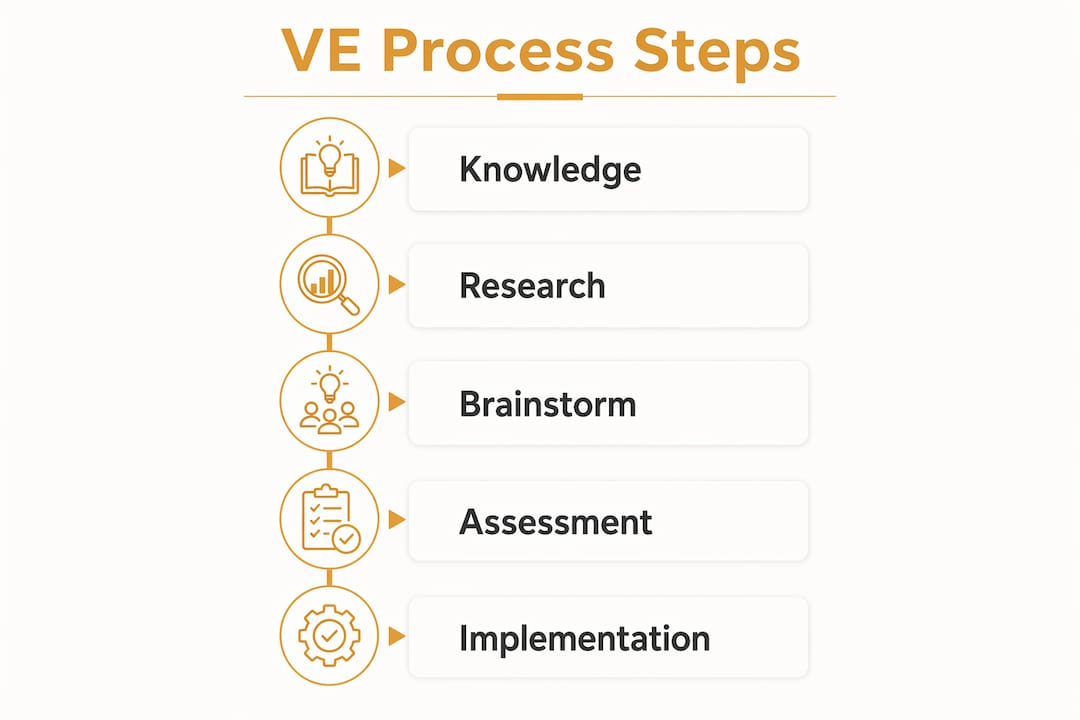
The VE process follows five structured phases. Applying them early in design development produces the greatest impact. The ability to influence cost diminishes sharply as a project moves toward the construction phase, because design decisions become locked in and change costs escalate.
-
Knowledge phase. The team collects all project documents: drawings, specifications, cost plans, and authority requirements. The goal is a shared understanding of what the project must deliver and what it currently costs.
-
Information and research phase. The team maps each major cost element to the function it performs. This is where a quantity surveyor (QS) and design leads identify which elements carry the highest cost relative to their functional contribution.
-
Innovation and brainstorming phase. VE workshops generate alternatives by defining functions broadly rather than narrowly. Instead of asking “how do we make this beam cheaper,” the team asks “how do we transfer this load at lower cost?” Broad definitions open more solution paths.
-
Assessment phase. Each alternative is scored against the four impact dimensions: capex, opex, timeline, and risk. Weighted analysis matrices and cost-risk assessments provide a defensible basis for recommendation. Teams also check each option against the non-negotiables defined in the VE brief.
-
Implementation phase. Approved alternatives are documented with full rationale, cost impact, and authority implications. Design, QS, and client collaboration at this stage produces an audit trail that protects the budget and reduces downstream variations.
Multi-disciplinary involvement is not optional. A structural engineer, architect, QS, and client representative each bring a different cost and risk perspective. Missing any one of them creates blind spots. For complex projects, a construction phase plan that integrates VE decisions with site safety and sequencing requirements reduces the risk of implementation conflicts.
Pro Tip: Issue a formal VE register from phase one. Log every proposal with its status, cost impact, and decision rationale. This document becomes the single source of truth if disputes arise during construction.
What distinguishes true value engineering from cost cutting?
Value erosion is the term for what happens when cost reductions compromise essential function, safety, or regulatory compliance. It is the most common failure mode in poorly managed VE exercises. True VE preserves safety, regulatory, and performance requirements. Value erosion sacrifices them.
The distinction shows up in several specific ways:
- Material substitution without lifecycle analysis. Specifying a cheaper waterproofing membrane that requires replacement every 10 years instead of every 25 years is not VE. The lower upfront cost is offset by higher long-term maintenance spend.
- Removing redundancy from safety systems. Reducing fire suppression coverage or structural load factors to save cost crosses an ethical and legal line. Professional engineers carry a duty to prioritize public health, safety, and welfare.
- Undocumented decisions. A cost change with no written rationale cannot be audited. Decisions reviewed against the original baseline with full documentation protect all parties from future claims.
- Scope reduction disguised as VE. Deleting a required function entirely is not engineering. It is scope reduction, and it must be treated as a formal contract variation, not a VE saving.
“Value engineering that cannot be defended against the project baseline, the authority requirements, and the lifecycle cost model is not value engineering. It is value erosion with better marketing.”
The ethical guardrail is straightforward: if a proposed change reduces the project’s ability to perform its required functions safely and compliantly over its design life, it fails the VE test regardless of the upfront saving.
What are practical examples of value engineering in construction?
Concrete applications of VE in construction fall across three main categories: material selection, structural design, and construction methodology. Each category offers genuine savings opportunities when evaluated against the full lifecycle cost model.
| VE Category | Example Option | Key Evaluation Criteria |
|---|---|---|
| Material selection | Precast concrete panels vs. in-situ formwork | Installation speed, surface finish quality, long-term durability |
| Structural design | Optimized steel section sizes | Load path efficiency, fabrication cost, fire protection requirements |
| Construction method | Top-down excavation vs. conventional | Program savings, temporary works cost, adjacent structure risk |
| Building services | Variable speed drives on HVAC systems | Higher capex offset by lower energy opex over 20–30 years |
Cost-saving substitutions must be evaluated for impact on service life, maintenance requirements, warranties, and overall return on investment. A cheaper material that voids the manufacturer’s warranty or requires specialist maintenance transfers risk back to the owner in ways that rarely appear in the initial cost comparison.
Collaboration between owners, designers, QS professionals, and contractors is the factor that most consistently separates successful VE from failed cost cutting. Owners define acceptable risk thresholds. Designers identify which specifications have flexibility. QS professionals quantify the full cost impact. Contractors flag constructability issues before they become site problems. For value engineering in design-build projects, this collaboration is built into the procurement model, which is one reason design-build often delivers stronger VE outcomes than traditional procurement.
A clean baseline is a prerequisite for measuring any VE option correctly. Without an agreed scope, specification, and cost plan as the reference point, teams cannot calculate the true impact of a proposed change. Defining this baseline before the VE exercise begins is not administrative overhead. It is the foundation of every credible cost comparison.
Common pitfalls to avoid:
- Evaluating VE options against an incomplete or outdated cost plan.
- Ignoring long-term maintenance costs and warranty implications.
- Failing to check proposed alternatives against current authority requirements.
- Approving VE changes verbally without updating the formal design documentation.
For structural projects, value engineering steel structures offers a well-documented set of techniques covering section optimization, connection design, and LEED-aligned material choices that deliver measurable savings without compromising structural performance.
Key Takeaways
Value engineering is a structured, function-first discipline that maximizes project value by evaluating every cost element against its lifecycle performance, not just its upfront price.
| Point | Details |
|---|---|
| Core formula | Value = Function / Cost; raising value means better function, lower lifecycle cost, or both. |
| Define non-negotiables first | Set statutory compliance and safety baselines before any brainstorming to avoid wasted effort. |
| Five-phase process | Apply VE during design development; cost influence drops sharply once construction begins. |
| VE vs. value erosion | True VE preserves function and safety; any change that compromises essential performance is value erosion. |
| Document every decision | A formal VE register with full rationale protects all parties and reduces downstream variations. |
Why the VE brief is the most underused tool on any project
Most VE failures I encounter share a common root cause: the team started brainstorming before anyone agreed on what “value” actually meant for that specific project. I have reviewed projects where significant cost savings were claimed through VE, only to find that the savings came from removing specified finishes the client had explicitly required, or from substituting materials that failed within five years of handover.
The VE brief fixes this. It takes less than a day to produce, and it forces every stakeholder to commit in writing to the project’s non-negotiables, the approved baseline, and the acceptable risk envelope. Every proposal generated after that point can be checked against a shared reference. Disagreements that would otherwise surface as construction disputes get resolved at the design table instead.
The second pattern I see consistently is teams treating VE as a one-time event rather than a discipline applied across the project lifecycle. The highest-value VE decisions happen during schematic and design development. By the time a project reaches tender, most of the structural and systems decisions are locked. Running a VE workshop at tender stage recovers a fraction of what early-stage VE delivers.
For civil and structural projects in Singapore, authority requirements from BCA, URA, and LTA add another layer of constraint that must be factored into every VE evaluation. Changes that look attractive on paper often require re-submission to authorities, which adds time and cost that erases the saving. Experienced teams price that risk into the VE assessment from the start.
— Aman
How Stellar Structures supports value engineering for your project
Stellar Structures applies structured value engineering principles across civil, structural, geotechnical, and architectural design projects in Singapore. The firm’s multi-disciplinary team, covering engineers, architects, and QS-aligned design leads, evaluates cost and performance trade-offs at the design stage, where changes deliver the most impact. For developers and property owners pursuing cost-effective commercial building design, Stellar Structures integrates VE into the design process from schematic stage through authority submission. The team also handles BCA, URA, HDB, JTC, and LTA submissions, so VE decisions are checked against regulatory requirements before they are locked into the design. Contact Stellar Structures to discuss how structured VE can reduce your project’s lifecycle cost without compromising compliance or performance.
FAQ
What is the value engineering definition in construction?
Value engineering in construction is a systematic process that maximizes the function-to-cost ratio of a project while maintaining all required performance, safety, and compliance standards. The core formula is Value = Function / Cost.
When should value engineering be applied in a project?
VE delivers the greatest impact during schematic design and design development. The ability to influence cost diminishes as the project moves toward construction, because design decisions become progressively harder and more expensive to change.
How is value engineering different from cost cutting?
True VE preserves essential function, safety, and regulatory compliance while reducing cost. Cost cutting that compromises any of these requirements is value erosion, not value engineering, and carries professional and legal risk for the project team.
What are the five phases of the value engineering process?
The five phases are knowledge, information and research, innovation and brainstorming, assessment, and implementation. Each phase builds on the previous one, producing a documented set of approved alternatives with full cost and risk rationale.
What role does documentation play in value engineering?
Documentation is the audit trail that protects all project parties. Every VE proposal must record its rationale, cost impact, lifecycle implications, and compliance check. Without this record, VE decisions cannot be defended against future claims or authority queries.
Recommended
- Value Engineering in Singapore’s Civil & Structural Projects
- The Ultimate Guide to Value Engineering Steel Structures: Design, Cost, & LEED
- Value Engineering Deep Excavations: Smart Steel Strutting Design
- Value Engineering Design Build Projects: A Practical Guide