





A well-constructed client brief is the foundational document that determines whether a design-build proposal succeeds or fails. Before a single drawing is produced or a cost estimate assembled, the client brief captures project goals, scope, budget, timeline, and stakeholder expectations in one authoritative reference. It is distinct from the proposal itself: the brief is an internal alignment tool, while the proposal is the polished sales document built from it. Skipping the brief causes scope creep, disputed change orders, and broken client trust. Projects with clearly defined scopes at the proposal stage experience significantly fewer change orders and higher client satisfaction scores.
Key benefits of a thorough client brief include:
- Scope clarity: Defines exactly what is and is not included, preventing mid-project disputes.
- Budget alignment: Establishes the financial framework before design work begins.
- Stakeholder consensus: Confirms decision-makers, approval processes, and revision limits upfront.
- Regulatory readiness: Identifies compliance requirements early, particularly relevant for Singapore’s BCA, URA, and HDB approval frameworks.
- Proposal efficiency: Gives the design-build team everything needed to draft a proposal without repeated client clarifications.
What should a client brief for a design-build proposal include?
A complete client brief for a design-build proposal covers twelve distinct components. Each one serves a specific function in preventing ambiguity and protecting both the client and the delivery team.
- Project title and overview: A one-line summary that any stakeholder can read and immediately understand.
- Client and contact details: Full names, roles, and contact information for the decision-maker, billing contact, and day-to-day liaison.
- Background and context: The reason the project exists now, including any regulatory triggers, business drivers, or site constraints.
- Objectives and success metrics: Measurable targets, not vague aspirations. “Deliver 12 residential units with BCA Green Mark certification by Q3 2027” is a usable objective; “build something modern” is not.
- Target users of the finished project: Residents, tenants, employees, or the public, defined with enough specificity to inform design decisions.
- Scope and deliverables: A precise list of what will be produced, including design stages, engineering submissions, and authority approvals.
- Out-of-scope exclusions: Explicitly stated items the team will not deliver. Exclusions and approval processes are the most frequently skipped sections and the most disputed when omitted.
- Mandatory requirements and constraints: Brand guidelines, structural load requirements, heritage conservation conditions, or any non-negotiable technical parameters.
- Budget and pricing basis: The confirmed range or fixed figure, structured as fixed-price, milestone-based, or provisional sum, so the design team scopes realistically from the start.
- Timeline and key milestones: Estimated start, authority submission dates, construction phases, and practical completion target.
- Approval and sign-off process: Who approves each stage, how feedback is collected, and how many revision rounds are included before additional fees apply.
- References and assets: Existing drawings, geotechnical reports, site photographs, or design precedents the client has provided.
Visuals belong in the brief as well as the proposal. Floor plan sketches, site photographs, and reference images help translate verbal requirements into spatial concepts before the design team commits resources. 3D renderings and floor plans are the highest-leverage visual elements for accelerating client decisions.
Pro Tip: Use a two-column checklist table in the brief itself, with each component in the left column and the client’s confirmed input in the right. This format makes gaps immediately visible during the sign-off review.
How do you build a repeatable client brief process?
Standardizing the client brief process is what separates firms that win projects consistently from those that rely on individual effort each time. Contractors who standardize their proposal processes for completeness and professionalism win more projects at higher prices. The same principle applies to the brief that precedes every proposal.
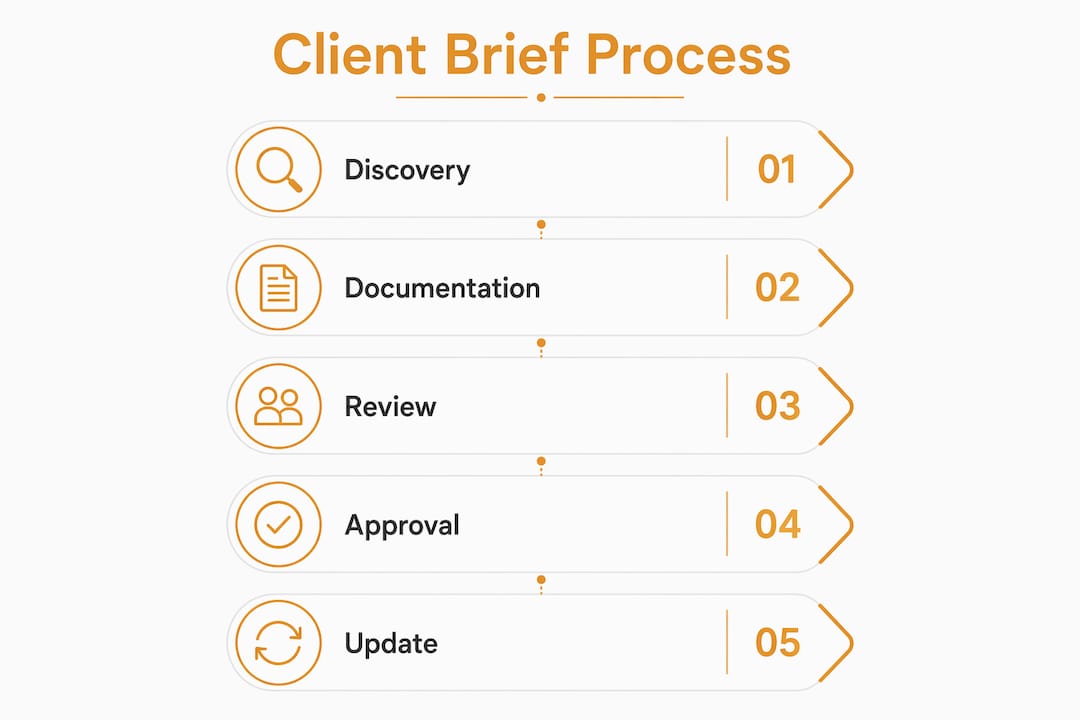
A structured process follows these steps:
- Discovery call: Qualify the project and gather high-level information before investing in a detailed brief. Confirm budget range, decision-maker authority, and project timeline at this stage.
- Standardized brief template: Use a fixed template tailored to design-build complexity, covering all twelve components listed above. Templates prevent omissions and reduce the time spent reformatting documents.
- Sharp intake questions: Transform vague client goals into measurable targets. Ask “What does success look like at handover?” rather than “What do you want?” Ask “What is the maximum budget before the project becomes unviable?” rather than “What is your budget?”
- Iterative review: Share a draft brief with the client before finalizing. This step surfaces misunderstandings early, when corrections cost nothing.
- Written sign-off: Obtain client confirmation in writing before the proposal is drafted. A signed brief is the contractual reference point if scope disputes arise later.
- Version control: Treat the brief as a living document. Date each version and record what changed, so the team always works from the current approved baseline.
- Integration with proposal drafting: Feed the signed brief directly into the proposal structure. The request for qualifications stage alone can span two weeks to four months on complex projects, making early brief standardization critical for managing that timeline.
Technology supports consistency. Project management platforms that track document versions and approval status reduce the risk of teams working from outdated briefs. For stakeholder communication strategies in complex land-use projects, structured frameworks that define milestones and roles at the outset produce measurably better coordination outcomes.
Pro Tip: Send the completed brief to the client within 48 hours of the discovery call. Prompt delivery signals organizational discipline and sets the professional tone for the entire engagement.

How Stellar Structures approaches client briefs in Singapore
Stellar Structures integrates the client brief directly into its civil, structural, geotechnical, and architectural workflows, treating it as the governing document for every project phase. For Singapore’s regulatory environment, where authority submissions to BCA, URA, HDB, JTC, SCDF, PUB, LTA, NEA, and NParks each carry specific technical requirements, a brief that omits compliance constraints creates downstream delays that are expensive to resolve.
The firm’s approach addresses several common pitfalls that appear repeatedly across design-build projects:
- Skipping the exclusions section: Teams that omit explicit exclusions face “you said you’d handle that” disputes at the worst possible moment, typically when the client withholds payment.
- Undefined allowances: Vague scope clauses and undefined allowances lead to margin erosion and relationship damage. Every allowance should carry a defined cost and quantity.
- No change order clause: Without a written change order procedure in both the brief and the proposal, verbal additions are assumed to be included in the original price.
- Missing approval process: Failing to define who approves each stage and how many revision rounds are included creates open-ended obligations.
A design-build proposal is fundamentally a sales tool reflecting the client’s vision and the design rationale, not merely a price quotation. Stellar Structures uses 3D renderings and detailed floor plans to translate brief requirements into tangible concepts, giving clients a concrete basis for decision-making before construction documents are produced. For design-build contract structure in Singapore, the brief also informs how responsibilities are allocated between the design and construction teams, reducing ambiguity in the contract itself.
A well-crafted project brief serves as the single source of truth that defines objectives, milestones, and roles before any work begins. Without it, every project phase carries the risk of costly misunderstandings and broken trust between the client and the delivery team.
How does a clear client brief reduce project risk?
The direct relationship between brief quality and project outcomes is well-documented. Projects with clearly defined scopes experience significantly fewer change orders and higher client satisfaction. The mechanism is straightforward: when the brief explicitly states what is included, what is excluded, and how changes are authorized, there is no ambiguity for disputes to fill.
Risk mitigation measures supported by a thorough brief include:
- Scope creep prevention: Explicit out-of-scope items and a written change order procedure give the team a defensible position when clients request additions.
- Margin protection: Explicitly defined allowances with confirmed costs and quantities prevent the profit erosion that follows from vague provisional sums.
- Payment security: Linking the brief’s milestones to the payment schedule ensures that each payment trigger corresponds to a defined deliverable, reducing disputes over what constitutes completion.
- Client trust: Transparency about budget, timeline, and deliverables from the outset builds confidence that the delivery team is organized and accountable.
- Operational efficiency: Contractors, architects, and developers working from a shared brief spend less time in clarification meetings and more time executing. For managing subcontractors in design-build projects, a clear brief also defines the scope boundaries that subcontract packages must respect.
Maintaining the brief as a living document handles unforeseen changes without disrupting project momentum. When site conditions, regulatory requirements, or client priorities shift, a versioned brief provides the baseline against which changes are formally assessed and priced.
Legal considerations and compliance factors in client briefs
A client brief carries legal weight even when it is not itself a contract. In Singapore’s construction sector, the brief informs the scope of work in the design-build contract, and any discrepancy between the two creates grounds for dispute. Several legal and compliance factors warrant explicit attention during brief preparation.
Regulatory compliance requirements must be identified at the brief stage, not discovered during design. For commercial and industrial projects, BCA structural plan approvals, URA planning permissions, and SCDF fire safety requirements each impose constraints on design parameters. Identifying these early prevents scope revisions after design work has begun.
Contractual alignment between the brief and the eventual design-build contract is critical. The design-build contract structure in Singapore typically assigns design responsibility to the contractor, which means the brief’s technical requirements become the contractor’s performance standard. Ambiguous brief language translates directly into ambiguous contract obligations.
Intellectual property and confidentiality provisions should be addressed when the brief contains proprietary client information, trade secrets, or unreleased development plans. A non-disclosure clause referenced in the brief protects both parties before any design concepts are shared.
Change order authorization procedures documented in the brief establish the legal mechanism for scope modifications. Without a written process, verbal instructions can create implied contractual obligations that are difficult to dispute. The brief should specify that all scope changes require written authorization from the named decision-maker before work proceeds.
Insurance and liability boundaries relevant to the project type, whether residential, commercial, or infrastructure, should be flagged in the brief so that the proposal can address them explicitly. For authority submission services in Singapore, the brief should also confirm which party is responsible for each submission, since misaligned assumptions here create both legal exposure and project delays.
Key Takeaways
A thorough client brief is the single most effective tool for converting a design-build inquiry into a well-scoped, dispute-resistant proposal.
| Point | Details |
|---|---|
| Brief precedes proposal | The client brief is an internal alignment document; the proposal is built from it, not the other way around. |
| Twelve core components | Every effective brief covers objectives, scope, exclusions, budget, timeline, approval process, and compliance requirements. |
| Exclusions prevent disputes | Explicitly stating out-of-scope items and change order procedures is the most commonly skipped and most disputed element. |
| Defined allowances protect margins | Every allowance must carry a confirmed cost and quantity to prevent profit erosion during execution. |
| Living document discipline | Version-controlled briefs with written sign-off give teams a defensible baseline when scope or conditions change. |
Recommended
- What Is a Design Build Contractor Role: A Clear Guide
- What Is a Design Build Program: A Developer’s Guide
- Managing Subcontractors in a Design-Build Project
- Value Engineering Design Build Projects: A Practical Guide