




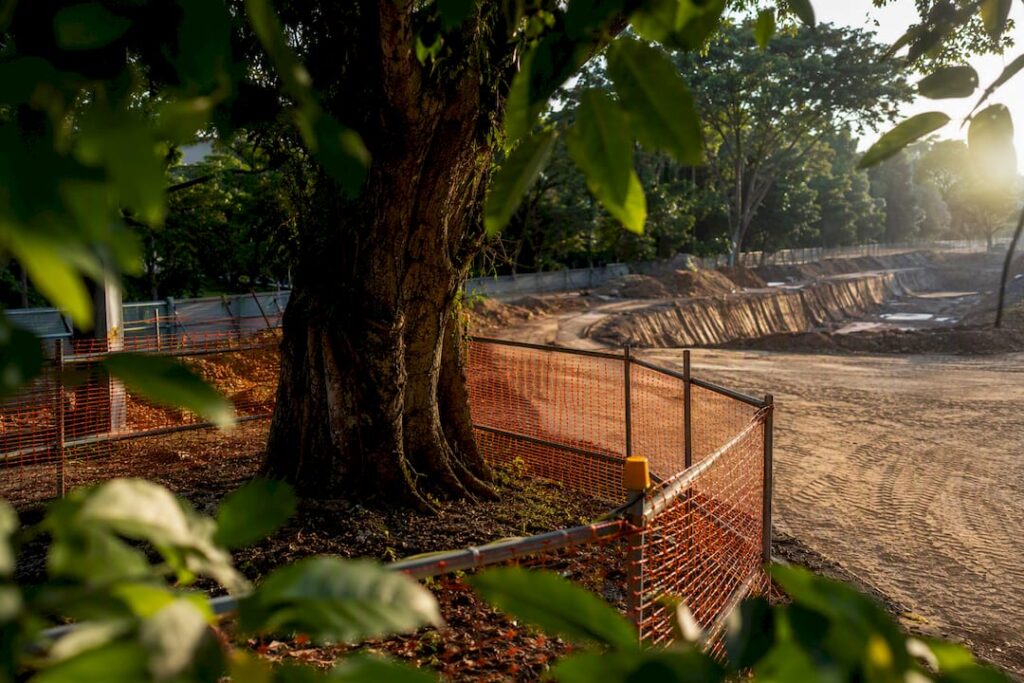
A tree protection zone marks the ground and root area around a mature tree that construction crews must fence off and leave undisturbed. In Singapore, any tree with a girth over 1 meter, measured 50 centimeters above ground, triggers NParks permission requirements before felling or works nearby. If your site holds trees near that threshold, check TreesSG for Tree Conservation Area status first, then engage a Qualified Person before tendering excavation work.
TL;DR:
- Trees with a girth over 1 meter require NParks permission for any work near their root zones or for felling, especially during development projects.
- Developers must submit detailed TPZ and tree condition reports through a Qualified Person, while property owners handle simpler non-development approvals directly to NParks.
- Fencing and signage must fully enclose the TPZ before construction begins, with specific methods like hydro excavation preferred to protect roots during digging.
- Site activities such as machinery operation, storage, and pruning are prohibited inside the TPZ, with penalties applied for breaches under the Parks and Trees Act.
- Incorporating tree protection and NParks coordination into early design phases reduces costly redesigns and delays during construction.
Table of Contents
- Legal Basis for Tree Protection Zones Under Singapore Law
- Checking Tree Conservation Areas Before You Break Ground
- The 1-Metre Girth Rule and When NParks Permission Kicks In
- Setting Up a Tree Protection Zone on a Live Construction Site
- What Goes Into the NParks Submission Package
- Prohibited Activities and What Enforcement Actually Looks Like
- A Pre-Tender Checklist for Owners and Developers
- Stellar Structures’ View: Sequence Trees Into the Design, Not Around It
- Get Your Authority Submissions and TPZ Planning Handled Together
- Where to Verify These Rules Yourself
- Sources
Legal Basis for Tree Protection Zones Under Singapore Law
The Parks and Trees Act 2005 sets the statutory backbone for tree conservation in Singapore. It defines a Tree Conservation Area and requires written NParks permission before anyone fells a mature tree, defined as one with girth exceeding 1 meter measured 50 centimeters from the ground.
The term “tree protection zone” itself is not a defined legal zone in the Act. It is a technical, site-specific protection area that arborists and Qualified Persons calculate and submit as part of development plans, guided by NParks technical guidelines. That distinction matters for paperwork: developers submit through a QP, while individual property owners doing non-development tree work use a separate, simpler route.
Checking Tree Conservation Areas Before You Break Ground
NParks maintains TreesSG, the authoritative mapping tool for confirming whether a site sits inside a conserved zone. Singapore currently has two gazetted Tree Conservation Areas, Central TCA and Changi TCA, both first gazetted on August 2, 1991, according to the Tree Conservation Area dataset on data.gov.sg.
To check your site:
- Open TreesSG and select “Search/Plot a Tree.”
- Toggle on the “Tree Conservation Areas” layer to see if your parcel overlaps Central or Changi TCA.
- Cross-reference any mature trees on site against the layer boundaries, not just the lot outline.
Treat the map as indicative rather than final. Boundary lines on a screen rarely match root spread on the ground, so any site touching a TCA edge, or holding a tree close to the girth threshold, warrants direct NParks confirmation or a formal QP assessment before design finalizes.
The 1-Metre Girth Rule and When NParks Permission Kicks In
The girth threshold is the single most consequential number in Singapore tree law. A tree qualifies as “mature” once its trunk girth exceeds 1 meter measured 50 centimeters above ground level, and that measurement point matters because buttressed or leaning trunks can read very differently at ankle height versus chest height.
Permission requirements get triggered by several common activities:
- Excavation or foundation work within a tree’s root spread during development.
- Transplanting a mature tree to another location on or off site.
- Felling as part of landscaping, demolition, or general site clearance.
For development projects, a Qualified Person handles the NParks submission on the developer’s behalf. Property owners doing non-development work, a backyard removal or pruning job unrelated to construction, apply directly through NPARKS_Registry@nparks.gov.sg or the OneService App instead of routing through a QP.
Setting Up a Tree Protection Zone on a Live Construction Site
Getting the protection zone right on paper means nothing if the fencing goes up in the wrong place or comes down halfway through the job. Arborists typically start their TPZ calculation from the tree’s dripline, then cross-check against the Structural Root Zone (SRZ), the area immediately supporting trunk stability. Where construction genuinely cannot preserve the full SRZ, mitigation options include root bridging, engineered support structures, or transplanting, paired with a monitoring schedule that tracks canopy health through the works period, a method described in NParks’ development guidelines.
On site, the sequence generally runs:
- Install fixed, rigid fencing (not temporary hoarding tape) around the calculated TPZ boundary before any mobilization.
- Post clear signage identifying the zone and prohibiting entry, storage, and vehicle parking.
- Apply a mulch layer inside the zone to protect surface roots and retain soil moisture.
- Maintain an inspection log documenting fence integrity and any incursions.
- Switch to hand excavation, air excavation, or hydro excavation for any digging near roots, with an arborist present for supervision.
- Route new utilities through trenchless methods, microtrenching or directional boring, wherever roots would otherwise be cut.
Pro Tip: Specify hydro excavation, not just “hand digging,” in your contractor’s method statement. Hand tools alone often still fracture fine root hairs that hydro jets leave intact, and NParks reviewers increasingly expect the distinction spelled out.
Geotechnical input matters here too, since deep excavation near a root zone raises soil stability questions that go beyond arboriculture. A geotechnical engineering consultant can flag where shoring design and root protection conflict before the contractor ever mobilizes equipment.
What Goes Into the NParks Submission Package
A typical application bundle includes a tree survey documenting girth and species, an arborist report assessing health and root structure, TPZ boundary drawings, and, where relevant, a transplanting or tree-moving proposal.
The Qualified Person carries specific responsibilities through this process:
- Prepare and sign off on technical reports supporting the application.
- Coordinate directly with NParks and any other relevant authorities on the same project.
- Act as the developer’s representative for queries and revisions during review.
Submissions for development-linked tree work run through the QP into NParks channels, while non-development enquiries go to NPARKS_Registry@nparks.gov.sg or the OneService App. Review timelines vary with site complexity, but complete documentation submitted early, rather than patched together after excavation starts, is consistently the biggest timeline accelerator. Our NParks approval checklist for contractors breaks the package down further for teams preparing their first submission.
Prohibited Activities and What Enforcement Actually Looks Like
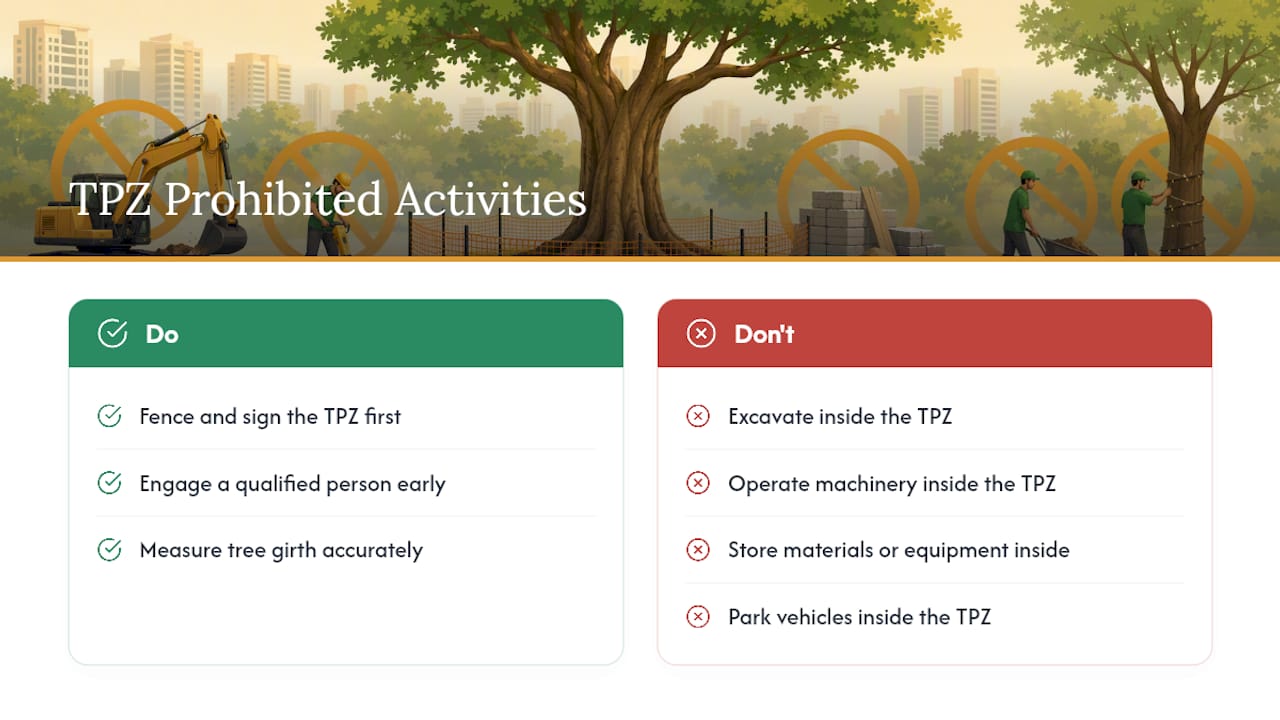
Once a TPZ is fenced and signed, a defined set of activities becomes off limits inside it. NParks guidance on urban tree care lists excavation, machinery operation, material or equipment storage, vehicle parking, root or trunk damage, and unauthorized pruning as prohibited within the protected boundary.
Breach the rules and you face penalties under the Parks and Trees Act, which can include fines tied directly to unauthorized felling or damage of a protected tree. Enforcement on real sites tends to follow the same pattern: a stored pallet of rebar compacting soil over a root plate, a excavator turning circle that clips the fence line, or a contractor pruning “just one branch” without arborist sign off.
The most common root cause behind these breaches is not malice but sequencing. Measurement errors on girth, or engaging a QP only after the tender is already awarded, both leave protection zones improperly sized or poorly communicated to the crew actually doing the digging.
A Pre-Tender Checklist for Owners and Developers
Before works start, put these questions to every bidder:
- What arborist qualifications does your team hold, and have they worked on NParks-reviewed projects before?
- Has your QP handled tree conservation submissions specifically, not just general authority approvals?
- Can you provide a written method statement for TPZ fencing, signage, and excavation technique?
- What monitoring schedule will you run during the works, and who signs off on it?
Bake TPZ fencing specifications, mandatory arborist supervision, breach penalties, and remediation obligations directly into the construction contract, not a side letter. If a contractor ever proposes moving a fence line without written QP sign off, that is the signal to stop work and escalate to NParks immediately.
Stellar Structures’ View: Sequence Trees Into the Design, Not Around It
Most TPZ headaches trace back to timing. Bringing an arborist and a Qualified Person into feasibility conversations, alongside structural and geotechnical input, catches root conflicts before foundation layouts lock in. Retrofitting a protection zone around a finished structural design almost always costs more than designing around the tree from day one.
Our own integrated design and construction approach treats NParks coordination as a design input, not a compliance afterthought filed after drawings are done. Talk to an authority-submission specialist before you tender major enabling works. It is far cheaper than redesigning after a QP flags a conflict mid-construction.
— Aman
Get Your Authority Submissions and TPZ Planning Handled Together
Splitting tree conservation compliance across separate consultants, one for the arborist report, another for structural checks, a third for the NParks paperwork, is exactly where projects lose weeks to miscommunication. Stellar Structures runs authority submission facilitation alongside structural, geotechnical, and civil engineering under one project team, so your NParks liaison, root protection drawings, and foundation design get coordinated from the same table rather than reconciled after the fact.
That single point of coordination matters most on sites where deep excavation and root protection compete for the same square meters. Our engineers can review your excavation plans against structural design constraints while the same team manages your NParks submission, cutting the back and forth between separate consultants down to a single conversation. If you have a site with mature trees and works planned in the next two quarters, bring your tree survey and site plan to an initial consultation so we can flag conflicts before your tender documents go out.
Where to Verify These Rules Yourself
For the statutory text, consult the Parks and Trees Act directly. For mapping, use TreesSG’s Tree Conservation Area data. For technical protection standards and submission procedure, refer to NParks’ greenery and tree conservation guidelines, and for root-damage prevention during excavation, this root cause analysis guide offers useful practitioner background.
This article is general information, not a substitute for advice from a qualified lawyer. Consult a qualified legal professional about your own circumstances before acting on anything here.
Sources
- Parks and Trees Act 2005 – Singapore Statutes Online
- Guidelines on greenery provision and tree conservation for developments – NParks
- Data
Recommended
- NParks Approval Process: Checklist for Singapore Contractors
- Authority Submissions for Trellis construction such as URA, BCA and SCDF
- Section 28 Building Control Act: Your Legal Obligations Summary
- How to Get BCA Approval for Landed Property Reconstruction in Singapore