




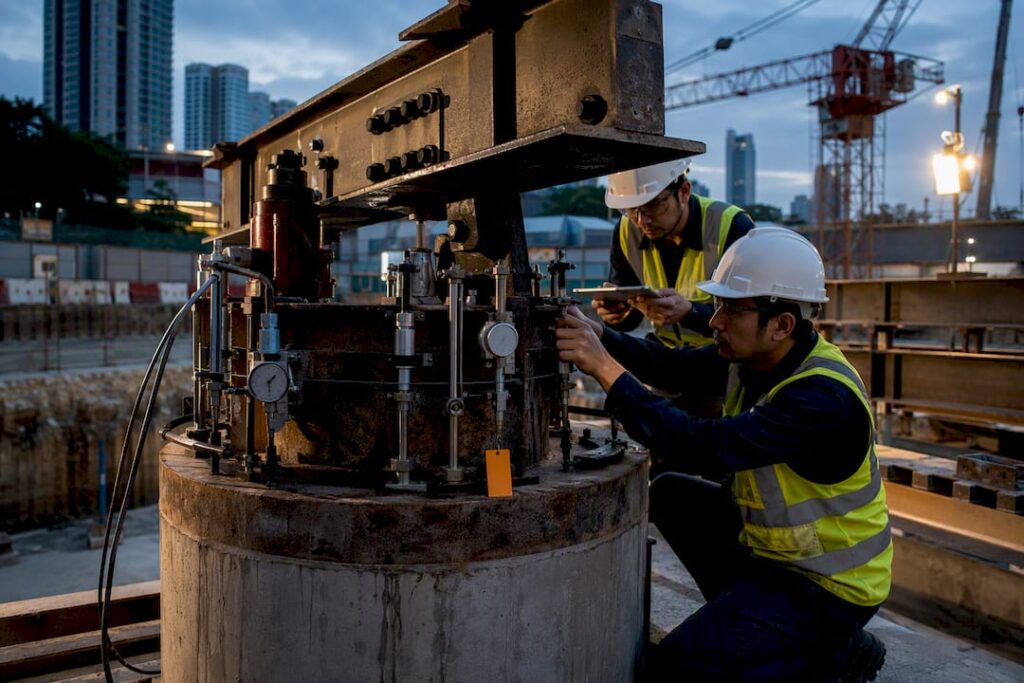
Pile load testing in Singapore is governed primarily by SS 723:2026 for bi-directional testing and BCA’s ST plan guidelines for structural submissions. Accepted methods include static (kentledge), rapid load testing, bi-directional, and dynamic tests, chosen based on site logistics and structural risk. Every Qualified Person must certify equipment calibration, follow the specified loading and acceptance criteria, and file pre-installation, post-installation, and final reports that satisfy both standards before a structural plan gets approved.
TL;DR:
- Static load testing remains the most direct method for verifying ultimate pile capacity but requires significant space and lifting equipment.
- Bi-directional testing, governed by SS 723:2026, offers a site-constrained alternative by using embedded jacks without needing surface reaction structures.
- Rapid load testing provides faster results and has proven consistent with static tests in Singapore soil conditions, making it a viable, less intrusive option.
- Calibration certificates and clear documentation of testing procedures are critical to avoid delays and ensure compliance with Singapore standards.
- Testing scope should increase if soil variability is high, design assumptions change, or structures are critical, with representative sampling used over rigid test ratios.
Table of Contents
- What Singapore Standards Govern Pile Load Testing?
- Which Pile Load Test Methods Are Accepted in Singapore?
- How Many Piles Should Be Tested and When?
- What Equipment and Calibration Standards Apply?
- How Do You Interpret Loading Schedules and Failure Criteria?
- What Must Go Into Pile Load Test Reports?
- What Practical Lessons Do Singapore Projects Offer?
- A pragmatic checklist for QPs
- Plan Your Pile Testing Program With Local ST Plan Expertise
- Where to Verify Pile Load Test Requirements
- Sources
What Singapore Standards Govern Pile Load Testing?
Pile load test requirements in Singapore trace back to a small set of documents, and knowing which one governs which decision saves weeks of back-and-forth with reviewers.
SS 723:2026 sets the technical scope for bi-directional load testing on cast-in-situ bored piles and barrette piles. It covers apparatus specifications, test procedures, safety provisions, and the equations used to convert bi-directional results into equivalent top-load curves. Copies are available through the Singapore Standards eShop.
BCA’s Guidelines for ST Plan Applications address the administrative side: what ground investigation data, load test records, and quality control documentation a QP must submit for structural plan approval. Related circulars govern how soil investigation data gets formatted for review, an area also shaped by AGS(SG) submission-format guidance.
For kentledge-specific practice, consult:
- GeoSS guidelines on good practice for pile load tests using kentledge blocks
- BCA circulars on QP duties and structural submission formats
- SS 723:2026 for any project involving bi-directional apparatus
Pile testing standards in Singapore work as a layered system. SS 723:2026 tells you how to run a bi-directional test correctly; BCA guidance tells you what to submit and when.
Which Pile Load Test Methods Are Accepted in Singapore?
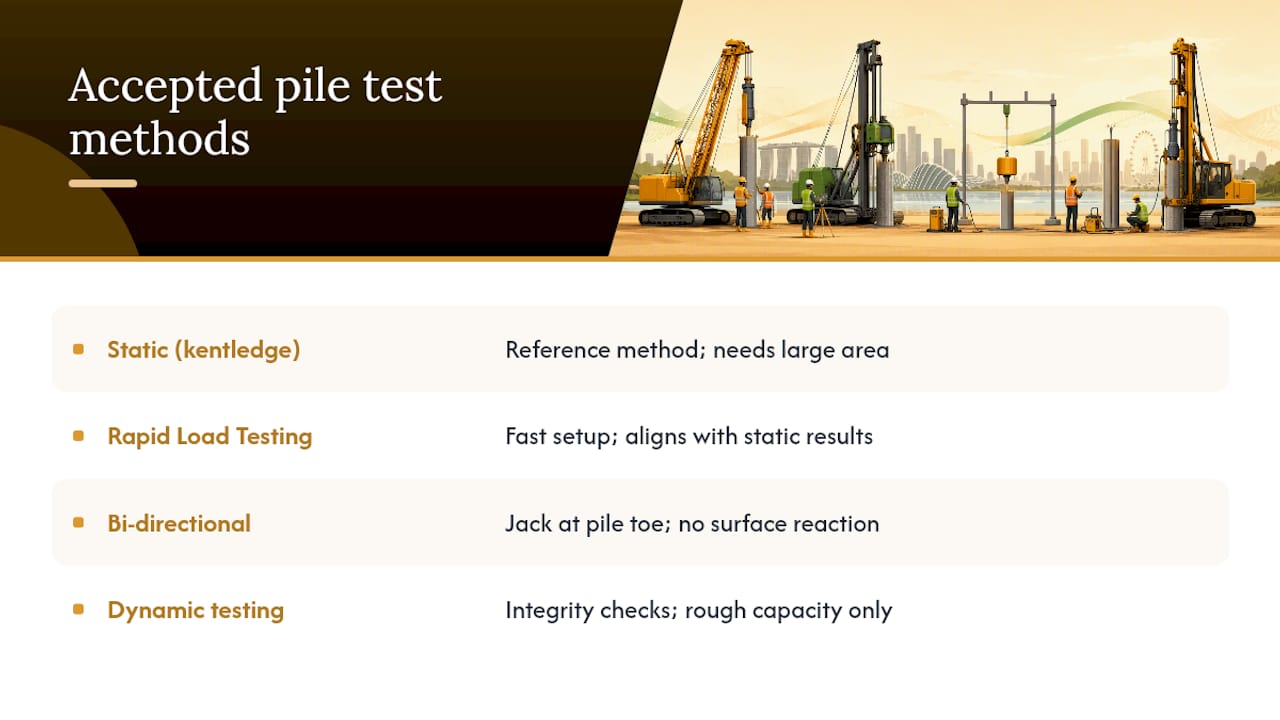
Singapore projects use four main test methods, and picking the right one comes down to site constraints, pile type, and how much verification the structure demands.
Static (kentledge) testing remains the reference method for verifying ultimate pile capacity. A reaction frame and stacked kentledge blocks apply load incrementally while telltales and displacement gauges track settlement. It delivers the most direct load-settlement data available, but it demands significant site area and lifting capacity, which makes it awkward on tight urban plots.
Rapid Load Testing (RLT), sometimes called Statnamic testing, has gained traction on Singapore bored pile projects because setup takes a fraction of the time and avoids heavy kentledge stacking. HDB correlation studies found RLT results align well with static test outcomes across local soil profiles, covering pile head settlement, mobilized skin friction, and end bearing behavior.
Bi-directional testing, governed directly by SS 723:2026, places a hydraulic jack system near the pile toe and loads the pile against itself. This eliminates the need for surface reaction structures entirely, a real advantage on constrained sites where kentledge simply won’t fit.
Dynamic testing offers rapid integrity checks and rough capacity estimates but doesn’t replace a static or bi-directional test where contract documents call for ultimate capacity verification.
Pro Tip: On sites where headroom or lateral space is the binding constraint, evaluate bi-directional testing before defaulting to kentledge. The apparatus footprint at ground level is a fraction of what a reaction frame needs.
How Many Piles Should Be Tested and When?
Pile testing procedures in Singapore don’t follow a single fixed ratio. The right sampling strategy depends on ground variability, structural risk, and what the contract specifies. A few triggers consistently push testing scope upward:
- Novel or variable ground conditions across the site, especially where soil investigation reveals inconsistent stratigraphy between borehole locations.
- Changes to design assumptions after piling has started, such as revised load estimates or a redesigned superstructure.
- Critical or high-consequence structures, including tall buildings, bridges, and any structure where foundation failure carries severe safety implications.
- Explicit contract or BCA requirements that mandate a minimum number of working or ultimate load tests regardless of site conditions.
Representative sampling across the site’s stratigraphic variation matters more than hitting a specific count. A QP should select piles that reflect the weakest expected ground conditions, not just the most convenient locations. If results from an initial test batch deviate meaningfully from design predictions, expanding the test program, rather than accepting a marginal result, is the safer call. Working load tests confirm serviceability; ultimate load tests to failure or a defined multiple of working load confirm the design’s safety margin.
What Equipment and Calibration Standards Apply?
Every pile load test setup rests on a short list of apparatus, and the calibration paperwork behind that apparatus matters as much as the hardware itself.
Reaction frames, hydraulic jacks, load cells, reference beams, and telltales form the backbone of a conventional static setup. Bi-directional tests substitute an embedded jack assembly per SS 723:2026 apparatus specifications. Instrumentation needs to capture displacement at defined intervals, with dataloggers recording readings frequently enough to plot a clean load-settlement curve rather than a handful of scattered points.
Key requirements to document:
- Load cells and jacks calibrated within a recent, defined period before testing, with calibration certificates included in the final report
- Reference beams and telltales checked for zero-drift before each loading cycle
- Kentledge stacking sequences controlled by an approved lift plan, particularly for stacks exceeding standard safe working loads
- Clear role division between the QP, the test engineer supervising instrumentation, and the contractor executing the physical load application
Pro Tip: Request calibration certificates before mobilization, not after the test. A jack or load cell calibrated outside the accepted window forces a retest, and that delay lands on the project schedule, not the calibration lab’s.
How Do You Interpret Loading Schedules and Failure Criteria?
Loading schedules in Singapore generally follow incremental static or quick load procedures, patterns also detailed in reference manuals like FHWA’s driven pile foundation guidance, adapted locally under SS 723:2026 and project-specific contract documents. The choice between incremental and quick load hinges on how much time the site schedule allows and how much settlement-rate data the design team needs.
Acceptance and failure criteria vary by contract, but common benchmarks include:
- A defined multiple of working load reached without excessive settlement
- Slope-based failure criteria, where the load-settlement curve’s slope signals the onset of plastic deformation
- Absolute settlement thresholds tied to the structure’s tolerance for movement
Contract-specific criteria always take precedence over generic benchmarks, so check the specification before assuming a standard rule applies.
Converting bi-directional results into an equivalent top-load curve requires applying the exact equations SS 723:2026 specifies, and any empirical adjustment factors drawn from local correlation studies need explicit documentation in the final report. RLT results get cross-checked against static test correlations rather than read in isolation. If a test fails to meet acceptance criteria, the immediate response is usually an expanded test program, a design review, or in some cases pile rework, and every one of those decisions needs to be documented alongside the original test data.
What Must Go Into Pile Load Test Reports?
BCA and SS 723:2026 both expect a structured report trail, not a single summary document at project close.
- Pre-installation report: pile identification, apparatus description, planned loading schedule, and calibration status of all instrumentation
- Post-installation report: raw time-settlement logs, actual loading sequence applied, and any deviations from the planned schedule
- Final report: load-settlement curves, calibration certificates for jacks and load cells, and, for bi-directional tests, the converted top-load equivalent curve with stated conversion factors
Aligning this documentation with BCA’s ST plan guidance and AGS(SG) SI data formats reduces review queries significantly, since reviewers are matching your submission against a known checklist. A well-organized soil investigation report paired cleanly with pile test data speeds up the whole approval cycle.
What Practical Lessons Do Singapore Projects Offer?
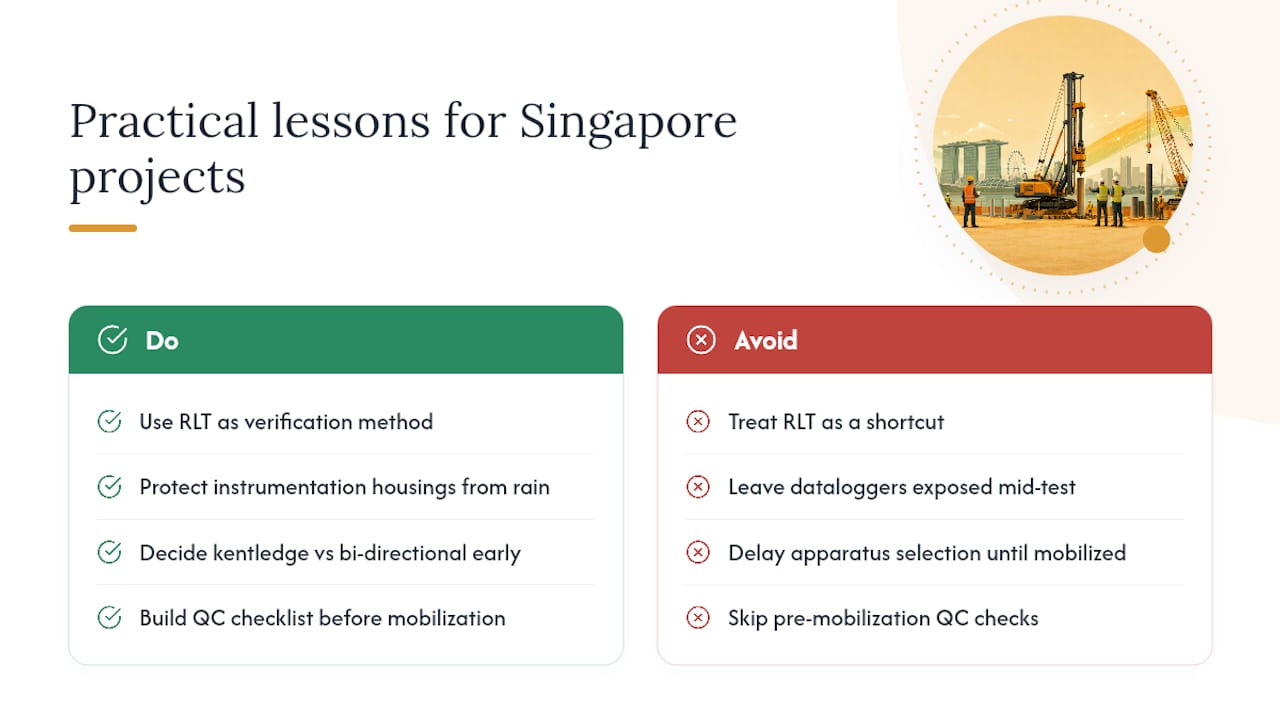
HDB correlation work consistently shows RLT tracking static test behavior closely across the sandy and clayey soils common on Singapore projects, reinforcing RLT as a credible verification method rather than a shortcut. Tropical humidity and sudden rain demand covered instrumentation housings, since a soaked datalogger mid-test can void an entire loading cycle. Tight urban plots often force early decisions between kentledge and bi-directional apparatus, well before piling begins.
Pro Tip: Build your QC checklist around calibration dates, instrumentation protection, and stratigraphy sampling before mobilization. Catching a gap on paper costs an afternoon; catching it mid-test costs a remobilization.
Firms with local ST plan experience, including geotechnical consultants who coordinate testing and authority submission together, tend to avoid the repeat-query cycle that stretches out lone-QP submissions.
A pragmatic checklist for QPs
Three pitfalls repeat across Singapore projects: calibration certificates arriving late, bi-directional conversion factors left undocumented, and sampling that ignores stratigraphic variation. Each has a one-line fix: verify calibration before mobilization, state conversion equations in the report, and select test piles from the weakest ground zones. Engage a geotechnical QP early enough to align the test program with ST plan expectations, not after piling starts.
— Aman
Plan Your Pile Testing Program With Local ST Plan Expertise
Getting pile load test requirements right on paper is one thing; getting a test program approved without repeated queries from reviewers is another. Stellar Structures works through both sides of that gap for Singapore projects, pairing geotechnical consulting with hands-on coordination of test planning, calibration documentation, and BCA authority submissions.

Because submissions are structured according to BCA’s ST plan checklist and SS 723:2026 requirements, query cycles that stall approvals can be reduced. That matters whether you’re running a straightforward static test on a landed redevelopment or coordinating bi-directional testing on a constrained downtown site. If your project needs a QP to plan the test program, verify calibration paperwork, and manage the foundation engineering submission end to end, reach out to Stellar Structures to scope your pile testing and authority approval requirements before piling starts.
Where to Verify Pile Load Test Requirements
- SS 723:2026 preview, for bi-directional test apparatus, procedure, and conversion equations
- BCA Guidelines for ST Plan Applications, for load test documentation and submission requirements
- GeoSS guidelines, for kentledge test good practice
- HDB-related RLT correlation study, for rapid versus static load test data across Singapore soils
Keep these four sources on hand before drafting any test program. Each one answers a different question a reviewer will eventually ask.
Sources
- SS 723:2026 preview (Singapore Standards)
- Guidelines for ST Plan Applications (BCA)
- GeoSS guidelines
Recommended
- Checklist for Developers Contractors Choosing the Right QP S and Supervision Team for Your Next Build in Singapore
- Why Every Structural Work in Singapore Requires a QP S Legal Consequences of Non Compliance
- What is BCA Periodic Structural Inspection? A Beginner’s Guide
- How to Read Your BCA Inspection Notice: Ultimate Compliance Guide