




Expect indicative build costs varying within a broad range per square meter for private residential projects in Singapore, with landed housing and hospital-grade fit-outs typically running higher and light industrial work coming in lower. These figures are budgetary reference points, not tender prices. Before committing capital, run a structured estimate using the method below or engage a quantity surveyor or engineer to validate the number against your specific site and design.
TL;DR:
- Construction costs in Singapore vary widely by building type, finish quality, and site complexity, with hospital and luxury projects priced at the top of the range.
- Materials, labor, and M&E systems are the main drivers of budget volatility, with commodity prices and manpower availability significantly affecting final costs.
- A thorough project estimate requires defining scope, selecting appropriate benchmark rates, adding allowances, and considering GST and contingencies to ensure budget realism.
- Prefabrication may reduce costs for repetitive projects by cutting program duration but can be costly or impractical for smaller or highly customized developments.
- Early geotechnical investigation and fixed-price tenders help manage risks from ground conditions and material volatility, respectively, improving budget accuracy.
Table of Contents
- What Does Construction Cost in Singapore Right Now?
- What Line Items Actually Drive a Construction Budget?
- How Do You Estimate a Construction Budget Step by Step?
- Practical Tips From an Engineering and Approvals Perspective
- How Is Material Price Volatility Affecting Singapore Construction Costs?
- How Do Manpower Constraints Affect Singapore Construction Costs and Timelines?
- Does Prefabrication Cost Less Than Traditional Construction in Singapore?
- How Much Do Green Building Requirements Add to a Singapore Construction Budget?
- Author View: What Should Singapore Project Owners Prioritize Right Now?
- Turn Your Estimate Into an Approved Project Budget
- Sources
- FAQ
What Does Construction Cost in Singapore Right Now?
Construction pricing Singapore-wide varies sharply by building type, finish quality, and site complexity, and the most reliable public benchmark is Rider Levett Bucknall’s Rider’s Digest, updated quarterly with indicative ranges as of the first quarter of 2025. Good-quality condominium developments fall within a specified range per square meter, while medium-quality condominiums sit lower, and luxury developments push past that band once specialist finishes and services enter the mix.
Landed residential work (terrace, semi-detached, and detached houses) typically prices above condominium averages per square meter because of lower floor efficiency and higher finish specification per unit of floor area. Office developments split by location: CBD towers carry a premium over suburban or decentralized office stock, driven by facade complexity, vertical transport capacity, and higher M&E specification. Light industrial and logistics buildings remain the most affordable category per square meter, reflecting simpler structural grids and lower finish standards. Hospital and healthcare projects sit at the top of the range because of specialized M&E, infection control systems, and structural loading requirements.
A few things to keep in mind when reading any benchmark table like this one:
- Figures exclude land cost, professional fees, furniture, fixtures and equipment, and GST unless a source states otherwise.
- The SISV Tender Price Index tracks how tender prices move over time, and recent movement signals continued upward pressure on base build rates industry-wide.
- Treat every number here as a starting point for discussion with your design team, not a substitute for a project-specific quantity surveyor estimate.
What Line Items Actually Drive a Construction Budget?
Base build rates only tell part of the story. A realistic Singapore construction budget breaks down into several cost blocks, each with its own volatility profile.
- Materials: concrete, structural steel, and finishes make up the physical shell and skin, and their pricing tracks global commodity cycles as much as local demand.
- Labour: local wage levels and foreign-worker manpower quotas both feed into the labour share of tender pricing, which can swing month to month depending on site competition for skilled trades.
- M&E and specialist works: mechanical, electrical, and plumbing systems, plus piling and basement works, often carry the widest cost variance because they depend on ground conditions and building services complexity.
- Preliminaries and contingency: site setup, temporary works, insurance, and a contingency allowance sit on top of trade costs and typically add a meaningful percentage to the base figure.
- Professional and authority fees: architect, engineer, and QS fees, along with authority submission costs, are frequently underestimated in early budgets.
Statistic callout: The SISV Tender Price Index is built on a base year of 2010 set at 100, and it blends material, equipment, labour, competition, and risk or profit elements into a single market signal. That composition is exactly why a rising TPI reading does not automatically mean your specific tender will land higher. It reflects market-wide competitive tension as much as raw input costs, according to SISV’s own compilation.
GST also enters the picture here. Construction services supplied in Singapore are standard-rated, and while most construction inputs qualify for input tax claims, certain categories like motor cars are blocked, according to IRAS guidance on business expenses.
How Do You Estimate a Construction Budget Step by Step?
Converting a benchmark range into a usable project budget takes four deliberate steps, and skipping any one of them is how owners end up with a number they can’t defend to a bank or a board.
- Define scope and measurement basis. Decide whether you’re pricing on gross floor area (GFA), construction floor area (CFA), or net lettable area (NLA), since mixing bases produces meaningless comparisons. Also lock the quality tier (medium, good, or luxury) before pulling a rate.
- Pick a baseline rate and add project-specific allowances. Start with a Rider’s Digest or BCA unit rate figure for your building type, then layer on premiums for piling, basement excavation, or constrained site access.
- Add preliminaries, consultant fees, and contingency. Preliminaries commonly add a percentage on top of trade costs; design-stage contingency tends to run higher than construction-stage contingency because unknowns shrink as drawings firm up. Consultant fees for a qualified person should be budgeted separately from build cost, not buried inside it.
- Apply GST and IRAS treatment correctly. GST applies to construction services at the standard rate, and plant or machinery generally attracts capital allowances rather than straight depreciation, per IRAS rules.
Worked example: For a residential build using a mid-range per square meter estimate, multiply the floor area by that rate to get a base figure, then add typical percentages for preliminaries and contingency to obtain a working estimate before professional fees and GST.
Pro Tip: Run your estimate twice, once with design contingency and once with construction contingency only, so your board sees how much risk allowance shrinks once drawings are finalized.
Practical Tips From an Engineering and Approvals Perspective
Cost overruns rarely originate in the finishes budget. They start with ground conditions nobody investigated early enough, or with M&E and structural drawings that were never properly coordinated before tender. Commissioning a geotechnical investigation at the concept stage, rather than after design freeze, catches piling and dewatering surprises before they become variation orders. Authority submission timing matters just as much: a resubmission cycle with BCA, URA, or SCDF because of an incomplete package can add weeks to a program and cost more than the fee saved by rushing the drawings.
Pro Tip: Sequence your structural design checks before, not after, M&E layout finalization. Clashes discovered post-tender are consistently the most expensive to fix.
How Is Material Price Volatility Affecting Singapore Construction Costs?
Global supply chains for steel, cement, and specialist M&E components have remained uneven, and Singapore’s import-dependent construction sector feels every disruption faster than markets with domestic heavy industry. Steel and concrete prices move with regional commodity cycles, while shipping delays for imported M&E equipment, lifts, and facade systems can stretch procurement lead times well beyond original tender assumptions.
This volatility shows up in two places on a project budget. First, base build rates drift upward between the time a design team pulls a benchmark figure and the time a contractor prices the actual tender, which is exactly why the SISV Tender Price Index exists as a market-movement gauge rather than a fixed number. Second, contractors increasingly build price escalation clauses into their tenders for long-duration projects, shifting some commodity risk back onto the client rather than absorbing it themselves.
For owners, the practical response is to treat contingency as a moving target rather than a fixed percentage. A project with a long design and approval runway before construction starts should carry a wider contingency band than one moving straight to tender. It also pays to lock in supply contracts for long-lead items like structural steel or specialist lifts as early as the design allows, rather than waiting until the main contract is signed. Digital cost-tracking platforms such as CivroBuild can help project teams monitor procurement commitments against budget in real time, which matters more in a volatile material market than in a stable one.
How Do Manpower Constraints Affect Singapore Construction Costs and Timelines?
Labour availability is one of the least visible line items in a construction budget until it becomes the most expensive one. Singapore’s construction workforce depends heavily on foreign-worker quotas and levy structures, and manpower policy shifts directly affect how contractors price labour into their tenders.
When skilled trades are scarce, tender prices absorb the scarcity through higher labour rates, longer program durations, or both. A tight labour market also compresses contractor capacity, meaning fewer firms are available to bid competitively on a given project, which itself pushes tender prices upward independent of material costs. This dynamic explains part of why the tender price index captures competition and risk allowance alongside raw input costs.
For project owners, the practical implication is timeline risk as much as cost risk. A program built on optimistic manpower assumptions during a tight labour market is one of the most common sources of completion delay, and delay itself carries cost through extended preliminaries, financing charges, and holding costs on the asset. Projects with flexible program windows, or the ability to shift trade sequencing, tend to weather manpower tightness better than those locked into a rigid critical path.
Owners planning projects with heavy specialist trade content, such as complex M&E or facade work, should factor manpower availability into their procurement strategy from the outset rather than treating it as a contractor-side problem alone. Engaging contractors early enough to lock in resourcing commitments, rather than waiting for a competitive tender to flush out capacity constraints, is a practical hedge against both cost and schedule risk.
Does Prefabrication Cost Less Than Traditional Construction in Singapore?
Prefabricated and modular construction methods, often grouped under Design for Manufacturing and Assembly, shift a large share of build activity from the site to an offsite factory. The cost comparison against traditional cast-in-situ methods is not a simple cheaper-or-more-expensive answer. It depends heavily on project scale, repetition, and site constraints.
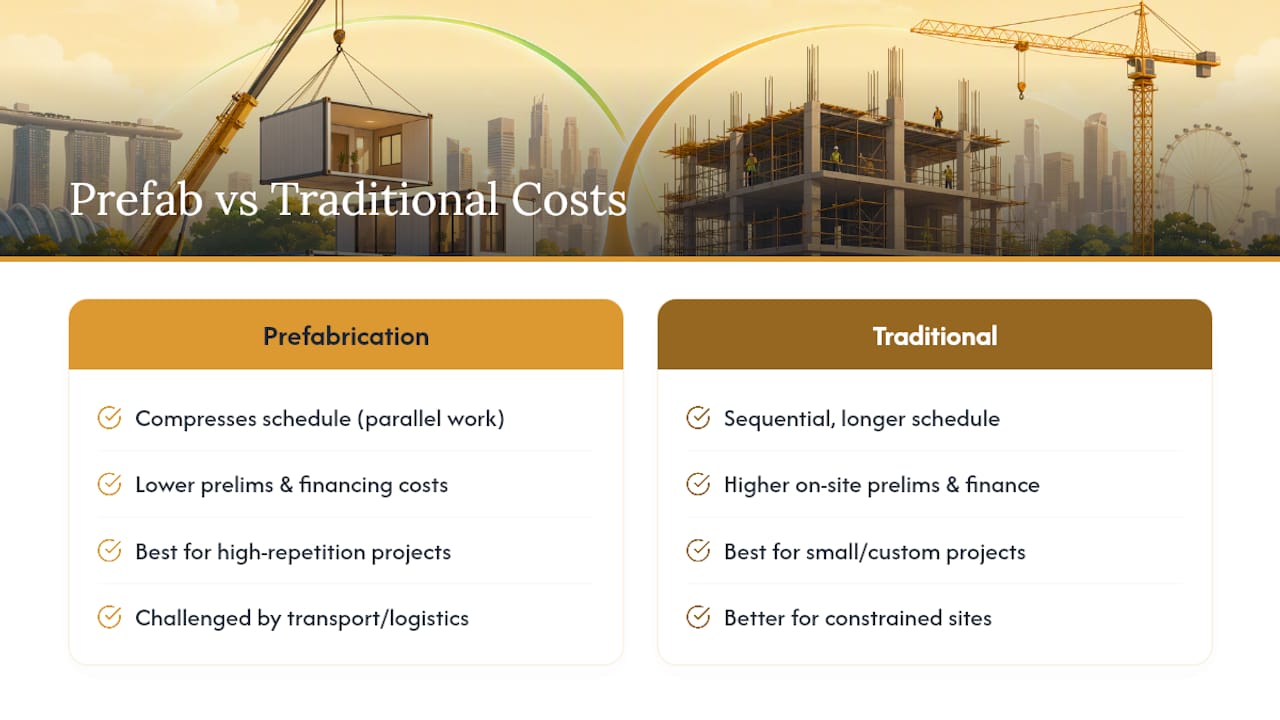
For projects with high unit repetition, such as public housing blocks or standardized condominium towers, prefabrication tends to compress program duration meaningfully because factory production runs in parallel with site groundworks rather than sequentially after them. That time compression translates into lower preliminaries and financing costs even when the per-unit material cost of prefabricated components runs close to, or occasionally above, traditional methods.
For smaller or highly customized projects, particularly landed housing or boutique developments with limited repetition, the factory setup and transport logistics for prefabricated elements can erode the cost advantage entirely. Site access also matters: a constrained urban site with limited crane access or narrow lift zones has to weigh the disruption savings of offsite fabrication against the added complexity of maneuvering large prefabricated modules into position.
The realistic takeaway for a Singapore project owner is that prefabrication is a design decision that has to be made early, ideally at the architectural concept stage, because retrofitting a traditional design into a modular delivery method after drawings are advanced rarely captures the same savings. Structural and architectural coordination at the outset determines whether prefabrication actually reduces total project cost or just relocates it.
How Much Do Green Building Requirements Add to a Singapore Construction Budget?
Sustainability requirements under Singapore’s Green Mark framework and related BCA standards influence construction budgets in ways that are easy to underestimate at the concept stage. Higher-performance building envelopes, energy-efficient M&E systems, and water-saving fixtures generally carry a cost premium over baseline specifications, and that premium scales with the certification tier a project targets.
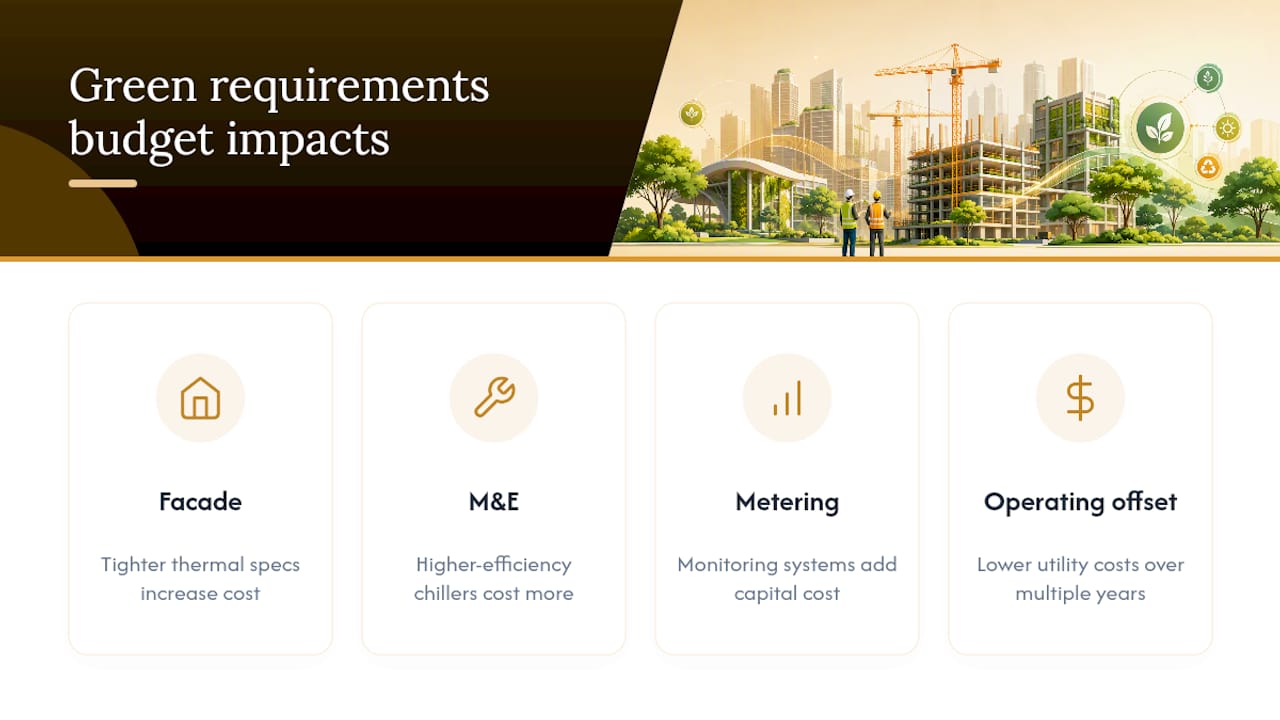
The budget impact tends to concentrate in a few areas: facade and glazing systems built to tighter thermal performance standards, higher-efficiency chillers and air-handling equipment, and monitoring or metering systems required for ongoing compliance reporting. These additions layer on top of the base build rates discussed earlier in this guide, and they should be scoped explicitly rather than assumed to fit within a standard contingency allowance.
The offsetting factor is operating cost. Buildings designed to higher sustainability tiers typically carry lower long-term utility costs, and for developers holding an asset rather than selling it immediately, that operating saving can offset the capital premium over a multi-year horizon. For owners evaluating whether to pursue a higher certification tier, the decision usually comes down to holding period and financing structure rather than construction cost alone.
Coordinating sustainability requirements with structural and M&E design early, rather than bolting them on after schematic design is locked, tends to produce a cleaner budget outcome. Retrofitting green requirements into an advanced design almost always costs more than designing for them from the start, which is one more reason design coordination deserves attention before tender rather than during it.
Author View: What Should Singapore Project Owners Prioritize Right Now?
Given current tender price movement, the safer posture is to keep contingency conservative rather than trim it to make an early number look attractive, and to front-load geotechnical investigation before design commitments harden. Where program allows, fixed-price tenders reduce exposure to material volatility better than cost-plus arrangements. For a deeper look at how procurement structure affects this trade-off, see this guide to design and build contract structures.
— Aman
Turn Your Estimate Into an Approved Project Budget
A benchmark range is a starting point, not a budget you can take to a bank or a board. A professional engineering team can help property owners, developers, and architects convert an indicative S$/m² figure into a defensible number, backed by structural and geotechnical input and coordinated authority submissions across relevant agencies.
Engineering teams typically handle architectural and structural design checks, geotechnical consulting for site-specific risk, and the authority submission process that determines whether your program holds or slips. Early geotechnical work is often the single biggest lever on final cost, and it’s where Com’s foundation engineering guidance gives owners a clearer read on ground risk before it becomes a variation order. If you’re ready to move from a benchmark range to a project-specific number, request a project assessment through Com’s civil and structural design checks page and get a scoped view of what your build actually requires.
Sources
Different sources answer different questions, and confusing them is a common budgeting mistake.
- Singapore Rider’s Digest 2025
- BCA unit rates (sample)
- Construction Tender Price Index Compilation (SISV)
- IRAS | Business expenses and deductions
Reconcile conflicting figures by checking publication dates first. Rate tables that are even a year old can miss a full TPI cycle of movement.
FAQ
How Can I Calculate Construction Cost in Singapore?
Multiply your floor area by a baseline S$/m² rate from a source like Rider’s Digest, then add preliminaries, contingency, and professional fees before applying GST. The worked example in this guide walks through the arithmetic for a mid-range residential build.
How Much Does It Cost to Build a House in Singapore?
Landed residential construction typically prices above condominium averages per square meter, reflecting lower floor efficiency and higher finish specification. Exact figures depend heavily on site conditions, so treat any published range as a starting point rather than a final number.
How Much Does It Cost to Build 500 Square Feet in Singapore?
A space priced at a residential benchmark within the usual range would incur base build costs subject to the specific rate applied, before preliminaries, fees, and GST.
What Are the Current Labor Costs in Singapore Construction?
Labour costs vary with foreign-worker quotas and levy structures, and tight manpower availability tends to push tender prices upward through both wage rates and extended program duration. There’s no single published labour rate. It’s embedded within the overall tender price index rather than tracked as a standalone figure.
Should I Use BCA Unit Rates or Rider’s Digest for My Estimate?
Use BCA unit rates for granular, item-level budgeting like specific finishes or fittings, and use Rider’s Digest for overall S$/m² benchmarking by building type. The two sources serve different levels of detail and work best together.
Recommended
- What Are The Requirements For Building Plan Submission In Singapore
- Stages of New Build Construction in Singapore: 2026 Guide
- Avoid BCA Rejection: Singapore Temporary Building Permit Requirements
- How to Get BCA Approval for Landed Property Reconstruction in Singapore