




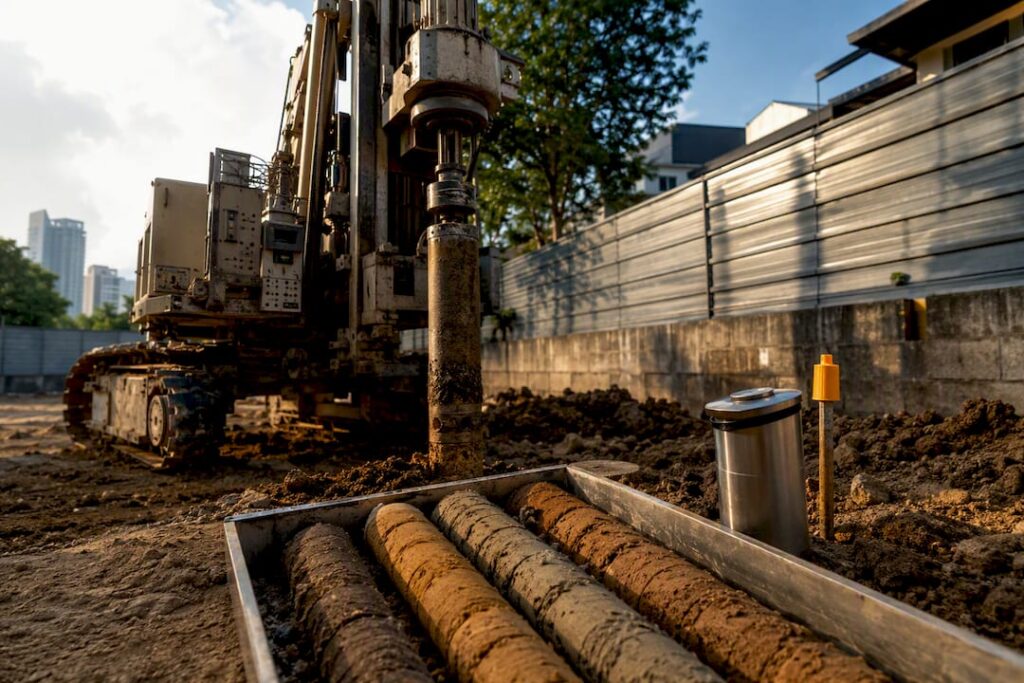
Budget a few thousand SGD for a single landed-property investigation, several thousand to tens of thousands for multi-unit or small commercial sites, and tens of thousands upward to a higher range, for large or geotechnically demanding developments. The spread within each band comes down to three variables: how many boreholes or CPTs are drilled and how deep they go, how difficult site access and mobilization turn out to be, and how complex the ground conditions are. Before committing to any figure, get an itemized proposal that breaks these three items out separately.
TL;DR:
- Most soil investigation costs in Singapore depend on borehole depth, quantity, and lab testing, with small projects costing a few hundred to a few thousand SGD.
- Large or complex sites, especially on reclaimed land or requiring deep foundations, often exceed tens of thousands SGD and involve multiple deep boreholes and extensive testing.
- Clear itemization of mobilization, drilling, lab testing, and reporting fees is essential, as lab and report costs can significantly influence the final price.
- Site conditions such as soft marine clay, high water tables, or restricted access can considerably increase drilling difficulty and overall costs.
- It is critical to specify scope details upfront to obtain comparable quotes and avoid understated bids or incomplete reports that delay project approval.
Table of Contents
- Soil Investigation Cost Singapore: Typical Ranges by Project Type
- Primary Cost Drivers: What Pushes a Quote Up or Down
- What a Soil Investigation in Singapore Actually Includes
- How Quotes Are Structured and What to Compare
- How Long a Soil Investigation and Report Take
- Who Signs the Report and What Standards Apply
- A Practical Procurement Checklist for Singapore Projects
- Getting This Right the First Time
- Get an Itemized Soil Investigation Proposal for Your Project
- Sources
- FAQ
Soil Investigation Cost Singapore: Typical Ranges by Project Type
Soil investigation cost in Singapore scales primarily with drilling depth, borehole count, and the laboratory testing program attached to each sample. A single landed home or small addition-and-alteration project typically needs one to three boreholes at modest depths, which keeps the indicative fee in the lower band. Multi-unit residential and small commercial sites usually require more boreholes, deeper penetration, and a broader lab-testing matrix, pushing costs into the mid range. Large or complex sites, especially those touching reclaimed land or requiring deep foundation design, can run well into five or six figures.
Singapore’s own tender history backs this up. Contract award notices for site investigation works at Marina Bay and comparable developments have listed values as specific as SGD 62,901 and SGD 403,977, depending on scope and ground difficulty. That range is a useful reality check against generic overseas cost guides quoted in US dollars.
Pro Tip: Ask every consultant to quote mobilization, drilling, laboratory testing, and reporting as four separate line items. A single lump-sum figure hides which component is driving your cost up.
| Project Type | Indicative Cost Range (SGD) | Typical Scope |
|---|---|---|
| Single landed dwelling / small A&A | a few hundred to a few thousand SGD | 1 to 3 boreholes, basic classification tests |
| Multi-unit residential / small commercial | several thousand to tens of thousands SGD | 3 to 8 boreholes or CPTs, expanded lab matrix |
| Large or complex site | tens of thousands to higher figures SGD | Multiple deep boreholes, CPTu, groundwater monitoring, extensive lab program |
Each budget band covers four cost components: mobilization (rig transport and setup), drilling priced per borehole or per meter, laboratory testing per sample, and engineering interpretation and reporting. That last item is not a minor add on. Report preparation, interpretation, and characteristic value derivation typically account for 20 to 40 percent of the total investigation cost, which is why two quotes with identical drilling scopes can still differ by thousands of dollars depending on how much engineering judgment goes into the final report.
Primary Cost Drivers: What Pushes a Quote Up or Down
Three factors explain most of the price variance you will see across competing proposals for the same site.
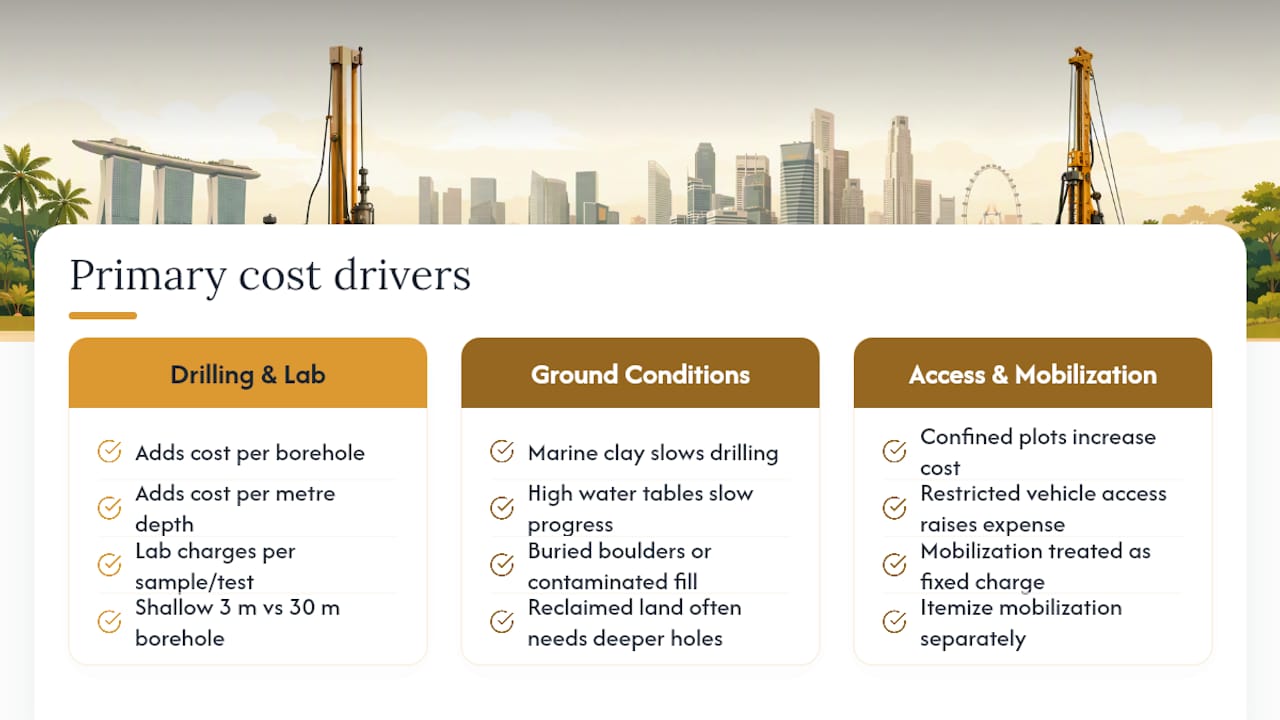
Borehole count, depth, and lab testing intensity. Every additional borehole and every extra meter of depth adds drilling time and material cost. A shallow three-meter borehole for a landed home costs a fraction of a 30-meter borehole needed to reach competent bearing strata for a high-rise foundation. Laboratory testing compounds this: a project requiring triaxial shear tests and consolidation tests on a dozen samples will cost noticeably more than one needing only basic classification tests, since local lab rate sheets charge per sample and per test type.
Ground conditions. Marine clay, high water tables, buried boulders, or contaminated fill all slow drilling progress and often trigger additional testing. Sites near reclaimed land in the eastern or southern parts of Singapore frequently need deeper boreholes simply to clear soft marine clay layers before reaching firmer strata, which extends both time and cost.
Site access and mobilization. Confined urban plots, restricted vehicle access, or the need for traffic control and permits can add cost disproportionate to the drilling work itself. Practitioners generally treat mobilization as a fixed charge that shouldn’t scale with project size, so a small project on a difficult site can end up paying almost as much for access as a much larger project on an open one.
Pro Tip: Always ask vendors to itemize mobilization separately from drilling and lab costs. If a quote lumps everything into one number, you cannot tell whether you’re overpaying for site access or for the actual fieldwork.
What a Soil Investigation in Singapore Actually Includes
A compliant investigation covers fieldwork, laboratory analysis, and a written report, and knowing what belongs in each lets you compare quotes on equal footing rather than by price alone.
Fieldwork methods commonly used in Singapore include:
- Boreholes drilled with rotary or percussion methods, sampling at regular intervals for classification and strength testing.
- Cone penetration tests (CPT or CPTu), which profile soil strength and pore pressure continuously without physical sampling.
- Trial pits, used for shallow investigations where hand or machine excavation suffices.
- Groundwater monitoring wells, installed to track water table fluctuation over weeks or months on sensitive sites.
Tender notices from Singapore government agencies routinely combine several of these methods, particularly CPTu alongside conventional boreholes, on larger infrastructure and building projects.
Laboratory tests typically follow this program:
- Soil classification and moisture content on nearly every sample.
- Atterberg limits to determine plasticity, critical for assessing clay behavior.
- Triaxial shear tests for strength parameters used in foundation design.
- Consolidation tests where settlement is a concern, particularly over marine clay.
- Chemical tests for contamination screening on former industrial or reclaimed sites.
A complete report, per BCA’s published guidance on site investigation reports, must include an executive summary, a site plan with coordinates, full borehole and CPT logs with termination depths, raw laboratory data sheets, and interpreted characteristic values with design recommendations.
How Quotes Are Structured and What to Compare
Consultants in Singapore price soil investigations three ways, and each has trade-offs worth understanding before you sign.
Lump-sum pricing quotes one fixed fee for the entire scope. It gives budget certainty but only works well when the scope, borehole count, and depths are locked in advance. Per-borehole or per-meter pricing charges based on actual drilling performed, which is fairer when ground conditions are uncertain but leaves your final cost open ended until drilling finishes. Hourly pricing is less common for fieldwork but sometimes applies to engineering consultation and report review time.
Whichever model a consultant proposes, insist on these items in the written proposal:
- Mobilization fee stated as a separate line.
- Number of boreholes or CPTs and their target depths.
- Specific lab tests named, with sample counts for each.
- Final deliverables listed explicitly, including whether the report carries professional endorsement.
- Exclusions clearly stated, such as permit fees or utility clearance costs.
Watch for red flags: an unusually low bid compared to competing quotes almost always means a shallower drilling depth or a thinner lab-testing program than the project actually needs. A proposal that omits professional endorsement or leaves the lab program unspecified is not ready to sign, regardless of price.
How Long a Soil Investigation and Report Take
Fieldwork mobilization typically starts within one to two weeks of contract signing, assuming permits and utility clearances are already in hand. Drilling progress on a standard project runs a few days for a single dwelling and can extend to several weeks for large sites with multiple boreholes and CPTu profiling.
Laboratory turnaround for standard classification tests usually takes one to two weeks; more involved tests like triaxial shear or consolidation can add another week or two. Report drafting, engineering interpretation, and professional endorsement typically add another two to four weeks on top of lab turnaround.
Common delays include:
- Utility clearance searches and permit approvals ahead of drilling.
- Wet weather halting rig access on unsealed sites.
- Restricted site access requiring smaller equipment, which slows progress.
Commission the investigation early in your project program, ideally before finalizing foundation design and well ahead of any authority submission deadline.
Who Signs the Report and What Standards Apply
A soil investigation report in Singapore should be prepared under the direction of a qualified geotechnical engineer and endorsed by a Professional Engineer, since the interpreted values in the report feed directly into foundation design and authority submissions.
BCA’s guidance on site investigation reports sets out mandatory contents that every compliant Geotechnical Investigation Report (GIR) or Geotechnical Design Report (GDR) should carry:
- Executive summary and site location plan with survey coordinates.
- Full borehole and CPT logs, including termination depths.
- Raw laboratory data sheets, not just summarized results.
- Interpreted characteristic ground values with clear justification.
Common omissions to check before you accept a report include missing coordinate references, borehole logs presented without termination depth, and characteristic values stated without supporting calculation or justification. A report missing any of these risks rejection or delay during authority review.
A Practical Procurement Checklist for Singapore Projects
Specify your scope in writing before requesting quotes: exact sample counts, whether CPT or conventional boreholes apply, the full lab-test matrix, and a requirement that coordinates be reported for every test location. Vague scope language is the single biggest reason quotes come back wildly inconsistent.
Build these clauses into your contract:
- A fixed mobilization fee, stated separately from drilling and lab costs.
- A pre-agreed variation rate for additional boreholes or unexpected depth, so cost overruns don’t require renegotiation mid-project.
- A clause allowing equipment substitution (such as portable rigs for restricted-access sites) at a stated variation price rather than an open-ended change order.
Pro Tip: Restricted urban sites often force a switch to smaller rigs partway through drilling. Agree on the substitute equipment’s rate before work starts, not after the rig is already on site.
Stellar Structures supports this process directly by preparing GIR and GDR documentation to BCA-aligned standards and coordinating the authority submission that follows.
Getting This Right the First Time
Commissioning a soil investigation too late in a project timeline is the most common mistake I see property owners and developers make, and it is almost always avoidable. Ground data should inform foundation design, not follow it. When you compare quotes side by side, insist on identical scope. Two proposals covering different borehole counts or lab programs are not comparable, no matter how close the headline numbers look.
Professional engineering firms bring geotechnical engineering consulting and report preparation together with the authority submission process that follows, which matters because a GIR that fails BCA’s checklist requirements creates delays that cost far more than the investigation itself.
— Aman
Get an Itemized Soil Investigation Proposal for Your Project
Generic cost ranges only get you so far. What actually protects your budget is a proposal built around your site, not a template. Stellar Structures works directly with property owners, builders, and developers across Singapore on geotechnical and structural and geotechnical engineering consultation, taking your project from scope definition through GIR or GDR preparation and into the authority submission process, whether that’s BCA, URA, or another statutory board.

When you engage Stellar Structures, expect a scope review that pins down borehole count, depth, and lab-testing requirements before any fieldwork starts, followed by an itemized proposal you can compare against competing quotes line by line. From there, the team carries the report through to endorsement and coordinates the authority submission so a compliance gap in your GIR does not stall your building permit later. If you’re planning a project and need a proposal scoped to your site rather than a generic estimate, review Stellar Structures’ full range of services and request a quote for your soil investigation and geotechnical reporting needs.
Sources
- Guidelines on requirements for site investigation reports — BCA (CoreNet host)
- Geotechnical engineering consulting fees: a complete cost guide — CivilMat
- Contract Award For Soil Investigation Works For A Proposed Development Site At Marina Bay — BidDetail
- Rates — Analabs (Singapore)
FAQ
How Much Does a Soil Investigation Cost in Singapore?
A single landed dwelling typically costs a few hundred to a few thousand SGD, multi-unit or small commercial sites run several thousand to tens of thousands SGD, and large or complex sites can reach tens of thousands SGD or higher, based on indicative geotechnical fee ranges and local contract award data. The main variables are borehole count and depth, ground conditions, and site access.
How Much Does Soil Testing Cost on Its Own?
Laboratory soil testing alone, separate from drilling and reporting, is priced per sample and per test type, with classification tests costing less than specialized tests like triaxial shear or consolidation. Local lab rate sheets, such as Analabs’ published rates, let you estimate a lab budget once you know your sample count and required test matrix.
How Much Does a Soil Analysis Cost for a Small Project?
For a single dwelling or small addition and alteration project, a full soil analysis, including drilling, lab testing, and reporting, generally falls in the budget range of a few hundred to a few thousand SGD. Costs rise if the site has difficult access, requires more than a few boreholes, or sits on marine clay that demands deeper drilling.
Who Should Prepare My Soil Investigation Report?
The report should be prepared under a qualified geotechnical engineer and endorsed by a Professional Engineer, since it must meet BCA’s mandatory report requirements before it can support an authority submission. Stellar Structures prepares GIR and GDR documentation to these standards and coordinates the submission process directly.
What Should I Check Before Accepting a Soil Investigation Quote?
Confirm the proposal itemizes mobilization, borehole count and depth, specific lab tests with sample counts, and final deliverables including professional endorsement. An unusually low bid almost always signals a shallower drilling program or a thinner lab-testing matrix than your project actually requires.
Recommended
- Soil Investigation Report Preparation: Singapore Guide
- Geotechnical Site Investigation in Singapore:
- Soil Improvement for Singapore’s Challenging Ground
- Singapore Marine Clay & Property Settlement: Guide for Homeowners (2025)