




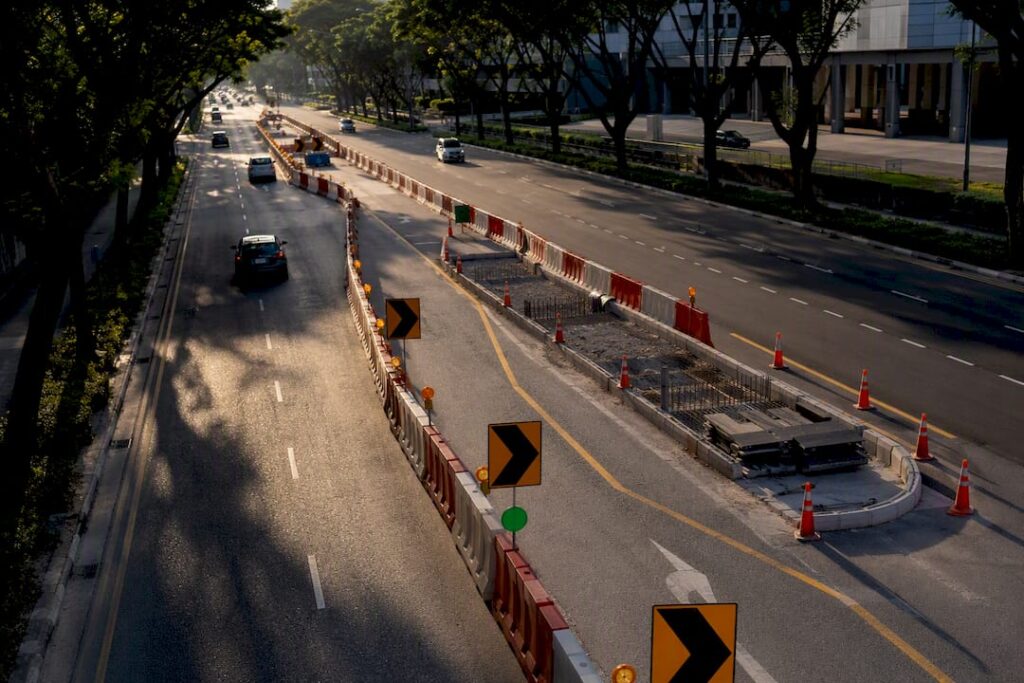
Submit your traffic control plan (TCP) through LTA.PROMPT, Singapore’s portal for works affecting public streets, and design it to the LTA Code of Practice for Traffic Control at Work Zone. The plan needs a Qualified Person or traffic consultant’s endorsement before it goes anywhere near the portal. LTA’s own guidance recommends submitting at least 45 working days ahead of implementation, and complex or continuous lane closures merit closer to 18 weeks of lead time.
TL;DR:
- Submissions should be based on the detailed guidelines in the Code of Practice for Traffic Control at Work Zone, matching approved templates and device standards.
- Prepare and endorse separate Traffic Management and Traffic Control Plans, with the TCP needing endorsement from a Qualified Person or traffic consultant before submission.
- Include comprehensive site-specific drawings, phasing, swept-path analyses, and quantity tables to avoid common resubmission issues and reviewer queries.
- Submit at least 45 working days prior to planned works, extending to 18 weeks for complex or continuous lane closures, to allow sufficient internal coordination.
- Conduct internal peer reviews, site walks, and double-check documentation to minimize rejection causes such as missing details, misaligned documents, or incomplete plans.
Table of Contents
- Which LTA Standards Govern Your Traffic Control Plan Submission?
- Who Needs to Prepare and Endorse the Traffic Control Plan?
- What Should a Submission-Ready Traffic Control Plan Include?
- What Technical Details Do LTA Reviewers Check Most Closely?
- How Do You Submit a Traffic Control Plan Through LTA.PROMPT?
- What Happens After LTA Approves Your Traffic Control Plan?
- Why Do LTA Submissions Get Returned, and How Do You Fix It?
- Your One-Page Pre-Submission QA Checklist
- How Stellar Structures Handles Your LTA Traffic Control Submission
- Sources
- FAQ
Which LTA Standards Govern Your Traffic Control Plan Submission?
The Code of Practice for Traffic Control at Work Zone is the reference document every reviewer measures a submission against. It sets out planning principles, design standards, device specifications, and appendices with example TCPs that show acceptable layouts for common site conditions. Contractors who skip a close read of the COP before drafting almost always end up redrawing something later, because the appendices contain the exact visual templates LTA expects reviewers to match against incoming submissions.
Three parts of the COP deserve particular attention during preparation:
- Planning and design chapters cover how to size work zones, sequence phases, and choose the right traffic control method for the road classification and traffic volume involved.
- Device specification sections list approved signs, cones, barriers, and lighting, along with placement distances that vary by road speed.
- Appendix example TCPs give worked drawings for typical scenarios like lane closures, footpath diversions, and junction works, which are worth tracing line by line against your own site plan.
Alongside the COP, the Diversion Checklist sets out exactly what data a submission must contain, from road capacity calculations to pedestrian impact notes and swept path diagrams for turning vehicles. Treat this checklist as a pre-flight document rather than an afterthought. Going through it line by line before you upload anything catches the gaps that would otherwise surface as reviewer queries weeks later.
It also helps to cite LTA Standard Details and the Civil Design Criteria directly on your plan notes rather than assuming a reviewer will infer compliance. A drawing that references the specific standard drawing number for a barrier type or kerb detail signals that the designer worked from the current documentation, not a template copied from an old project. That small habit shortens review cycles more than most contractors expect, and it costs nothing beyond a few extra notes on the sheet.
Who Needs to Prepare and Endorse the Traffic Control Plan?
A Singapore project touching public roads almost always needs two separate documents, not one. A Traffic Management Plan (TMP) governs internal workplace controls under the Ministry of Manpower’s Workplace Safety and Health framework, while the TCP governs the public road interface and falls under LTA’s jurisdiction. Confusing the two, or assuming one covers the other, is one of the more common compliance gaps found during site audits, according to industry guidance on Singapore worksite traffic management.
The SCAL site traffic management guidance states that a TMP should be prepared by a construction manager or engineer, developed with advice from a Workplace Safety and Health professional, and endorsed by the Project Manager acting as Occupier. The TCP, by contrast, requires endorsement from a Qualified Person or a traffic consultant before LTA will accept it. Responsibilities typically break down like this:
- Preparers: the construction manager or a traffic engineer familiar with the site geometry and phasing plan.
- TMP endorser: the Project Manager or Occupier, guided by a WSH professional.
- TCP endorser: a Qualified Person or licensed traffic consultant who signs off on the LTA-facing drawings.
- Site personnel: traffic controllers and banksmen, who need recognized training certificates referenced in SCAL Academy’s traffic management course listings before they can be deployed at a work zone.
Pro Tip: Reconcile your TMP and TCP before either document leaves your desk. If the phasing dates, device lists, or personnel positions differ between the two, an auditor will flag it even when both documents individually look complete.
What Should a Submission-Ready Traffic Control Plan Include?
LTA reviewers work through submissions methodically, checking drawings against the COP and the Diversion Checklist in sequence. Missing even one item on this list is the single most common reason submissions bounce back with comments instead of moving to approval. Assemble the following before you open LTA.PROMPT:
- Key plan at an appropriate scale, showing the work zone location relative to named roads, junctions, and landmarks so a reviewer unfamiliar with the site can orient immediately.
- Plan and section views of the work zone, drawn to a scale that makes lane widths and dimensions legible without a magnifying glass.
- Phasing or stage drawings for every distinct period of the works, since a single static drawing rarely captures how a multi-week project actually unfolds on the ground.
- Cross-sections through the work zone showing retained carriageway width, temporary barriers, and any pedestrian corridor alongside the works.
- Swept-path analyses for the design vehicle relevant to the road, particularly at any temporary junction or turning movement affected by the closure.
- Quantity tables covering the implementation period, retained lane widths, taper lengths, and pedestrian diversion widths, since LTA expects these numbers stated explicitly rather than scaled off a drawing.
- A Traffic Management Plan for internal reference, cross-checked against the TCP for consistency.
- A traffic study, when the works involve lane reductions or junction impacts significant enough to affect flow. A traffic impact assessment may be required here depending on scale.
- Contractor method statements describing how the works will be sequenced and how traffic control devices will be installed and maintained.
- The Qualified Person or traffic consultant endorsement form, signed and dated, attached as a standalone document rather than buried in the drawing set.
Skipping the quantity tables is a mistake worth calling out on its own. Reviewers do not want to derive a taper length by scaling a PDF. State it in a table, in meters, next to the corresponding drawing sheet number.
What Technical Details Do LTA Reviewers Check Most Closely?
Every LTA-compliant TCP divides a work zone into distinct sections, and each one needs its own drawing treatment. The COP frames these as the advance warning area, the transition or taper zone, the buffer space, the activity area where the actual works happen, and the termination area where traffic returns to its normal path. A drawing that only shows the activity area and skips the advance warning signage upstream is incomplete by definition, no matter how well the rest of the sheet is drawn.
Reviewers focus their attention on a specific set of technical checks rather than reading every drawing line by line:
- Lane width retained through the work zone, checked against the COP’s minimum widths for the relevant road classification.
- Taper ratios, which determine how gradually traffic gets funneled away from the closed lane and depend directly on posted speed.
- Sight distance at the advance warning point, confirming drivers have enough visibility to react before reaching the taper.
- Swept path clearance for emergency vehicles, not just the design vehicle used for general traffic.
- Temporary surface conditions, including any changes in road surface that could affect braking or cyclist stability.
Device placement gets equally close scrutiny. The COP specifies sign offset distances, approved barrier types, requirements for truck-mounted attenuators on higher-speed roads, and lighting standards for night work. LTA’s Diversion Checklist consistently flags lane width, pedestrian provision, and swept paths as the items that draw the most reviewer comments, more so than sign placement alone. Tailoring your swept-path check to the actual site geometry, rather than reusing a generic diagram from a previous project, cuts down on that category of comment substantially.
The COP also carries ongoing maintenance obligations once devices are installed. Reviewers expect a submission to acknowledge that signage and barriers will be inspected and adjusted throughout the works, not just installed once and left alone.
How Do You Submit a Traffic Control Plan Through LTA.PROMPT?
LTA.PROMPT is the single portal for permit applications tied to works on public streets, including the Permit to Carry Out Works that a TCP submission falls under. The LTA.PROMPT FAQ walks through the required document list and portal navigation, and it’s worth reading in full before your first submission on a given project, since portal requirements shift slightly between updates.
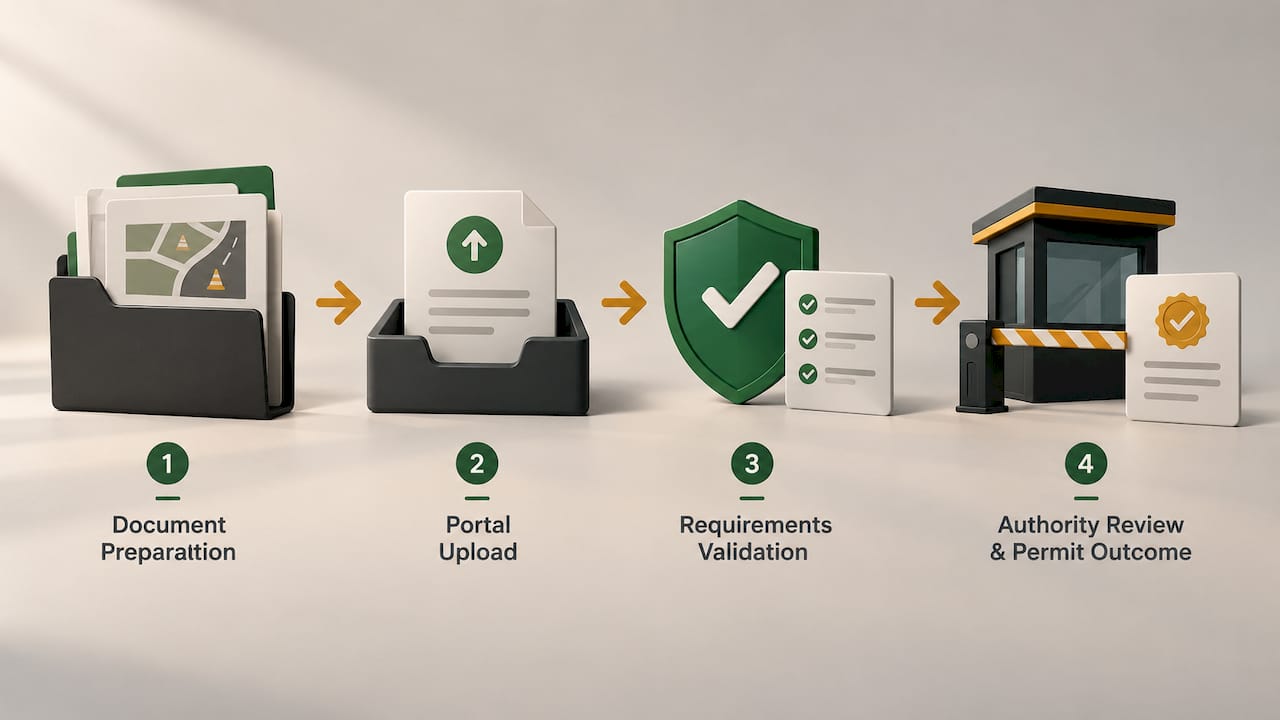
Timing matters more than most first-time applicants expect. LTA’s guidance recommends submitting at least 45 working days before implementation for standard works. For continuous lane closures or anything touching a major junction, plan for a longer runway, with example project schedules suggesting up to 18 weeks. The reasoning is straightforward: complex closures often require internal coordination between multiple LTA divisions, and a compressed timeline leaves no room for a second review cycle if the first submission draws comments.
A practical submission sequence looks like this:
- Assemble every attachment before opening the portal, including the Diversion Checklist, the QP endorsement form, and any traffic study, so the submission goes in as a complete package rather than trickling in over several sessions.
- Label files clearly, using sheet numbers and revision dates that match your drawing set, since reviewers process dozens of submissions and an unlabeled “Drawing1.pdf” slows everyone down.
- Select the correct permit type within LTA.PROMPT rather than defaulting to whichever option appears first, since misrouted applications sit in the wrong queue until someone catches the error.
- Monitor application status through the portal dashboard rather than waiting for an email, since status updates sometimes post before formal correspondence goes out.
- Expect queries on swept paths and pedestrian provision as the most common reviewer follow-ups, based on patterns from the Diversion Checklist’s own emphasis on those categories.
A related resource on navigating LTA.PROMPT for road opening permits covers the broader permit workflow if your project involves excavation alongside the traffic control scope.
What Happens After LTA Approves Your Traffic Control Plan?
Approval is the midpoint of the process, not the end of it. LTA’s obligations continue through implementation and into a formal post-implementation reporting stage, and skipping any of these steps can trigger enforcement action even after the plan itself was approved cleanly.
- Complete pre-mobilization checks and appoint a full-time qualified supervisor responsible for the traffic control scheme once it goes live on site.
- Run daily and, where relevant, nightly inspection routines, logging any defects such as a knocked-over cone or a faded sign and recording the corrective action taken.
- Keep a current contact list on site, covering the supervisor, the QP or traffic consultant, and an emergency contact reachable outside working hours.
- Submit the post-implementation checklist within the timeframe LTA specifies, generally within 10 working days of the scheme going live, confirming that what was built on the ground matches what was approved on paper.
- Close out the works properly, removing devices promptly once the works finish, reinstating the road surface, and obtaining final sign-off before demobilizing the crew.
Pro Tip: Photograph the completed work zone against the approved drawing before you submit the post-implementation checklist. A side-by-side comparison resolves most discrepancy questions before a reviewer even asks.
For projects where the work zone interacts with temporary structures or scaffolding near the carriageway, the temporary works design guide covers the engineering judgment calls that often overlap with traffic control decisions during this phase.
Why Do LTA Submissions Get Returned, and How Do You Fix It?
Most rejections trace back to a small handful of recurring issues, and nearly all of them are avoidable with a careful internal check before upload.
- Key plans at the wrong scale or missing orientation markers confuse reviewers trying to locate the site relative to named roads. Check scale and north arrow placement before every submission, not just the first one.
- Generic plans that ignore actual site geometry are easy to spot, since a swept path drawn for a straight road reads differently from one drawn for a site with an adjacent junction. Run site-specific swept path and junction checks every time, even when a previous project nearby used a similar layout.
- Mismatched TMP and TCP documents, particularly around phasing dates or personnel roles, is flagged repeatedly in industry analysis of Singapore worksite compliance as the most commonly missed reconciliation item. Cross-check both documents side by side before submission, not after a query comes back.
- Absent or undersized pedestrian and cyclist provisions draw comments consistently. Provide a replacement route with a stated minimum width and handrail or barrier detail rather than leaving the pedestrian path as an afterthought on the drawing margin.
A street works permit checklist built around these recurring issues can shorten the gap between first submission and approval considerably, particularly on projects where the design team hasn’t submitted to LTA before.
Your One-Page Pre-Submission QA Checklist
Before uploading anything, run through these ten checks with someone who did not draft the plan. A second set of eyes catches the assumptions the original drafter stopped noticing.
Confirm the portal and permit type selected match the works described. Confirm the Qualified Person or traffic consultant endorsement is signed and attached as its own file. Confirm the key plan shows correct orientation and scale. Confirm swept paths reflect actual site geometry, not a template. Confirm pedestrian and cyclist replacement routes meet minimum width standards. Confirm implementation start and end dates are stated and match the TMP. Confirm a named supervisor is assigned for on-site implementation. Confirm the post-implementation checklist plan is prepared in advance, not left until after go-live. Confirm device lists match between the TCP and TMP. Confirm quantity tables state lane widths and taper lengths explicitly.
Where possible, walk the actual site with the final plan in hand before submitting, and run one internal peer review separate from the person who drafted it. Practitioners who build this kind of internal gateway into their process, combining a site walk, a swept path recheck, and an endorsement confirmation, tend to see meaningfully fewer review iterations on complex closures, according to industry practice observations.
— Aman
How Stellar Structures Handles Your LTA Traffic Control Submission
A qualified firm can be the direct route to an LTA-compliant traffic control plan when your project team doesn’t have a Qualified Person or traffic consultant on staff to prepare and endorse the package internally. Such firms handle authority submissions across various statutory boards, which means the TCP doesn’t sit in isolation. It gets coordinated against whatever other approvals your project needs at the same time.
The engagement typically runs in a straightforward sequence: a readiness review of existing drawings against the COP and Diversion Checklist, preparation of the TCP and its endorsements, submission through LTA.PROMPT, and follow-up to the post-implementation checklist once the works go live. That last step is often underestimated, and tracking the 10-working-day deadline alongside the project schedule can prevent oversights. If your project has public road frontage and a submission deadline approaching, request a TCP readiness review through the authority submissions services page to see where your current drawings stand against LTA’s requirements.
Sources
Bookmark these four documents before you start drafting. Between them, they cover the full span of what LTA and industry practice expect from a traffic control submission in Singapore.
The LTA Code of Practice for Traffic Control at Work Zone sets the design rules, device specifications, and example TCP drawings. The Diversion Checklist spells out the submission items and the 45-working-day lead time guidance. The LTA.PROMPT FAQ covers portal-specific submission instructions. The SCAL site traffic management guidance explains the workplace TMP requirements from the MOM and WSH side, which every TCP needs to align against.
- Code of Practice for Traffic Control at Work Zone (LTA, Apr 2026)
- Permit to Carry Out Works – LTA.PROMPT FAQ
- SCAL site traffic management guidance
FAQ
How Do You Make a Traffic Control Plan?
Start with the site’s phasing and geometry, then draw plan, section, and swept-path views against the standards in the LTA Code of Practice for Traffic Control at Work Zone. A Qualified Person or traffic consultant needs to review and endorse the finished plan before it can go into LTA.PROMPT.
How Much Does Traffic Controller Training Cost in Singapore?
Course pricing varies by provider and training scope, so check current fees directly with a provider such as SCAL Academy’s traffic management course listing rather than relying on a general estimate. Certification is required for traffic controllers and banksmen deployed at a work zone regardless of course cost.
Which Projects Need an Approved Traffic Control Plan?
Any project involving works on or affecting a public road, including lane closures, footpath diversions, or junction works, needs an LTA-approved TCP. This sits alongside, not instead of, a workplace Traffic Management Plan required under MOM and WSH rules for internal site controls, as outlined in SCAL’s site traffic management guidance.
What Does It Cost to Apply Through LTA.PROMPT?
LTA.PROMPT does not publish a flat application fee for traffic control plan submissions on its FAQ page, and fee structures can depend on permit type and works scope. Check the LTA.PROMPT FAQ directly or confirm current requirements with an authority submissions specialist before budgeting for a project.
How Long Before Works Should You Submit a Traffic Control Plan?
LTA guidance recommends submitting at least 45 working days before implementation for standard works. For complex or continuous lane closures, plan for a longer window, with example schedules suggesting up to 18 weeks, according to the Diversion Checklist.
Recommended
- Temporary Traffic Diversions in Singapore: The Definitive LTA Compliance Guide
- Singapore Contractors’ LTA.PROMPT Playbook for Road Opening Permits
- Engineer’s Checklist to Pass LTA for Street Works Permits in Singapore
- Streamlining Fast Tracking Authority Submissions Coordinating URA