




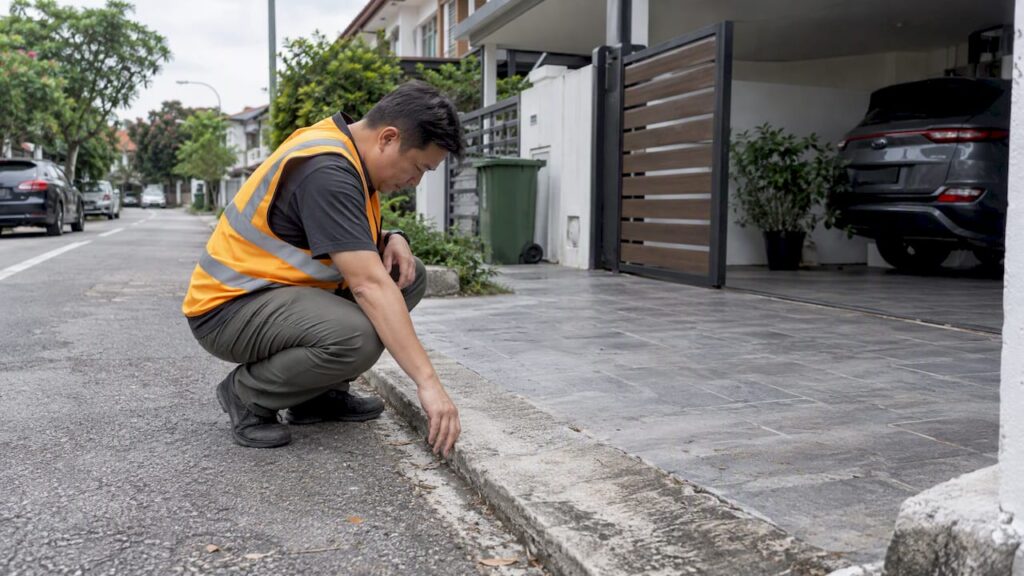
The Land Transport Authority (LTA) is the main authority that clears vehicular access, checking access siting, safety buffers and parking provision under the Range-based Parking Provision Standards (RPPS). The Urban Redevelopment Authority (URA) governs access type for strata-landed and terrace housing, and its approval should come first. Your next step is to confirm your Qualified Person (QP) and assemble URA evidence before lodging anything on CORENET.
TL;DR:
- Mark access points at least 30m from bus stops, pedestrian bridges, junctions, and bends, and show the buffers directly on the site plan.
- For strata landed housing, route vehicles through the common driveway; terrace plots normally allow one access, with paired openings spaced about 6m apart.
- Secure any required URA approval first, then lodge LTA plans with QP endorsement, the approval copy, RPPS calculations, and complete CORENET fields.
- Choose the correct application type: Type 1 covers developments with indoor parking; change of use and layout only proposals fall under other types.
- For RPPS deviations, attach technical justification and consult LTA before lodging; changes to approved parking layouts need prior approval.
Table of Contents
- What LTA checks when it reviews your access points
- URA rules for strata-landed housing and terrace plots
- How to lodge the submission: LTA forms and CORENET
- A QP checklist for a submission-ready package
- Timing, fees and why submissions get delayed
- Why we involve ourselves early in access approvals
- How our authority submission services help
- FAQ
- Sources
What LTA checks when it reviews your access points
Start with siting, because it is the first thing reviewers test against your drawings. LTA’s access arrangement quick guide sets out what must appear on a compliant layout:
- Access points sit at least 30m from bus stops, pedestrian overhead bridges, road junctions and road bends.
- Avoid access from expressways, slip roads and acceleration lanes.
- Provide sufficient space for vehicles to queue before the drop barrier.
- A dedicated pedestrian gate, separated from the vehicle route.
- Recessed or porous boundary walls that preserve sight lines.
- Finish the entrance culvert in concrete without grating.
LTA guidance requires access points to be sited at least 30m from bus stops, overhead pedestrian bridges, road junctions and road bends. The distance protects sight lines and keeps vehicles away from points where pedestrians, cyclists and buses already compete for space.
Pro Tip: Dimension the 30m buffers directly on the site plan, so the reviewer can verify them without scaling the drawing.

URA rules for strata-landed housing and terrace plots
URA rules decide which access types are even available before LTA’s technical review begins. In strata-landed housing, vehicular access must come from the common driveway, because individual units may not open directly onto a public road. Terrace and other landed plots follow a different logic. URA’s access point guidance normally allows one vehicular access point per terrace plot, and it recommends paired arrangements with spacing of about 6m between paired accesses.
The practical points for coordination:
- Settle the access type with URA first, because it fixes how many openings the site can have.
- Keep a copy of the URA approval or written permission, since LTA expects it at lodgement.
- Do not detail driveway geometry until the access type is confirmed.
The sequence matters. LTA parking and access submissions follow URA approval, so a design that skips this step risks rework on the drawings.
How to lodge the submission: LTA forms and CORENET
The workflow is short, but each step has a trap. The steps run in this order:
- Obtain URA approval where it is required.
- Prepare the LTA parking and access submission with QP endorsement.
- Complete the LTA vehicle parking form, LTA-DBC_VEHICLE PARKING.XFDX, with the right application type.
- Attach endorsed plans, the URA approval copy and RPPS calculations or technical justification for any deviation.
- Submit through CORENET e-Submission, then re-check every field before clicking submit.
Application type is where many teams slip. Type 1 covers developments with indoor parking, while change-of-use and layout-only proposals fall under other types. Choosing the wrong one, or leaving out the URA approval copy, is the most common reason a lodgement is rejected or stalls.
A QP checklist for a submission-ready package
Before sign-off, a QP can run the package against this list. For layouts that include parking, our guide to car park standards in Singapore covers layout detail.
- Drawings: exact access locations, setback dimensions, queuing lengths, pedestrian gate position, porous or recessed boundary treatment, and kerb and culvert details, as LTA’s quick guide describes.
- Vehicle movement: turning radii, access width and approach gradient, with swept paths checked for the largest vehicle expected.
- Parking compliance: RPPS calculations and proposed lot counts. LTA’s parking Code of Practice requires prior approval before approved parking layouts or provision change, so any deviation needs technical justification.
- Attachments: URA approval, QP endorsement, a traffic impact assessment if LTA requests one (see our note on whether you need a Traffic Impact Assessment), and the completed CORENET form.
Pro Tip: Book a pre-application consultation with LTA whenever you propose a deviation from standards, so objections surface before formal lodgement.
Timing, fees and why submissions get delayed
Sequence drives the timeline more than any single review period. Check whether URA approval is required before lodging with LTA, as the required sequence depends on the proposal. The LTA form itself states fees for change-of-use and certain parking modifications, so read its guidance before budgeting for a given application type.
The LTA parking form specifies fees for change-of-use proposals and certain parking modifications, so confirm the applicable charge for your application type before lodging.
The usual causes of delay:
- The wrong application type.
- A missing URA approval copy.
- Thin technical justification for RPPS deviations.
- Incomplete CORENET fields.
- No QP endorsement.
To reduce the risk, run the QP checklist above, test vehicle turns with simple swept-path simulations, and raise waiver questions with LTA before lodging.
Why we involve ourselves early in access approvals
In our experience, vehicular access problems are cheapest to fix on paper and most expensive after a layout has been fixed for other reasons. Moving a gate to clear a bus stop buffer can affect the queuing space, pedestrian gate and boundary wall. That is why we prefer to be engaged at the early design stage, or straight after URA pre-submission, so access siting follows LTA’s technical rules from the first sketch.
Our usual scope covers coordination between URA and LTA, QP-endorsed access and parking drawings, RPPS calculations and CORENET lodgement. The benefits show up as fewer review rounds, clearer sign-offs and coordinated replies when LTA raises comments. Parking policy also shapes access design, and residential teams often weigh it alongside questions such as EV charger installation in condominiums.
— Aman
How our authority submission services help
We prepare and lodge authority submissions for projects across Singapore, including vehicular access and parking proposals that must clear LTA and URA together. Our authority submission services include:
- BCA, URA and LTA submission preparation
- QP endorsement support
- RPPS and parking plan preparation
- CORENET lodgement
- Compliance-ready drawings and forms, with liaison to resolve review comments
If you have a site with an access question, contact us through our authority submission services page and we will review it with you.
FAQ
What does vehicular access approval cover in Singapore?
It covers whether the position and design of a development’s vehicle entrance meet LTA’s technical rules, along with parking provision compliance. URA rules decide the permitted access type for strata-landed and terrace housing.
Do I need URA approval before applying to LTA?
Yes, URA approval or written permission is normally needed first. LTA’s parking submission form asks for a copy of it at lodgement.
Can a terrace house have more than one vehicular access?
Normally not for a terrace plot. URA’s access point guidance normally allows one vehicular access point per plot, with paired arrangements recommended where suitable.
What if I want more parking than RPPS allows?
You may apply to LTA for a waiver of the upper bound. Under URA’s parking guidance, approved surplus car lots are computed as 35sqm of gross floor area each.
Sources
- 1. Location of Access Points
- Vehicular Access and Parking | Urban Redevelopment Authority (URA)
- Vehicle Parking
Recommended
- Streamlining Fast Tracking Authority Submissions Coordinating URA
- 45 Day Traffic Control Plan Submission for Singapore Contractors
- Temporary Traffic Diversions in Singapore: The Definitive LTA Compliance Guide